AI Tools
GPT-5.5 vs Claude Opus 4.8 vs Gemini: Which AI Assistant Wins in June 2026?
If you only want one answer: in June 2026, Claude Opus 4.8 is the best model for coding and long documents, GPT-5.5 is the best all-round agent that finishes multi-step tasks across tools, and Gemini is the best value if you live inside Google Workspace or need heavy multimodal work. All three have a capable $20/month tier, so the real question is which one matches the work you actually do.
I make video tutorials about these tools for a living, which means I spend hours each week inside all three. Here is how they compare right now, with current pricing and benchmark numbers.
Key takeaways
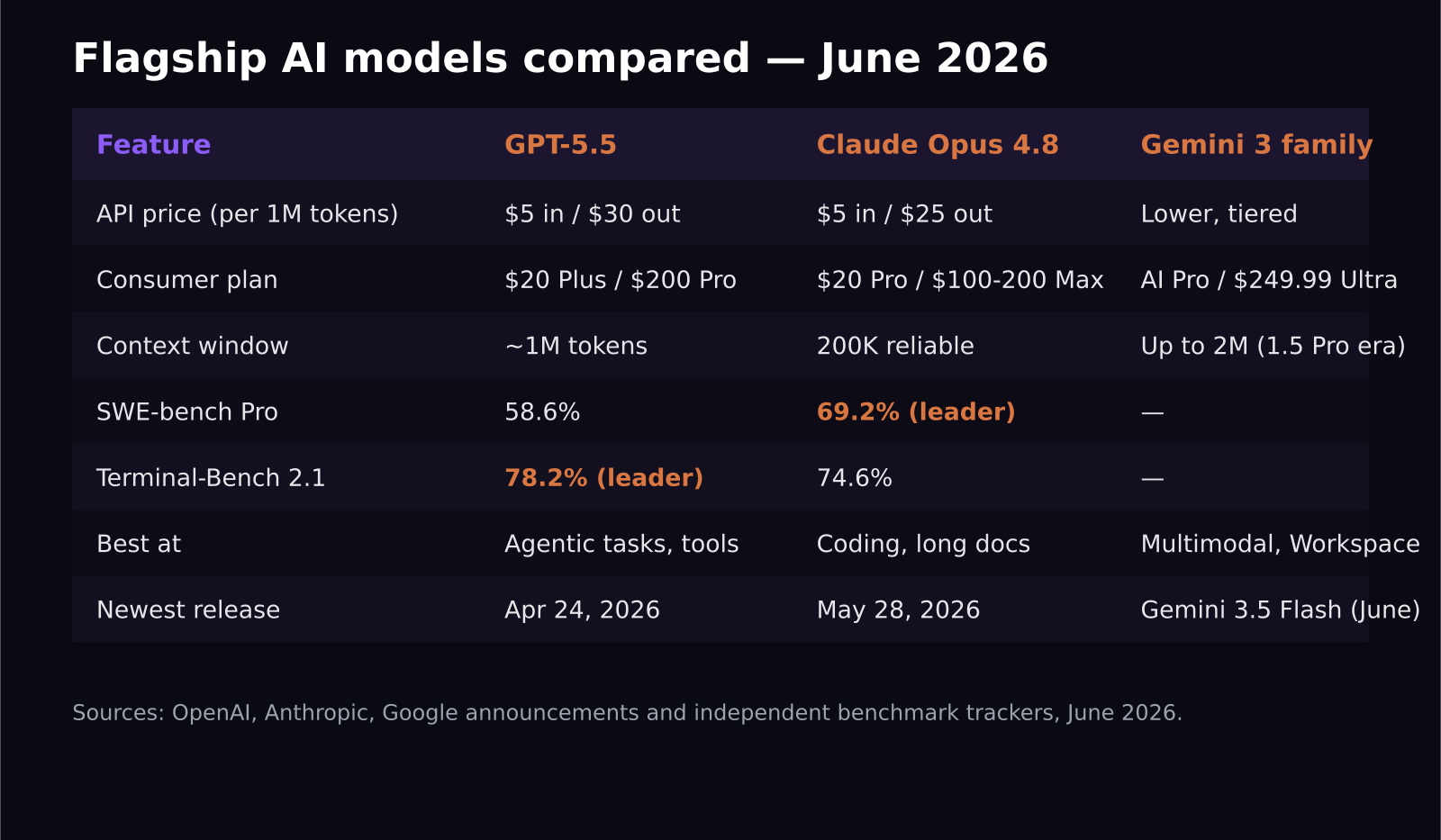
- Claude Opus 4.8 (released May 28, 2026) leads coding benchmarks: 69.2% on SWE-bench Pro vs GPT-5.5's 58.6%.
- GPT-5.5 (released April 24, 2026) keeps one crown: agentic terminal coding, at 78.2% on Terminal-Bench 2.1.
- API pricing is nearly identical at the top: GPT-5.5 is $5/$30 per million tokens, Opus 4.8 is $5/$25.
- Google's premium tier is the most expensive consumer plan at $249.99/month for Google AI Ultra.
- For most people, the $20 tier of any of the three is enough; the differences show up in specialized work.
What changed in spring 2026?
The release cycle has gotten absurdly fast. OpenAI shipped GPT-5.5 and GPT-5.5 Pro on April 24, 2026, with a roughly 1M-token context window and API pricing of $5 per million input tokens and $30 per million output. Anthropic answered on May 28 with Claude Opus 4.8, just 41 days after Opus 4.7, holding its price at $5/$25 and cutting Fast Mode pricing to a third of what it was. Google, meanwhile, has been rolling Gemini 3.5 Flash into Search and pushing its rebranded plans: Google AI Pro, plus the $249.99/month Google AI Ultra tier.
That 41-day cycle matters for buyers: whatever you pick today will be leapfrogged within a quarter. Pick based on workflow fit, not on who holds this week's benchmark crown.
Which is best for coding?
Claude Opus 4.8, with one exception. On SWE-bench Pro, the benchmark closest to real software engineering work, Opus 4.8 scores 69.2% against GPT-5.5's 58.6%. It also leads on OSWorld (83.4% vs 78.7%) and on GDPval-AA Elo (1,890 vs 1,769). In my own use, building small web apps for tutorial videos, Claude produces cleaner code on the first pass and handles full-file refactors with fewer broken imports.
The exception is terminal-based agentic coding: GPT-5.5 still wins Terminal-Bench 2.1 at 78.2% to Opus 4.8's 74.6%. If your workflow is mostly "let the agent loose in a shell," GPT-5.5 is arguably the better pick.
One genuinely new thing in Opus 4.8 is user-level effort control with low, high, extra, and max settings. The default high setting spends about the same tokens as Opus 4.7 did but performs better, and you can dial effort down for cheap bulk work. As someone who pays my own API bills for demo projects, I appreciate the throttle.
Which is cheaper, GPT-5.5, Claude, or Gemini?
At the consumer level, all three start at $20/month, so "cheaper" depends on what happens above that. ChatGPT Pro is $200/month. Claude has two Max tiers, $100 for 5x usage and $200 for 20x usage, which is a more gradual ladder. Google AI Ultra is the priciest consumer plan at $249.99/month, though Google bundles storage and Workspace extras into it.
On the API side, Opus 4.8 is slightly cheaper on output ($25 vs $30 per million tokens) at identical input pricing. GPT-5.5 offers Batch and Flex at half rate, which matters for high-volume background jobs. A real-world data point: Databricks reported 61% lower token costs running Opus 4.8 Fast Mode in their Genie agent compared to Opus 4.7.
My honest advice for solo founders and creators: start at $20 on whichever fits your main task, and only upgrade when you hit caps two weeks in a row.
Where does Gemini actually win?
Two places: multimodal work and Google integration. Gemini's models lead at native image, video, and audio understanding, and they plug directly into Lens, Photos, YouTube, and Workspace. If your day happens in Gmail, Docs, and Sheets, Gemini's integration saves more time than a few benchmark points elsewhere would. Its long-context options are also the largest on paper, though in my testing quality gets uneven at extreme lengths.
For a video creator like me, Gemini is the one I reach for when I need a model to actually watch a screen recording and describe what happens in it. Neither competitor does that as smoothly today.
So which one should you pick?
Pick Claude if you write code or work with long documents daily; the SWE-bench gap is real and visible in everyday use. Pick ChatGPT if you want one assistant that researches, builds spreadsheets, operates tools, and finishes multi-step tasks; GPT-5.5's agentic range is the broadest, and its per-token speed did not regress from GPT-5.4. Pick Gemini if Google Workspace is your home or multimodal understanding is the job.
And honestly, if you are a freelancer or small SaaS team, the strongest move I have seen in 2026 is running two $20 subscriptions, usually Claude plus ChatGPT, instead of one $200 plan. You get the best of both specialists for a fifth of the price.
What about speed and day-to-day feel?
Benchmarks miss something that matters enormously for daily work: latency and rhythm. OpenAI made a point of GPT-5.5 matching GPT-5.4's per-token speed despite the intelligence jump, and you feel it; responses stream fast enough that you stay in flow. Claude's new effort control changes the feel too: on low effort it answers simple questions quickly, and on max it will chew on a hard refactor noticeably longer but come back with something more complete. Gemini's Flash models remain the snappiest of all for short tasks, which is why Google is wiring Gemini 3.5 Flash directly into Search.
For my video production workflow, this translates concretely: I script with Claude (long-document strength), do research and competitive sweeps with ChatGPT (browsing plus agentic tools), and use Gemini to pull facts out of screen recordings and YouTube videos. None of the three is dispensable, which itself is the most honest review of the state of play in mid-2026.
How should teams choose?
For a small SaaS team, map the subscription to the role rather than picking a single winner. Engineers get Claude Pro; the gap on SWE-bench Pro and in real refactoring work justifies it. Marketing and ops get ChatGPT Plus, since GPT-5.5's spreadsheet, document, and research chops cover the widest range of non-technical tasks. If you are on Google Workspace, a Gemini plan for the team handles meeting summaries, Gmail drafting, and Docs work natively. Three specialists at $20 each beat one $200 generalist for almost every team under twenty people I have worked with.
The other consideration is data policy. All three vendors now offer training opt-outs on paid tiers, but if you handle client data, read the retention terms before standardizing; this is the area where enterprise tiers differ more than the models themselves do.
Frequently asked questions
Is GPT-5.5 better than Claude Opus 4.8?
It depends on the task. Opus 4.8 leads most coding and agentic benchmarks, including SWE-bench Pro at 69.2% vs 58.6%. GPT-5.5 wins terminal-based agentic coding (Terminal-Bench 2.1, 78.2%) and has a larger context window at roughly 1M tokens.
How much does GPT-5.5 cost in the API?
$5 per million input tokens and $30 per million output tokens, with Batch and Flex processing at half those rates. GPT-5.5 Pro costs $30/$180 per million tokens.
Do I need the $200/month plans?
Most people do not. The $200 tiers (ChatGPT Pro, Claude Max 20x) make sense for heavy daily agent use or professional development work. Casual and even most professional users stay comfortably within the $20 tiers.
Want your product explained this clearly — in video?
Tutorials, walkthroughs, reviews, and shorts for SaaS, AI, and WordPress products.
Work With SaaS Master