Claude Opus 5 vs Opus 4.8: Should You Upgrade?
In short
Claude Opus 5 launched July 24, 2026 at the same $5/$25 as Opus 4.8 with a real jump on coding. What moved, when to switch, and when to stay on 4.8.

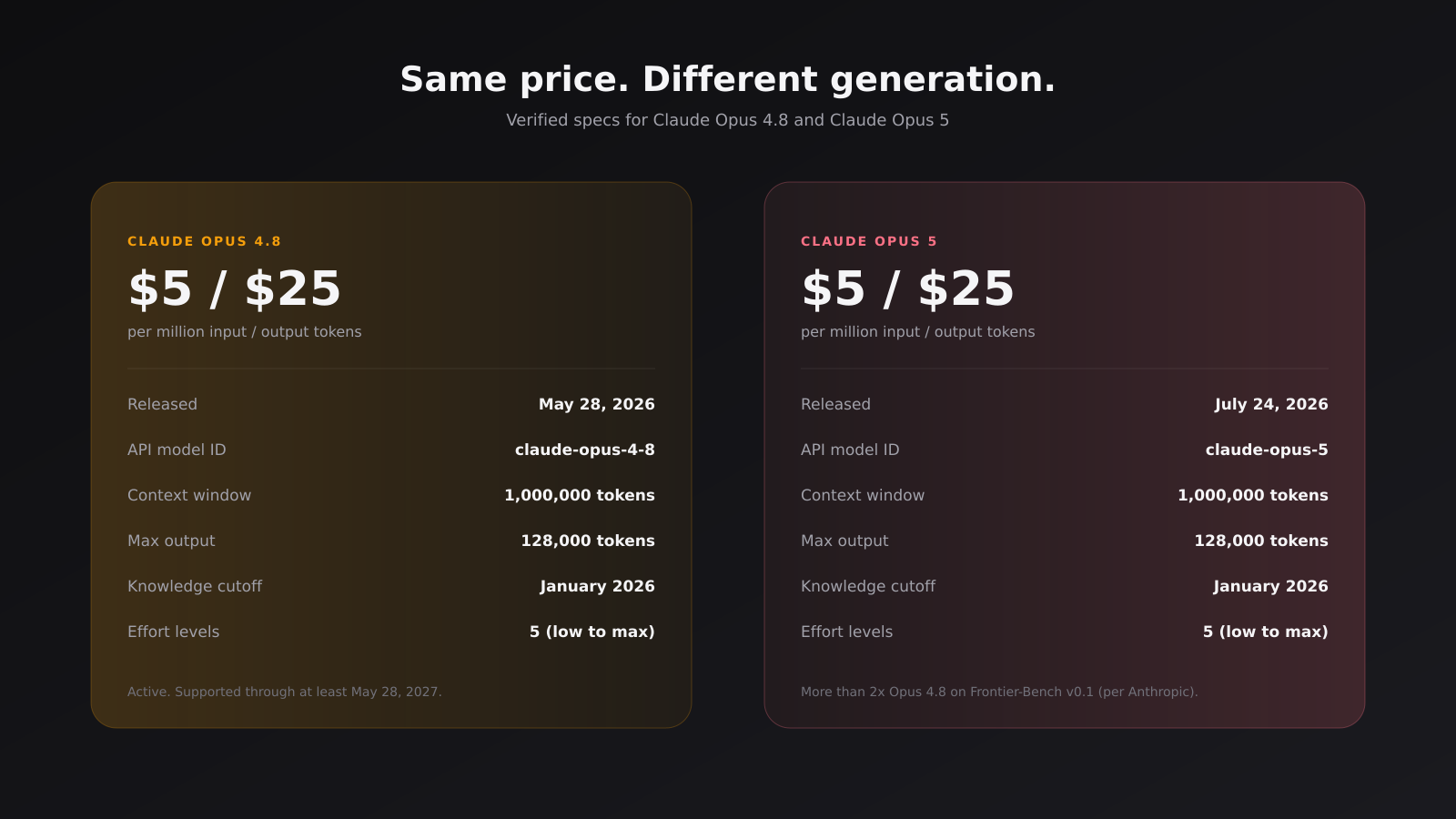
Claude Opus 5 launched on July 24, 2026, sixty days after Opus 4.8. Same $5 per million input tokens, same $25 per million output tokens. Same 1,000,000-token context window, same 128,000-token max output, same January 2026 knowledge cutoff. The capability story is the one that actually moved, and it moved a lot. Here is what changed, what did not, and which one to pick.
In short
Opus 5 is the new default Opus model. It costs the same as Opus 4.8 and, on Anthropic's published benchmarks, more than doubles Opus 4.8 on Frontier-Bench v0.1 while landing within half a percent of Claude Fable 5 on CursorBench 3.2 at max effort. Opus 4.8 is still active and supported through at least May 28, 2027, so there is no forced migration.
Same price, sixty days apart
The most important fact about this release is the one that did not change. Opus 5 ships at the same $5 / $25 per million tokens as Opus 4.8, including the prompt caching and batch discounts. Anthropic's positioning is that Opus 5 "approaches the frontier intelligence of Claude Fable 5 at half the price," with Fable 5 priced at $10 / $50. That pitch only lands because the Opus tier did not move on price.
Both models share the same 1,000,000-token context window, 128,000-token max output, January 2026 knowledge cutoff, and zero data retention for general access. Both ship on the same API surface under the same Anthropic, AWS Bedrock, Google Cloud, and Microsoft Foundry endpoints. If you are running Opus 4.8 in production today, swapping in Opus 5 is a one-line change to the model string.
The effort parameter is now the headline control
The single most useful upgrade on Opus 5 is not on a benchmark slide. It is the way the `effort` parameter behaves. Anthropic now publishes five named effort levels, `low`, `medium`, `high`, `xhigh`, and `max`, and `xhigh` is the new sweet spot for coding and agentic work. On Opus 4.7 and 4.8, `xhigh` existed but was not the default. On Opus 5, Anthropic's migration guide explicitly says to start at `xhigh` for coding and agentic use cases, and at least `high` for most intelligence-sensitive work.
The practical impact is a wider effective range without paying for the top end. A research summary at `medium` is still a research summary. A migration script that needs to run for an hour and verify its own work gets `xhigh` and the headroom to think. The ceiling, `max`, is reserved for the cases where you have measured the difference on your own evals and decided the extra tokens are worth it.
If you have been writing prompts that say "think carefully" or "ultrathink" to nudge the model toward more reasoning, Opus 5 with explicit effort settings replaces that hand-waving with a real control surface. The same control exists on Opus 4.8, but the calibration is the new one in 5.
The benchmark deltas
Anthropic's published numbers for Opus 5 are unusually specific. A few worth pulling out, all from the Opus 5 announcement and the Opus 4.8 announcement:
- Frontier-Bench v0.1: Opus 5 surpasses every other model and more than doubles Opus 4.8's score, at a lower cost per task.
- CursorBench 3.2: at `max` effort, Opus 5 lands within 0.5% of Fable 5's peak score, at half the cost per task. At every effort level, Opus 5 is the cheapest model to reach a given score.
- ARC-AGI 3: Opus 5 is roughly three times the next-best model.
- OSWorld 2.0: Opus 5 beats Fable 5's best result at about a third of the cost.
- Zapier AutomationBench: at the lowest effort setting, Opus 5 still passes more tasks than any other model.
- Life sciences: Opus 5 is 10.2 percentage points higher than Opus 4.8 on a molecular-structure-from-spectroscopy benchmark, and 7.7 points higher on a protein-variant-effect task.
Anthropic's own caveat: Opus 5 trails Claude Mythos 5 specifically on cybersecurity tasks. Mythos 5 is invitation-only inside Project Glasswing, so this caveat is more of a footnote for most teams than a blocker.
These are the vendor's numbers. Independent verification on third-party harnesses was not available at the time of writing. Anthropic's system cards page lists the full methodology for Opus 5 (June 2026) and Opus 4.8 (May 2026), and the Claude platform docs carry the model overview and pricing as of the same date.
Where each model sits in the lineup
Anthropic's July 2026 Claude lineup, in order of capability:
- Claude Fable 5: most capable widely released model, $10 / $50, 1M context.
- Claude Mythos 5: Fable-class, invitation-only, defensive cyber only.
- Claude Opus 5: the new everyday default, $5 / $25.
- Claude Sonnet 5: the new free and Pro default, intro $2 / $10 through August 31, then $3 / $15.
- Claude Haiku 4.5: the fast and cheap tier, $1 / $5.
Opus 5 is now the strongest model on Claude Pro and the new default on Claude Max. Opus 4.8 is the model you were on yesterday. Both are still listed as active in Anthropic's deprecation table, with Opus 4.8 explicitly supported through at least May 28, 2027. There is no cliff.
The single practical difference at the consumer tier is which one sits behind your subscription. If you are on Claude Pro or Max, you will be moved to Opus 5 by default. Pinning to Opus 4.8 in the API is still supported.
How to migrate in a day
The actual change is a one-line string swap, but the rollout has a few small gotchas worth flagging.
If you are on the Anthropic API directly, change the model string from `claude-opus-4-8` to `claude-opus-5` and redeploy. Both models share the same 1M context, same 128K max output, same prompt caching behavior, and the same tool use surface. There is no schema migration.
If you are on AWS Bedrock, the model ID follows the same `anthropic.claude-opus-*` pattern, just with the new version string. On Google Cloud Vertex AI and Microsoft Foundry, the equivalent identifier follows the same shape, and Anthropic has published the Claude Opus 5 system card with full provider deployment details. Check the provider docs for your region and inference profile before swapping.
Two things worth testing in staging before you cut over:
- Reasoning effort defaults. The new `xhigh` recommendation for coding and agentic work on Opus 5 will spend more tokens than your current `high`-on-4.8 setup. Either accept the higher per-task cost or pin `effort: "high"` in your request body for the first week to keep bills flat.
- Mid-conversation system messages. Both Opus 4.8 and Opus 5 accept `role: "system"` immediately after a user turn, which lets you append instructions in long-running agentic loops without restating the full prompt and breaking the cache.
That should be enough to ship a safe cutover in an afternoon.
When to keep using Opus 4.8
Three cases where staying on Opus 4.8 is the right call:
- Stable production prompts you cannot easily re-evaluate. If you have prompts that are tuned to Opus 4.8's specific style and that are working, leave them alone. Anthropic has not announced any deprecation date.
- Cost-sensitive batch jobs where the deltas do not matter. The $5 / $25 price is the same on both models, and you can keep using 4.8 until you have time to re-evaluate.
- Compliance or vendor-locked deployments. Some Bedrock or Vertex AI contracts were signed against a specific model version. Check before swapping.
In every other case, the move to Opus 5 is the one to make this week, not this quarter. The price is identical, the API is identical, and the benchmarks are a real jump, not a marketing rename.
If you want this produced for you
A model comparison is one of the most-watched content categories in the AI tool space, and the explainer format works well as a short video for product pages, sales decks, and YouTube. If you want a 60-second walkthrough of the Opus 5 vs Opus 4.8 deltas, see AI tool video production or pricing. For other comparisons and reviews, see the SaaS Master blog.
Was this article helpful?
Jorge Aguilar
Founder & Creator, SaaS Master
Producing SaaS and AI product videos since 2019 — 800+ videos for 200+ brands, covering tutorials, demos, walkthroughs, and explainers. Writing here about the tools, trends, and tactics that actually move the needle. LinkedIn · About · Work with me
Building an AI product that needs a clearer onboarding flow?
Client-owned videos that make your product easy to understand — demos, walkthroughs, onboarding, and explainers.
Explore AI product video productionRelated guides
More AI Tools & AI Workflows →
Claude Opus 5 vs GPT-5.6: Which Should You Use in 2026?
Claude Opus 5 Is Here: What's New, What It Costs, and Why It Matters
Bonsai 27B Runs a 27-Billion-Parameter Model on a Phone: What On-Device AI Changes for SaaS