Lovable vs Bolt vs v0 vs Replit Agent: Which AI App Builder Should You Use in 2026?
In short
Lovable vs Bolt vs v0 vs Replit Agent compared for 2026: real pricing, how each meters credits, code export, and which AI app builder fits your work best.
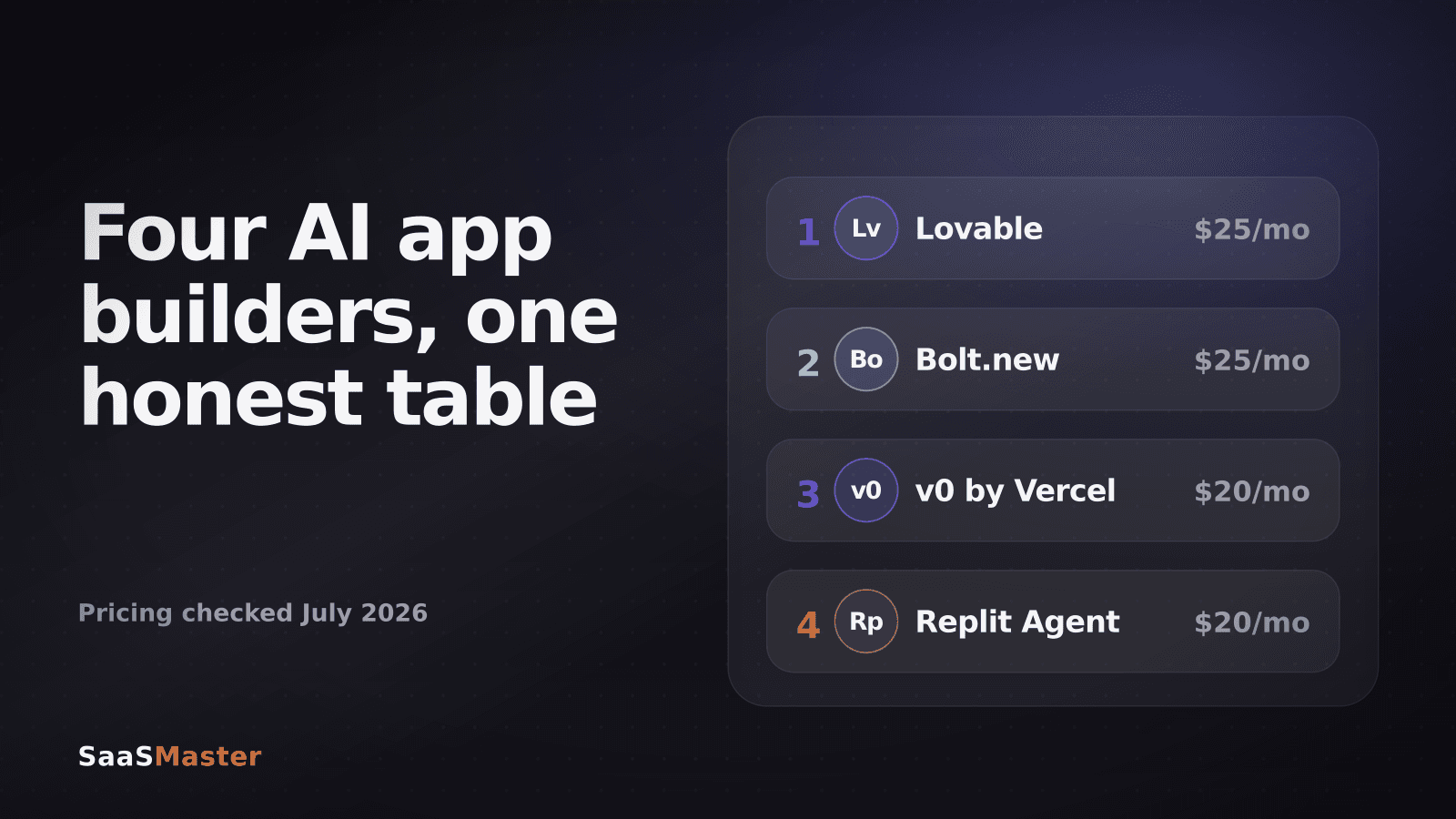
If you want the short version: pick Lovable if you are shipping a polished product front end and want predictable costs, Bolt.new if you need framework flexibility and clean exportable code, v0 if you already live in the Vercel and Next.js ecosystem, and Replit Agent if you need a real backend, a database and hosting in the same place. All four start between $20 and $25 a month, which makes the entry price nearly irrelevant to the decision. What separates them is how they meter your work and what happens when you outgrow them.
Key takeaways
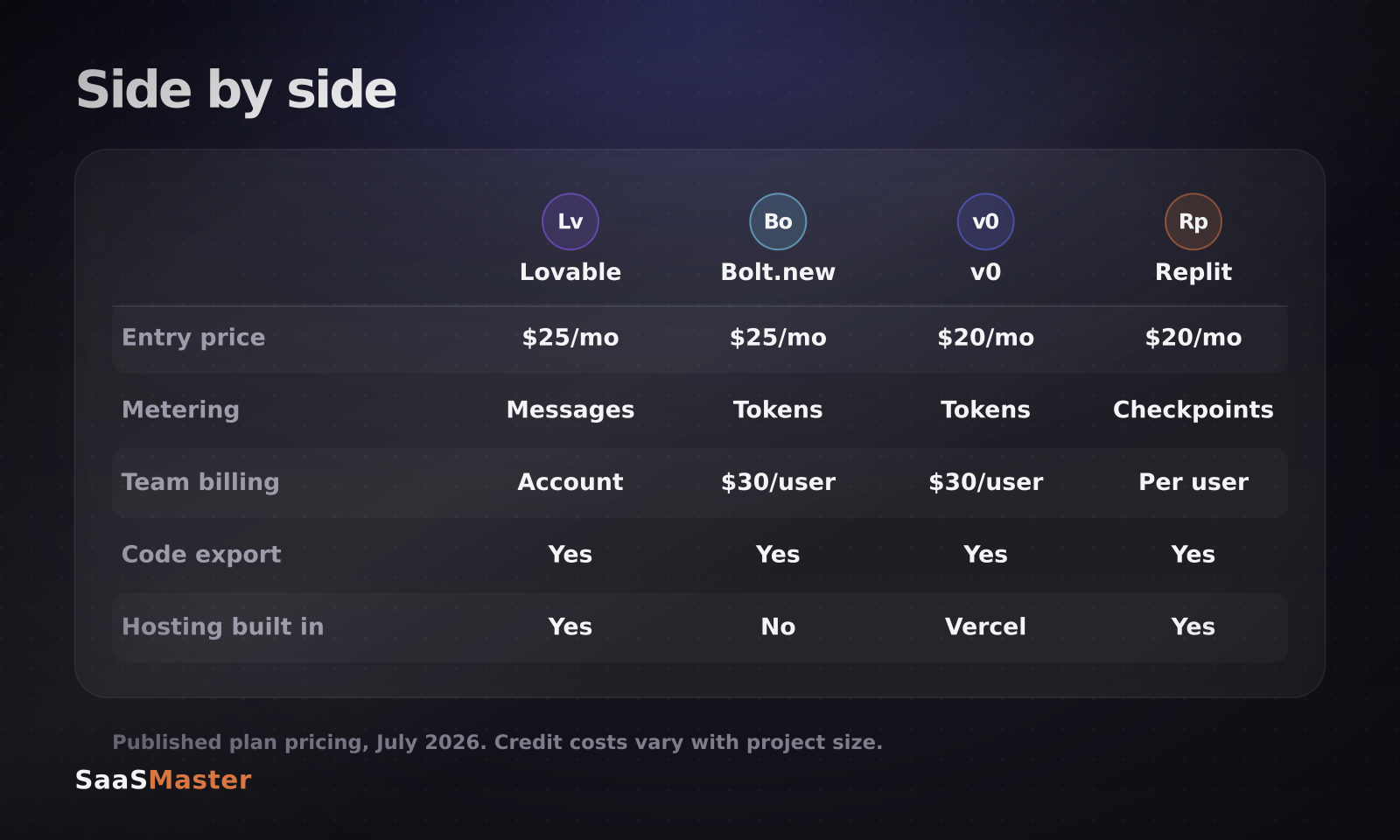
- Entry pricing is effectively identical: Lovable Pro $25, Bolt Pro $25, v0 Premium $20, Replit Core $20 billed annually.
- Metering is the real difference. Lovable charges per message, Bolt and v0 charge per token, so iterative work costs far more on Bolt and v0.
- Team billing diverges hard: Lovable bills per account, Bolt and v0 bill roughly $30 per user with unshared allowances.
- All four export code. Only Replit and Lovable give you a meaningful backend and hosting story without extra setup.
- These are app builders, not coding agents. If you want something that edits an existing repo, this is the wrong category entirely.
What is the actual difference between these four tools?
They all take a natural-language prompt and return a working app, but they were built from different starting points and it shows.
Lovable optimises for the finished artifact. It produces the most polished, most portable, most presentable output of the four, and it is the one people reach for when the thing they are building needs to look investor-ready rather than functional.
Bolt.new optimises for flexibility. It gives you real framework choice and clean code you can lift out and run somewhere else, which makes it the pragmatic pick when the AI builder is a starting point rather than a home.
v0 by Vercel optimises for one ecosystem. It is excellent at React and Next.js components and it hands off to Vercel deployment without friction. If your stack is already Next.js on Vercel, it removes steps nothing else removes.
Replit Agent optimises for completeness. It is the only one of the four that genuinely gives you an environment: backend, database, hosting, collaboration, all in the same place. Agent intelligence also scales by plan, so Starter gets limited capability, Core gets autonomous long builds, and Pro accesses the strongest models.
What does each one cost in 2026?
Lovable publishes three tiers: Free at $0 with five daily credits capped at 150 a month, Pro at $25 a month with 100 monthly credits plus the daily allowance up to 150 total, and Business at $50 with SSO and a security centre. Every interaction with the AI costs exactly one credit regardless of how big the request is.
Bolt.new runs a free tier with roughly 1M tokens a month, Pro at $25 a month, and Teams at $30 per member. You will see $20 quoted for Pro in some places; the figure has moved, so check the current page before you budget.
v0 by Vercel has five tiers: Free, Premium at $20 a month, Team at $30 per user, Business at $100 per user, and custom Enterprise. It meters token-based credits.
Replit Core is $20 a month billed annually and Pro is $95. The jump between them buys agent capability, not just quota.
Why does metering matter more than price?
Because it decides what a month actually costs you, and the two systems behave completely differently under real use.
Lovable charges one credit per interaction. Asking it to scaffold an entire dashboard costs one credit. Asking it to nudge a button two pixels to the left also costs one credit. That is bad news for trivial changes and very good news for ambitious ones, and it makes your monthly spend predictable.
Bolt and v0 charge by token, and tokens include context. Every iteration re-reads a growing project, so the twentieth small change in a session costs meaningfully more than the first. Fine-tuning a layout — which is most of what building actually is — is where token metering gets expensive, and it is the reason people report bills that bear no relation to the sticker price.
The practical rule: if your work is many small refinements, message-based metering wins. If your work is a few large generations, token metering is competitive. Almost everyone underestimates how much of their time is refinement.
Team billing compounds this. Lovable covers all users on one account. Bolt charges $30 per user with allowances that do not pool, so a four-person team pays four times and cannot share unused capacity.
Are these the same thing as Claude Code or Cursor?
No, and conflating them is the most common mistake I see.
Lovable, Bolt, v0 and Replit Agent are app builders. They generate a project from a prompt. They are strongest on greenfield work — a landing page, an internal tool, a prototype, an MVP you need in front of someone this week.
Claude Code, Cursor and Windsurf are coding agents. They work inside an existing codebase, read the repository, and make changes in context. They are strongest on brownfield work — the thing you already have and need to modify without breaking.
If you are choosing in that second category instead, Claude Code vs Cursor vs Windsurf is the direct comparison, and the pricing breakdown across Copilot, Claude Code, Cursor and Windsurf covers what each actually charges once you are past the free tier.
The two categories increasingly overlap at the edges, but the question that sorts them is simple: does the code already exist?
Which one should you actually pick?
Pick Lovable if the output has to look good to someone who is not a developer. Investor demos, marketing sites, client-facing prototypes. The account-based billing also makes it the clear choice for any team above two people, and the message-based credits mean you can iterate without watching a meter.
Pick Bolt.new if you want to leave. It produces the cleanest exportable code with real framework choice, so it works well as a fast start for a project that will graduate to a normal development workflow. Just budget for token costs during the refinement phase.
Pick v0 if you are already on Next.js and Vercel. Outside that stack its advantage largely evaporates; inside it, the integration is genuinely frictionless.
Pick Replit Agent if you need a backend, a database and hosting without assembling three services. It is the most complete environment of the four, and the Core-to-Pro gap is worth understanding before you commit — Starter's limited agent intelligence frustrates people who expected the demo experience.
A caveat that applies to all four: what these tools produce is a working prototype, not a maintained product. The gap between "it runs" and "it survives real users" is still engineering work, and it is where most vibe-coded projects stall. Our testing methodology explains how we evaluate that gap rather than reporting demo results.
The rest of this year's evaluations live in the AI tools library. And once you have built the thing, explaining it is a separate problem — software demo videos exist because a working prototype does not sell itself.
Frequently asked questions
Which AI app builder is cheapest?
At the sticker price they are nearly identical: v0 Premium and Replit Core at $20, Lovable Pro and Bolt Pro at $25. The real cost depends on metering. If you iterate heavily, Lovable's one-credit-per-message model usually works out cheaper than Bolt or v0's token-based billing, because token costs scale with the size of your growing project. For teams, Lovable's account-based billing is materially cheaper than paying roughly $30 per user.
Can I export my code from these tools?
Yes, all four let you export. Bolt.new has the cleanest exportable output with genuine framework flexibility, which makes it the easiest to migrate away from. Lovable's output is portable and well-structured. v0 exports React and Next.js components that assume the Vercel ecosystem. Replit is the most self-contained, so exporting means recreating the environment your app was running in.
Should I use an AI app builder for a production product?
For a prototype, an internal tool, or an MVP you need in front of users quickly, yes. For a product with real users, treat the output as a well-structured starting point rather than a finished system. Authentication, data handling, error states, performance under load and security review all remain your responsibility, and none of the four tools will tell you when you have skipped one.
Was this article helpful?
Jorge Aguilar
Founder & Creator, SaaS Master
Producing SaaS and AI product videos since 2019 — 800+ videos for 200+ brands, covering tutorials, demos, walkthroughs, and explainers. Writing here about the tools, trends, and tactics that actually move the needle. LinkedIn · About · Work with me
Building an AI product that needs a clearer onboarding flow?
Client-owned videos that make your product easy to understand — demos, walkthroughs, onboarding, and explainers.
Explore AI product video productionRelated guides
More AI Tools & AI Workflows →
Bonsai 27B Runs a 27-Billion-Parameter Model on a Phone: What On-Device AI Changes for SaaS
Kimi K3 vs DeepSeek V4 vs Qwen 3.7 Max: The Best Chinese AI Model in 2026

GEO for SaaS: How to Get Your Software Cited in AI Answers