Claude Code + MiniMax M3: Fixing AI-Built Landing Pages With Real Images in 2026
In short
MiniMax M3 pairs 1M-token coding power at 0.30 dollars per million tokens with real image generation, fixing placeholder-heavy AI-built SaaS landing pages.
Claude Code writes excellent application logic, but it still drops generic vector placeholders where a real product photo or hero image should go. MiniMax M3, an open-weight model that launched June 1, 2026, fixes that gap by pairing frontier-level coding performance with a 1 million token context window and multimodal input, and its parent platform bundles real image generation models that slot directly into a Claude-driven build. I tested the combo on a live SaaS landing page rebuild this week.
Key takeaways
- MiniMax M3 launched June 1, 2026, as the first open-weight model combining frontier coding, a 1 million token context window, and native multimodal input
- On OpenRouter's launch promotion, M3 runs 0.30 dollars per million input tokens and 1.20 dollars per million output tokens, half of the regular 0.60 and 2.40 dollar rate
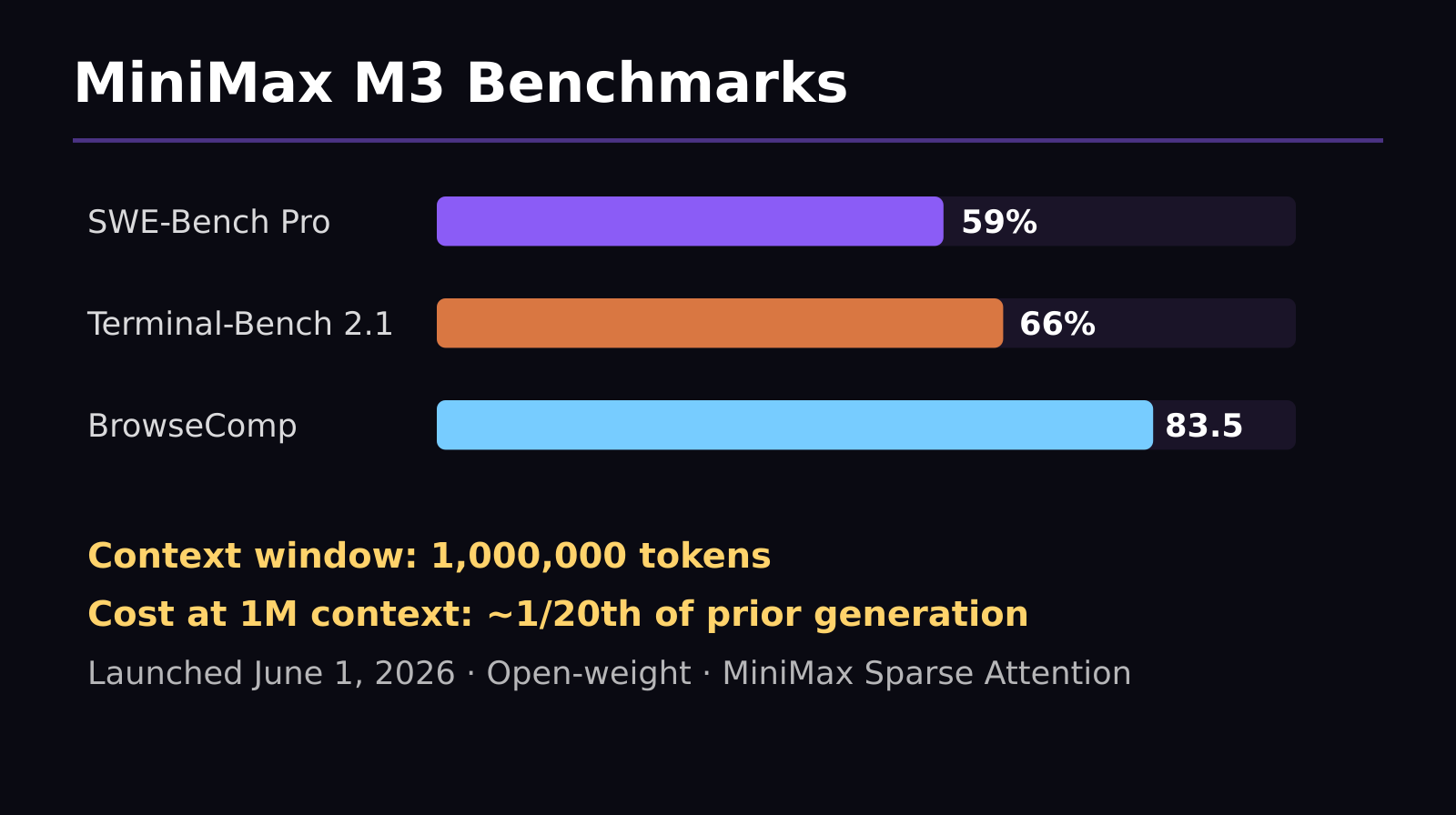
- M3 scores 59 percent on SWE-Bench Pro and 66 percent on Terminal-Bench 2.1, surpassing GPT-5.5 and Gemini 3.1 Pro on SWE-Bench Pro and approaching Claude Opus 4.7
- Its MiniMax Sparse Attention architecture cuts per-token compute at long context to roughly one-twentieth of the prior generation at the same 1M-token window
- MiniMax M3 itself does not generate images, but MiniMax's broader Hailuo platform bundles image models including Nano Banana Pro, Seedream, and GPT Image alongside its own video generation
- Pairing a coding-focused API key with Claude Desktop lets you replace stock template graphics with real, batch-generated images without leaving your coding workflow
[[video:GM32tNeSP3E]]
What is MiniMax M3, and why pair it with Claude Code?
Claude and Cursor remain the strongest tools available for the actual logic of an application: reading a codebase, tracing a bug across multiple files, and writing production-ready components. Where they consistently fall short is visual asset generation. Ask Claude to build a digital signage SaaS dashboard and it will happily wire up the React components, the state management, and the animation logic, but the hero image and background art come out as flat SVG placeholders that look unfinished next to real photography.
MiniMax M3 addresses the coding half of that gap directly. It is an open-weight model built on what MiniMax calls Sparse Attention, or MSA, which replaces full attention with selective key-value block attention. In practice that means the model can hold a full 1 million tokens of context, roughly an entire mid-sized codebase, while running at about one-twentieth the compute cost of the previous generation at that same context length. That is what makes it realistic to feed M3 an entire project rather than a few relevant files.
How much does MiniMax M3 cost to run?
MiniMax M3's list pricing is 0.60 dollars per million input tokens and 2.40 dollars per million output tokens. As of this month, OpenRouter is running a launch promotion that cuts both figures in half, to 0.30 dollars per million input tokens and 1.20 dollars per million output tokens, which puts it well below what comparable frontier-class coding models charge for a 1M-token context window. For a solo developer or small SaaS team running frequent agentic coding sessions, that pricing is the real draw: you can afford to let the model read far more of your project before it starts writing, without the token bill scaling out of control.
How does MiniMax M3 actually perform on coding benchmarks?
On SWE-Bench Pro, a benchmark built around realistic, multi-step software engineering tasks, MiniMax M3 scores 59 percent, ahead of both GPT-5.5 and Gemini 3.1 Pro, and closing in on Claude Opus 4.7's results on the same test. On Terminal-Bench 2.1, which measures an agent's ability to complete real command-line and tooling tasks, M3 scores 66 percent. It also posts 83.5 on BrowseComp, a benchmark for autonomous web research and browsing tasks, which matters if you plan to use it for agentic workflows that involve pulling live data rather than just writing code in isolation.
None of those numbers make M3 a strict replacement for Claude on the hardest architectural decisions, where Claude Opus still tends to lead. What they do show is a genuinely frontier-tier open-weight model at a fraction of the typical cost, which is exactly the profile that makes it worth adding to a workflow rather than replacing your primary coding model outright.
How do you connect MiniMax to Claude Desktop or Claude Code?
The setup is a straightforward API key handoff. You generate a MiniMax API key from the platform dashboard at platform.minimax.io, then add it as a connected tool inside Claude Desktop the same way you would connect any other API-backed integration. Once it is connected, you can prompt Claude directly to hand off specific tasks, like generating a batch of realistic hero images for a landing page, to MiniMax's image models while Claude continues handling the surrounding component code, animation logic, and page structure.
This is where the distinction matters: MiniMax M3 is the coding and reasoning model, but the image generation happening in that workflow comes from the image models bundled inside MiniMax's Hailuo platform, including Nano Banana Pro, Nano Banana 2, Seedream, and GPT Image, all accessible through the same API key. Paid Hailuo tiers run from 9.99 dollars a month at the entry Standard level up to 199.99 dollars a month for the highest tier, and that single subscription is what unlocks watermark-free, 1080p-capable output across those bundled image and video models.
What does the combo actually fix that Claude alone does not?
The concrete before-and-after is visual, not architectural. A Framer Motion landing page built by Claude alone typically ships with placeholder gradients, generic icon sets, or stock-looking vector art standing in for product photography. Once MiniMax's image models are wired into the same session, those same sections get realistic, on-brand imagery generated in a batch, matched to the same prompt context Claude is already using to write the surrounding copy and layout. For a SaaS dashboard specifically, that meant swapping flat placeholder screenshots for realistic mockups that actually looked like a shipped product rather than a wireframe.
The other underrated benefit is Chrome extension development, which MiniMax's 1M token context and lower per-token cost make more financially reasonable, since agentic Chrome extension builds tend to involve a lot of back-and-forth context re-reading that gets expensive fast on premium-priced models.
Is this worth setting up for your own SaaS project?
If you are already running Claude Code or Claude Desktop for development and your project regularly needs real imagery, whether that is marketing pages, dashboard mockups, or app store assets, the setup cost is low enough that it is worth trying. Generating a MiniMax API key takes a few minutes, and the pricing means testing it on one landing page rebuild will not meaningfully move your monthly AI spend. If your project is pure backend logic with no visual asset needs, this combo will not add much, and you are better off staying on your current coding model alone.
What about Chrome extensions and smaller SaaS tools?
The same context-to-cost math applies below the scale of a full landing page rebuild. Chrome extension projects tend to involve a lot of repeated context re-reading as an agent checks manifest files, background scripts, and popup UI against each other, which gets expensive fast on models priced for shorter sessions. Running that kind of project through MiniMax M3's larger context window at its current promotional rate keeps the token bill predictable even when the agent is re-reading the same files dozens of times in a single session. The same applies to lightweight internal SaaS tools where you want an agent to hold the whole project in memory rather than re-fetching files on every turn.
Frequently asked questions
Is MiniMax M3 free to use?
No, but it is inexpensive. Through OpenRouter's current launch promotion it costs 0.30 dollars per million input tokens and 1.20 dollars per million output tokens, half of the regular 0.60 and 2.40 dollar pricing, with no subscription required since it is billed pay-as-you-go per token.
Can Claude Code generate images on its own?
No, Claude Code focuses on reading, writing, and reasoning about code and text, not image generation. To get real generated images inside a Claude-driven build, you connect a separate image-capable API, such as MiniMax's Hailuo platform, which bundles models including Nano Banana Pro, Seedream, and GPT Image.
Does MiniMax M3 work well for very large codebases?
Yes, that is its core strength. The 1 million token context window, combined with its Sparse Attention architecture that keeps compute costs roughly one-twentieth of the prior generation at that context length, is specifically built for holding an entire mid-sized codebase in context rather than working file by file.
Was this article helpful?
Jorge Aguilar
Founder & Creator, SaaS Master
Producing SaaS and AI product videos since 2019 — 800+ videos for 200+ brands, covering tutorials, demos, walkthroughs, and explainers. Writing here about the tools, trends, and tactics that actually move the needle. LinkedIn · About · Work with me
Building an AI product that needs a clearer onboarding flow?
Client-owned videos that make your product easy to understand — demos, walkthroughs, onboarding, and explainers.
Explore AI product video production