AI & SaaS
The First Public Mythos-Class Model: Why Claude Fable 5 Is a Turning Point
Claude Fable 5 marks a genuine turning point: it's the first time Anthropic has put a "Mythos-class" model — a tier of capability the company previously deemed too risky for public release — into the hands of everyone. Just weeks ago, this level of AI was restricted to a small group of vetted cyber defenders. Now anyone can use it, gated by safeguards rather than by an access list. How Anthropic threaded that needle says a lot about where AI is headed. Here's why it matters.
I want to step back from the feature list and look at the bigger picture, because this launch is as much about safety strategy as it is about capability.
Key takeaways
- Fable 5 is the first publicly available Mythos-class model — capability Anthropic had kept restricted until now.
- The same model, as Mythos 5, has the strongest cybersecurity capabilities of any model in the world.
- Anthropic released it broadly only after building safeguards strong enough to block misuse while preserving benefits.
- The launch pairs huge upside (drug design, cyber defense, science) with real dual-use risk, handled by classifiers and gated access.
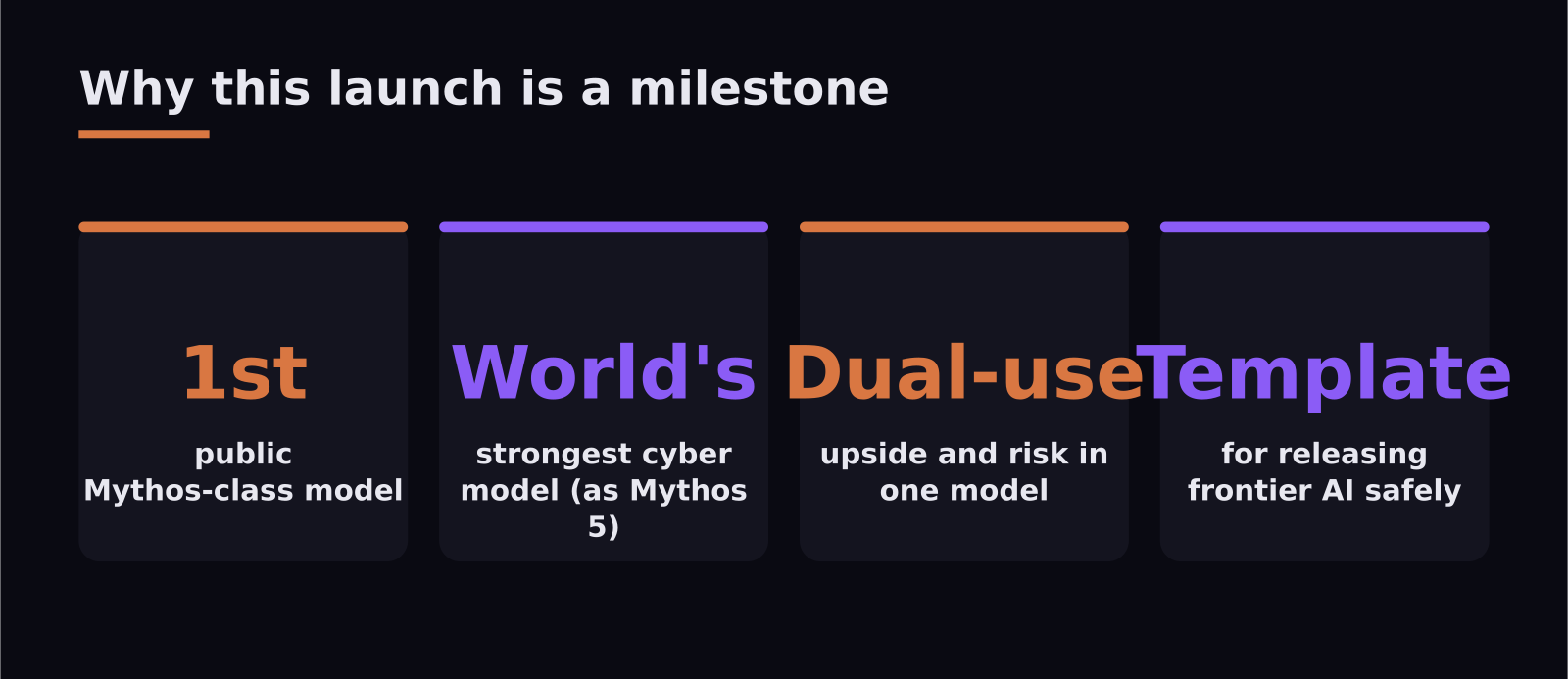
- It sets a template: safe public model for all, unguarded version for trusted experts, careful data and jailbreak controls.
From locked lab to public access in weeks
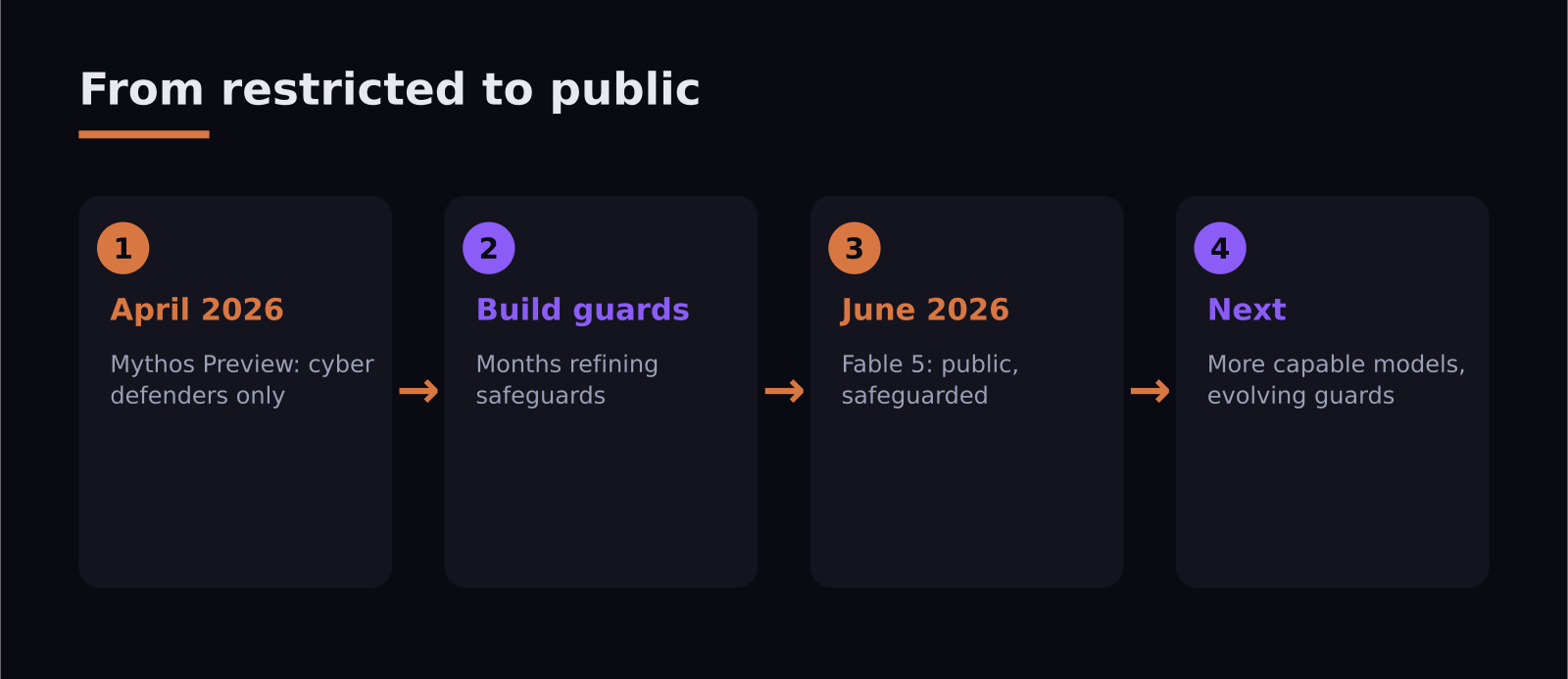
In April 2026, Anthropic released its first Mythos-class model, Claude Mythos Preview, to only a handful of cyber defenders through Project Glasswing. At the time, the company said it hoped to eventually offer Mythos-level capability to all users — but only once it had safeguards strong enough to reliably prevent misuse. Fable 5 is the moment that condition was met. In a matter of weeks, capability that was considered too dangerous for general release became something you can use today.
That compression is the turning point. It signals both how fast frontier capability is advancing and how Anthropic intends to handle the gap between "powerful enough to be dangerous" and "available to everyone": not by withholding the model, but by wrapping it in guardrails and releasing it.
The upside is enormous — and so is the risk
It's worth holding both truths at once. On the upside: Mythos-class models have already helped cyber defenders secure critically important software, accelerated drug design roughly tenfold, proposed novel scientific hypotheses that humans later validated, and conducted autonomous genomics research that beat a published model. These are not parlor tricks; they're early signs of AI doing real, beneficial scientific and defensive work.
On the risk side: the very same capabilities are dual-use. Strong cybersecurity skills make attacks easier as well as defenses stronger. Biology reasoning that speeds gene therapy could, unguarded, assist dangerous research. Anthropic is explicit that releasing a model this capable without safeguards could enable serious harm. The entire design of the Fable/Mythos split — public safeguarded model, restricted unguarded model, classifiers, trusted-access programs, 30-day safety retention — exists to capture the upside while containing the downside.
A template for releasing powerful AI
What makes this launch instructive is the structure, not just the model. Anthropic shipped one underlying model in two forms: Fable 5, safeguarded for everyone, and Mythos 5, unguarded for vetted defenders. It added classifiers that redirect rather than refuse, conservative tuning that errs toward caution, external red-teaming and bug bounties to stress-test the guardrails, and planned trusted-access tracks for legitimate experts in cyber and biology. Whether or not you think they got every dial right, it's a concrete answer to a hard question: how do you give the world near-frontier AI without giving every bad actor a weapon?
Expect this pattern to recur. As Anthropic itself notes, more capable models are arriving in the coming months, and the safeguards will keep evolving — narrowing false positives, tightening against jailbreaks. The Fable 5 launch is less an endpoint than a working prototype of responsible release at the frontier.
Why you should care even if you never use it
Even if Fable 5 never touches your workflow, the way it was released shapes the AI you will use. The norms set now — safeguarded public access, gated expert capability, data and jailbreak controls — become the playbook for every powerful model that follows. This launch is where "we can't release this safely" turned into "here's how we release it safely." That shift, more than any benchmark, is the thing worth paying attention to.
Frequently asked questions
What makes Claude Fable 5 a turning point?
It's the first time a Mythos-class model — capability Anthropic previously kept restricted as too risky — is available to the general public, gated by safeguards rather than a limited access list.
Is Fable 5 dangerous?
Its underlying capabilities are dual-use, which is why Anthropic added safeguards that reroute high-risk cyber, biology, and distillation queries to Opus 4.8. The public Fable 5 is designed to deliver benefits while blocking misuse.
What does this launch mean for the future of AI?
It sets a template for releasing powerful AI: a safeguarded public model plus a restricted unguarded version for trusted experts, with classifiers, red-teaming, and data controls — a playbook likely to repeat as more capable models arrive.
SaaS Master
Creator behind SaaS Master — tutorials, walkthroughs, reviews, and explainers that help SaaS, AI, and WordPress products get understood and chosen. Writing here about the tools, trends, and tactics that actually move the needle. Work with me →
Want your product explained this clearly — in video?
Tutorials, walkthroughs, reviews, and shorts for SaaS, AI, and WordPress products.
Work With SaaS Master