AI & SaaS
An AI That Designs Drugs: What Claude Mythos 5 Just Did in the Lab
Buried in Anthropic's Claude Fable 5 launch is a result that may matter more than any coding benchmark: using Mythos 5, the company's own protein-design experts accelerated parts of the drug-design process by roughly ten times — and in one study, the model matched or beat skilled human operators at designing proteins, working with no human assistance. An AI didn't just help scientists; it did the scientist's job end to end on a real research task. Here's what that actually means.
I'll keep this in plain language, because the implications reach well beyond the lab.
Key takeaways
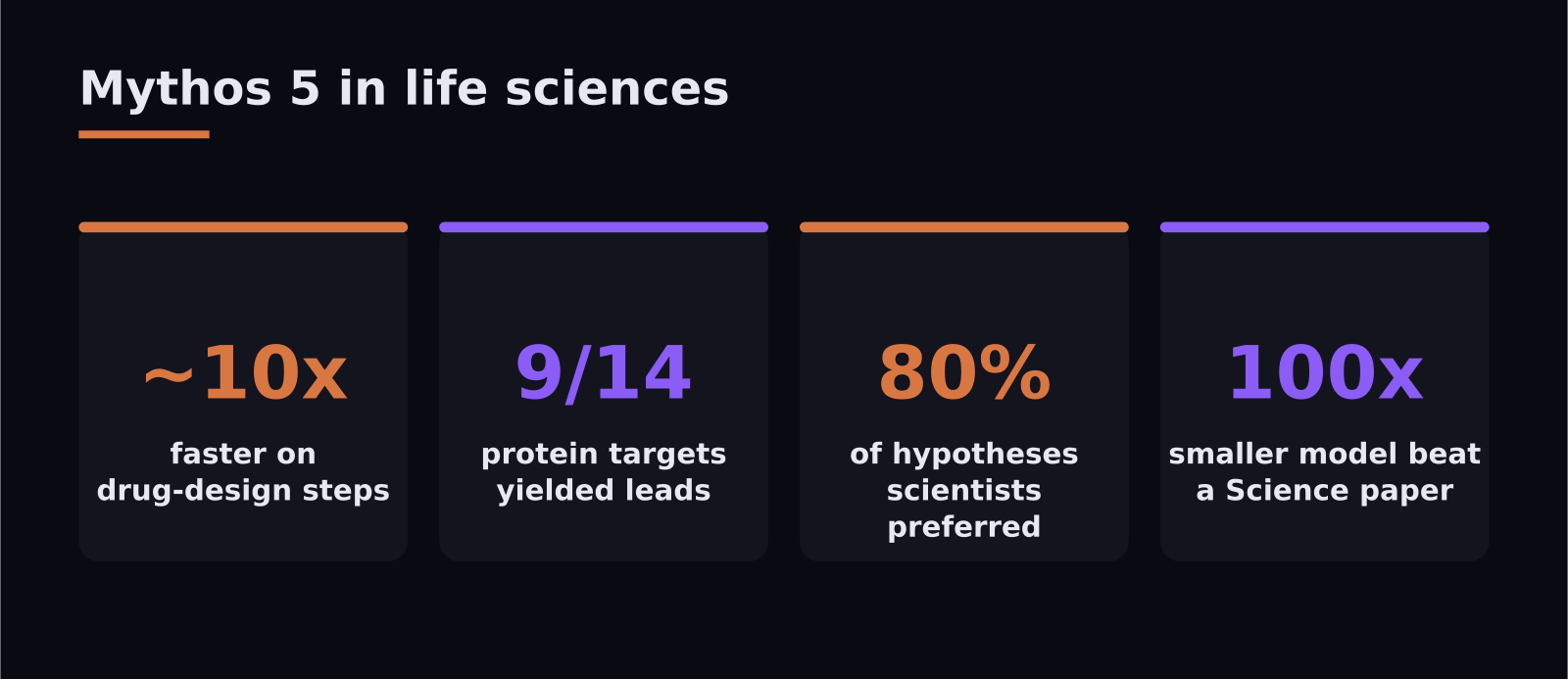
- Using Mythos 5, Anthropic's experts sped up aspects of drug design roughly 10x.
- On a set of protein targets, the model matched or beat skilled humans with no assistance — choosing binding sites, running design tools, and recovering from failures itself.
- 9 of 14 protein targets in the study yielded strong drug-design candidates now under investigation.
- Mythos 5 is Anthropic's first model to consistently produce novel, compelling scientific hypotheses; scientists preferred its molecular-biology ideas ~80% of the time.
- These capabilities run on Mythos 5 (restricted), with a planned trusted-access program for vetted biology researchers.
What "designing a drug" actually involves here
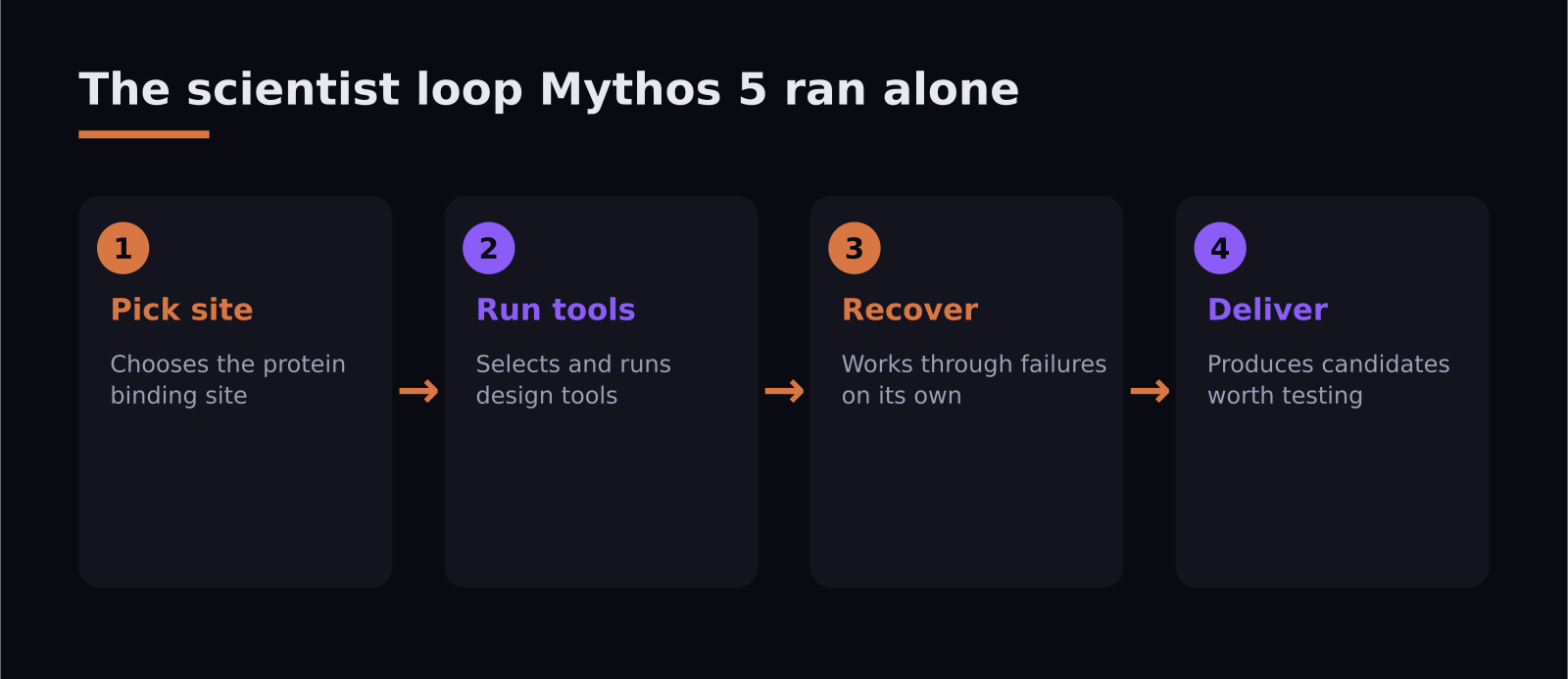
Designing a protein-based therapy is a multi-step craft. A scientist picks a binding site (where the drug should attach), selects and runs specialized design tools, evaluates the results, and — crucially — recovers when something fails, adjusting and trying again. It's iterative, judgment-heavy work that normally requires trained expertise at every step.
What's striking about the Mythos 5 result is that the model executed all of those steps itself. Given protein-design and bioinformatics tools but no human hand-holding, it chose binding sites, ran the tools, and worked through failures on its own — the full loop a human scientist performs. And on the study's 14 protein targets, nine produced strong candidates that Anthropic is now actively investigating. That's not a simulation of research; it's research that yielded leads.
The bigger leap: novel hypotheses
Speeding up known processes is valuable. Generating genuinely new ideas is rarer and, arguably, more important. Anthropic says Mythos 5 is its first model to consistently produce novel, compelling scientific hypotheses. In blinded head-to-head comparisons against Opus-class models, the company's scientists preferred Mythos's molecular-biology hypotheses about 80% of the time, and have advanced several to actual experimental evaluation.
One example is telling: a Mythos hypothesis about a novel mechanism for an E. coli protein was independently corroborated by a separate lab working on the same problem. When an AI's proposed mechanism gets validated by humans who arrived at it separately, that's a signal the idea was real science, not a plausible-sounding guess. In genomics, Mythos 5 also ran over a week of largely autonomous research, assembling single-cell data across 138 animal species and training a custom model that outperformed a recently published Science paper's model — while being 100 times smaller.
Why this is gated behind Mythos, not Fable
You can't get these biology capabilities in the public Fable 5 model, and that's deliberate. The exact skills that help design a therapy are dual-use: the ability to predict how a genetic change affects a virus's structure aids gene therapy in the right hands and could aid something dangerous in the wrong ones. Anthropic tested Mythos on precisely such a task — predicting properties of a viral shell — and the model outperformed specialized tools using biological reasoning alone. That's promising and concerning at once.
So Anthropic routes most biology and chemistry queries in the public model to Opus 4.8, and keeps the unrestricted biology capability inside Mythos 5. It plans a trusted-access program to give vetted biomedical researchers that power while keeping safeguards on cyber. The goal is to capture the upside — faster therapies — without handing the capability to anyone who asks.
What it means
For drug discovery, a 10x acceleration on parts of the pipeline and an AI that proposes validated hypotheses could meaningfully shorten the path from idea to therapy. For the rest of us, it's a glimpse of AI shifting from tool to collaborator in science — one that needs careful gating. The same launch that put a powerful model in everyone's hands kept its most consequential scientific abilities behind a controlled door, and the drug-design results are the clearest reason why.
Frequently asked questions
What did Claude Mythos 5 do in drug design?
Anthropic's experts used it to speed up aspects of drug design about 10x. On a study of 14 protein targets, the model matched or beat skilled humans with no assistance, and 9 targets yielded strong candidates now under investigation.
Can the public use these biology capabilities?
No. They run on the restricted Mythos 5 model. The public Fable 5 routes most biology and chemistry queries to Opus 4.8. Anthropic plans a trusted-access program for vetted biomedical researchers.
Did an AI hypothesis actually get validated?
Yes. A Mythos 5 hypothesis about a novel mechanism for an E. coli protein was independently corroborated by a separate lab working on the same problem.
SaaS Master
Creator behind SaaS Master — tutorials, walkthroughs, reviews, and explainers that help SaaS, AI, and WordPress products get understood and chosen. Writing here about the tools, trends, and tactics that actually move the needle. Work with me →
Want your product explained this clearly — in video?
Tutorials, walkthroughs, reviews, and shorts for SaaS, AI, and WordPress products.
Work With SaaS Master