AI Tools
DeepSeek V4 vs Kimi K2.6 vs Qwen 3.6: Best Chinese AI for SaaS Teams in 2026

In the span of 12 months, Chinese AI models went from 1% to 15% of global AI market share. The three models driving most of that shift are DeepSeek V4 Pro, Kimi K2.6, and Qwen 3.6 — all open-weight, all released within weeks of each other in April 2026, and all outperforming GPT-5.5 on at least one major benchmark at a fraction of the cost.
If you are building a SaaS product, running agentic pipelines, or trying to figure out which AI to bet on for the rest of 2026, this is the comparison you need.
Key takeaways
- DeepSeek V4 Pro costs $0.435/M input and $0.87/M output with a native 1M-token context — roughly 1/20th the cost of GPT-5
- Kimi K2.6 ties GPT-5.5 on SWE-bench Pro at 58.6%, supports native 300-agent swarm orchestration, and processes video and image input
- Qwen 3.6's 27B dense model outperforms Alibaba's own 397B model on agentic coding, with the highest tool-call accuracy of the three at 94%
- All three released within 4 days of each other in April 2026, signaling how rapidly the Chinese AI ecosystem has organized
- Chinese AI market share grew from 1% to 15% globally in 12 months — DeepSeek and Qwen alone account for most of that
Which is cheaper: DeepSeek V4, Kimi K2.6, or Qwen 3.6?
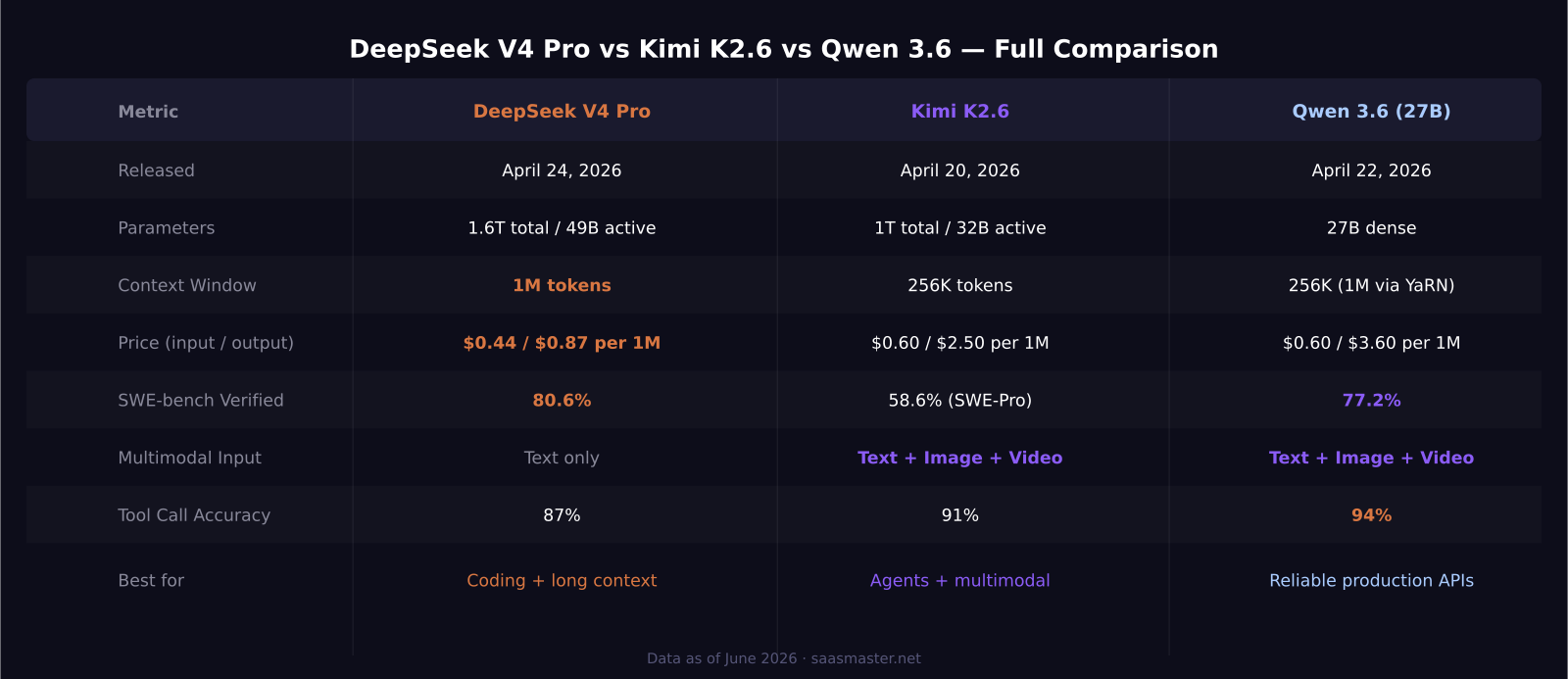
DeepSeek V4 Pro is the clear cost winner. At $0.435 per million input tokens and $0.87 per million output tokens, it is roughly 1/20th the cost of GPT-5. The 75% discount that DeepSeek launched at as a promotional price was made permanent on May 22, 2026. For cached input in workloads like RAG pipelines or multi-turn agents, the price drops to $0.003625/M — effectively negligible at scale.
Kimi K2.6 runs $0.60 input and $2.50 output per million tokens on the official API, with some providers offering it at slightly different rates across nine tracked inference endpoints. Qwen 3.6 sits at about $0.60 input and $3.60 output via Alibaba's API, or lower on OpenRouter at around $0.29 input and $3.17 output for the 27B model.
If pure cost is your constraint, DeepSeek V4 Pro is the easy pick — especially for long input workloads where its 1M-token context window and aggressive caching pricing compound significantly over time.
How do the benchmarks actually compare?
Each model leads on something different, which makes this a genuinely interesting three-way comparison rather than a clear winner.
DeepSeek V4 Pro leads on raw coding performance: 80.6% on SWE-bench Verified, which puts it 0.2 points behind Claude Opus 4.7 (80.8%) and well ahead of GPT-5.5 (74.9%). On LiveCodeBench it reaches 93.5 and on Codeforces it scores 3206, the highest of any evaluated model including closed frontier APIs. For competitive programming and code generation at scale, nothing at this price point competes.
Kimi K2.6 leads on agentic performance and complex reasoning diversity. It ties GPT-5.5 on SWE-bench Pro at 58.6%, leads all frontier models on Humanity's Last Exam with tools at 54.0% (versus DeepSeek V4's 48.2%), and includes native support for video and image input. Its 300 sub-agent orchestration system — capable of executing up to 4,000 coordinated steps in a single autonomous run — is currently unique in the open-weights space.
Qwen 3.6 is the reliability story. Its 27B dense model outperforms Alibaba's own 397B Qwen 3.5 on agentic coding, scoring 77.2% on SWE-bench Verified. Its tool-calling accuracy is 94% on first attempt, compared to 87% for DeepSeek V4 Pro and 91% for Kimi K2.6. In production API workflows where reliability matters as much as peak performance, that 7-point gap translates to fewer retries, less error handling code, and more predictable behavior.
Architecture: what is actually under the hood?
All three use Mixture-of-Experts architectures, which is why they can have large total parameter counts while remaining fast and affordable to run.
DeepSeek V4 Pro is 1.6 trillion total parameters with 49 billion active parameters. It uses a combination of Compressed Sparse Attention and Heavily Compressed Attention to serve a 1M-token context at roughly 27% of V3.2's per-token compute and 10% of its KV-cache memory. That engineering is what makes the permanent low pricing sustainable, not just a promotional strategy.
Kimi K2.6 has 1 trillion total parameters with 32 billion active and a 256K context window on the official API. What sets it apart architecturally is the multi-agent infrastructure: native 300-agent swarm orchestration built directly into the model, not bolted on as tooling. For anyone building complex agentic products, that is a meaningful architectural difference.
Qwen 3.6 comes in two open variants: a 27B dense model and a 35B-A3B MoE with only 3 billion active parameters. Both use hybrid attention with thinking mode on by default and both extend to approximately 1M tokens via YaRN. The 35B-A3B variant is extremely efficient and runs well on modest hardware at around $0.14/M input on OpenRouter — the most self-hostable option of the three.
What is each model actually best for?
DeepSeek V4 Pro is the model to choose when you are building coding agents, code review tools, or any product where raw technical accuracy at low cost matters more than multimodal input. The $0.435/M input price with a 1M context window makes it the most cost-effective option for long document processing, RAG pipelines, and large codebase analysis at scale.
Kimi K2.6 is the right choice when you need native multimodal input, complex multi-agent orchestration, or the strongest performance on long-horizon agentic tasks. The HLE-with-tools lead (54.0% vs 48.2% for DeepSeek) is significant for research agents or tool-using assistants that need to synthesize across many sources. It costs more than DeepSeek but still runs at roughly one-fifth the cost of GPT-5.5 with comparable or better performance on those tasks.
Qwen 3.6 is the pick when API reliability and tool-call consistency matter most. A 94% first-attempt tool-call success rate is the highest of the three, which compounds directly into fewer retries and more predictable agentic behavior in production systems. The 27B model is also the most practical option for teams wanting to self-host without needing enterprise-grade infrastructure.
My take after testing all three
After working through the benchmarks and testing these models against real SaaS development tasks, I think DeepSeek V4 Pro wins on raw value for most builders. The combination of 1M context, top-tier coding performance at 80.6% SWE-bench, and $0.87/M output is genuinely hard to beat for backend development, document processing, or code-heavy products.
But if you are building anything that involves complex agents interacting with external tools, images, or video — Kimi K2.6 is the more complete choice. Its multi-agent orchestration and multimodal support are capabilities DeepSeek V4 currently does not offer.
Qwen 3.6 is what I would reach for in a production API where my team cannot afford to deal with tool-call formatting bugs at scale. That reliability number is not glamorous, but in production it saves real engineering time and reduces customer-facing errors.
Frequently asked questions
Are these models safe to use in commercial products?
All three are released under open-weight or open-source licenses permitting commercial use. DeepSeek V4 and Kimi K2.6 use custom open licenses, and Qwen 3.6 uses Apache 2.0. Review each license's specific terms for your use case, particularly around distribution and model derivatives.
Which Chinese AI model has the largest context window?
DeepSeek V4 Pro leads with a native 1M-token context window at $0.435/M input. Qwen 3.6 can extend to approximately 1M tokens via YaRN. Kimi K2.6 has a 256K native context on the official API.
How do these compare to GPT-5.5 and Claude Opus?
DeepSeek V4 Pro outperforms GPT-5.5 on SWE-bench Verified (80.6% vs 74.9%) and nearly matches Claude Opus 4.7 (80.8%). Kimi K2.6 ties GPT-5.5 on SWE-bench Pro at 58.6%. All three cost significantly less than either GPT-5.5 or Claude Opus at current API pricing.
Was this article helpful?
SaaS Master
Creator behind SaaS Master — tutorials, walkthroughs, reviews, and explainers that help SaaS, AI, and WordPress products get understood and chosen. Writing here about the tools, trends, and tactics that actually move the needle. Work with me →
Want your product explained this clearly — in video?
Tutorials, walkthroughs, reviews, and shorts for SaaS, AI, and WordPress products.
Work With SaaS Master