AI Tools
ElevenLabs vs OpenAI TTS vs Murf: Best AI Voiceover for Creators in 2026
If you need an AI voiceover for video content in 2026, here is the quick answer: ElevenLabs is still the quality leader and the only one of the big three with serious voice cloning, OpenAI's text-to-speech is dramatically cheaper if you can work through an API, and Murf is the most comfortable option if you want a studio-style editor with timing controls and team features. I record and produce software videos every week, and voiceover is one of the places where AI has quietly become good enough for production, so the real question is no longer whether to use these tools but which one fits your volume and budget.
Key takeaways
- ElevenLabs starts at $5 a month for 30,000 characters; the Pro plan is $99 for 500,000 characters and Scale is $330 for 2 million. Its Eleven v3 model is the most natural-sounding voice I have tested.
- OpenAI TTS costs $15 per million characters for standard quality and $30 per million for HD through the API, which makes it pennies for typical creator volumes.
- Murf's Creator plan is $29 a month, or $19 a month billed annually with 24 hours of generation per year; Business is $99 a month, or $66 annually with 96 hours.
- OpenAI offers 13 preset voices and no voice cloning; ElevenLabs offers professional cloning and supports more than 70 languages.
- Budget APIs like Voxtral at $0.016 per 1,000 characters and cloud providers at around $16 per million characters are viable for high-volume, lower-stakes audio.
Which AI voice sounds most human in 2026?
ElevenLabs, and it is not especially close. The Eleven v3 model handles the things that used to give AI voices away: breath placement, emphasis that follows meaning rather than punctuation, and emotional shifts mid-sentence. For tutorial narration, where a flat voice puts viewers to sleep and an overacted one feels fake, v3 hits a believable middle register.
OpenAI's TTS is closer than its price suggests. The voices are clean and pleasant, and a unique feature is steering delivery with natural-language instructions, telling the model to sound calm, excited, or like a sports commentator. The limitation is the catalog: 13 preset voices, no cloning, so your channel cannot own a voice the way it can with ElevenLabs.
Murf sits between them. Its voices are professional-grade for explainer and corporate content, and where Murf earns its keep is the editor: you adjust pauses, pitch, emphasis, and timing against your video on a visual timeline, which is much closer to how video people actually work than a text box and a generate button.
Which is cheaper for a video creator?
The pricing models are so different that the only fair comparison is by use case.
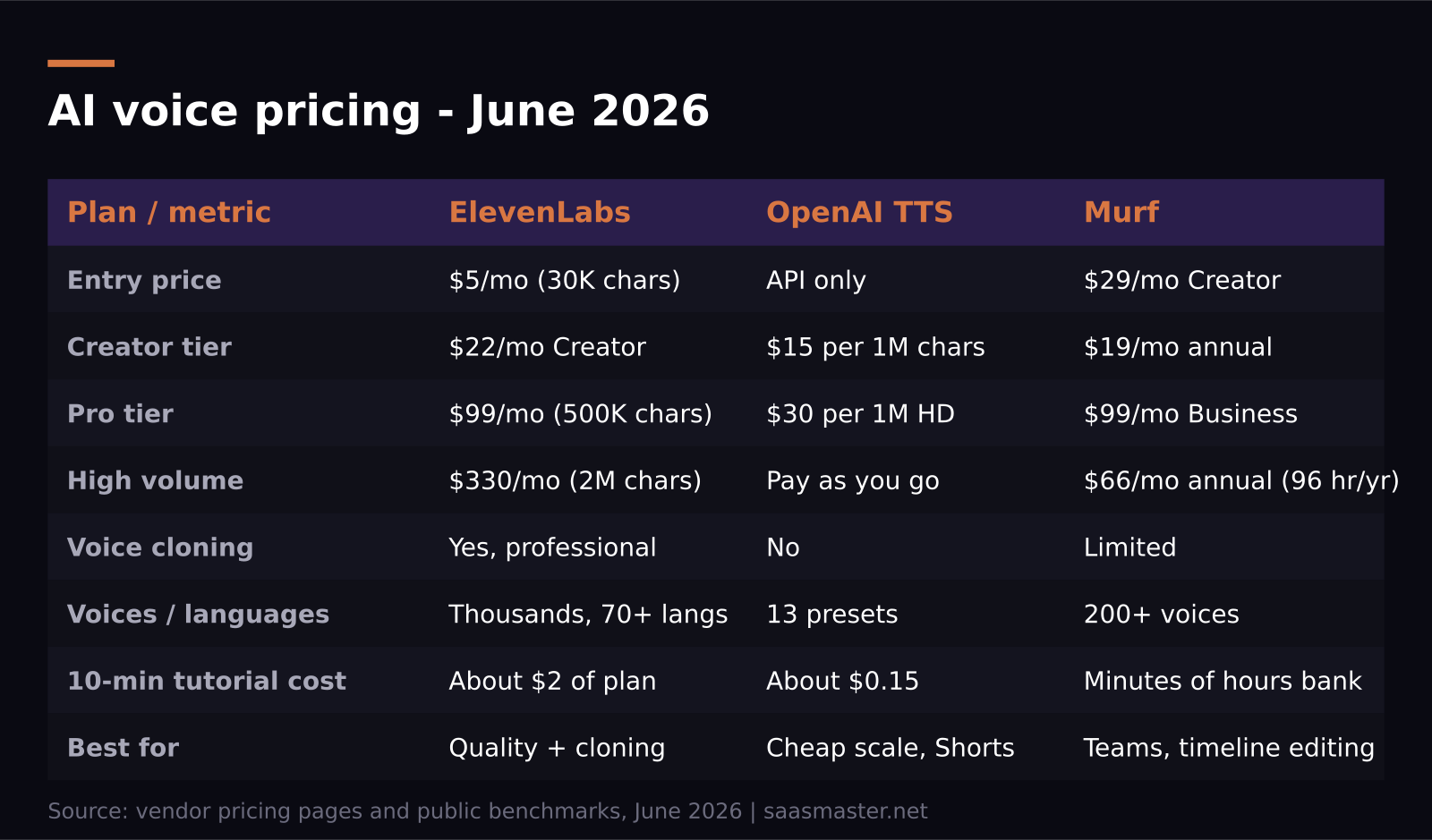
A typical 10-minute tutorial script runs around 9,000 to 10,000 characters. On OpenAI's API at $15 per million characters, that voiceover costs about 15 cents, or 30 cents in HD. On ElevenLabs, a $22 Creator plan covers roughly ten such videos a month, and the $99 Pro plan covers about fifty. On Murf's annual Creator plan at $19 a month, your constraint is hours generated, with 24 hours a year being plenty for a weekly channel but tight for a daily one.
So why does anyone pay ElevenLabs prices? Because for a channel, the voice is part of the brand. A cloned voice that sounds like you, reading scripts you never had time to record, is worth a real premium, and OpenAI simply does not sell that at any price.
What does voice cloning actually get you?
With ElevenLabs professional voice cloning, you record a clean sample of your own voice and get a model that reads any script as you. I use this for revision work: when a product UI changes after a video ships, I can patch one sentence of narration without setting up a microphone and trying to match a months-old recording session. For multilingual channels, cloning pairs with ElevenLabs' 70-plus language support, so your voice can present in Spanish even if you only speak English.
One word of caution from experience: cloned voices are convincing enough that you should disclose AI narration where platforms require it, and platforms increasingly do. YouTube now auto-labels detected synthetic media, so build disclosure into your workflow rather than hoping nobody notices.
Which should you pick for tutorials, explainers, and Shorts?
For software tutorials and walkthroughs, I lean ElevenLabs. Long-form viewers spend twenty minutes with the narration, and quality differences compound. The $22 Creator tier is the sweet spot for a weekly channel.
For Shorts, Reels, and TikTok, OpenAI TTS is hard to argue with. Short scripts cost fractions of a cent, the punchy preset voices suit the format, and nobody judges micro-content narration the way they judge a flagship tutorial.
For teams producing explainer videos at volume, Murf's Business plan at $66 a month annually makes sense because the editor, collaboration features, and predictable hours-based billing fit a production pipeline better than character math.
And if you are an app builder wiring voice into a product rather than a video, look at the budget APIs: Voxtral at $0.016 per 1,000 characters is about 73 percent cheaper than ElevenLabs' fast Flash tier, and the cloud providers, Amazon Polly, Google, and Azure, sit around $16 per million characters for neural voices with rock-solid uptime.
What about workflow: API or app?
One underrated difference is how these tools fit into a production pipeline. ElevenLabs and Murf are products you log into, with project history, voice libraries, and pronunciation dictionaries; OpenAI TTS is fundamentally an API, and while wrappers exist, you are expected to bring your own interface. If you script videos in a doc and paste into a web app, ElevenLabs and Murf feel natural. If your pipeline is already automated, scripts generated, assets rendered, uploads scheduled, the OpenAI route slots in as one more API call and the per-character price becomes almost a rounding error. I run both: ElevenLabs in the browser for flagship tutorials where I audition takes, and an API script for batch-generating Shorts narration overnight.
Is AI voiceover good enough to replace recording yourself?
For some content, yes, and I say that as someone whose actual voice is the product. Patch fixes, localized versions, B-roll narration, and high-volume short-form are already better served by AI in 2026. Where I still record myself is anything where personality carries the video: reviews, opinions, anything where viewers should feel a person behind the take. The technology is no longer the bottleneck; trust is. My rule is simple: AI voice for information, human voice for opinion, and honest disclosure either way.
Frequently asked questions
Is ElevenLabs worth it over OpenAI TTS?
If you need voice cloning, multilingual output in your own voice, or the most natural delivery for long-form content, yes. If you need clean, cheap narration for shorts or app features and can live with 13 preset voices, OpenAI at $15 per million characters is the better buy.
How much does a 10-minute AI voiceover cost in 2026?
Roughly 15 cents via OpenAI's standard API, around $2 of plan allowance on ElevenLabs' Creator tier, and a few minutes of your hours bank on Murf. The spread is enormous, which is why volume should drive your choice.
Can I use these AI voices commercially on YouTube?
All three offer commercial licensing on paid plans. Check your specific tier, and remember YouTube's 2026 rules require disclosure of meaningfully synthetic content, including realistic AI narration of real events, and the platform can auto-apply labels if it detects synthetic media.
SaaS Master
Creator behind SaaS Master — tutorials, walkthroughs, reviews, and explainers that help SaaS, AI, and WordPress products get understood and chosen. Writing here about the tools, trends, and tactics that actually move the needle. Work with me →
Want your product explained this clearly — in video?
Tutorials, walkthroughs, reviews, and shorts for SaaS, AI, and WordPress products.
Work With SaaS Master