AI & SaaS
Supabase Raised $500M at $10.5B, and AI Agents Now Deploy Most of Its Databases
Supabase announced a $500 million Series F at a $10.5 billion post-money valuation on June 4, 2026, led by GIC, and the detail that should grab you is not the dollar figure. It is this line from the announcement: AI agents now deploy the majority of new databases on the platform, and Claude Code has been the single largest contributor of new databases since the start of the year. The backend of the AI-built internet has quietly picked a winner.
I use Supabase in my own projects, it sits behind a large share of the vibe-coded apps I make tutorials about, and if you have ever built anything with Lovable, you have probably used it without noticing. So this is not just funding news. It is confirmation of how software is getting built now, and it has practical consequences for anyone shipping products with AI tools.
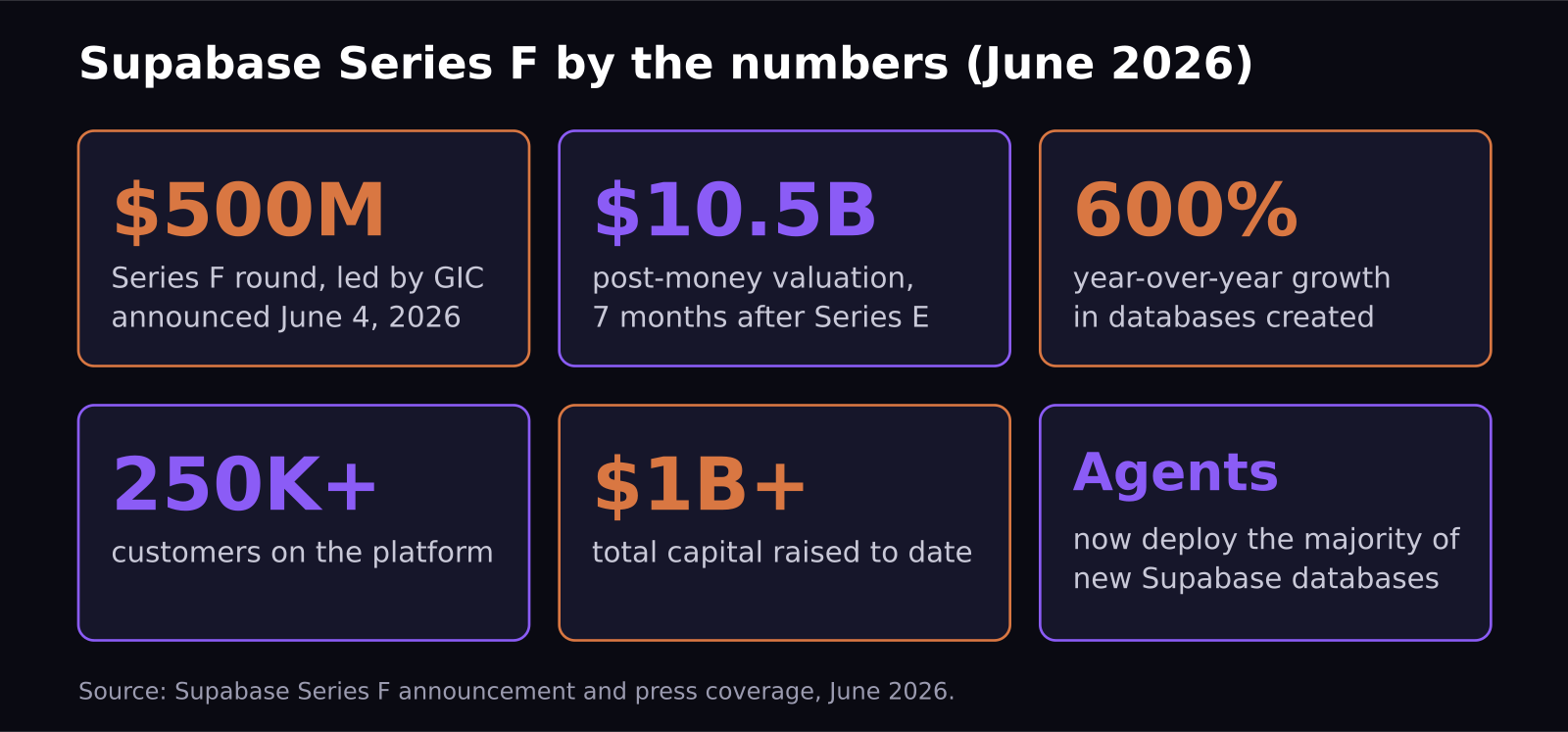
- Supabase raised $500 million at a $10.5 billion valuation on June 4, 2026, just seven months after its Series E, bringing total funding past $1 billion.
- GIC led the round, with Accel, Y Combinator, Craft, Felicis, Peak XV, and Coatue participating; Stripe invested for the second time and Salesforce Ventures joined.
- Databases created on the platform grew 600 percent year over year, and the user base has more than doubled since the Series E.
- AI agents, not humans, now deploy the majority of new Supabase databases, with Claude Code the largest contributor in 2026.
- Supabase serves more than 250,000 customers and is positioning itself as the default backend for AI-native applications.
What is Supabase, and why does every AI tool use it?
If you are new to this: Supabase is an open-source backend platform built around PostgreSQL, the most trusted database in the industry. It bundles the unglamorous essentials every app needs, including a database, user authentication, file storage, and APIs, into a service you can spin up in about a minute.
The reason it became the darling of AI app builders is a happy alignment of design choices. Supabase is open source, so AI models trained on public code know it deeply. It exposes everything through clean, predictable APIs, which is exactly what a code-generating AI needs. And because it is just PostgreSQL underneath, nothing about your data is proprietary or trapped. When Lovable wires up auth and a database for your prompt-built app, it reaches for Supabase by default, and tools across the vibe-coding landscape have made the same choice.
Why are AI agents creating most of the databases now?
This is the stat I keep returning to, because it marks a real line being crossed. For fifty years, a human decided when a database came into existence. Sometime in the past year, on the world's fastest-growing backend platform, that flipped: the majority of new Supabase databases are now deployed by AI agents acting on a builder's intent, with Claude Code leading the wave.
The 600 percent year-over-year growth in databases tells you what this looks like at scale. People describe an app, an agent builds it, and a database appears, often several per project as agents spin up environments to test against. Each database is cheap, instant, and disposable, which is precisely the property that lets non-developers iterate the way professional teams always have.
Supabase is calling this category agentic infrastructure, and the investor list signals who believes it: GIC does not lead $500 million rounds for developer-tool fads, Stripe coming back for a second investment suggests the payments giant sees where transactional apps are being born, and Salesforce Ventures joining means enterprises are paying attention too. Seven months between a Series E and a Series F at double the activity is the kind of pace that only happens when usage is dragging the company forward.
What does this mean for builders who are not developers?
Three practical takeaways, from someone who lives on the non-developer side of this shift.
First, your stack just got safer to bet on. The realistic worry with any tool at the center of your product is that it stalls, gets acquired badly, or shuts down, and this spring's Sora shutdown showed how fast that can happen even at the biggest AI companies. A billion dollars raised, 250,000 customers, and the deepest bench of investors in the category make Supabase one of the safer infrastructure bets a small builder can make right now. And because it is open-source PostgreSQL, even the worst case leaves your data in a standard format you can move anywhere.
Second, expect the platform to get more agent-shaped, fast. The announcement frames the new capital as accelerating agentic infrastructure, which means the tools your AI assistants use to manage your backend will keep getting more capable. The practical upside for you: the gap between describing what you want and having working, hosted software keeps shrinking.
Third, learn just enough of the floor underneath you. My standing advice to every vibe coder applies double here: you do not need to write SQL, but you should understand what tables your app has, what data lives in them, and who can access it. Row-level security is the Supabase feature that protects your users' data, and AI tools do not always configure it correctly on the first pass. Twenty minutes reviewing your security rules, or one prompt explicitly asking your agent to audit them, is the cheapest insurance in software.
How does this fit the wider SaaS moment?
Supabase's round did not happen in a vacuum; the same week told a consistent story. Anthropic filed confidentially for what could become one of the largest software IPOs ever on June 1, and Ramp raised $750 million at a $44 billion valuation on June 4, the same day as Supabase's announcement. Capital is concentrating around two things: the AI models doing the building and the infrastructure absorbing what they build. Supabase sits squarely in the second category, and that is arguably the more durable position, since builders may swap models the way they swap camera brands, but migrating a production database is the move everyone avoids. For those of us making things rather than funding them, the read-through is simple: the picks-and-shovels layer of AI-built software is now well funded, stable, and competing hard for individual builders, which is exactly the environment you want to be building in.
The bigger picture: the question used to be whether AI-built apps were real enough to matter. When the database company underneath them is worth $10.5 billion and growing 600 percent a year, that debate is over. The interesting question now is what you are going to build.
Frequently asked questions
Is Supabase free to use for small projects?
Yes. There is a free tier suited to prototypes and small apps, with paid plans kicking in as your usage grows. Most projects built through tools like Lovable start on the free tier, and for a surprising number of side projects it stays sufficient.
Does this funding change anything for existing Supabase users?
Nothing changes day to day. The signals are positive: more capital means faster development, and the stated focus is agentic infrastructure and scaling the platform. Pricing changes were not part of the announcement.
What is agentic infrastructure in plain language?
It means backend services designed to be operated by AI agents, not just by humans clicking dashboards. The agent can create a database, configure access rules, and deploy changes through APIs built for that purpose, while you describe what you want in plain language and review what it did.
SaaS Master
Creator behind SaaS Master — tutorials, walkthroughs, reviews, and explainers that help SaaS, AI, and WordPress products get understood and chosen. Writing here about the tools, trends, and tactics that actually move the needle. Work with me →
Want your product explained this clearly — in video?
Tutorials, walkthroughs, reviews, and shorts for SaaS, AI, and WordPress products.
Work With SaaS Master