AI & SaaS
Gartner: Agentic AI Could Put $234 Billion of SaaS Spending at Risk by 2030
In short
Gartner warns agentic AI arbitrage could put 234 billion dollars of enterprise SaaS spending at risk by 2030, and what it means for SaaS builders today.
Gartner now says agentic AI could put 234 billion dollars of enterprise SaaS spending at risk by 2030, roughly 20 percent of global enterprise SaaS spend. The mechanism is what Gartner calls agentic arbitrage: AI agents increasingly complete tasks across multiple business applications on a worker's behalf, which cuts the number of human seats that need to log into any single piece of software. This is not a forecast that SaaS is dying. It is a forecast that the per-seat pricing model most SaaS companies were built on is about to get a serious stress test.
Key takeaways
- Gartner estimates 234 billion dollars of enterprise SaaS spending, about 20 percent of the global total, is at risk from agentic AI by 2030.
- The driver is agentic arbitrage: AI agents completing cross-application tasks, reducing the need for per-seat human logins.
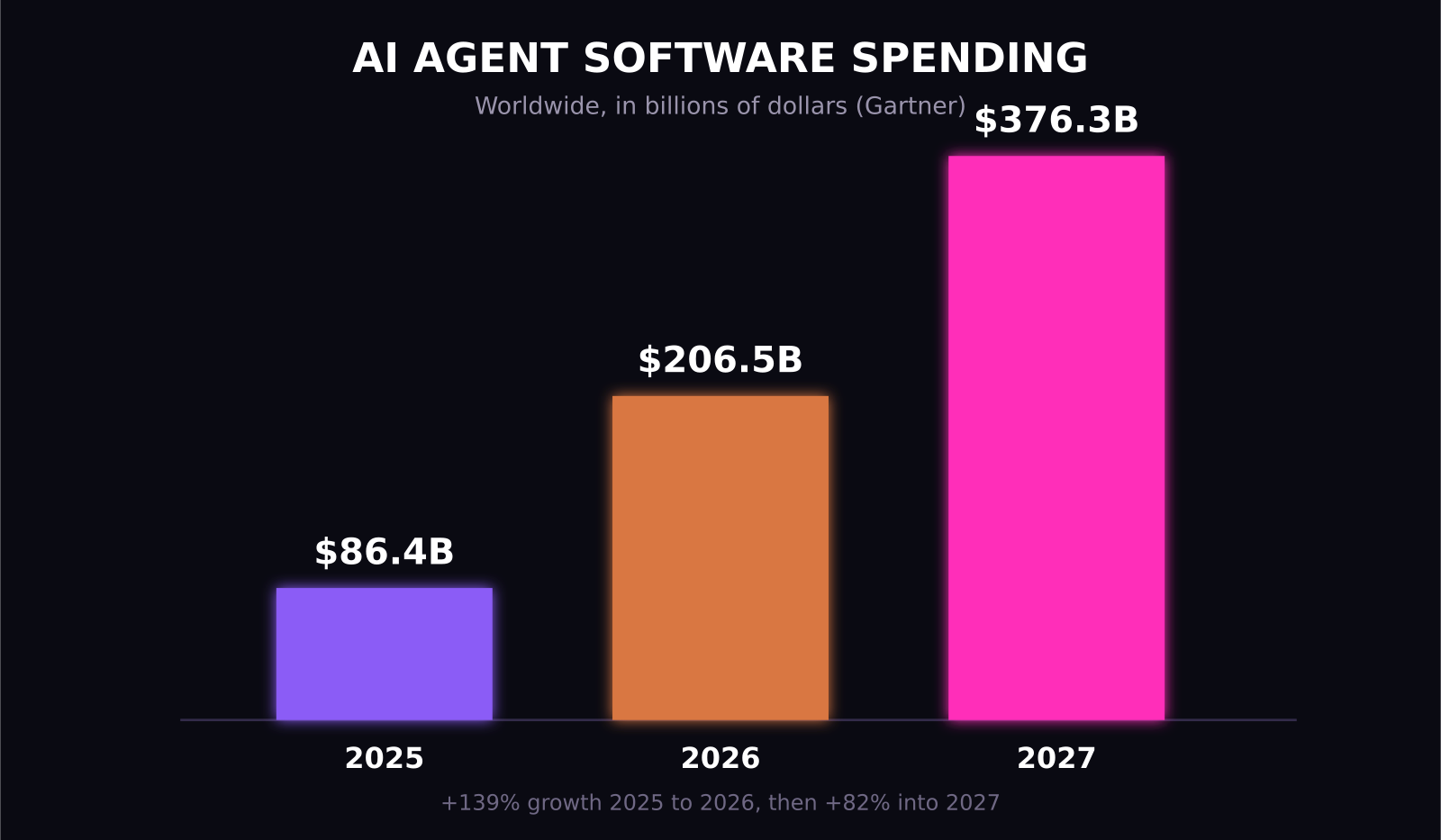
- Separately, Gartner forecasts AI agent software spending itself will hit 206.5 billion dollars in 2026, up 139 percent from 86.4 billion in 2025, and 376.3 billion dollars in 2027.
- 40 percent of enterprise apps are expected to embed task-specific AI agents by the end of 2026, up from under 5 percent in 2025.
- Gartner also predicts over 40 percent of agentic AI projects will be canceled by the end of 2027, a caution flag against over-committing.
- Gartner's own framing: SaaS will not be destroyed, it will emerge in a different form.
What is agentic arbitrage, in plain terms?
Traditional SaaS pricing charges per named user or per seat, on the assumption that a human opens the app, clicks around, and does the work. Agentic arbitrage describes a shift where an AI agent does that work instead, often orchestrating across several different tools in a single workflow without a human touching any individual interface. If one agent can complete tasks that previously required five employees each logging into their own software licenses, the vendor collecting five seat licenses now has a problem, even if total task volume and total value delivered stayed the same or grew.
This is fundamentally a pricing model risk, not a product risk. The work still needs software behind it. What is at risk is the specific mechanism SaaS companies use to charge for that work.
How big is the number, really?
234 billion dollars sounds enormous until you frame it against overall spending: Gartner puts it at roughly 20 percent of global enterprise SaaS spend by 2030, a meaningful minority, not a majority collapse. For context on how fast the underlying agent market itself is growing, Gartner separately forecasts purpose-built AI agent software spending will go from 86.4 billion dollars in 2025 to 206.5 billion in 2026, a 139 percent jump in a single year, then to 376.3 billion in 2027. Agent software spending is growing nearly three times faster than overall AI spending, which Gartner pegs at 47 percent growth for 2026.
Is this actually happening yet, or is it a future risk?
Both, at different speeds. The spending growth numbers for 2026 and 2027 are current-year and near-term forecasts, already reflected in enterprise buying behavior today: Gartner says 40 percent of enterprise applications will have task-specific AI agents embedded by the end of 2026, up from under 5 percent at the start of 2025. That is an extremely fast adoption curve for enterprise software.
The 234 billion dollar figure is a longer-horizon forecast, out to 2030, and it depends on how quickly agentic arbitrage actually displaces seat-based billing in practice, which is slower and messier than the technology headlines suggest. Gartner has also flagged the other side of this story: more than 40 percent of agentic AI projects are expected to be canceled by the end of 2027, due to rising costs, unclear business value, or inadequate risk controls. Enterprises are moving fast on agents, but not all of that momentum will survive contact with production reality.
What should SaaS founders actually do about this?
If you run or build a SaaS product priced primarily per seat, this is worth treating as a real planning input, not a distant hypothetical.
- Model what your revenue looks like if 20 to 30 percent of your current seats get replaced by agent-mediated usage over the next 3 to 5 years, even if you think the number will land lower than Gartner's estimate.
- Look at usage-based or outcome-based pricing components now, so your product has a billing mechanism that still captures value when an agent, not a human, is the one driving usage.
- Build for agent access as a first-class citizen: a clean API, structured outputs, and predictable rate limits matter more when your customer's AI agent is the one calling your product, not a human clicking through a UI.
- Do not panic-cancel your own roadmap based on the 2030 number alone. Gartner's 40 percent agentic project cancellation forecast is a reminder that a lot of agent initiatives, including ones aimed at your product, will stall out before they change anything.
Does this mean SaaS is going away?
No, and Gartner is explicit about that: "SaaS will not be destroyed; it will emerge in a different form." The most likely outcome is not fewer SaaS companies, but a shift in how the successful ones charge for value, moving away from strict per-seat counting toward pricing that holds up whether a human or an agent is doing the clicking. Companies that adapt their pricing model early have a real window to turn this into an advantage over competitors still billing purely by headcount.
Has anything like this happened to software pricing before?
Yes, and the parallel is useful. When cloud computing displaced on-premise licensing, and later when mobile displaced desktop as the primary access point for many products, the winners were not the companies that fought hardest to preserve their old pricing model. They were the companies that rebuilt their pricing around the new unit of value fastest, moving from per-server licenses to per-API-call or per-active-user metrics, for example. Agentic arbitrage looks like the same shape of disruption, applied to the seat itself: the unit SaaS pricing was built around is being questioned, not the underlying willingness of businesses to pay for software that gets work done.
The companies most exposed are ones whose entire pricing model assumes a human clicks through a UI: think seat-gated project management tools, seat-gated CRM add-ons, or per-user analytics dashboards where the actual value delivered has little to do with how many humans logged in that month.
What does this look like in practice, today?
A concrete example: a customer support SaaS charging per agent seat starts losing seat revenue when a company deploys one AI agent that resolves tickets across five previously-separate tools, a helpdesk, a CRM, a knowledge base, and a billing system, without a human seat logging into any of them individually. The task volume the vendor's software still processes may not drop at all. The seat count attached to that volume does. This is exactly the disconnect Gartner is describing: value delivered and pricing mechanism becoming decoupled.
For a company already selling API access, usage-based add-ons, or workflow automation as part of its product, this shift is closer to an opportunity than a threat, since agent-driven usage often means higher-volume, more predictable API consumption instead of fewer total user relationships.
Frequently asked questions
What is agentic arbitrage?
Agentic arbitrage is Gartner's term for AI agents completing tasks across multiple enterprise applications on a user's behalf, reducing the number of individual human logins and per-seat licenses needed, which pressures the traditional per-seat SaaS pricing model.
How much SaaS spending is actually at risk?
Gartner estimates 234 billion dollars of enterprise SaaS spending, about 20 percent of the global total, is at risk from agentic AI disruption by 2030. That is a forecast about pricing model pressure, not a prediction that SaaS revenue itself falls by that amount.
Should SaaS companies switch to usage-based pricing now?
Gartner's data suggests it is worth testing. Building usage-based or outcome-based pricing options alongside existing per-seat plans lets a company capture value from agent-driven usage without abandoning current customers who still prefer seat-based billing.
Was this article helpful?
SaaS Master
Creator behind SaaS Master — tutorials, walkthroughs, reviews, and explainers that help SaaS, AI, and WordPress products get understood and chosen. Writing here about the tools, trends, and tactics that actually move the needle. Work with me →
Want your product explained this clearly — in video?
Tutorials, walkthroughs, reviews, and shorts for SaaS, AI, and WordPress products.
Work With SaaS Master