AI Tools
Gemini 3.1 Pro vs GPT-5.5: Which Frontier AI Model Is Worth the Cost in 2026?
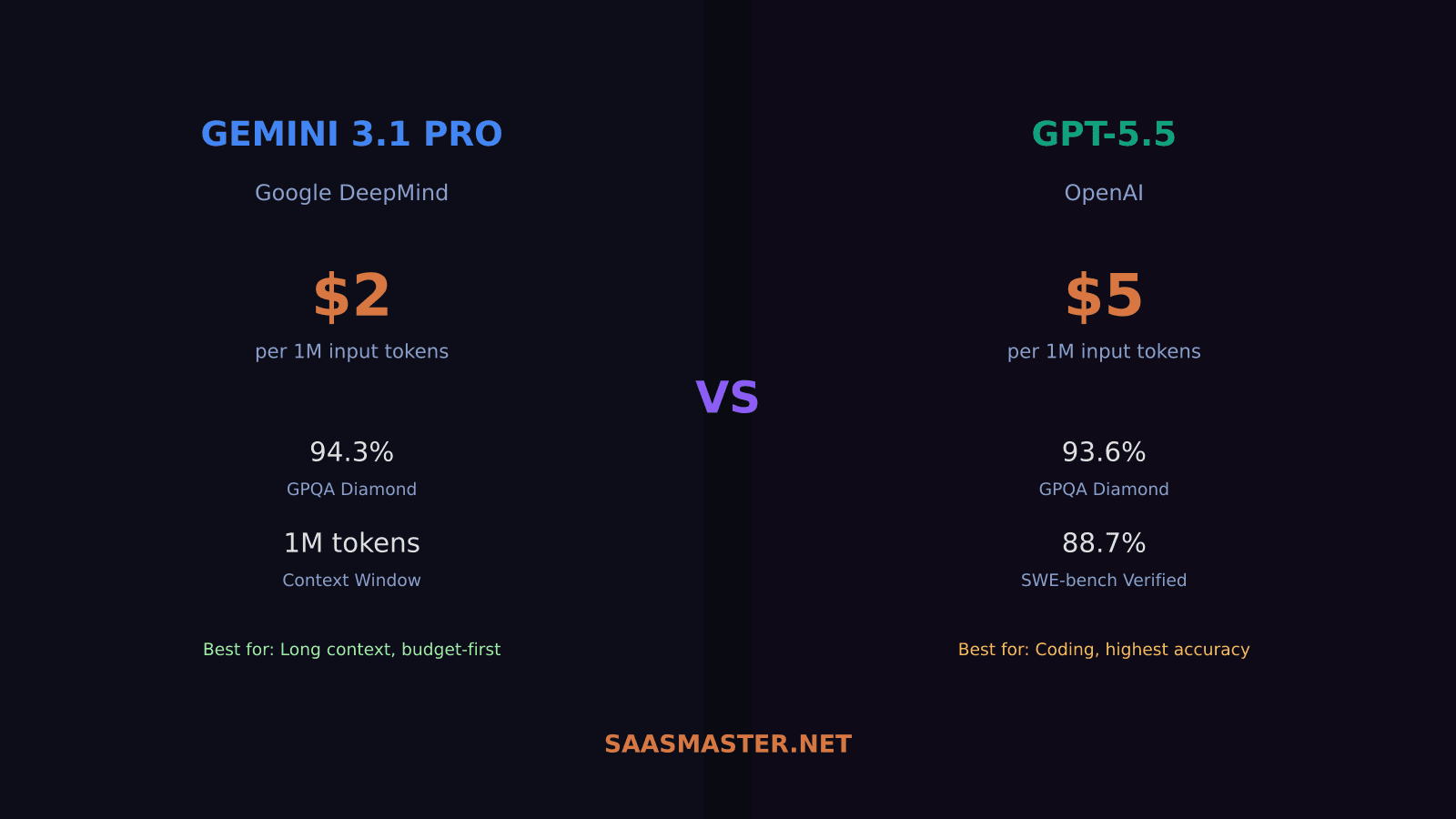
Gemini 3.1 Pro costs $2 per million input tokens. GPT-5.5 costs $5. When your app sends a billion tokens a month, that gap is $3,000 in savings — or a reason to stick with OpenAI if you need its coding edge. Here is the full picture so you can decide with actual numbers rather than hype.
Key takeaways
- Gemini 3.1 Pro is 60% cheaper than GPT-5.5 at $2/$12 vs $5/$30 per million input/output tokens
- GPT-5.5 leads on coding benchmarks with 88.7% SWE-bench Verified versus Gemini's ~80.6%
- Gemini edges out GPT-5.5 on scientific reasoning: 94.3% vs 93.6% on GPQA Diamond
- Both offer roughly 1 million tokens of context — effectively the same for most workflows
- Gemini wins for long-document and multimodal-heavy workloads; GPT-5.5 wins for agentic coding
What you are actually comparing
These are the two most capable non-reasoning frontier models available via API today. Gemini 3.1 Pro dropped into preview on February 19, 2026. GPT-5.5 followed with a significant price increase over its predecessor — input tokens doubled from $2.50 to $5.00 per million versus GPT-5.4. Neither is cheap, but the gap between them has widened in a way that matters if you are building anything at scale.
Neither model requires chain-of-thought toggling or reasoning budget controls — that is the domain of o3 and Gemini 2.5 Pro Thinking. These are your fast, capable, non-reasoning workhorses.
Which is cheaper, Gemini or GPT-5.5?
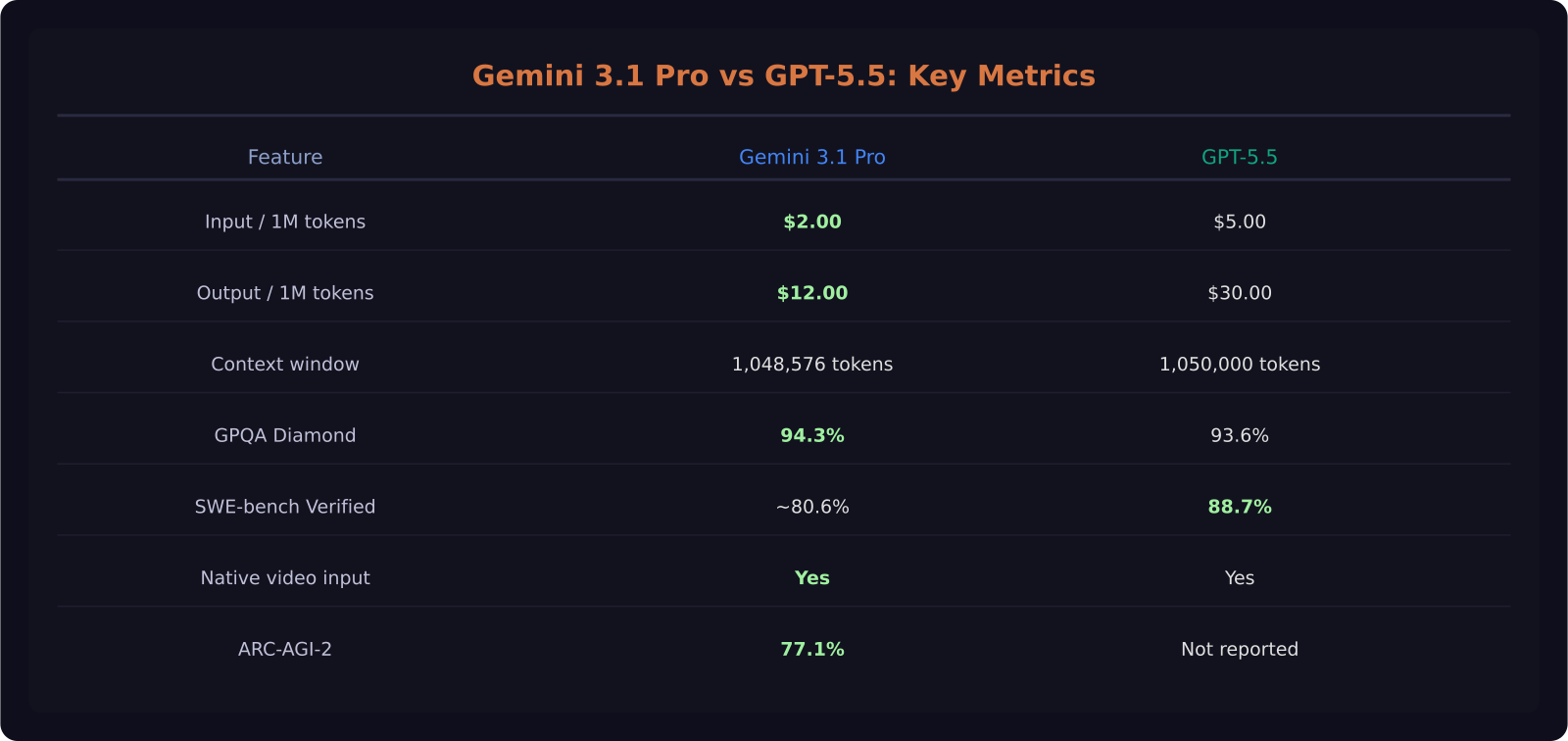
Gemini 3.1 Pro wins convincingly on cost. At $2.00 input / $12.00 output per million tokens, it is exactly 2.5x cheaper on input and 2.5x cheaper on output than GPT-5.5. For prompts under 200K tokens — which covers the vast majority of real-world API calls — that pricing is flat and predictable. Push past 200K tokens and Gemini's input rate doubles to $4.00 per million, which still undercuts GPT-5.5 at $5.00 for standard prompts.
GPT-5.5 adds another pricing wrinkle: prompts longer than 272K input tokens trigger 2x input pricing and 1.5x output pricing for the entire session. That makes very long GPT-5.5 sessions meaningfully more expensive than the headline rate suggests. On the upside, both models offer substantial caching discounts — GPT-5.5 cached input drops to $1.25 per million, a 75% reduction for repeated context.
Which scores higher on benchmarks?
The scorecard is split by category, which is why picking a winner depends on what you are actually building.
Gemini 3.1 Pro takes GPQA Diamond at 94.3%, edging GPT-5.5 at 93.6%. On ARC-AGI-2 — a test of novel reasoning not easily gamed by training data — Gemini 3.1 Pro posted 77.1% at launch, a number GPT-5.5 has not matched publicly. For science, medicine, or research-adjacent tasks, Gemini holds a slight lead.
GPT-5.5 dominates on software engineering. SWE-bench Verified at 88.7% is a meaningful gap over Gemini's approximately 80.6%, and Terminal-Bench 2.0 shows GPT-5.5 at 82.7% versus Gemini at 68.5%. If your core use case involves writing, reviewing, or executing code — especially in agentic settings — GPT-5.5 earns that price premium.
What does the context window difference actually mean?
Both models land at roughly 1 million tokens of context: Gemini at 1,048,576 and GPT-5.5 at 1,050,000. For practical use these are identical. What differs is how each handles very long prompts. Gemini's pricing steps up above 200K tokens but stays predictable. GPT-5.5 applies surcharges above 272K that can make a single session feel expensive if you are processing large codebases or legal corpora.
Gemini also processes video and audio natively — not just as transcribed text — which matters if your app does media analysis, meeting summarization from raw audio, or video search. GPT-5.5 handles multimodal input natively too, but Google's toolchain for large-scale video ingestion via the Gemini API remains more mature.
Who should pick Gemini 3.1 Pro?
If you are running a content platform, legal document analyzer, research tool, or any app where volume and long-context retrieval matter more than raw coding accuracy, Gemini 3.1 Pro is the cleaner choice. The 60% cost advantage compounds fast at scale. For teams already in Google Cloud, the latency and billing integration through Vertex AI makes it even easier to justify.
I have used Gemini's API in a few automation flows, and the native video input is genuinely useful — you can feed it a full YouTube recording and get a structured summary without any intermediate transcription step. That alone has changed how I script some content.
Who should pick GPT-5.5?
If code generation, agentic coding loops, or complex software workflows are your primary use case, GPT-5.5 earns its higher price. The 8-point gap on SWE-bench Verified and the 14-point gap on Terminal-Bench 2.0 are not small — they translate to fewer failed tool calls and fewer revision loops when the model is driving automation. OpenAI's Responses API also integrates neatly with GPT-5.5 for building agentic apps with built-in web search, file search, and computer use.
For teams already deep in the OpenAI ecosystem — using Assistants, Evals, or the batch API — switching incurs real migration cost. If GPT-5.4 was working well and the jump to 5.5 helps your specific eval scores, paying up may be rational.
The creator perspective
From where I sit — making tutorials and walkthroughs for AI tools — I tend to reach for Gemini 3.1 Pro when drafting scripts or summarizing long briefing docs. The price-per-token difference means I can run more iterations without sweating the bill. When I need something that involves code review or technical accuracy on a specific API, I still lean on OpenAI's model family. I do not think there is a universal winner here, which is actually good news — it means there is a real choice.
Frequently asked questions
Is Gemini 3.1 Pro better than GPT-5.5?
It depends on the task. Gemini 3.1 Pro scores higher on GPQA Diamond and ARC-AGI-2 and costs 60% less. GPT-5.5 scores higher on coding benchmarks like SWE-bench Verified (88.7% vs ~80.6%). For most non-coding use cases, Gemini offers better value. For agentic coding, GPT-5.5 is the stronger choice.
What is the price difference between Gemini 3.1 Pro and GPT-5.5?
Gemini 3.1 Pro costs $2.00 input / $12.00 output per million tokens. GPT-5.5 costs $5.00 input / $30.00 output per million tokens. Gemini is 2.5x cheaper on both input and output at standard prompt lengths.
Can Gemini 3.1 Pro process video natively?
Yes. Gemini 3.1 Pro accepts text, image, speech, and video as input natively without requiring separate transcription or preprocessing. GPT-5.5 also supports multimodal input, but Gemini's video processing pipeline via the Google AI and Vertex AI APIs is more mature for large-scale media workloads.
Was this article helpful?
SaaS Master
Creator behind SaaS Master — tutorials, walkthroughs, reviews, and explainers that help SaaS, AI, and WordPress products get understood and chosen. Writing here about the tools, trends, and tactics that actually move the needle. Work with me →
Want your product explained this clearly — in video?
Tutorials, walkthroughs, reviews, and shorts for SaaS, AI, and WordPress products.
Work With SaaS Master