AI Tools
Gemini 3.5 Pro: Release Date, Features, and What to Expect
Gemini 3.5 Pro was announced at Google I/O on May 19, 2026, but it is not generally available yet. Google shipped Gemini 3.5 Flash that same day and held Pro in limited enterprise preview on Vertex AI, with a June general availability target that has since slipped to July 2026. If you are waiting on Pro, here is exactly where things stand and what the model actually offers.
Key takeaways
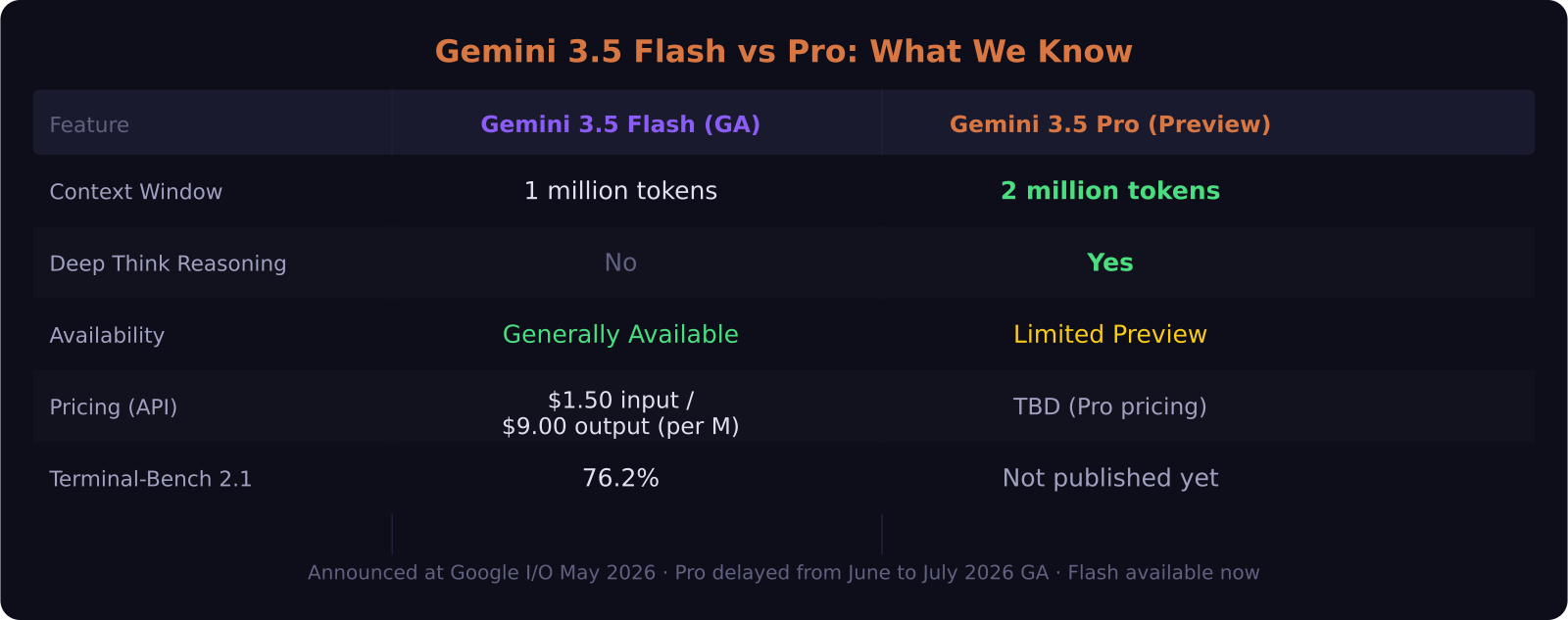
- Gemini 3.5 Pro features a 2-million-token context window — double Flash's 1 million — and a new Deep Think reasoning mode for complex multi-step analysis.
- As of June 25, 2026, Gemini 3.5 Pro is in limited preview for enterprise customers on Vertex AI only. General availability has been pushed from June to July 2026.
- Gemini 3.5 Flash is available now at $1.50/million input tokens and $9/million output tokens, with a 76.2% Terminal-Bench 2.1 score — ahead of Claude Opus 4.8 on that single benchmark.
- Pro pricing has not been announced. Based on the Flash-to-Pro pricing ratio Google used for Gemini 3.1, expect roughly a 3–4x increase over Flash rates.
- For developers and enterprise users not in the Vertex AI preview, July 2026 is the earliest realistic general access window.
What Was Announced at Google I/O?
Google's I/O keynote on May 19, 2026 introduced the Gemini 3.5 family. Sundar Pichai described a model line built around what Google calls "frontier intelligence with action" — multimodal understanding, native tool use, and context windows large enough to process entire document sets in a single prompt.
Two models were announced: Gemini 3.5 Flash and Gemini 3.5 Pro. Flash shipped immediately that day to Google AI Studio and the Gemini API. Pro shipped into limited preview for select enterprise Vertex AI customers only. When developers in the audience pushed back on the delay, Pichai reportedly told them to "give us until next month" — a line that was widely cited afterward because it drew an audible reaction from the crowd.
That "next month" has now also slipped. As of June 23, 2026, reporting from Insider indicates Google moved the Pro general availability target to July 2026. The official line is that final safety evaluations and capacity provisioning are taking longer than expected.
What Is the 2 Million Token Context Actually Good For?
Two million tokens is not a number that maps easily to everyday tasks until you convert it. At roughly 750 words per 1,000 tokens, 2 million tokens is approximately 1.5 million words — five to eight full novels, ten thousand pages of documents, or a year of company meeting notes, all held in memory at once.
In practice, the use cases that change with this context window are: legal document review across an entire contract history, code analysis across an entire enterprise codebase in a single session, multi-year financial analysis without chunking, and research synthesis across hundreds of academic papers simultaneously.
Most users will not hit the 2-million-token ceiling in everyday use. The value is less about constantly using the maximum and more about having a model that does not degrade on long, complex tasks because it ran out of context halfway through. Flash's 1-million-token window is already larger than most models; Pro's doubling of that is meaningful specifically for enterprise-scale document workflows.
What Is Deep Think Mode?
Deep Think is Gemini 3.5 Pro's extended reasoning mode, designed for multi-step problems where the model takes more time before responding to produce a higher-quality answer. Google positions it as the analog to OpenAI's o-series reasoning modes and Anthropic's extended thinking on Claude.
In Deep Think, the model works through a problem step-by-step internally before producing output. This trades speed for accuracy — Deep Think responses take longer but show measurably better performance on math, science, logic, and complex coding tasks that require multi-step reasoning.
Google has not published Deep Think benchmark numbers for Pro specifically, since it remains in limited preview. The assumption from Google I/O comparisons is that Pro with Deep Think will score above what Flash achieves without it.
How Does Gemini 3.5 Flash Compare to Alternatives Right Now?
While Pro is still in preview, Flash is the model you can actually use. At $1.50/million input tokens and $9/million output tokens, it is one of the most cost-efficient frontier-capable models available. For context: Claude Opus 4.8 costs $5 input and $25 output per million tokens; GPT-5.5 costs $5 input and $30 output per million tokens.
On Terminal-Bench 2.1, Gemini 3.5 Flash scores 76.2%, which is ahead of Claude Opus 4.8's 74.6% on that specific benchmark — a notable result given the price gap. On GDPval-AA (agentic tasks), Flash scores 1,656 Elo versus Opus 4.8's 1,890, so the picture is mixed depending on task type.
Gemini 3.5 Flash scores 55.3 on the Artificial Analysis Intelligence Index at roughly 70% lower cost than Opus 4.8 and about 4x the speed. For applications where cost and throughput matter more than peak intelligence on the hardest reasoning tasks, Flash is a strong current choice.
Should You Wait for Gemini 3.5 Pro?
If you are building production workflows that would benefit from the 2-million-token context or Deep Think reasoning, it is worth waiting. July 2026 is the current target for general availability, and even enterprise teams without current Vertex AI access should be able to evaluate it within the next few weeks.
If you need something now and the context window matters more than reasoning depth, Flash's 1-million-token window handles most production use cases and is available today.
If you are comparing frontier models for reasoning-heavy tasks and price is less of a concern, Claude Opus 4.8 leads on GDPval-AA agentic benchmarks and is available today without a waitlist.
The honest read: Gemini 3.5 Pro looks like a strong model based on what Google has described, but the delay from June to July is a reminder that "announced at I/O" and "available to use" are different things. Plan for July; treat anything earlier as a bonus.
Frequently asked questions
Can I access Gemini 3.5 Pro today?
As of June 25, 2026, Gemini 3.5 Pro is in limited preview for enterprise customers through Google's Vertex AI platform. General availability is expected in July 2026. Gemini 3.5 Flash is available now via Google AI Studio and the Gemini API.
What is the difference between Gemini 3.5 Flash and Pro?
Flash has a 1-million-token context window and no Deep Think reasoning mode. Pro doubles the context to 2 million tokens and adds Deep Think for complex multi-step analysis. Pro will be priced higher than Flash; Google has not announced Pro API pricing yet.
How does Gemini 3.5 Pro compare to GPT-5.5 and Claude Opus 4.8?
Direct benchmark comparisons are not possible yet since Pro is not publicly available. Gemini 3.5 Flash scores competitively on throughput benchmarks versus both, at significantly lower cost. Pro's 2M context window exceeds both GPT-5.5 (128K) and Claude Opus 4.8 (200K), which is likely its primary differentiation for enterprise document workflows.
Was this article helpful?
SaaS Master
Creator behind SaaS Master — tutorials, walkthroughs, reviews, and explainers that help SaaS, AI, and WordPress products get understood and chosen. Writing here about the tools, trends, and tactics that actually move the needle. Work with me →
Want your product explained this clearly — in video?
Tutorials, walkthroughs, reviews, and shorts for SaaS, AI, and WordPress products.
Work With SaaS Master