AI Tools
Grok Build vs Claude Code vs Codex: Which AI Coding Agent Wins in 2026?
Grok Build, Claude Code, and Codex CLI are the three terminal-based coding agents developers are actively comparing in mid-2026. All three take natural-language instructions and produce working code, run tests, fix bugs, and push commits without you writing every line. The differences come down to benchmark scores, how they handle long autonomous runs, parallel execution, and what you actually pay.
xAI shipped Grok Build on May 14, 2026 — the fourth major entry in a category that Claude Code (Anthropic) and Codex CLI (OpenAI) helped define. Grok Build runs up to eight parallel subagents, supports the Agent Client Protocol, and targets the same developer workflows. How does it actually compare?
Key takeaways
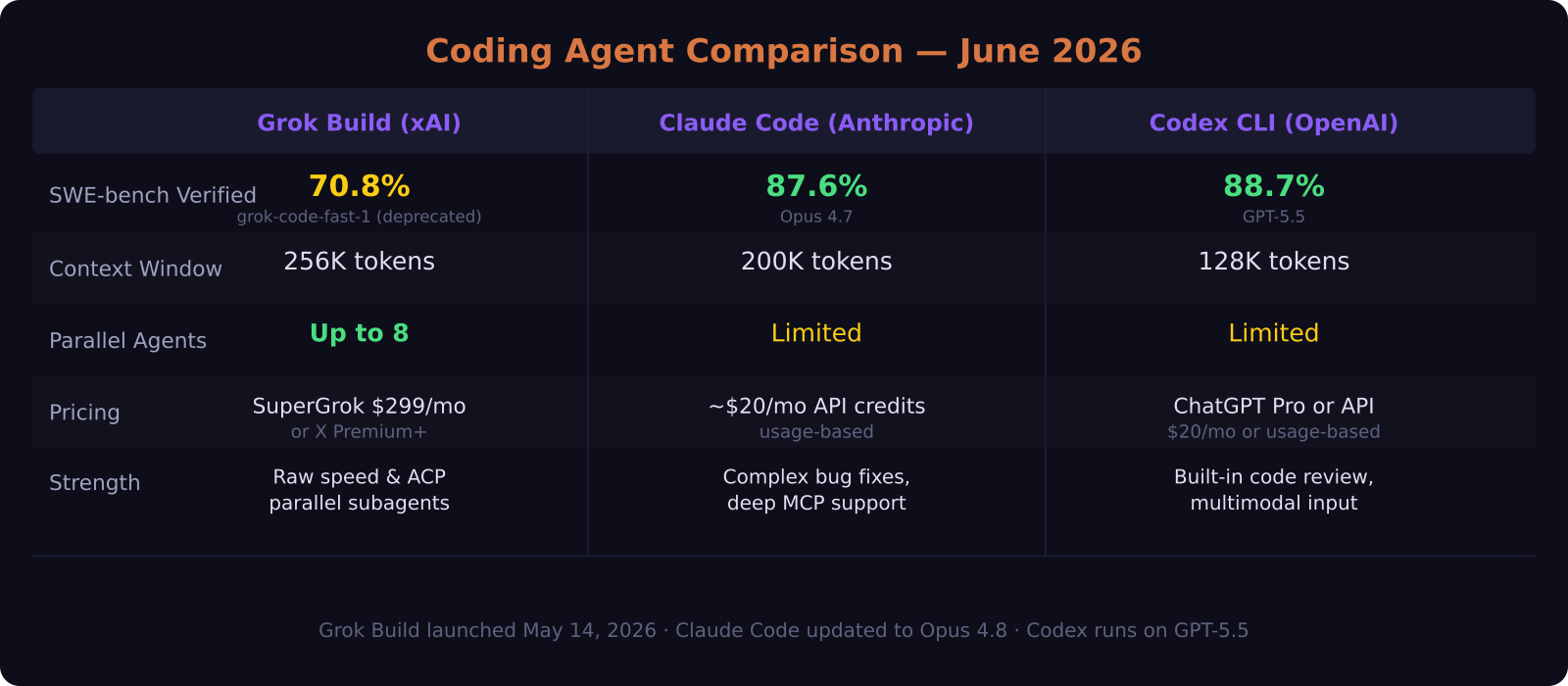
- Codex CLI (GPT-5.5) and Claude Code (Opus 4.7) hold the top SWE-bench Verified scores at 88.7% and 87.6% respectively. Grok Build's documented score of 70.8% was on a deprecated model, so the gap should narrow with updated benchmarks.
- Grok Build's standout feature is parallel subagents — up to eight can run simultaneously, which is unique in this category and meaningfully faster for large, independent task lists.
- Claude Code leads on complex multi-file bug fixes requiring deep understanding of component relationships, and has the most mature MCP integration of the three.
- Codex CLI is the only one with native multimodal input (text, images, audio, video in a single architecture) and includes a built-in diff-review agent that critiques your changes before you commit.
- Pricing is a meaningful variable: Grok Build requires a SuperGrok ($299/month) or X Premium+ subscription; Claude Code and Codex run on API credits or $20/month chat plans.
What Is Grok Build?
Grok Build is xAI's agentic coding CLI, launched May 14, 2026 for SuperGrok and X Premium Plus subscribers. It runs from the terminal, takes natural-language instructions, and uses the Agent Coordination Protocol to spawn up to eight parallel subagents that work on independent tasks simultaneously.
The backing model is grok-build-0.1 (replacing the deprecated grok-code-fast-1 from August 2025), with a 256,000-token context window. In June 2026, xAI added /goal, a new long-running autonomous mode that plans a task, executes until completion, and provides status, pause, resume, and clear controls. That positions Grok Build closer to the sustained-run capability that Claude Code has had since earlier in the year.
The ACP (Agent Client Protocol) support is meaningful: it allows Grok Build to interoperate with other ACP-compatible agents and tools, which is increasingly important as the ecosystem matures.
What Makes Claude Code Different?
Claude Code is Anthropic's terminal coding agent, backed by the Claude Opus model line (currently Opus 4.8 for the strongest tasks). It runs from the command line, handles multi-file refactoring, reads and writes to your local filesystem, and executes terminal commands as part of a task loop.
On SWE-bench Verified — the most commonly cited coding benchmark for autonomous agents — Claude Code with Opus 4.7 scored 87.6%, one of the highest documented scores in the category. On the GDPval-AA agentic evaluation, Opus 4.8 leads at 1,890 Elo, ahead of GPT-5.5 at 1,769.
Where Claude Code consistently stands out in practice is on tasks that require understanding relationships across a large, unfamiliar codebase. When a bug touches four files and the fix requires understanding why each file was written the way it was, Claude Code's reasoning depth shows. The native MCP (Model Context Protocol) support is also the most mature of the three, which matters for developers building agentic workflows that connect multiple tools.
What Does Codex CLI Offer?
Codex CLI is OpenAI's terminal coding agent, running on GPT-5.5. It holds the highest published SWE-bench Verified score at 88.7%, and adds two capabilities the others do not have in the same form.
First: the built-in diff reviewer. Before you commit, a second agent reads your diff and provides a structured critique — checking for logic errors, security issues, and style consistency. This is built into the tool rather than being a separate step. Second: GPT-5.5 is natively multimodal, meaning you can pass in images, diagrams, or wireframes alongside text prompts and get code that reflects what you showed it.
Codex CLI is available through ChatGPT Pro ($20/month) or directly via the OpenAI API on usage-based pricing.
Which Is Fastest?
Grok Build's parallel subagent architecture makes it the fastest for workloads that can be parallelized. When you have eight independent tasks — write a test for this function, refactor that module, update the README, generate mock data for four endpoints — Grok Build can run all eight simultaneously rather than sequentially. For the right type of project, this is a genuine structural advantage.
For single, sequential tasks, all three agents run at roughly comparable speeds. Grok Build emphasizes execution speed and quick decision loops; Claude Code and Codex tend to take more time planning before executing, which sometimes produces cleaner first-pass output on complex tasks.
Which Handles Complex Projects Best?
For complex, multi-file production refactors where mistakes are costly, Claude Code is still the maturity pick. Its track record is longer, its failure modes are better documented, and its MCP integration makes it easier to wire into existing toolchains.
For high-volume iteration — writing tests, generating boilerplate, processing many similar tasks in parallel — Grok Build's subagent architecture gives it a structural edge once you have enough tasks to parallelize.
For teams already inside OpenAI's ecosystem, Codex CLI is the natural choice: same billing, same API, multimodal by default, and the diff-review agent provides a useful safety layer before commits.
The Pricing Reality
Grok Build at $299/month for SuperGrok is significantly more expensive than Claude Code or Codex at their API or $20/month plan levels. That price point makes sense for teams that are heavy xAI users and get SuperGrok for other workflows, but it is a real barrier for an individual developer who just wants a coding agent.
Claude Code's API-based pricing scales with usage. Heavy users will spend more than $20/month; light users will spend less. Codex via ChatGPT Pro is a flat $20/month with usage limits.
If you are evaluating coding agents as a solo developer, Claude Code and Codex offer the lower entry cost with mature benchmark results. Grok Build makes more sense if you're on SuperGrok anyway and want the parallel execution advantage.
Frequently asked questions
How does Grok Build's parallel agent system work?
Grok Build can spawn up to eight subagents under the Agent Coordination Protocol, each running an independent task simultaneously. You might assign one agent to write tests, another to refactor a module, and three others to handle documentation updates — all running in parallel and completing faster than sequential execution.
Is Claude Code or Codex better for production use?
Both have strong SWE-bench scores (87.6% and 88.7% respectively) and mature tooling. Claude Code leads on complex reasoning across large codebases and MCP integrations. Codex adds a built-in diff reviewer and native multimodal input. The choice depends on your workflow — try both on a real task from your codebase before committing.
Does Grok Build require an X / Twitter account?
Yes. Grok Build is currently available to SuperGrok ($299/month) and X Premium Plus subscribers. There is no standalone developer plan separate from xAI's subscription tiers as of June 2026.
Was this article helpful?
SaaS Master
Creator behind SaaS Master — tutorials, walkthroughs, reviews, and explainers that help SaaS, AI, and WordPress products get understood and chosen. Writing here about the tools, trends, and tactics that actually move the needle. Work with me →
Want your product explained this clearly — in video?
Tutorials, walkthroughs, reviews, and shorts for SaaS, AI, and WordPress products.
Work With SaaS Master