AI Tools
GLM-5.2 Review: The Open-Source AI That Beats GPT-5.5 at 1/6 the Cost

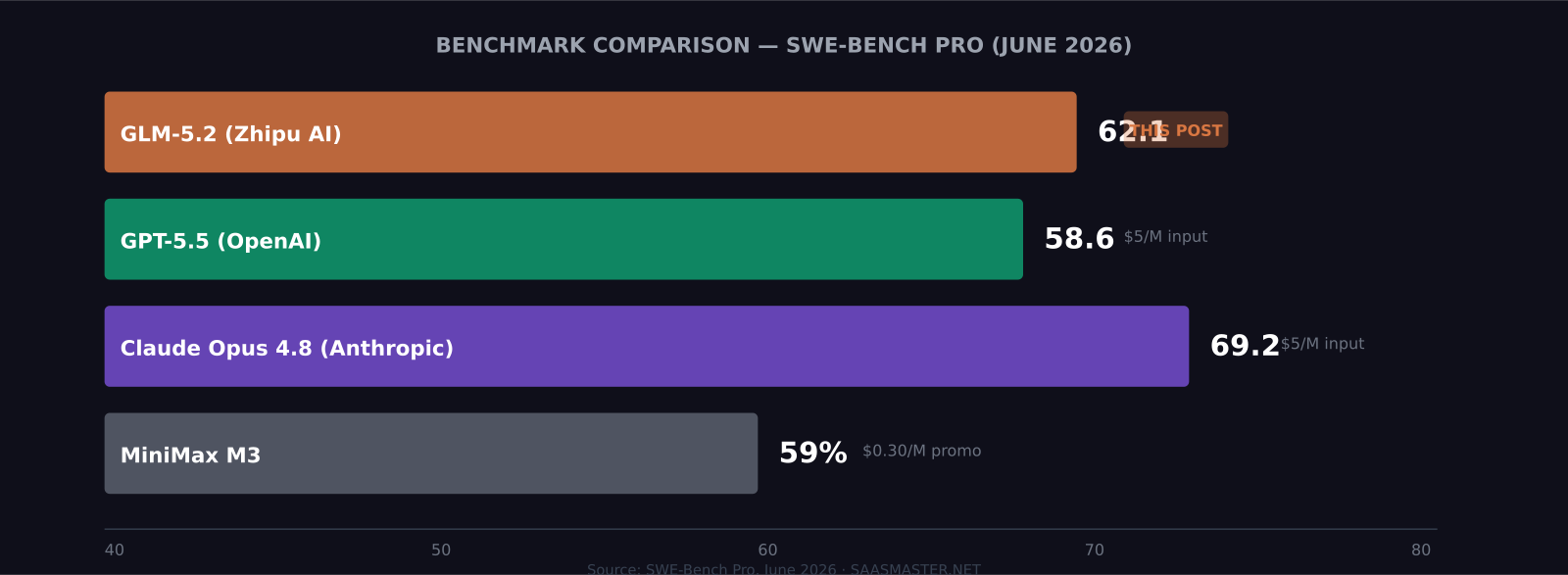
On June 13, 2026, Chinese AI company Zhipu AI released GLM-5.2 as fully open-source software under the MIT license — and the benchmarks landed like a punch. On SWE-bench Pro, the standard coding benchmark used to rank frontier models, GLM-5.2 scored 62.1. GPT-5.5 scored 58.6. Claude Opus 4.8, which currently leads the coding benchmark leaderboard, sits at 69.2.
For SaaS builders and AI-curious creators, that number matters for one reason: GLM-5.2 costs $1.40 per million input tokens via OpenRouter. GPT-5.5 costs $5. You can run GLM-5.2 at roughly one sixth the cost of OpenAI's best model and get better coding performance.
Key takeaways
- GLM-5.2 released June 13, 2026, built by Zhipu AI (China), MIT license — free to use commercially with no restrictions
- SWE-bench Pro score of 62.1 beats GPT-5.5 (58.6) but trails Claude Opus 4.8 (69.2) — best-in-class open-source
- 750 billion total parameters in a Mixture-of-Experts design with around 40 billion active per token — efficient to run
- 1-million-token context window, same size as Gemini 2.5 Pro
- $1.40/M input via OpenRouter versus $5/M for GPT-5.5 and Claude Opus 4.8
- Text and code only — no image or audio input, which is a notable gap in 2026
What is GLM-5.2 and why does it matter?
GLM-5.2 is an open-weights large language model from Zhipu AI, one of China's leading AI research labs. It is optimized specifically for software engineering, multi-step reasoning, and tool-augmented agent tasks — the kind of work where you chain a model through a sequence of actions, like reading a codebase, writing a fix, running tests, and iterating.
The architecture is a Mixture-of-Experts design. Total parameter count is around 750 billion, but only about 40 billion are active for any given token. This is the same general approach used by Mistral's Mixtral models and DeepSeek V4 — it lets you build a very capable model that runs efficiently because most of the network is dormant on any given forward pass. Zhipu also developed a technique called IndexShare sparse attention that helps control the cost of 1-million-token inference, which would otherwise be prohibitive.
The MIT license means no usage restrictions. You can deploy it commercially, fine-tune it, build products on it, and redistribute it. No royalties, no usage caps.
How does GLM-5.2 actually benchmark against the competition?
SWE-bench Pro is the main scorecard for coding models. It tests models on real software engineering tasks pulled from open-source repositories — bug fixes, feature additions, refactors — in conditions that require the model to understand context, navigate unfamiliar codebases, and produce working patches.
GLM-5.2 scored 62.1. That is above GPT-5.5's 58.6 and above MiniMax M3's 59%. Claude Opus 4.8 leads at 69.2. On Terminal-Bench 2.1, which focuses on command-line and shell tasks, GLM-5.2 jumped from 63.5 (its predecessor GLM-5.1) to 81.0 — within four points of Opus 4.8.
On the Intelligence Index v4.1, a broader capabilities ranking, GLM-5.2 scores 51. That puts it ahead of MiniMax M3 at 44, DeepSeek V4 Pro at 44, and Kimi K2.6 at 43. It is not beating the closed frontier leaders, but it is comfortably ahead of every other open model available in June 2026.
What does it cost compared to GPT-5.5 and Claude?
The pricing gap is substantial. Via OpenRouter (the most accessible third-party inference provider), GLM-5.2 runs at approximately $1.40 per million input tokens and $4.40 per million output tokens. Compare that to GPT-5.5 at $5 input and $30 output, and Claude Opus 4.8 at $5 input and $25 output.
For a SaaS builder running agentic coding tasks — where one complex session might consume 50 to 200 thousand tokens — the cost difference is real and adds up quickly at scale. At 100M tokens of input per month, GLM-5.2 costs $140 versus $500 for GPT-5.5 or Claude.
Why is this release significant beyond the benchmarks?
The timing is not coincidental. Zhipu released GLM-5.2 with full open weights on the same week the Trump administration tightened AI export controls, blocking access to certain Anthropic models for foreign nationals and restricting commercial AI transfers to specific countries.
GLM-5.2's MIT release is a direct strategic response: a Chinese AI lab publishing a frontier-capable model with zero usage restrictions, explicitly positioning it as an alternative to US AI in markets where access to OpenAI or Anthropic may be restricted or uncertain.
For SaaS builders outside the US who have been dependent on closed API access, this is significant. An MIT-licensed model you can self-host or access through multiple inference providers is a different risk profile than relying on a single US-domiciled vendor.
What GLM-5.2 is missing
The biggest gap is multimodal input. GLM-5.2 handles text and code only. No image input, no audio, no video understanding. In 2026, where Gemini 2.5 Pro reads video and audio natively and GPT-5.5 handles images and voice, that is a meaningful limitation for workflows that involve visual content.
GLM-5.2 also has less third-party tooling and fewer integrations than GPT-5.5 or Claude at this stage. The ecosystem will grow, but right now you are often routing through OpenRouter or Z.ai's own platform rather than a rich library of native connectors.
Who should actually use GLM-5.2?
SaaS builders with heavy coding agent workloads who want to cut API costs without sacrificing benchmark performance. Teams outside the US who need open-weight access without export-control risk. Developers who want to self-host a frontier-capable model on their own infrastructure. Researchers and open-source contributors who want MIT-licensed access to a model that competes with closed alternatives.
If your workflow depends on image input, multimodal analysis, or tight integration with existing AI platforms, GLM-5.2 is not ready to replace your current stack. If you are primarily running text and code tasks, it is worth running in parallel today.
Frequently asked questions
How do I access GLM-5.2 right now?
The easiest path is through OpenRouter, where it is available at $1.40/M input. Zhipu AI's own Z.ai platform includes it on the GLM Coding Plan. It is also available on several other inference providers. The weights are publicly available under MIT license if you want to self-host on your own GPU infrastructure.
Can GLM-5.2 replace Claude Opus 4.8 for coding?
Not fully. Claude Opus 4.8 leads SWE-bench Pro at 69.2 versus GLM-5.2's 62.1 — a meaningful gap on hard coding tasks. For straightforward code generation, bug fixing, and refactoring within a single codebase, GLM-5.2 is a solid alternative at a fraction of the cost. For the most complex multi-file, multi-dependency agentic work, Opus 4.8 still holds the advantage.
Is GLM-5.2 safe to use in a commercial product?
The MIT license allows full commercial use with no restrictions. The model comes without usage caps, royalties, or access conditions attached. You should still apply your own content safety layer if deploying it in a user-facing context, as you would with any model.
Was this article helpful?
SaaS Master
Creator behind SaaS Master — tutorials, walkthroughs, reviews, and explainers that help SaaS, AI, and WordPress products get understood and chosen. Writing here about the tools, trends, and tactics that actually move the needle. Work with me →
Want your product explained this clearly — in video?
Tutorials, walkthroughs, reviews, and shorts for SaaS, AI, and WordPress products.
Work With SaaS Master
