AI Tools
Microsoft Just Launched Its Own AI: MAI-Thinking-1 and MAI-Code-1-Flash Reviewed

For the first time in its seven-year AI partnership with OpenAI, Microsoft has launched models it built entirely from scratch. At Build 2026 on June 2, Microsoft unveiled seven proprietary models under the MAI family — short for Microsoft AI. Two are immediately available to developers: MAI-Thinking-1, a reasoning model, and MAI-Code-1-Flash, a production coding model. Both were trained on commercially licensed data with no distillation from OpenAI, Anthropic, or any third-party model.
The timing matters. Until 2025, Microsoft was contractually restricted from building broadly capable AI models — a condition embedded in its original 2019 deal with OpenAI and extended through 2023. That restriction was lifted as part of a renegotiation that coincided with OpenAI's $110 billion funding round. What you are seeing at Build 2026 is the direct result: Microsoft now has operational alternatives at every tier of the developer stack.
Key takeaways
- Microsoft launched 7 MAI models at Build 2026 on June 2, 2026, trained without any OpenAI data
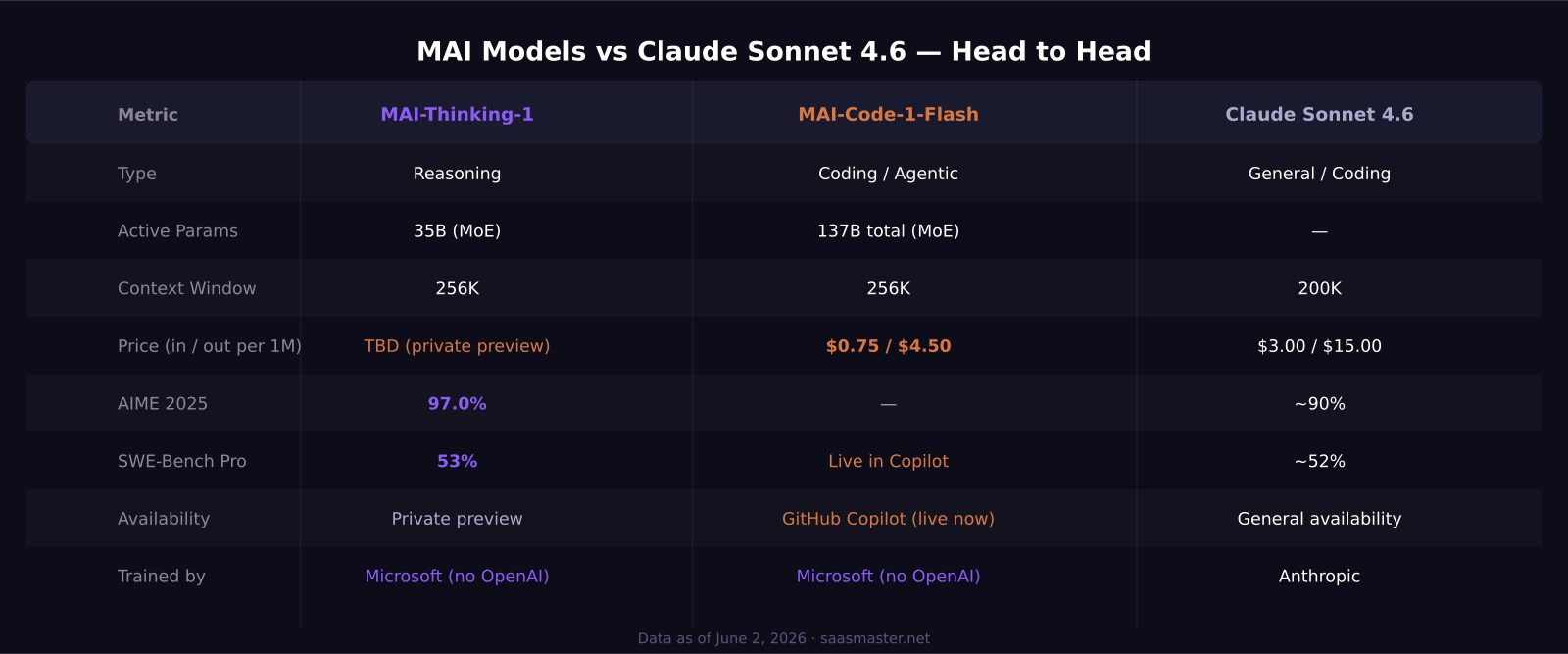
- MAI-Thinking-1 is a 35B active parameter reasoning model scoring 97.0% on AIME 2025 with a 256K context window
- MAI-Code-1-Flash is priced at $0.75/M input and $4.50/M output and is rolling out in GitHub Copilot now
- Microsoft claims up to 10x better cost efficiency versus Claude Sonnet 4.6 on equivalent tasks
- Azure customers can now route across Microsoft, OpenAI, and Anthropic without leaving Microsoft's billing perimeter
What is MAI-Thinking-1?
MAI-Thinking-1 is Microsoft's first in-house reasoning model. It uses a sparse Mixture of Experts architecture with 35 billion active parameters and a 256,000-token context window. On AIME 2025, it scores 97.0%, putting it in the same tier as the top-performing reasoning models available today. On AIME 2026, it scores 94.5%. On SWE-bench Pro — one of the harder software engineering benchmarks — it reaches 53%, roughly matching Claude Sonnet 4.6.
The model is in private preview on Microsoft Foundry, with support for the Chat Completions API, function calling, and developer-defined system instructions. Public rollout via OpenRouter, Fireworks AI, and Baseten is coming, but pricing has not been finalized. Independent side-by-side evaluations on Surge put human raters preferring MAI-Thinking-1 overall against Sonnet 4.6 in blind comparisons.
What makes this notable from a creator and builder perspective is not just the numbers — it is the architecture story. Microsoft did not shortcut this by distilling from a bigger model. The team trained it end-to-end on enterprise-licensed data, which matters for business applications where training data provenance affects legal risk. That is a meaningfully different value proposition from a model that effectively learned by copying what GPT-4 or Claude already knew.
What is MAI-Code-1-Flash?
MAI-Code-1-Flash is the production coding companion. It runs at 137 billion total parameters with a sparse MoE architecture and like MAI-Thinking-1 it supports a 256K context window. Pricing is live at $0.75 per million input tokens and $4.50 per million output tokens.
What sets it apart from other coding models is how it was trained. Microsoft built it using the same GitHub Copilot harnesses used in production, meaning the model learned to operate inside the actual tool it would later run in. Most models are trained on static code corpora and adapted to IDEs as an afterthought. MAI-Code-1-Flash was trained with live agentic workflows in mind, including adaptive solution length control — it stays concise on simple edits and expands its reasoning budget when a problem calls for it.
It is already rolling out inside GitHub Copilot across Free, Pro, Pro+, and Max plans via the VS Code model picker. If you use Copilot today, you can switch to it from the model picker.
How does this change things for SaaS developers?
The strategic shift here is significant. Before Build 2026, if you built on Azure and used AI, you were essentially routing everything through OpenAI. Microsoft now has its own models at the reasoning tier, the coding tier, and also at the transcription, voice, and image generation tiers based on the full Build keynote.
This creates a genuinely multi-model routing scenario where you can keep everything inside Azure's billing and governance framework while choosing the right model for each task. Developers building agentic workflows — where a single user action triggers dozens of API calls — will feel the cost difference most. If MAI-Thinking-1 delivers on its claim of 10x cost efficiency against Claude Sonnet 4.6 for reasoning tasks, that changes the economics of product features that were previously too expensive to ship.
For smaller SaaS teams the practical impact is also about trust. You are building on a model that Microsoft controls, that runs on Azure infrastructure, and that does not create licensing exposure from OpenAI data. That is a cleaner legal position than most alternatives, and one worth having a conversation with your legal team about.
Should you use MAI models?
Here is my honest take after digging through the benchmarks and technical documentation. MAI-Thinking-1 is impressive for a v1. Scoring 97% on AIME 2025 and matching Sonnet 4.6 on SWE-bench at a significantly lower claimed cost is a real result, not marketing copy.
MAI-Code-1-Flash is the one to watch more closely. The production training approach is smart — it means the model actually understands the environment in which it will be used, not just abstract coding tasks in isolation. The $0.75/M input price is reasonable for a coding model, though you need to factor in output costs at $4.50/M if you are running agentic loops with long outputs.
The catch for now is availability. MAI-Thinking-1 is still in private preview. If your team needs to ship something this week, you cannot depend on it yet. MAI-Code-1-Flash is live in Copilot, which is more immediately useful.
Who should prioritize testing these? Teams already on Azure or GitHub Copilot who want to benchmark real cost reduction. Anyone building compliance-sensitive products where training data provenance matters. Developers who have been stuck choosing between OpenAI cost and Anthropic quality — this is a legitimate third lane, and it is Microsoft's.
What Microsoft launched across the full MAI family
Beyond the two headline models, Microsoft confirmed five additional MAI models at Build 2026 covering transcription in dozens of languages, voice generation, image synthesis running live in PowerPoint and OneDrive, and a faster retrieval-optimized variant for document workflows. The full seven-model roster positions Microsoft to serve every layer of an enterprise AI stack without a third-party dependency at any point.
This is not just a product launch. It is the structural end of Microsoft's reliance on external AI suppliers, delivered quietly and competently at a developer conference most people will move past in a week. For anyone building on Azure, it is worth paying attention to.
Frequently asked questions
Is MAI-Thinking-1 available to the public?
As of June 2026, MAI-Thinking-1 is in private preview on Microsoft Foundry. Public access via third-party inference providers including OpenRouter is planned but not yet live, and final public pricing has not been announced.
How does MAI-Code-1-Flash compare to existing GitHub Copilot models?
MAI-Code-1-Flash was trained specifically on GitHub Copilot's production harnesses, making it more naturally aligned to real-world IDE and agentic workflows than models adapted after the fact. It replaces or supplements existing Copilot models in VS Code through the model picker.
Is Microsoft still partnering with OpenAI after launching MAI?
Yes. Microsoft remains OpenAI's primary cloud provider under the renegotiated 2025 agreement. The MAI launch gives Microsoft proprietary alternatives, but OpenAI models remain available on Azure. The relationship is now coopetitive rather than fully dependent.
Was this article helpful?
SaaS Master
Creator behind SaaS Master — tutorials, walkthroughs, reviews, and explainers that help SaaS, AI, and WordPress products get understood and chosen. Writing here about the tools, trends, and tactics that actually move the needle. Work with me →
Want your product explained this clearly — in video?
Tutorials, walkthroughs, reviews, and shorts for SaaS, AI, and WordPress products.
Work With SaaS Master