AI Tools
GPT-5.5 vs Gemini 3.5 Flash: Which AI Model Is Worth Your Money in June 2026?
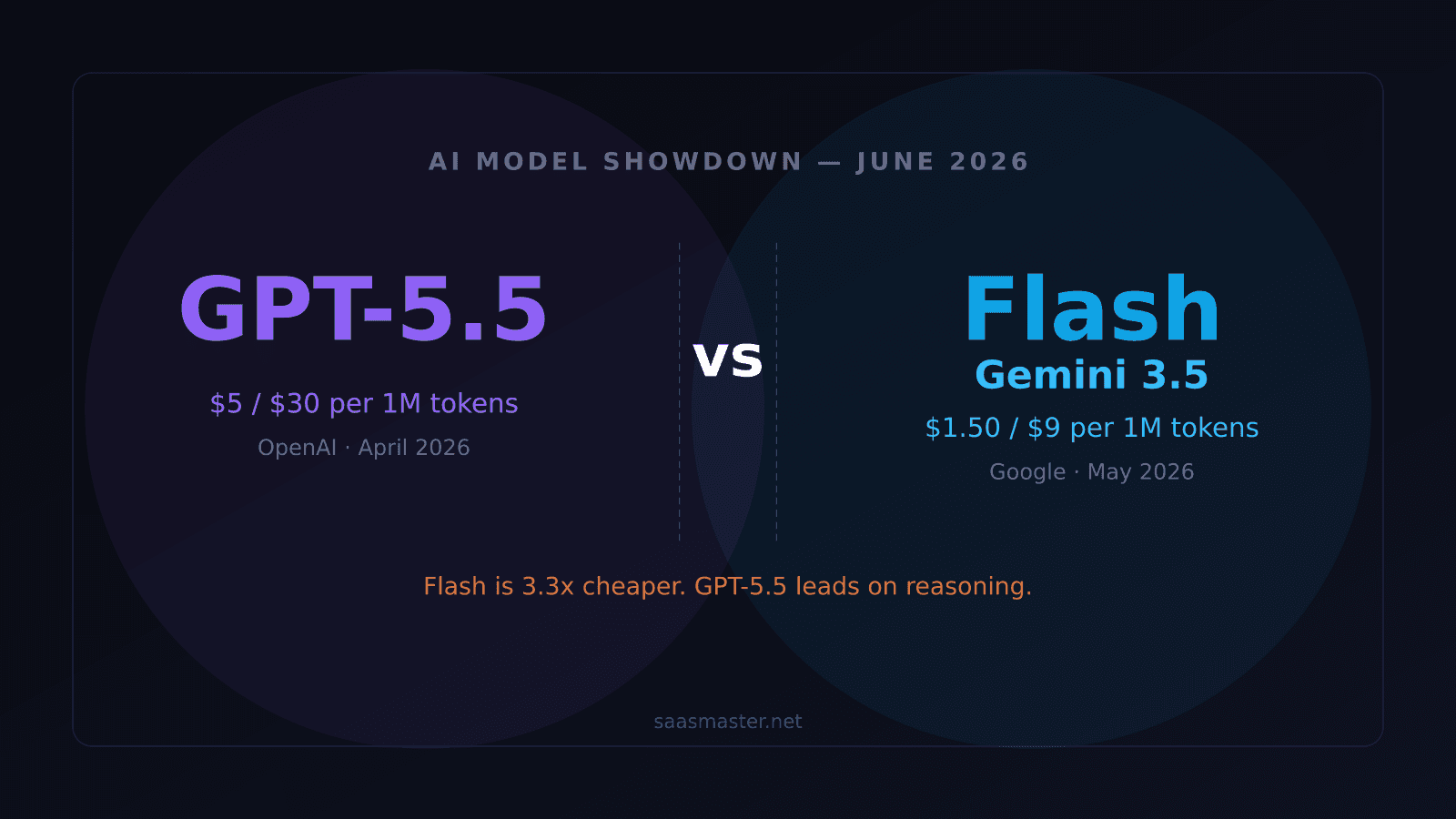
Gemini 3.5 Flash costs 3.3 times less than GPT-5.5 on every token — and on two of the most important benchmark categories in 2026 (agentic tasks and multimodal), it actually wins. But GPT-5.5 is meaningfully better on reasoning and holds the higher overall score. So which one should you actually be paying for?
This comparison breaks down both models on the numbers that matter: pricing, benchmarks, context window, and real-world use cases. Both launched within weeks of each other in spring 2026 and are now the two most-used mid-to-frontier models for developers and creators who are not on the enterprise tier.
Key takeaways
- Gemini 3.5 Flash ($1.50/$9 per 1M tokens) is 3.3x cheaper than GPT-5.5 ($5/$30 per 1M tokens)
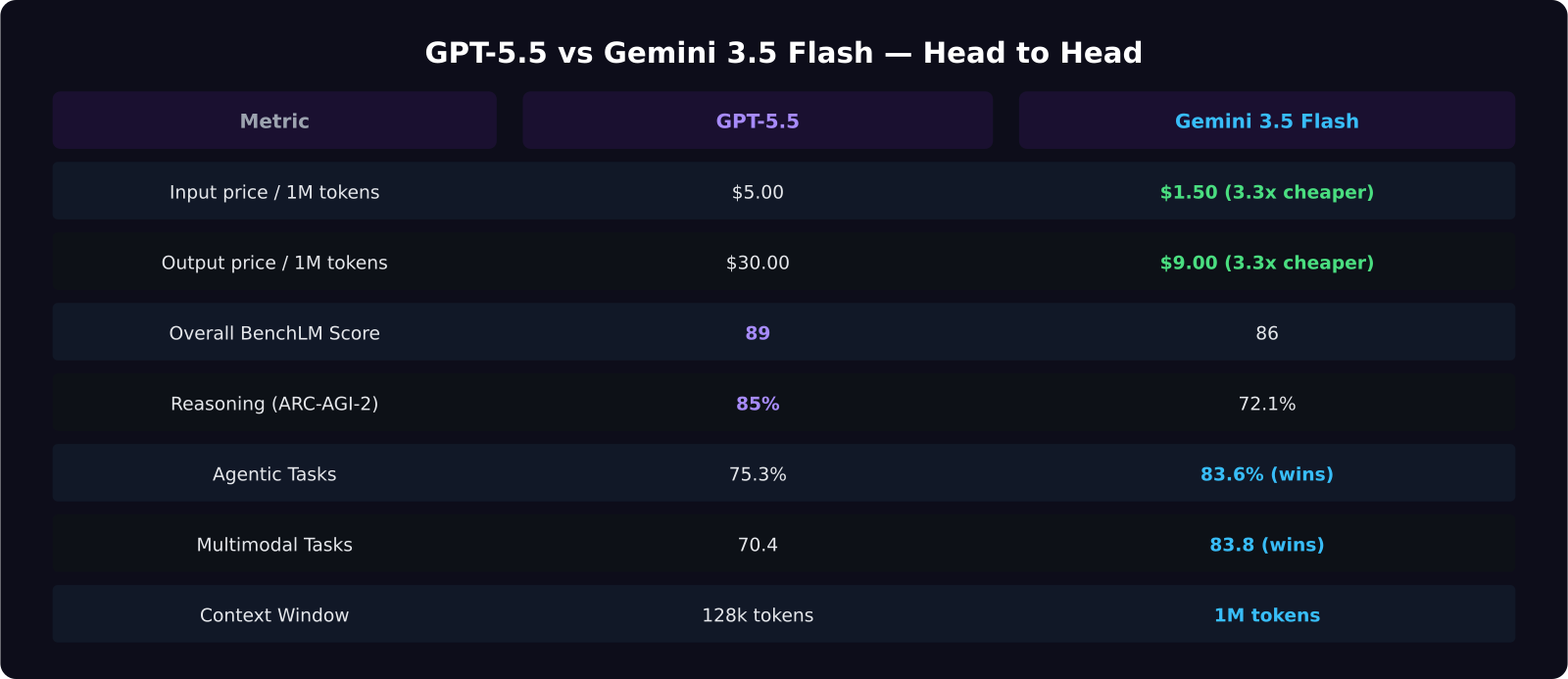
- GPT-5.5 scores 89 overall on BenchLM vs Flash's 86, with a clear edge in hard reasoning (ARC-AGI-2: 85% vs 72.1%)
- Gemini 3.5 Flash wins on agentic multi-step tasks (83.6% vs 75.3%) and multimodal work (83.8 vs 70.4)
- Flash has a 1M token context window; GPT-5.5 tops out at 128k
- If your work involves images, video, or multi-step tool use, Flash likely delivers more value per dollar
The pricing gap is real and it matters
OpenAI released GPT-5.5 in April 2026, and Google followed with Gemini 3.5 Flash on May 19, 2026. The timing is not coincidental — Google priced Flash to undercut GPT-5.5 at every tier.
GPT-5.5 costs $5 per million input tokens and $30 per million output tokens. Gemini 3.5 Flash costs $1.50 input and $9 output. That is a 3.3x difference on both sides of the equation.
To put that in real terms: if you are running a workflow that processes 10 million output tokens per month — not uncommon for a product that summarizes, drafts, or analyzes at scale — you are paying $300/month on Flash versus $900/month on GPT-5.5. For a solo builder or small team, that difference alone might make the decision.
Which is better at actually thinking?
On raw benchmark performance, GPT-5.5 holds a real lead on hard reasoning. The clearest data point is ARC-AGI-2, the benchmark designed to test genuine novel reasoning rather than pattern matching on training data. GPT-5.5 scores 85%; Gemini 3.5 Flash scores 72.1%. That 12.9-point gap is large enough to matter in practice.
The overall BenchLM score gap is smaller — 89 vs 86 — but the reasoning category is where GPT-5.5 separates itself. If your use case involves legal analysis, complex financial modeling, long-form argument evaluation, or research synthesis, that extra reasoning headroom is worth paying for.
Where Flash actually beats GPT-5.5
The story flips when you move to agentic and multimodal tasks.
On a benchmark testing multi-step tool calling — the kind of workflow where a model has to plan, call tools in sequence, handle errors, and synthesize results — Flash scores 83.6% versus GPT-5.5's 75.3%. That 8.3-point gap is the kind of real-world signal that matters if you are building anything with MCP, n8n, or direct API automation.
On multimodal tasks (feeding images, mixed content, or structured documents), Flash scores 83.8 versus GPT-5.5's 70.4. Google's native multimodal architecture is a genuine advantage here. If you are building workflows that process screenshots, product images, PDFs with charts, or any kind of vision-first task, Flash is the stronger model for less money.
Flash also has a 1 million token context window versus GPT-5.5's 128k. For long document work — legal contracts, book-length content, code repositories — Flash handles jobs that GPT-5.5 simply cannot take on in a single pass.
How should I decide which one to use?
The decision comes down to what your work actually looks like.
If most of what you do is hard analytical reasoning — you need a model to think through a complex problem, evaluate competing arguments, or generate novel solutions to non-standard challenges — GPT-5.5 is worth the price premium. It is a measurably better thinker in the benchmark categories that test that kind of work.
If you are building automation workflows, processing images or multimodal content, working with long documents, or running high-volume tasks where cost efficiency is a real constraint, Gemini 3.5 Flash delivers better results in most of those categories at less than a third of the price.
A practical pattern I have landed on: use Flash as the default model for most tasks, and route only the genuinely complex reasoning tasks to GPT-5.5. You can do this with a single conditional in your workflow and cut your API bill significantly without giving up meaningful quality on the tasks that matter most.
What about Gemini 3.5 Pro?
Gemini 3.5 Pro was announced at Google I/O 2026 in May but is still not in general availability as of June 18. It is in limited enterprise preview and targets a 2 million token context window with a Deep Think reasoning mode. Google's stated goal for Pro is to match frontier-level reasoning — the gap where GPT-5.5 currently leads Flash.
When Pro ships, this comparison will shift. But right now, Flash is the only Gemini 3.5 model most developers can actually use.
Frequently asked questions
Is Gemini 3.5 Flash good enough to replace GPT-5.5 completely?
For most workflows, yes. Flash wins on agentic tasks, multimodal work, and long-context processing while costing 3.3x less. The only area where GPT-5.5 holds a meaningful lead is hard analytical reasoning, where it scores 85% on ARC-AGI-2 versus Flash's 72.1%. If your work is primarily reasoning-heavy, keep GPT-5.5. Otherwise, Flash is the better value in June 2026.
What is the context window difference between GPT-5.5 and Gemini 3.5 Flash?
Gemini 3.5 Flash supports a 1 million token context window. GPT-5.5 tops out at 128k tokens. For long document work — contracts, codebases, books, or research papers — Flash can process in a single pass what GPT-5.5 requires chunking to handle.
When does Gemini 3.5 Pro launch and how will it compare to GPT-5.5?
Gemini 3.5 Pro was announced at Google I/O 2026 and is expected in general availability in June or July 2026. It targets a 2 million token context window and a Deep Think reasoning mode aimed at closing the gap with frontier models on hard reasoning. Google has not published pricing for Pro yet. When it launches, it will likely be the most direct competitor to GPT-5.5 in the reasoning category.
Was this article helpful?
SaaS Master
Creator behind SaaS Master — tutorials, walkthroughs, reviews, and explainers that help SaaS, AI, and WordPress products get understood and chosen. Writing here about the tools, trends, and tactics that actually move the needle. Work with me →
Want your product explained this clearly — in video?
Tutorials, walkthroughs, reviews, and shorts for SaaS, AI, and WordPress products.
Work With SaaS Master