AI & SaaS
Supabase Just Doubled to $10.5B in 8 Months. AI Agents Are Behind It.
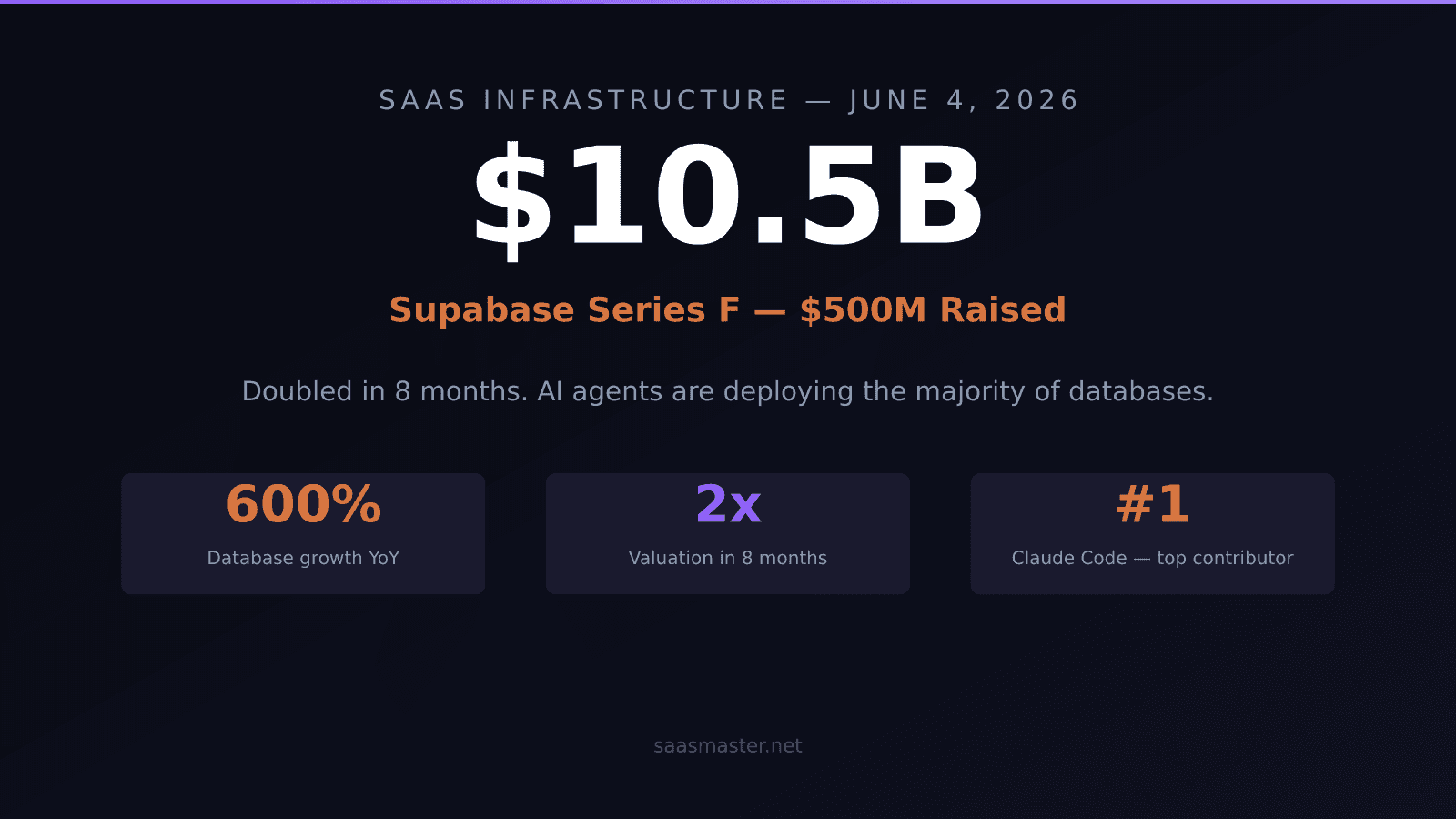
Eight months ago Supabase was worth $5 billion. On June 4, 2026, it closed a $500 million Series F at a $10.5 billion valuation. The round doubled the company's value in less time than most startups take to close a single hire. The explanation is not a hot IPO market or a frothy venture cycle. It is AI agents — specifically, the fact that AI coding tools and autonomous agents are now deploying the majority of new databases on the platform, and that growth is accelerating faster than any human-driven adoption curve the company has seen before.
Claude Code is Supabase's single largest contributor to new database creation since the start of 2026. That one data point tells a larger story about what is happening to developer infrastructure broadly.
Key takeaways
- Supabase raised $500M at $10.5B on June 4, 2026, doubling its $5B Series E valuation in just 8 months.
- Year-over-year database creation grew 600% — driven primarily by AI coding agents and vibe-coding tools.
- Claude Code is the largest single contributor to new Supabase database deployments since January 2026.
- AI agents are now deploying the majority of databases on the platform, a structural shift from human-driven adoption.
- This follows Ramp's $750M raise at $44B on the same day — June 4 may have been the biggest day for AI-powered SaaS funding in 2026 so far.
What Supabase actually is
Supabase is the open-source alternative to Firebase, built on Postgres. It gives developers a managed database, authentication, file storage, and edge functions — all the backend infrastructure a modern web or mobile app needs — with an API-first design that makes it easy to integrate with any frontend or AI tool.
The company has been growing steadily since its 2020 launch, but what changed in the last 18 months is the nature of who is using it. The original Supabase user is a developer who manually sets up a database, configures RLS (row-level security) policies, and writes SQL migrations. That user still exists. But increasingly, the new Supabase user is an AI coding agent that spins up a database as part of an automated workflow, provisions tables, configures authentication, and deploys an app — all without a human touching the Supabase dashboard at all.
The 600% number and what it actually means
Supabase reported 600% year-over-year growth in database creation. That is not a typo and it is not a small-base effect. The company at its Series E in October 2025 already had tens of thousands of projects running. A 6x increase on top of that base in roughly 8 months means the platform is adding databases at a rate that was structurally impossible when human developers were the only users creating them.
Humans move at a certain pace. They evaluate options, read documentation, configure environments, and make decisions one by one. AI agents do not. An agent running a build workflow might spin up five Supabase databases in the time a developer reads the getting-started guide. Multiply that across the thousands of developers who have adopted Claude Code, Cursor, Windsurf, and similar tools in 2026, and the math on 600% starts to make sense.
The user base itself more than doubled since the Series E. That is the human-driven growth number. The 600% database figure is what you get when humans plus agents are both creating databases, and agents do it at machine speed.
Claude Code as the top contributor
The most specific data point Supabase disclosed is that Claude Code has been the single largest contributor to new database creation on the platform since the start of 2026. This is worth sitting with.
Claude Code is Anthropic's command-line AI coding tool. When a developer uses Claude Code to build a web app, the agent can provision a Supabase database as part of the scaffolding, set up tables and schema, configure environment variables, and integrate auth — all autonomously. The developer might have asked for a simple to-do app and Claude Code handles the database creation as one step in the process.
What this means for Supabase's growth trajectory is that their new user acquisition is no longer fully dependent on human developers choosing Supabase over competitors. When Claude Code recommends and deploys Supabase, it is effectively a distribution channel with machine-level throughput. The same is true for any AI coding tool that has Supabase integrations baked in.
From a product strategy standpoint, Supabase has invested heavily in being the most agent-friendly backend. Their MCP (Model Context Protocol) integration means AI agents can query and modify Supabase databases through standardized tool calls. The company built for this moment — and the funding round is the market's acknowledgment that it paid off.
Why the valuation doubled in 8 months
At $5B in October 2025, Supabase was already a well-regarded developer tool with strong community traction. The Series F at $10.5B reflects a structural re-rating based on a changed growth model.
Investors are not just buying a database company anymore. They are buying into a platform that sits at the intersection of human developers and AI agents — and that intersection is becoming the most active part of the software market. Every new AI coding tool that integrates with Supabase adds another automated distribution channel. Every agent that recommends Supabase adds another database. The growth model compounds in a way it never did when the only way to add a database was for a developer to make a conscious decision.
GIC led the round, with Stripe participating for the second time and Salesforce Ventures joining as a new investor. Stripe's double-down is notable — it reflects confidence in Supabase as infrastructure that handles payments data and user auth for the next generation of apps, many of which will be built or managed by agents.
The June 4 signal: Ramp raised $750M on the same day
It is worth noting that June 4, 2026 was an unusual day in SaaS funding. Supabase closed $500M at $10.5B. On the same day, Ramp — the AI-powered corporate finance platform — closed $750M at a $44 billion valuation, the highest valuation in the company's history and roughly 6x where it was in early 2024.
Two unrelated companies, both explicitly built around AI as a core capability, raising over $1.25 billion combined in a single day is not coincidence — it is a signal. Investors are placing very large bets on infrastructure and workflow tools where AI is not a feature but the operating model. Supabase is infrastructure for what AI agents build. Ramp is the finance layer for how AI agents spend and track money. Both are getting premium valuations because the AI agent economy needs backend rails.
What this means for SaaS builders in 2026
If you are building a SaaS product or tool in 2026, the Supabase round contains a practical lesson: the infrastructure choices you make now will determine how well you get adopted by AI agents, not just human developers.
Supabase bet on open-source, on Postgres compatibility, on API-first design, and on MCP integration. Those are not flashy features. But they are the features that make it easy for an AI agent to understand, use, and recommend your product without human mediation. The 600% database growth is the result of being on the right side of that bet.
For SaaS marketers and founders, the question is: when an AI agent is choosing which tool to use for a given task, what makes your product the obvious choice? Supabase's answer was documentation quality, Postgres compatibility, and deep integrations with the coding tools agents use most. That is a repeatable playbook.
Frequently asked questions
What is Supabase used for?
Supabase is an open-source backend platform built on Postgres. It provides a managed database, user authentication, file storage, and edge functions. Developers use it to build web apps, mobile apps, and increasingly, backend infrastructure for AI agents.
Why did Supabase's valuation double so fast?
The core driver is AI agent adoption. AI coding tools like Claude Code, Cursor, and Windsurf now deploy Supabase databases autonomously as part of their build workflows. This created 600% year-over-year database growth, a rate impossible to achieve through human-only adoption, which prompted investors to re-rate the company's growth potential.
Is Claude Code the reason Supabase grew so fast?
It is one of the main reasons. Supabase disclosed that Claude Code is the single largest contributor to new database creation on the platform since January 2026. Other AI coding tools contribute as well, but Claude Code's scale and Supabase's early investment in AI-agent compatibility made it the most impactful single relationship.
Was this article helpful?
SaaS Master
Creator behind SaaS Master — tutorials, walkthroughs, reviews, and explainers that help SaaS, AI, and WordPress products get understood and chosen. Writing here about the tools, trends, and tactics that actually move the needle. Work with me →
Want your product explained this clearly — in video?
Tutorials, walkthroughs, reviews, and shorts for SaaS, AI, and WordPress products.
Work With SaaS Master