AI Tools
Microsoft's 7 MAI Models Explained: Which One Should SaaS Builders Use in 2026?
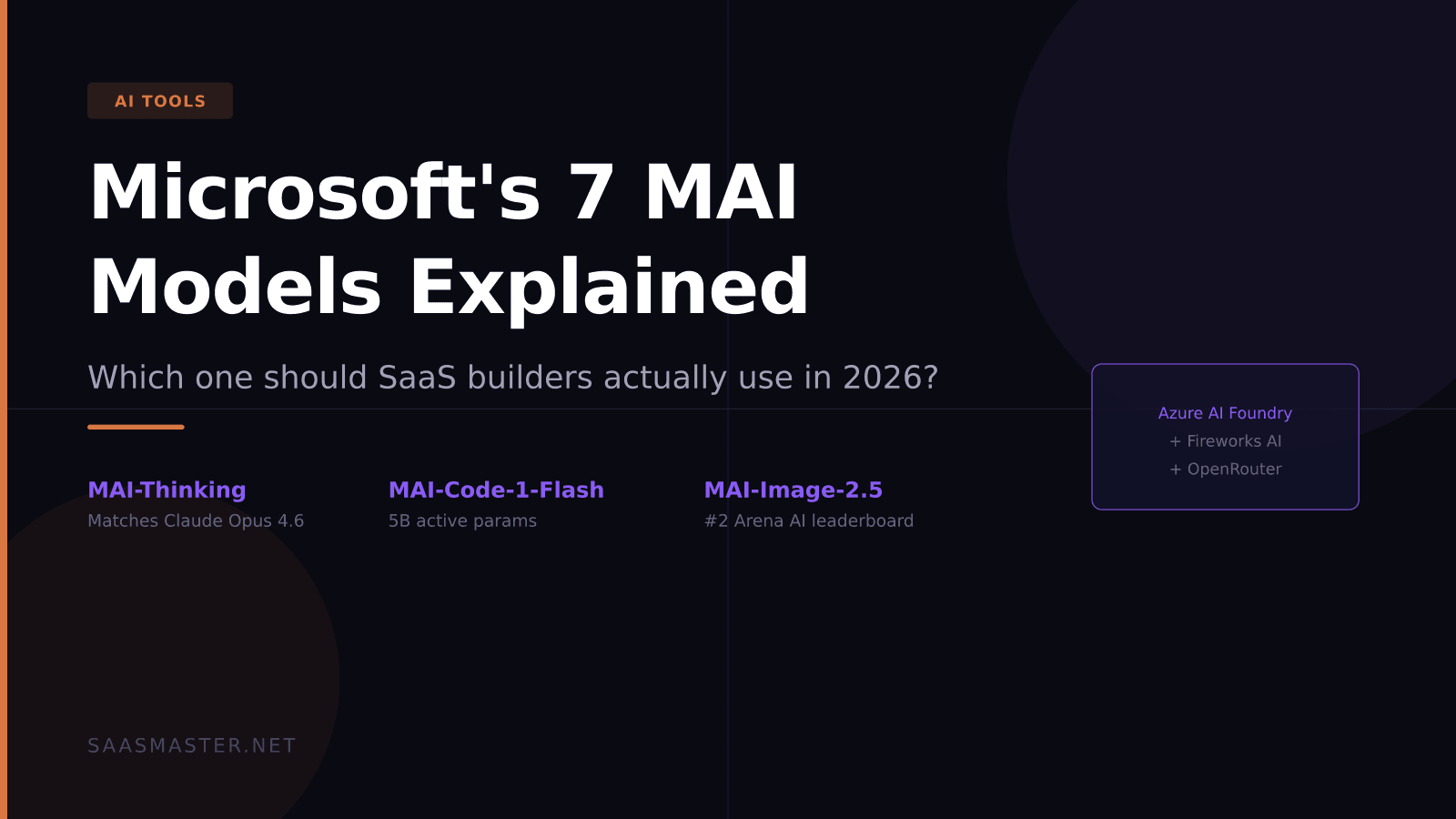
When Microsoft launched seven in-house AI models at Build 2026 on June 2, the AI community largely overlooked the bigger story: Microsoft is now serious about not depending on OpenAI forever.
That matters if you build SaaS products, run content workflows, or just want cheaper access to capable AI. The MAI model family is Microsoft's clearest signal yet that the OpenAI partnership is a transitional arrangement, not a permanent foundation.
Key takeaways
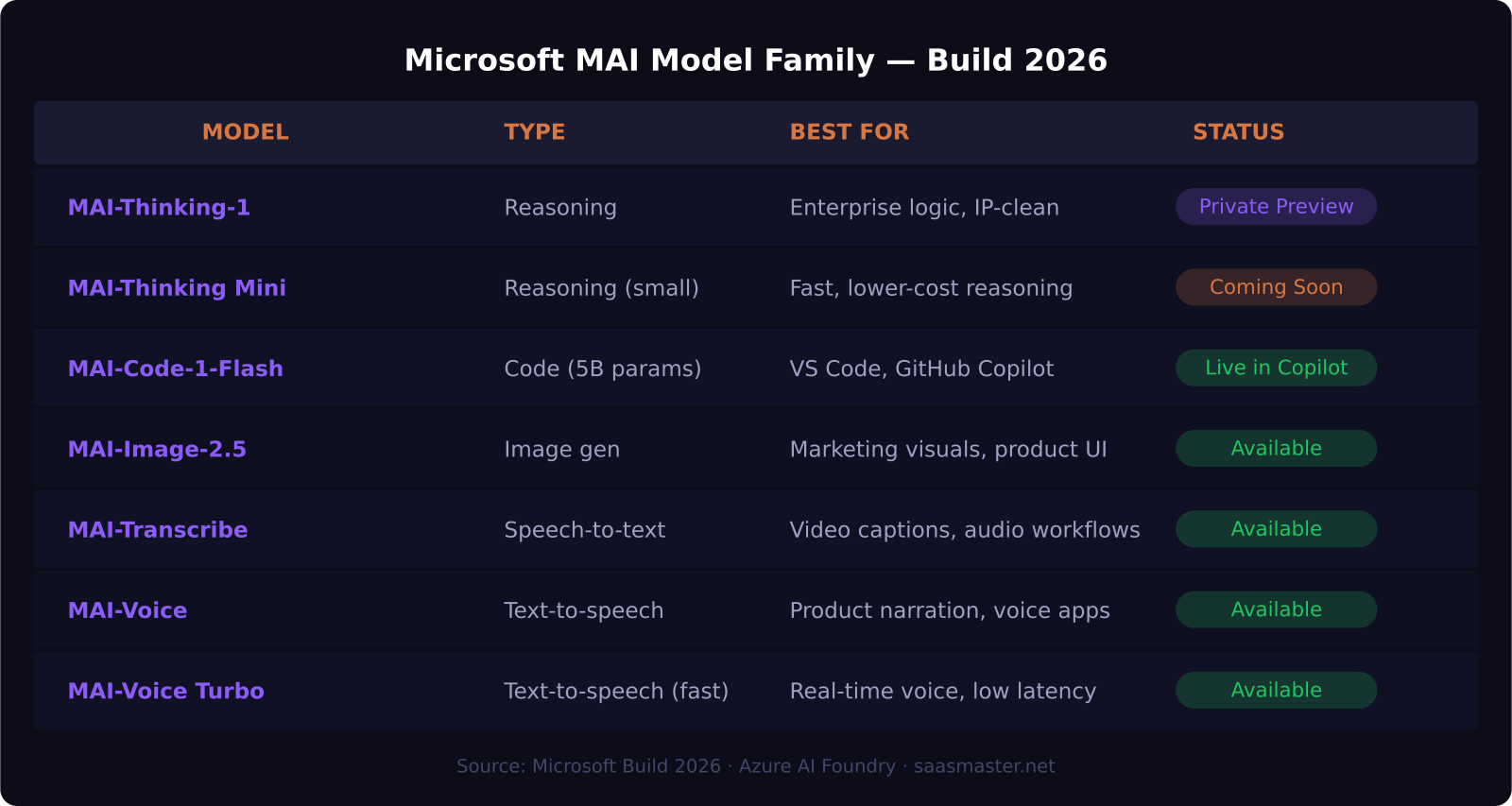
- Microsoft launched 7 first-party MAI models at Build 2026: MAI-Thinking, MAI-Thinking Mini, MAI-Code, MAI-Image, MAI-Transcribe, MAI-Voice, and MAI-Voice Turbo.
- MAI-Thinking-1 matches Claude Opus 4.6 on coding benchmarks and was built from scratch — no distillation from OpenAI or any third-party model.
- MAI-Code-1-Flash has 5 billion active parameters, runs inside GitHub Copilot and VS Code, and is priced to compete with Claude Haiku.
- MAI-Image-2.5 ranks #2 on the Arena AI leaderboard for image-to-image and #3 for text-to-image generation.
- All MAI models are available on Azure AI Foundry, with several also accessible on Fireworks AI, Baseten, and OpenRouter.
What is the MAI model family?
MAI stands for Microsoft AI. These are the company's first fully first-party models — built from scratch on commercially licensed data, with no distillation from OpenAI or any external provider. That distinction carries legal and strategic weight that is easy to underestimate.
Microsoft has spent years deeply integrated with OpenAI through a $13B+ investment relationship. The MAI launch signals a pivot toward what Microsoft is calling long-term self-sufficiency in AI infrastructure. When your largest customer and your investment partner are the same company, building your own foundation is inevitable.
The seven models are split across five capability domains: reasoning, code, image, transcription, and voice. Each is optimized for one job, not trying to win every benchmark.
Is MAI-Thinking-1 worth watching?
MAI-Thinking-1 is the flagship. It is a reasoning model — it works through problems step by step before responding, similar to Claude extended thinking or OpenAI's o3 series.
In blind human preference tests run by Microsoft, MAI-Thinking-1 draws even with Claude Sonnet 4.6. On coding benchmarks, it matches Claude Opus 4.6 — a model that costs significantly more per token. The training methodology is unusual: Microsoft built this from scratch on clean, commercially licensed data with no distillation from any third-party model.
This matters for enterprise SaaS customers who need to document their AI supply chain. If a customer asks you which models your product uses and where those models were trained, "IP-clean, first-party Microsoft data" is a cleaner answer than "distilled from various providers."
As of June 2026, MAI-Thinking-1 is in private preview on Azure AI Foundry and GitHub Models, with broader rollout expected later this year. It is not something you can simply spin up today — but worth tracking for early-access partnerships.
MAI-Code-1-Flash: The VS Code integration is the real story
The more immediately practical model for most SaaS teams is MAI-Code-1-Flash.
At 5 billion active parameters, it is compact by 2026 standards — similar in size class to Claude Haiku — and built specifically for the GitHub Copilot and VS Code environment. Microsoft designed it to run fast and cheap inside developer tooling, not to top general benchmarks.
If your team already lives in VS Code and uses GitHub Copilot, this model is worth paying attention to. The tight integration means lower latency, better code completion context awareness, and pricing designed to compete with smaller efficient models. The 5B parameter count is small enough to run at very low inference cost, which matters when you are completing hundreds of code snippets per developer per day.
For SaaS founders evaluating Copilot for their engineering team, MAI-Code-1-Flash is now the model running underneath — and it is a Microsoft-trained model, not a resold OpenAI product.
How does MAI-Image-2.5 compare to the competition?
The image model is a genuine surprise from Microsoft. MAI-Image-2.5 sits at number 2 on the Arena AI leaderboard for image-to-image tasks and number 3 for text-to-image generation. It also ships with a Flash variant for faster, cheaper generation at slightly lower quality.
Context matters here: the image generation market in 2026 is very competitive. Midjourney v7, Ideogram 3, and Adobe Firefly 4 all compete on quality. That Microsoft has entered the top three on a widely used leaderboard without existing brand recognition in image generation is notable.
For SaaS marketing teams generating product screenshots, social assets, or UI mockups at scale on Azure, MAI-Image-2.5 is worth a genuine evaluation. The practical advantage is infrastructure consolidation — one Azure bill, one API surface, instead of separate accounts with image generation providers.
MAI-Transcribe and MAI-Voice: Who actually needs these?
MAI-Transcribe is a speech-to-text model and MAI-Voice with its Turbo variant handles text-to-speech. These are niche in the context of general AI model comparisons, but important for specific product categories.
For SaaS companies building products with audio features — meeting transcription, voice commands, customer support call analysis — MAI-Transcribe is worth comparing against Whisper. The main practical factor is whether Azure is already your cloud provider. If it is, native transcription that bills to your existing Azure account simplifies the stack.
MAI-Voice Turbo is the speed-first variant for real-time voice applications. If you are building a voice agent or any product where latency between text input and audio output is a user experience factor, the Turbo variant is designed for that use case specifically.
Which MAI model actually fits SaaS work right now?
For teams making immediate decisions, here is the honest breakdown.
Use MAI-Code-1-Flash if your engineering team is in VS Code and GitHub Copilot and you want better-integrated AI assistance without switching tools or vendor relationships.
Watch MAI-Thinking-1 for private preview access if you are building enterprise SaaS products where customers will audit your AI supply chain and IP-clean training data is a meaningful differentiator.
Evaluate MAI-Image-2.5 if you are already on Azure and generating marketing or product images at scale — the leaderboard ranking makes it a legitimate contender, and consolidating image generation into Azure simplifies billing.
Skip MAI-Transcribe and MAI-Voice for now unless you have specific audio features in your product — Whisper and ElevenLabs are mature, well-supported alternatives with larger ecosystems.
The broader context: Claude Opus 4.8 is still the number 1 model on the Artificial Analysis Intelligence Index as of June 2026 with a score of 61.4. GPT-5.5 remains strong for premium general use. MAI models are not leading on composite benchmarks today. What they offer instead is specialization, Microsoft ecosystem integration, and pricing designed to compete with smaller efficient models.
Does Microsoft's self-sufficiency strategy matter for your business?
Over a 2 to 3 year horizon, probably yes.
If Microsoft succeeds at reducing its reliance on OpenAI, Azure AI pricing will become more competitive on its own merit rather than being partially subsidized by the broader partnership. The MAI family also signals a healthy trend: more providers building specialized models for specific tasks rather than racing on a single general benchmark.
For SaaS companies that have standardized on Azure, having reasoning, code, image, transcription, and voice models arrive natively in Foundry means less vendor juggling. That has real operational value even if no single MAI model beats every competitor head-to-head today.
Microsoft calls this a hill-climbing machine — shipping fast, iterating continuously, using real-world feedback to improve. That approach worked for GitHub Copilot. It is worth watching whether it works for a full model family.
Frequently asked questions
Are Microsoft MAI models available without an Azure account?
Yes, some are. MAI models are available through Azure AI Foundry, but several are also on Fireworks AI, Baseten, and OpenRouter — meaning you can access them without an Azure subscription. MAI-Thinking-1 is still in private preview, so broad access outside Azure is currently limited to early partners.
How does MAI-Thinking-1 compare to GPT-5.5?
Based on available data, MAI-Thinking-1 draws even with Claude Sonnet 4.6 in human preference testing and matches Claude Opus 4.6 on coding benchmarks. GPT-5.5 still leads on composite benchmark scores, computer-use tasks, and coding evaluations like SWE-Bench. MAI-Thinking-1 is positioned closer to a Sonnet-class model than a direct GPT-5.5 competitor.
When will MAI-Thinking-1 be broadly available?
As of June 2026, MAI-Thinking-1 is in private preview on Azure AI Foundry and GitHub Models. Microsoft has not announced a public release date. Early access is limited to enterprise partners and early program participants. If you need access now, the Azure AI Foundry waitlist is the recommended path.
Was this article helpful?
SaaS Master
Creator behind SaaS Master — tutorials, walkthroughs, reviews, and explainers that help SaaS, AI, and WordPress products get understood and chosen. Writing here about the tools, trends, and tactics that actually move the needle. Work with me →
Want your product explained this clearly — in video?
Tutorials, walkthroughs, reviews, and shorts for SaaS, AI, and WordPress products.
Work With SaaS Master