AI & SaaS
Ramp Hit $44B — And It's Now Selling a Product Your AI Budget Needs
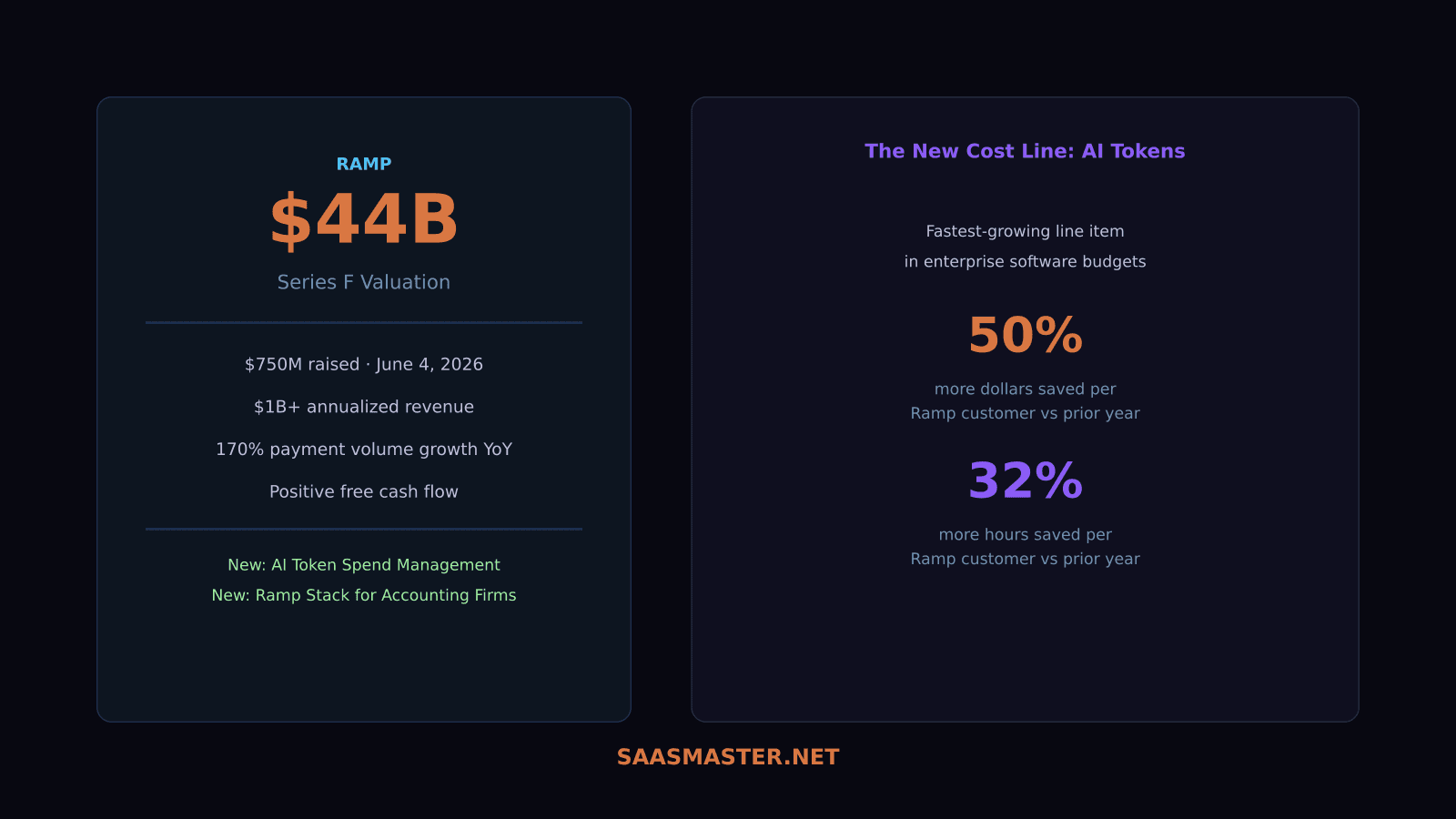
Ramp raised $750 million at a $44 billion valuation on June 4, 2026. That makes it one of the most valuable private fintech companies in the world. The round was led by ICONIQ, GIC, and Ontario Teachers' Pension Plan, with Goldman Sachs, D.E. Shaw, Morgan Stanley, and Generation Investment Management also participating. The headline is impressive. But the more interesting story is what Ramp is actually selling now — and why it tells you something important about where SaaS budgets are going.
Key takeaways
- Ramp raised $750M at a $44B valuation — a nearly 6x increase that reflects $1B+ annualized revenue and 170% payment volume growth year over year
- The company launched AI token spend management, a new category targeting what it calls the fastest-growing cost in business
- Ramp Stack is a new AI-powered operating system for accounting firms, a market it had not previously entered
- The median Ramp customer saved 50% more dollars and 32% more hours in 2026 versus a year earlier
- Ramp is now positioning itself not just for company spend but for the entire financial operations layer of the AI era
How did Ramp get to $44 billion?
Ramp launched in 2019 as a corporate card with spend controls. It grew by doing one thing better than every incumbent: real-time visibility into where money was going, with automatic enforcement rather than after-the-fact reconciliation. The product expanded into bill payments, travel, procurement, and vendor negotiations.
The $44B valuation reflects a company that is not just growing revenue but doing it profitably. Ramp has positive free cash flow, which is unusual for a company at this stage. Payment volume grew 170% year over year in March 2026 — the company's highest growth rate in three years, despite being roughly 20 times larger than when it last saw that rate. $1 billion in annualized revenue is the other number that matters: it is not a projection, it is a run rate.
All of this is remarkable. But the feature announcement buried inside the funding news is what caught my attention.
The new product no one expected: AI token spend management
Ramp's announcement specifically names AI token spend management as one of its new capabilities — calling tokens the fastest-growing cost in business today. That is a significant statement about where enterprise budgets are heading.
Think about what that means in practice. A year ago, SaaS companies worried about seat licenses and cloud infrastructure costs. In 2026, many companies are spending significant sums on API calls — OpenAI, Anthropic, Google, and now Microsoft MAI models all bill per token. Those costs can explode without visibility, especially when AI features go viral inside a product or when engineering teams deploy agents that run longer than expected.
Ramp now wants to be the layer that tracks, budgets, and controls that spending the same way it controls travel costs or software subscriptions. You can set token budgets per team, per model, per project. You get real-time visibility into which AI vendors are consuming what. It is the same product insight that made Ramp successful applied to a new and growing cost category.
If your company is spending meaningful money on AI APIs — and by 2026, most SaaS companies are — this is worth paying attention to. The alternative is finding out about cost spikes in your monthly invoice.
Ramp Stack: entering the accounting firm market
The second major announcement inside the funding round is Ramp Stack, an AI-powered operating system built specifically for accounting firms. This is a new market for Ramp. Previously its customers were companies; now it is also targeting the firms that serve those companies.
Ramp Stack gives accounting firms a unified layer for managing client finances, automating month-end close, reconciliation, and reporting. The AI agents built into Stack handle the repetitive work — pulling transactions, categorizing, flagging anomalies — so that human accountants spend time on judgment calls rather than data entry.
The timing is deliberate. Accounting firms are under cost pressure from clients who expect more value for less time. AI agents that can do in minutes what took hours changes the economics of running a firm. Ramp is betting that if it can become the financial operating system for accounting firms, it gets indirect access to those firms' entire client roster.
What this means for SaaS companies
If you run a SaaS company with any AI functionality, you now have a meaningful token spend line item to manage. Ramp's positioning around AI token management is early — but it signals where the broader spend management category is going. Before this round, tracking AI API costs meant custom dashboards, billing alerts, and manual reconciliation. Platforms like Ramp are building that visibility into the standard financial operations layer.
The second implication is competitive. Ramp is now one of the fastest-growing financial SaaS companies in the world at a scale where growth should be slowing. Any company building in adjacent spaces — expense management, procurement, accounts payable — should be watching how Ramp is packaging AI not as a feature but as a core product driver.
The creator angle
From where I sit, the most interesting thing about this raise is not the $44 billion number. It is that Ramp is treating AI tokens as a budget category equivalent to SaaS seats. That shift in framing reflects something real happening inside companies right now: AI costs are becoming significant enough that finance teams need tools to manage them, not just engineering dashboards. The companies that build for that transition early are going to be interesting to watch.
Frequently asked questions
How did Ramp reach a $44 billion valuation?
Ramp raised $750M in a Series F led by ICONIQ, GIC, and Ontario Teachers' Pension Plan. The valuation reflects $1B+ annualized revenue, positive free cash flow, and 170% year-over-year payment volume growth — the company's highest growth rate in three years despite being 20x larger than when it last hit that rate.
What is Ramp's AI token spend management?
Ramp launched a new product category that tracks and controls spending on AI API providers — OpenAI, Anthropic, Google, and others — the same way it tracks travel or software subscriptions. Companies set token budgets per team or project and get real-time visibility into AI API costs before they appear on monthly invoices.
What is Ramp Stack?
Ramp Stack is an AI-powered financial operating system built specifically for accounting firms, announced alongside the Series F. It automates month-end close, reconciliation, and client financial reporting using AI agents, allowing accounting firms to handle more clients with less manual work.
Was this article helpful?
SaaS Master
Creator behind SaaS Master — tutorials, walkthroughs, reviews, and explainers that help SaaS, AI, and WordPress products get understood and chosen. Writing here about the tools, trends, and tactics that actually move the needle. Work with me →
Want your product explained this clearly — in video?
Tutorials, walkthroughs, reviews, and shorts for SaaS, AI, and WordPress products.
Work With SaaS Master