AI & SaaS
OpenAI and Anthropic Both Filed S-1s — What the $3 Trillion AI IPO Race Means for SaaS Builders
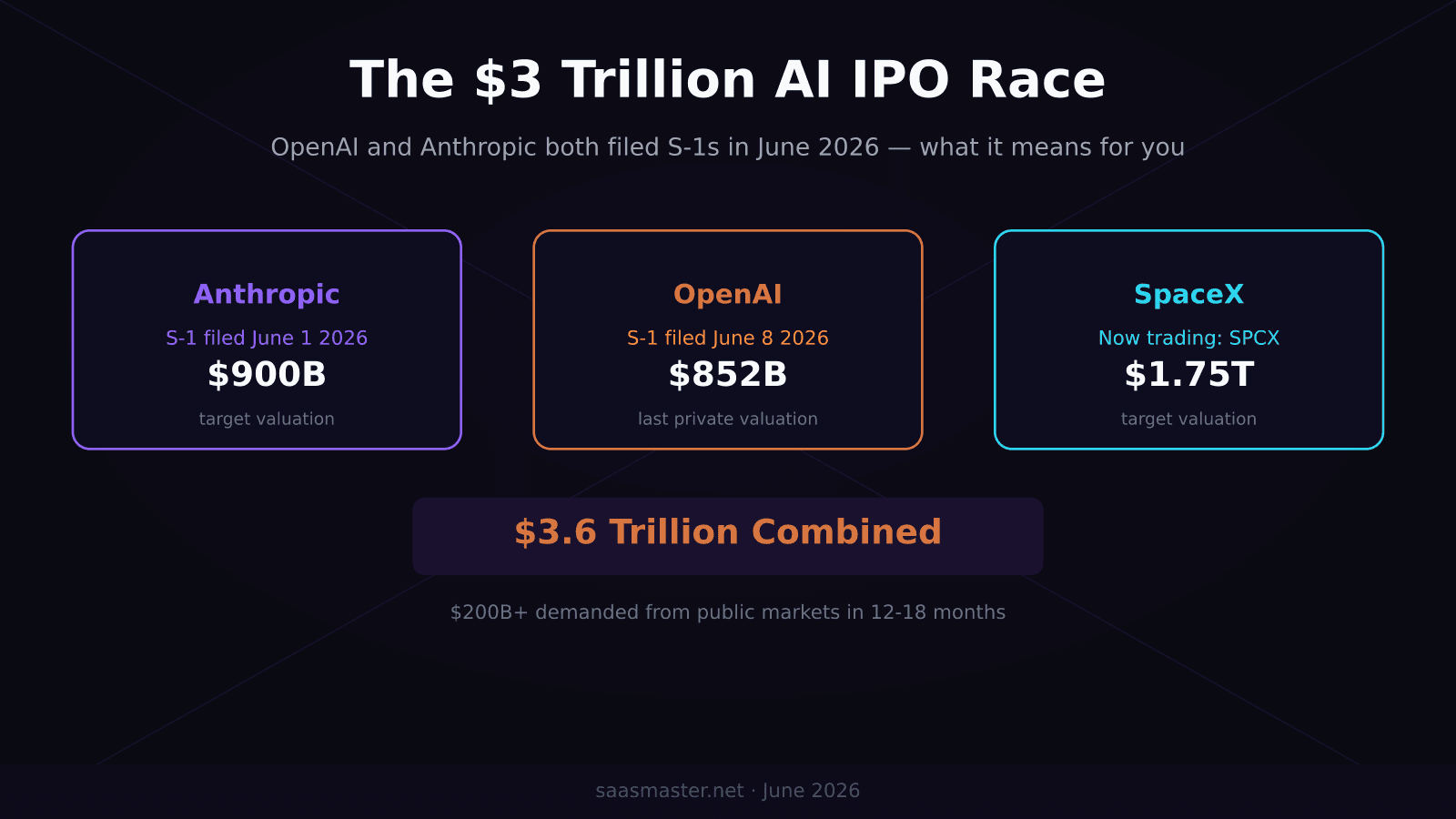
In ninety days, two AI labs that together power most of the world's AI tools went from private companies to S-1 filers. Anthropic submitted its confidential Form S-1 on June 1, 2026. OpenAI followed on June 8. Together with SpaceX — which began trading on Nasdaq under SPCX on June 12 — these three companies represent roughly $3.6 trillion in combined valuation and are collectively asking public markets for more capital than the entire US IPO market raised in all of 2025.
That has never happened before. Here is what it means.
Key takeaways
- Anthropic filed its confidential S-1 on June 1, 2026; OpenAI followed on June 8 — eight days apart
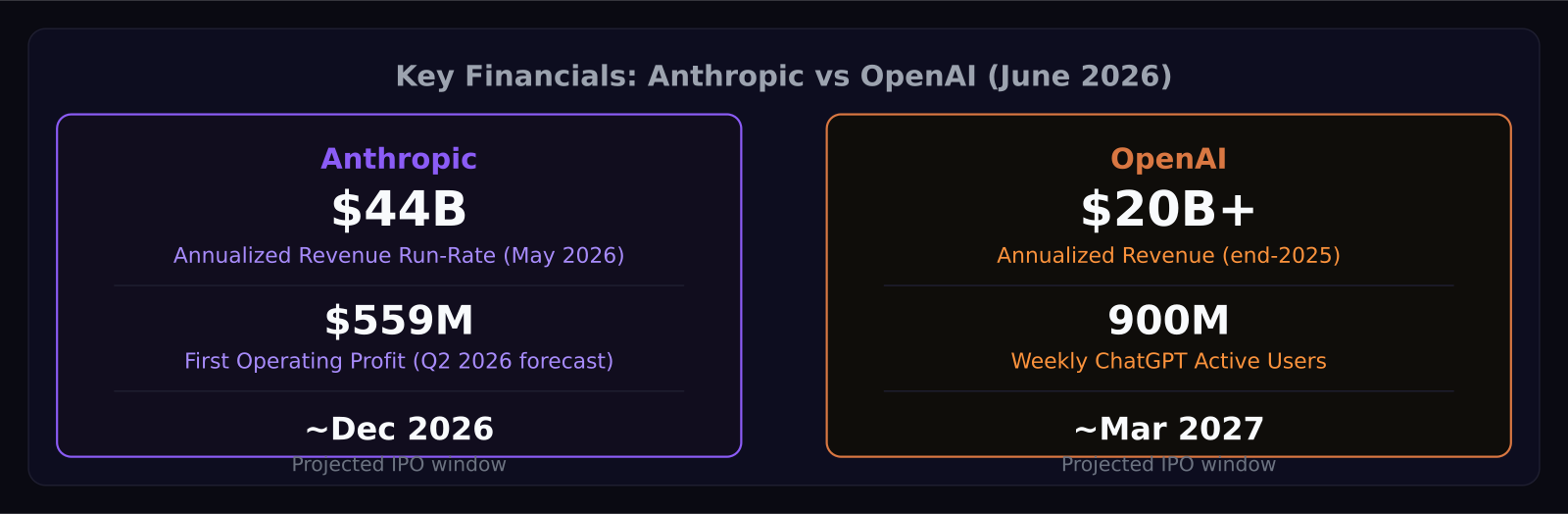
- Anthropic's annualized revenue reached approximately $44 billion by May 2026 and the company is forecasting its first-ever operating profit of $559M in Q2 2026
- OpenAI has 900 million weekly ChatGPT users and $20B+ in annualized revenue; its last private valuation was $852 billion
- SpaceX began trading on Nasdaq in June 2026, becoming a benchmark for how public markets price mega-cap AI-adjacent companies
- For SaaS builders: IPO pressure means API pricing becomes more disciplined, but also more stable — and developer ecosystems get more investment, not less
The backdrop: why all three filed in the same window
The timing is not a coincidence. SpaceX's Nasdaq debut provided a live data point for how institutional investors price massive, first-of-their-kind offerings. Both Anthropic and OpenAI are watching every tick of SPCX as a proxy for their own likely valuations.
There is also a financial logic to the timing. Anthropic president Daniela Amodei explained publicly in early June that the sheer cost of frontier AI compute is a direct driver behind the IPO decision. Training the next generation of foundation models requires capital at a scale that even repeated large private rounds cannot sustain indefinitely. Public markets offer a recurring funding mechanism that private rounds simply cannot match at that level.
Both companies had already raised well over $10 billion in private capital by mid-2026, and both were still operating at a scale where public equity markets represent a meaningful step change in available capital — not just for training runs but for hiring, infrastructure build-out, and international expansion.
Anthropic's filing: what we know
Anthropic filed confidentially with the SEC on June 1, 2026. The company is not yet required to publish a full prospectus, but reporting from multiple outlets has surfaced the key financial picture.
Annualized revenue run-rate as of May 2026: approximately $44 billion. That figure reflects the rapid enterprise adoption of Claude across industries including software development, legal, financial services, and healthcare, plus the consumer-facing Claude.ai platform.
More significant for the IPO story: Anthropic is forecasting its first-ever operating profit of approximately $559 million in Q2 2026. Going public while approaching profitability is a materially different narrative than going public while still posting large net losses. It gives institutional investors a clearer line of sight to positive free cash flow.
Anthropic is reportedly in active discussions to raise $50 billion at a $900 billion valuation alongside or in preparation for the IPO. FutureSearch, which models IPO timing and valuations quantitatively, places Anthropic's first-day market cap at approximately $1.1 trillion with a December 2026 pricing window as the most likely scenario.
Claude Code — the AI coding CLI that has become one of the most widely used developer tools of 2026 — is a significant part of the Anthropic ecosystem story. Supabase recently disclosed that Claude Code is its largest single contributor to new database creation, with more than 60% of new databases now being spun up by AI coding agents rather than human developers. That kind of developer ecosystem lock-in is exactly what institutional investors look for in an IPO narrative.
OpenAI's S-1: what's different
OpenAI submitted its confidential S-1 to the SEC on June 8, 2026. The company has publicly stated that IPO timing is undecided and "may be a while," which most observers interpret as signaling a 2027 debut rather than a 2026 one.
The scale of the business is clear: ChatGPT reached 900 million weekly active users as of early 2026. Annualized revenue crossed $20 billion by end-2025. The last known private valuation was approximately $852 billion.
The key difference between Anthropic and OpenAI in the IPO context is profitability. Anthropic expects its first operating profit in Q2 2026. OpenAI has strong gross margins but has continued to post net losses as it reinvests aggressively in infrastructure and model development. That dynamic shapes the narrative — Anthropic can tell a profitability story; OpenAI is still primarily telling a growth and market-share story.
FutureSearch models an OpenAI first-day market cap of approximately $1.08 trillion, with a March 2027 pricing window as the most likely scenario.
What going public actually changes for these companies
Access to capital is the direct and obvious answer. Public companies can raise money through follow-on share offerings and can use stock for acquisitions and partnerships. For companies with frontier AI compute bills measured in the billions per year, recurring access to public capital markets is strategically important.
The less-discussed effect is accountability. Public companies report quarterly earnings. Shareholders ask pointed questions about profitability timelines. For companies that have operated primarily on investor patience, public ownership introduces financial discipline — which can force efficiency or, less helpfully, pressure short-term decisions at the expense of long-term research bets. How well each company manages that transition will matter.
For the AI industry broadly, successful IPOs at near-$1 trillion valuations would validate the sector's financial fundamentals to a new class of institutional investors — pension funds, sovereign wealth funds, index investors — who have largely stayed on the sidelines during the private phase. That validation could accelerate further capital flow into AI infrastructure and startups below the frontier level.
What this means if you build on Claude or ChatGPT
The practical implications for SaaS builders and API developers break into three areas.
Pricing discipline: Both companies have used aggressive API pricing as a growth tool — cutting prices to gain developer adoption. Post-IPO, that flexibility decreases. Shareholders scrutinize margins. Expect pricing decisions to become more deliberate and tied to margin requirements, meaning fewer surprise cuts but also fewer surprise increases. The developer-tier pricing you are on today is unlikely to drop dramatically after an IPO, but it is also unlikely to be cut aggressively to capture new cohorts.
Enterprise focus intensifies: Enterprise contracts carry higher average deal values and better retention metrics than developer-tier API usage, and they look better on a quarterly earnings call. Both companies will increasingly prioritize winning and retaining enterprise deals over consumer-side growth. If you are a smaller team on a pay-as-you-go plan, you are not going to be cut off — but you may see fewer of the introductory offers that both companies have used to build developer share.
API stability as a product feature: Public companies have a strong incentive to maintain stable, well-documented APIs because breaking developer workflows generates negative noise that surfaces in analyst calls and press coverage. This is actually a signal in favor of building on either platform. Post-IPO, both companies become more motivated to protect their developer ecosystem reputations, not less.
The valuation math worth understanding
SpaceX, OpenAI, and Anthropic together represent an estimated $3.6 trillion in valuation entering public markets within a roughly 12-to-18-month window. For context: the entire US IPO market raised approximately $45 billion across all of 2025. These three companies are collectively asking for more than four times that amount.
The institutional appetite for AI equity is genuinely unprecedented. But the gap between current revenue and current valuation is also large. Most serious analysts believe the underlying business is real — AI revenue is growing fast and defensible in ways earlier tech waves were not. The question public markets will ask relentlessly is how quickly that gap narrows. That question will shape both companies' operating decisions for years after their debuts.
My read on the timeline
Based on available reporting, Anthropic is further along the IPO process and has the cleaner near-term profitability story. December 2026 looks like the most realistic Anthropic window. OpenAI will almost certainly use Anthropic's offering as a pricing benchmark before committing to its own timeline, which points to early-to-mid 2027.
The real race is not between Anthropic and OpenAI. It is between both of them and the public market's ability to absorb massive new AI equity after SpaceX has already consumed a very large portion of available institutional capital in summer 2026.
Frequently asked questions
When will Anthropic IPO?
Anthropic filed its confidential S-1 on June 1, 2026 and is reportedly targeting a raise of $50 billion at a $900 billion valuation. Forecasting firm FutureSearch models December 2026 as the most likely pricing window, though SEC review timelines and market conditions could shift that into early 2027.
Will OpenAI going public affect API pricing?
Not dramatically in the near term. OpenAI has publicly indicated that the IPO timing is undecided. Post-IPO, pricing will likely become more margin-conscious — meaning fewer aggressive cuts — but API instability is bad for the enterprise story that drives IPO valuations. Expect more stability, not less, once both companies are publicly accountable.
Is this good or bad for the AI industry?
Broadly positive, if the IPOs are successful. Successful offerings at near-$1 trillion valuations validate the AI sector's financials to a new class of institutional investors and could accelerate capital into the broader ecosystem. The risk is that market pressure on profitability reduces long-term research investment at exactly the moment when frontier AI development is most consequential.
Was this article helpful?
SaaS Master
Creator behind SaaS Master — tutorials, walkthroughs, reviews, and explainers that help SaaS, AI, and WordPress products get understood and chosen. Writing here about the tools, trends, and tactics that actually move the needle. Work with me →
Want your product explained this clearly — in video?
Tutorials, walkthroughs, reviews, and shorts for SaaS, AI, and WordPress products.
Work With SaaS Master