WordPress
Your WordPress Site Can Run Itself Now — Here's What AI Agents Actually Do in 2026
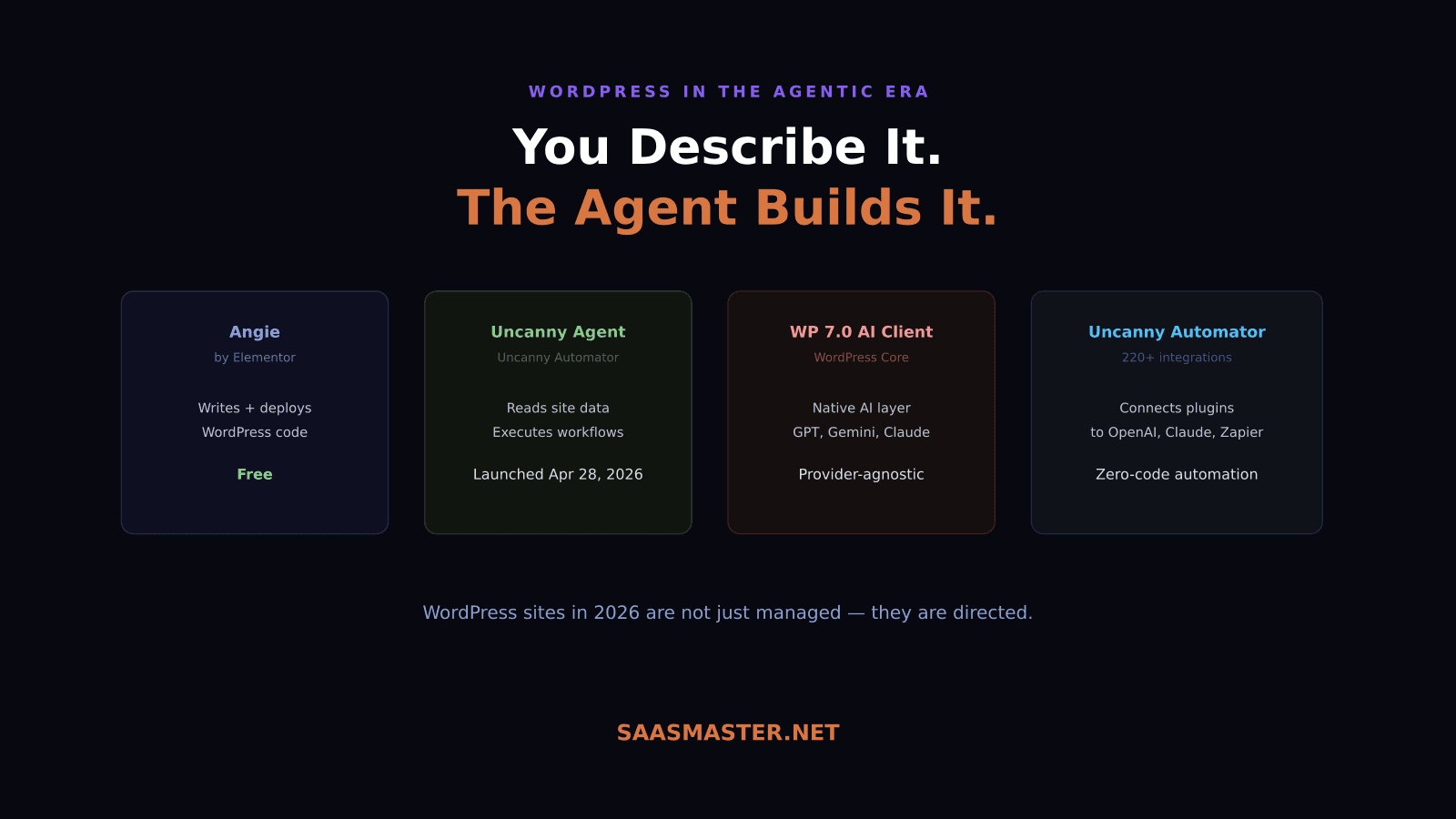
WordPress sites are doing things in 2026 that would have required a developer to build six months ago. Angie by Elementor writes and deploys custom WordPress code based on a description. Uncanny Agent reads your site's content, user data, and active workflows, then executes tasks based on triggers you set. WordPress 7.0's native AI Client connects directly to GPT, Gemini, or Claude without a plugin. Here is what the agentic WordPress era actually looks like — and where the limits still are.
Key takeaways
- Angie by Elementor is a free, fully autonomous agent inside your WordPress dashboard that uses MCP to read site data and write production-ready code
- Uncanny Agent launched April 28, 2026, bringing autonomous AI action execution to Uncanny Automator's 220+ plugin integrations
- WordPress 7.0 shipped a provider-agnostic AI Client as a core feature, making AI a first-class citizen in WordPress rather than a plugin add-on
- The shift is from AI-assisted content creation to AI-directed site operation — the model takes actions, not just suggestions
- Current limits: agents still need human approval before pushing code to production, and complex multi-system workflows require careful setup
What changed between AI plugins and AI agents
For most of 2024 and 2025, AI in WordPress meant one thing: a text generation button inside the editor. You clicked it, the model wrote something, you edited it, you published it. Useful, but fundamentally the same workflow with an AI shortcut inserted in the middle.
Agents are different. An agent does not wait for you to click a button. It reads your site, it understands what is on it, and it takes action based on instructions you give it or triggers you set. The distinction sounds subtle but the practical effect is significant. You are no longer using AI as a better autocomplete — you are directing it to do things on your behalf.
Three developments made this shift real for WordPress users in 2026.
Angie: the agent that writes your WordPress code
Angie is Elementor's autonomous AI agent, available free as a beta plugin. It runs inside your WordPress dashboard and uses Model Context Protocol to read your site's actual data — not a generic context, but your specific site: your pages, your settings, your installed plugins, your Elementor widgets.
Here is what Angie does that no previous WordPress AI tool did: it writes production-ready WordPress code and deploys it to a sandboxed test environment for you to review before pushing live. You describe what you want — a custom widget that shows upcoming events from a calendar, a membership gate on a specific page, a contact form that triggers a Slack notification — and Angie builds it. Custom Elementor widgets from scratch. Extensions to existing widgets. Backend and front-end code. Not a template, not a shortcode, but actual PHP, JavaScript, and CSS that does what you described.
The sandboxed test environment is the critical safety feature. You see the result before it touches your live site. Approve it and it deploys. If something looks off, you reject it and iterate. For non-developers who have been paying developers for simple customizations, this changes the economics significantly.
Angie is in beta, free, and available through the WordPress plugin repository.
Uncanny Agent: AI that executes your workflows
Uncanny Automator has been the benchmark for no-code WordPress automation since it launched — connecting over 220 plugins and applications so that actions in one trigger actions in another. It added AI capabilities in 2025. On April 28, 2026, it launched Uncanny Agent: an inbuilt AI assistant that reads your entire site, including user data and your existing workflow configurations, before taking actions.
Where Uncanny Automator lets you build recipes — if a user completes a course, send them an email and update their profile — Uncanny Agent lets you instruct the system in natural language and have it configure those recipes for you. It also integrates with OpenAI, Claude, and Zapier, meaning the actions it can take extend well beyond WordPress itself.
For membership sites, learning management systems, WooCommerce stores, and any WordPress installation with complex user journeys, this is a meaningful capability jump. Instead of building each automation rule manually, you describe the outcome and the agent figures out the recipe.
WordPress 7.0's native AI Client
WordPress 7.0 Armstrong, which shipped in early 2026, introduced something that changes the plugin ecosystem permanently: a provider-agnostic AI Client baked into WordPress core. This is not a plugin you install — it is a first-class feature of the platform.
The AI Client connects to whichever provider you configure: OpenAI, Google Gemini, or Anthropic Claude, based on your API keys. Third-party plugins can call the AI Client to add AI features without building their own API integrations. This is the Abilities API — a shared layer that any plugin can hook into.
The practical effect: plugins that previously needed their own AI integration can now use the core client instead. That reduces fragmentation, lowers development cost for plugin authors, and creates a more consistent AI experience across the WordPress ecosystem. It also means that when you configure your preferred AI provider once, all your plugins that use the Abilities API benefit from that configuration.
What these agents still cannot do
The current generation of WordPress AI agents is powerful within its scope, but the scope has real boundaries worth understanding.
Angie deploys code to a sandbox, not directly to production, because autonomous code deployment without human review creates risk. That review step is intentional. For teams that want fully automated deployments, there is no current path through Angie without human approval at the final step.
Uncanny Agent is strong at executing existing workflows and configuring automation recipes, but it requires that the plugins and integrations you want to connect are already part of Uncanny Automator's ecosystem. If you want it to interact with a tool that is not in the 220+ integrations list, you need custom development.
WordPress 7.0's AI Client is provider-agnostic, but you still need API keys and you still manage your own costs. It does not come with a free tier — it is a connection layer, not a service.
Why this matters for WordPress site owners in 2026
If you run a WordPress site — whether for a business, a content operation, or a SaaS product — the agent layer is starting to make real tasks genuinely autonomous. Custom development tasks that previously required a developer. Automation workflows that previously required careful manual configuration. AI features across plugins that previously required separate integrations.
The practical recommendation right now: install Angie if you have Elementor and start using it for custom functionality requests you would otherwise send to a developer. Set up Uncanny Automator if you have complex user journeys across multiple plugins. Configure the WordPress 7.0 AI Client with your preferred API provider so your entire plugin stack can use it.
This is not the destination — agents will get significantly more capable over the next year. But the foundation is here, and the sites that start building on it now will have compounding advantages as the tools mature.
Frequently asked questions
What is Angie for WordPress?
Angie is a free autonomous AI agent built by Elementor that lives inside your WordPress dashboard. It uses Model Context Protocol to read your site's data and can write and deploy custom WordPress code — including Elementor widgets, custom PHP, and JavaScript — to a sandboxed test environment for your review before going live.
Is WordPress 7.0's AI feature free to use?
The AI Client in WordPress 7.0 is included in the core platform at no charge, but it requires you to provide your own API keys for the AI provider you choose — OpenAI, Google Gemini, or Anthropic Claude. You pay your chosen provider's standard API rates for usage.
What does Uncanny Agent do that regular Uncanny Automator does not?
Uncanny Agent, launched April 28, 2026, adds an AI assistant that reads your entire WordPress site — content, user data, and existing automation configurations — and can configure automation recipes in natural language. Standard Uncanny Automator requires manual recipe creation; Uncanny Agent lets you describe what you want and have the AI set it up.
Was this article helpful?
SaaS Master
Creator behind SaaS Master — tutorials, walkthroughs, reviews, and explainers that help SaaS, AI, and WordPress products get understood and chosen. Writing here about the tools, trends, and tactics that actually move the needle. Work with me →
Want your product explained this clearly — in video?
Tutorials, walkthroughs, reviews, and shorts for SaaS, AI, and WordPress products.
Work With SaaS Master