AI & SaaS
AI Agents Are Killing Per-Seat SaaS Pricing — What Founders and Buyers Must Know in 2026
The economics of SaaS are breaking. Not collapsing — breaking, as in being remade. The per-seat subscription model that built Salesforce, Slack, Notion, and hundreds of other software companies is under more pressure in 2026 than at any point since the cloud era began. The reason is AI agents, and understanding what is happening matters whether you are building software, buying it, or both.
Here is the simple version: when one person equipped with AI agents can do the work that used to require five people and five seats, charging per seat stops making sense — for buyers and eventually for sellers too.
Key takeaways
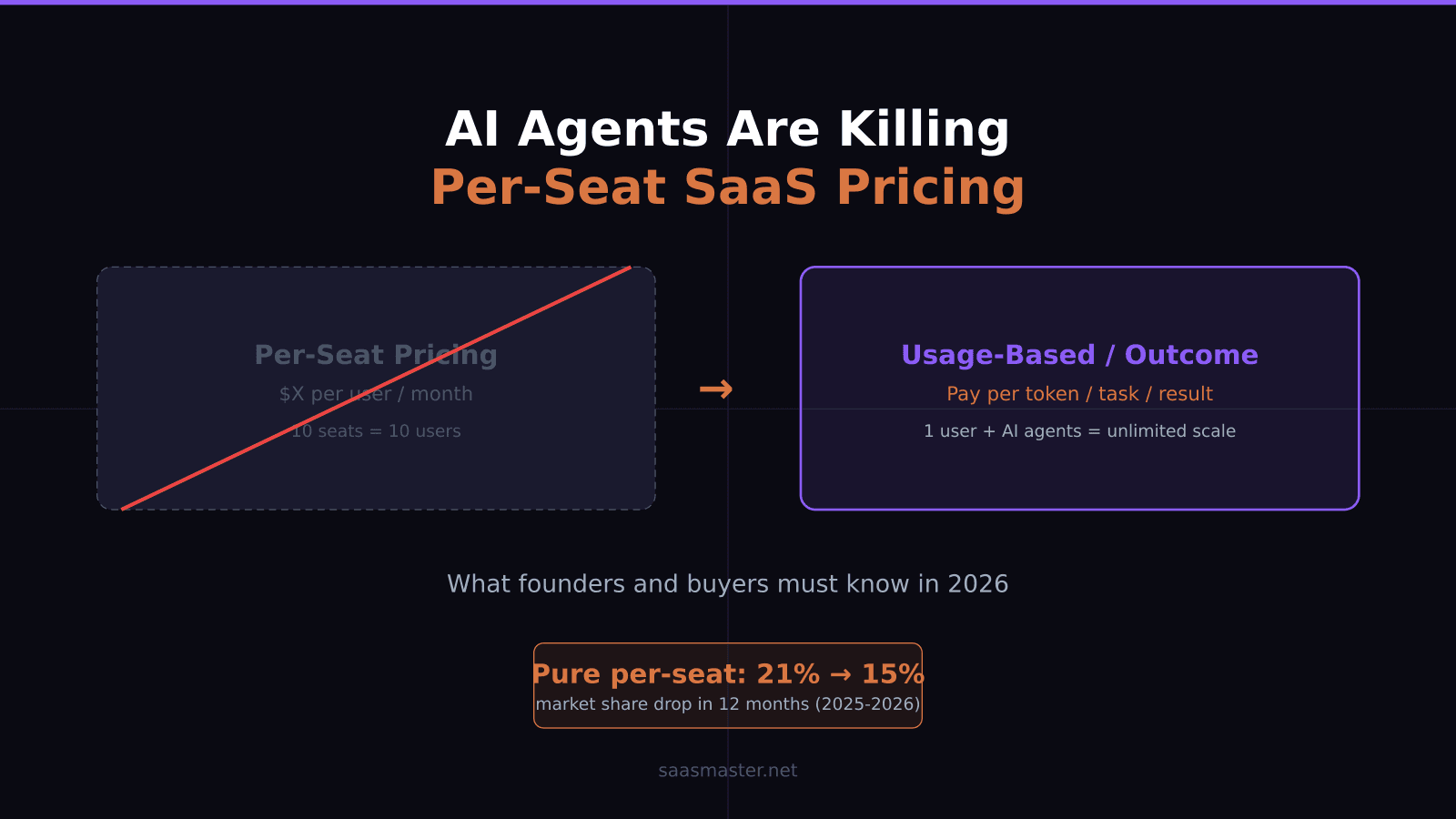
- Pure per-seat pricing fell from 21% to 15% market share among SaaS vendors between 2025 and 2026.
- Hybrid pricing (a base subscription plus usage overage) is now the dominant model at 41% adoption.
- AI agents act as software users, consuming API calls, processing records, and triggering workflows — but do not show up on a headcount or a seat license.
- Gartner predicts 40% of enterprise SaaS spend will shift to usage-, agent-, or outcome-based models by 2030.
- For SaaS founders, this is not just a pricing decision — it is a product and business model rethink.
Why per-seat pricing made sense before AI
Seat-based pricing was elegant in its simplicity. One person, one login, one monthly fee. It was easy to forecast, easy to audit, and aligned cost with actual human usage. A 50-person team paid for 50 seats. The vendor made predictable revenue. The buyer had predictable costs.
The model worked because software was a tool that required human hands to operate. A sales team needed 10 CRM seats because 10 people were logging calls and updating records. Automate those tasks with AI agents, and suddenly one person with one seat is doing the work of ten — while consuming ten times the platform resources.
The shift in numbers
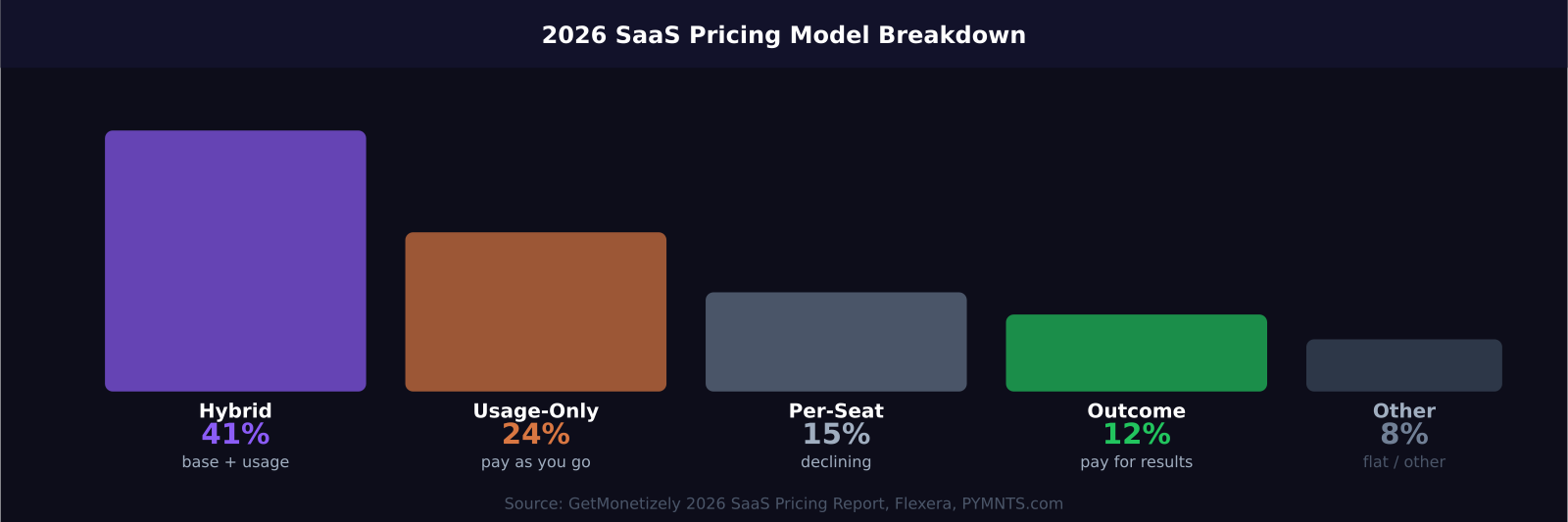
According to the 2026 SaaS Pricing Report from GetMonetizely and Flexera, pure per-seat pricing now accounts for just 15% of SaaS vendors — down from 21% in 2025. That 6-point drop in 12 months is the fastest shift in pricing model adoption in the history of the SaaS industry.
Hybrid pricing — a base subscription that covers a certain usage volume, with metered overage charges above that threshold — has emerged as the dominant model at 41% of vendors. Usage-only (pure pay-as-you-go) is at 24%. Outcome-based pricing, where customers pay based on business results rather than consumption, is at 12% and growing fastest.
The change is being driven by both sides of the market. Vendors are finding that AI-augmented customers consume dramatically more compute, API calls, and data processing than non-AI users — without the seat count going up. Buyers are pushing back on per-seat agreements that no longer reflect how they actually use the software.
What this means for SaaS buyers
If you are purchasing SaaS in 2026, per-seat contracts are worth scrutinizing carefully. Ask the vendor how AI agent usage is metered. Many contracts written before 2025 did not anticipate agents that could trigger thousands of API calls per hour on a single user account.
The more important question is whether the vendor's pricing model will penalize you as you adopt AI workflows. A contract that prices per seat might look affordable today and become expensive fast as your team deploys agents that multiply their output — and the platform's consumption.
Usage-based and hybrid agreements are often more transparent about what you are actually paying for, even if they require more careful budget forecasting. Push for commitments on token or credit pricing when renewing contracts, and ask for usage dashboards that show AI agent consumption separately from human usage.
What this means for SaaS founders
If you are building SaaS in 2026 and still anchored on pure seat pricing, you should be running a pricing audit now rather than later. The risk is not that your current customers leave immediately — most of them are on existing contracts. The risk is that your pricing model stops attracting new customers who are designing AI-native workflows from day one.
The best outcomes I see for SaaS founders are the ones who introduce a hybrid structure: keep the per-seat base for human users (it is still predictable and easy to sell), and add a consumption layer for AI agent activity. This captures the value your platform creates when an agent is doing ten times the work of a human user, without requiring you to overhaul your entire go-to-market motion.
Outcome-based pricing is the most ambitious model — charge for the result, not the compute. A customer support tool that charges per ticket resolved, a recruiting platform that charges per successful hire, a marketing tool that charges per qualified lead generated. These models are intellectually compelling and harder to implement, but they are the direction the most forward-looking vendors are moving.
The security and governance angle nobody talks about
AI agents introduce a new category of SaaS risk that pricing models alone do not solve. When an agent has access to your CRM, your support inbox, and your billing system, the question of permission scoping and data access becomes urgent.
Security vendors tracking SaaS usage report that over-privileged agents — agents granted access to more systems than they need for their specific task — are now among the top enterprise security risks in 2026. Buying software in 2026 means asking not just about pricing, but about what agent permissions your contract allows, how usage is logged, and whether the vendor provides audit trails for agent activity.
Frequently asked questions
Is per-seat SaaS pricing dead?
Not dead, but declining fast. Pure per-seat models dropped from 21% to 15% of SaaS vendors between 2025 and 2026. Hybrid pricing — a base subscription with usage overage — is now the dominant model at 41% adoption. Per-seat will remain relevant for human-only software tools, but for anything AI-augmented, expect more usage-based elements in your next contract renewal.
How do AI agents affect my SaaS budget?
AI agents consume platform resources — API calls, data processing, compute credits — independently of human users. If your SaaS contract is priced per seat, agents running on a single account can generate usage equivalent to dozens of human users. Ask your vendors specifically how agent activity is metered and billed before deploying agents at scale.
What is outcome-based SaaS pricing?
Outcome-based pricing means you pay based on the business result the software delivers — tickets resolved, leads generated, revenue influenced — rather than on consumption or per user. It is growing quickly among AI-native SaaS vendors because it aligns the vendor's revenue with the customer's success. Gartner expects it to account for a meaningful share of enterprise SaaS spend by 2028–2030.
Was this article helpful?
SaaS Master
Creator behind SaaS Master — tutorials, walkthroughs, reviews, and explainers that help SaaS, AI, and WordPress products get understood and chosen. Writing here about the tools, trends, and tactics that actually move the needle. Work with me →
Want your product explained this clearly — in video?
Tutorials, walkthroughs, reviews, and shorts for SaaS, AI, and WordPress products.
Work With SaaS Master