AI Tools
Perplexity vs ChatGPT Deep Research vs Gemini: Which Gets Citations Right in 2026?
When you need a factual answer that you can actually trust, the choice of AI research tool matters more than most people realize. ChatGPT gives you a long essay. Gemini pulls in your Google Docs. Perplexity hands you citations you can click. And all three now have a "deep research" mode that promises to do the heavy thinking for you.
The problem: citation hallucination rates, time to result, and the depth of analysis vary dramatically. After testing all three on real research tasks — market analysis, competitive research, technical documentation review — here is what I found.
Key takeaways
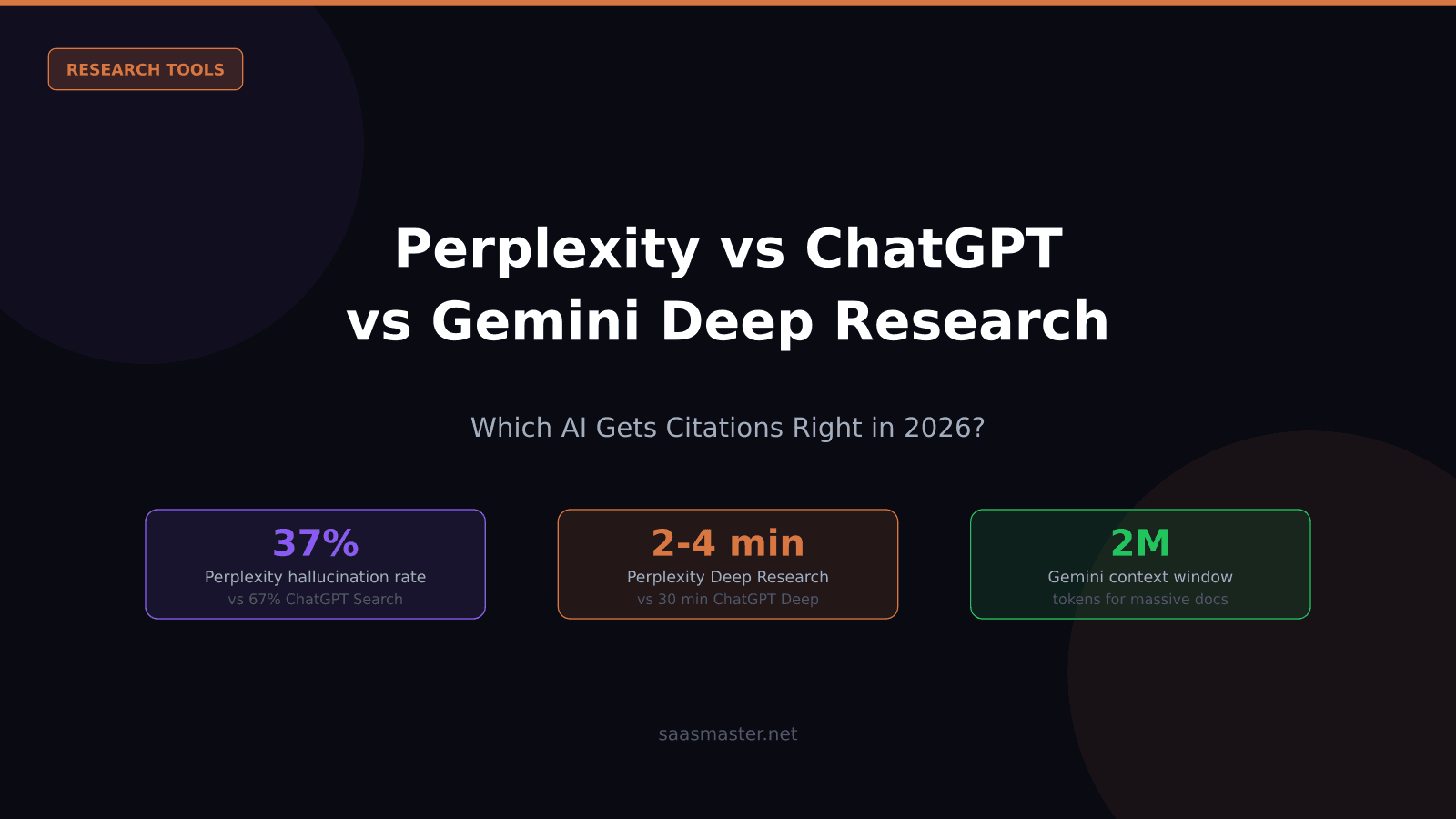
- Perplexity has the lowest citation hallucination rate among the three at 37%, versus 67% for ChatGPT Search and 51% for Gemini (per CJR analysis).
- Perplexity Deep Research returns results in 2 to 4 minutes; ChatGPT Deep Research can take 10 to 30 minutes for complex queries.
- Gemini Deep Research is the strongest pick if you live in Google's ecosystem — it writes directly to Google Docs and reads from Drive.
- ChatGPT Deep Research writes the most thorough, narrative-style reports but takes significantly longer and is more likely to confabulate citations.
- All three are roughly the same price at $20–22/month for their premium tiers.
What "deep research" actually means in 2026
All three platforms now have a dedicated deep research mode that goes beyond single-query answers. The workflow: you give it a complex question, it searches dozens of sources autonomously, synthesizes a long report, and returns it with citations.
The differences in how they do this are significant. Perplexity uses a parallel search architecture — it fans out across multiple sources simultaneously and returns a structured answer fast. ChatGPT Deep Research takes a more sequential, deliberate approach that produces longer, more thesis-like reports but takes much more time. Gemini uses Google's Search index plus its 2 million token context window to pull in large documents and synthesize across them.
Citation accuracy: this is the number that matters
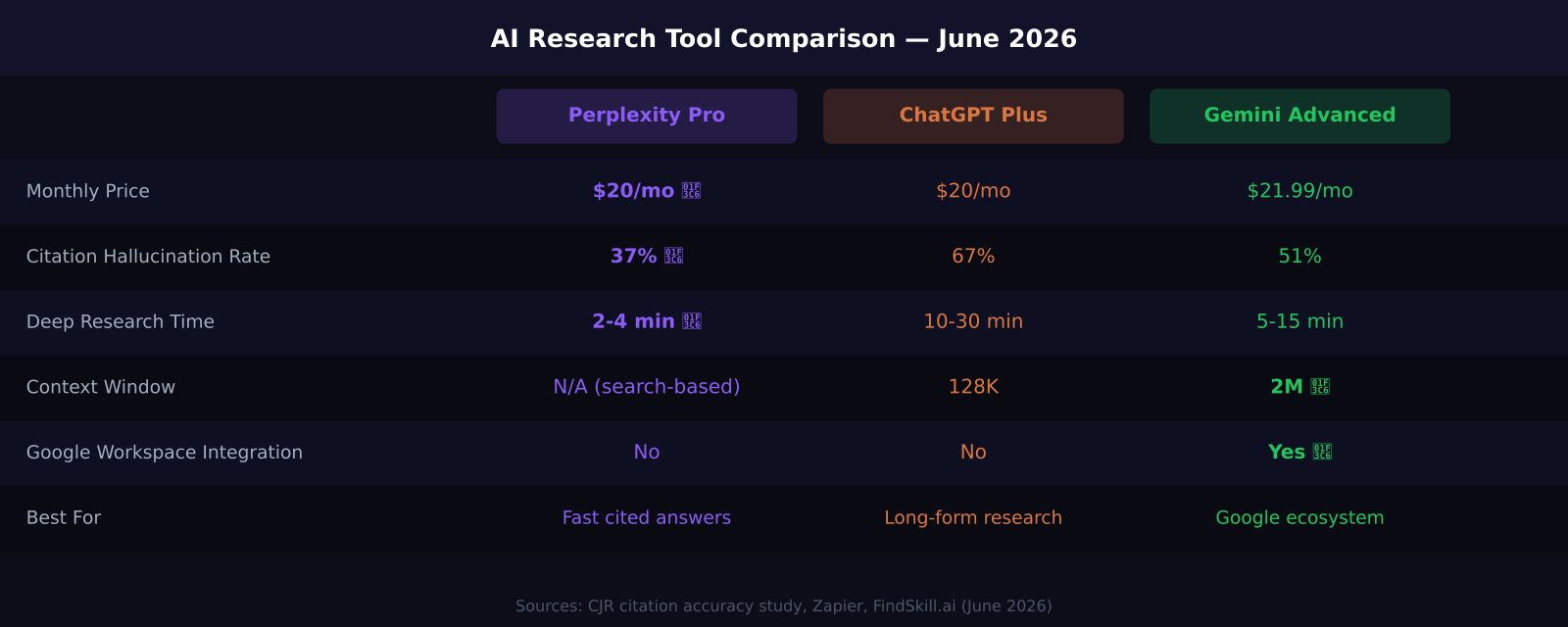
A CJR (Columbia Journalism Review) study on AI search platforms in 2026 found that Perplexity had the lowest citation hallucination rate at 37%. That means 37 out of 100 citations point to a source that does not actually support the claim in the way it is presented. That sounds bad — and it is — but it is dramatically better than ChatGPT Search at 67% and Grok 3 at 94%.
Gemini Deep Research lands around 51% based on third-party testing, which puts it between the other two. The practical implication: always verify citations before publishing or presenting AI-generated research. But if you need the most reliable starting point, Perplexity is the least risky.
How fast is "deep research"?
Speed matters when you are doing competitive research under a deadline or answering a question live in a meeting. Perplexity Deep Research typically returns a result in 2 to 4 minutes. Gemini Deep Research usually lands in 5 to 15 minutes depending on the complexity. ChatGPT Deep Research can take 10 to 30 minutes — and for very complex queries, it can run longer.
The trade-off is depth. ChatGPT Deep Research tends to produce the most comprehensive, long-form reports with detailed analysis and narrative structure. Perplexity's faster output is more like a very well-sourced summary than a full research report. Gemini falls in between.
Which AI is better for research use cases?
For quick competitive research and fact-checking: Perplexity wins. The speed, citation transparency, and lower hallucination rate make it the best tool when you need a reliable answer fast. The interface also makes citations obvious — each claim has a numbered source you can click to verify.
For deep analysis reports and writing: ChatGPT Deep Research is better for producing a complete, polished document. If you need a 3,000-word analysis with narrative flow, methodology, and executive summary, ChatGPT will give you something closer to publication-ready. Just plan for the wait and verify every citation.
For teams using Google Workspace: Gemini Deep Research is the clear choice. It writes research directly to Google Docs, reads from Drive files, integrates with Google Sheets, and uses the full 2 million token context window to process massive documents in one pass. If your workflow is built around Google's tools, this integration advantage is significant.
The creator's perspective on research tools
I use all three in my workflow depending on the task. For background research on a new software product I'm about to review, Perplexity gets me up to speed in minutes with clickable sources I can verify on the spot. For deep-dive competitive analysis reports I share with clients, I use ChatGPT Deep Research as the first draft — but I always fact-check the citations before sending anything.
Gemini I mostly reach for when I need to process a long document — a 200-page software documentation PDF, a long email thread, a full year of meeting notes — because that 2 million token context window genuinely changes what is possible.
Frequently asked questions
Is Perplexity better than ChatGPT for research?
For speed and citation reliability, yes. Perplexity delivers results in 2 to 4 minutes with a 37% citation hallucination rate versus 67% for ChatGPT Search. For long-form, narrative research reports, ChatGPT Deep Research produces more thorough documents — just budget more time and always verify sources.
Does Gemini Deep Research work with Google Docs?
Yes. Gemini Deep Research integrates directly with Google Workspace, allowing it to write reports into Google Docs, read from Drive files, and cross-reference Google Sheets data. This is one of its biggest practical advantages over Perplexity and ChatGPT.
What is citation hallucination and why does it matter?
Citation hallucination is when an AI links a claim to a source that does not actually support that claim. All current AI research tools do this to some degree. It matters because if you share AI-generated research without verification, you risk spreading misinformation backed by authoritative-looking but inaccurate citations. Always click through to verify the source before using AI research in professional or public contexts.
Was this article helpful?
SaaS Master
Creator behind SaaS Master — tutorials, walkthroughs, reviews, and explainers that help SaaS, AI, and WordPress products get understood and chosen. Writing here about the tools, trends, and tactics that actually move the needle. Work with me →
Want your product explained this clearly — in video?
Tutorials, walkthroughs, reviews, and shorts for SaaS, AI, and WordPress products.
Work With SaaS Master