AI & SaaS
AI Agents Can Now Spend Your Money: Inside the Agentic Commerce Boom
Yes — AI agents can now spend real money on your behalf, and the infrastructure to let them do it safely shipped this spring. Stripe, Amazon Web Services, Coinbase, and OpenAI have all rolled out payment rails that let an autonomous agent buy a product, pay for an API, or settle a bill without ever touching your actual card number. This is the quiet shift that turns AI from something that talks into something that transacts.
I cover the tools SaaS companies build on, and this is one of those changes that sounds like science fiction until you realize it is already generally available. Here is what "agentic commerce" actually is, how the money moves without exposing your card, and what it means for anyone running an online business.
Key takeaways
- AI agents can now make purchases and pay for services autonomously, with the buyer's real card credentials kept hidden from the agent.
- Stripe's Link Agent Wallet, OpenAI's Agentic Commerce Protocol, and the Machine Payments Protocol went generally available in late April 2026.
- AWS launched Bedrock AgentCore Payments, letting agents pay in stablecoins via Coinbase's x402 protocol, with early testers like Warner Bros. Discovery.
- Security rests on single-use, merchant-bound, amount-capped tokens — the agent gets permission to spend a set amount at one place, not your wallet.
- For online sellers, the new question is no longer just "is my site easy for humans" but "can an AI agent check out here?"
What is agentic commerce, in plain English?
Agentic commerce is the idea that an AI agent can complete a purchase end to end. You tell your assistant "reorder my usual coffee" or "find and book the cheapest flight under $300," and instead of handing you a list of links, the agent actually pays and confirms the order. To do that safely, the payment industry had to solve one hard problem: how do you let software spend money without handing software your credit card?
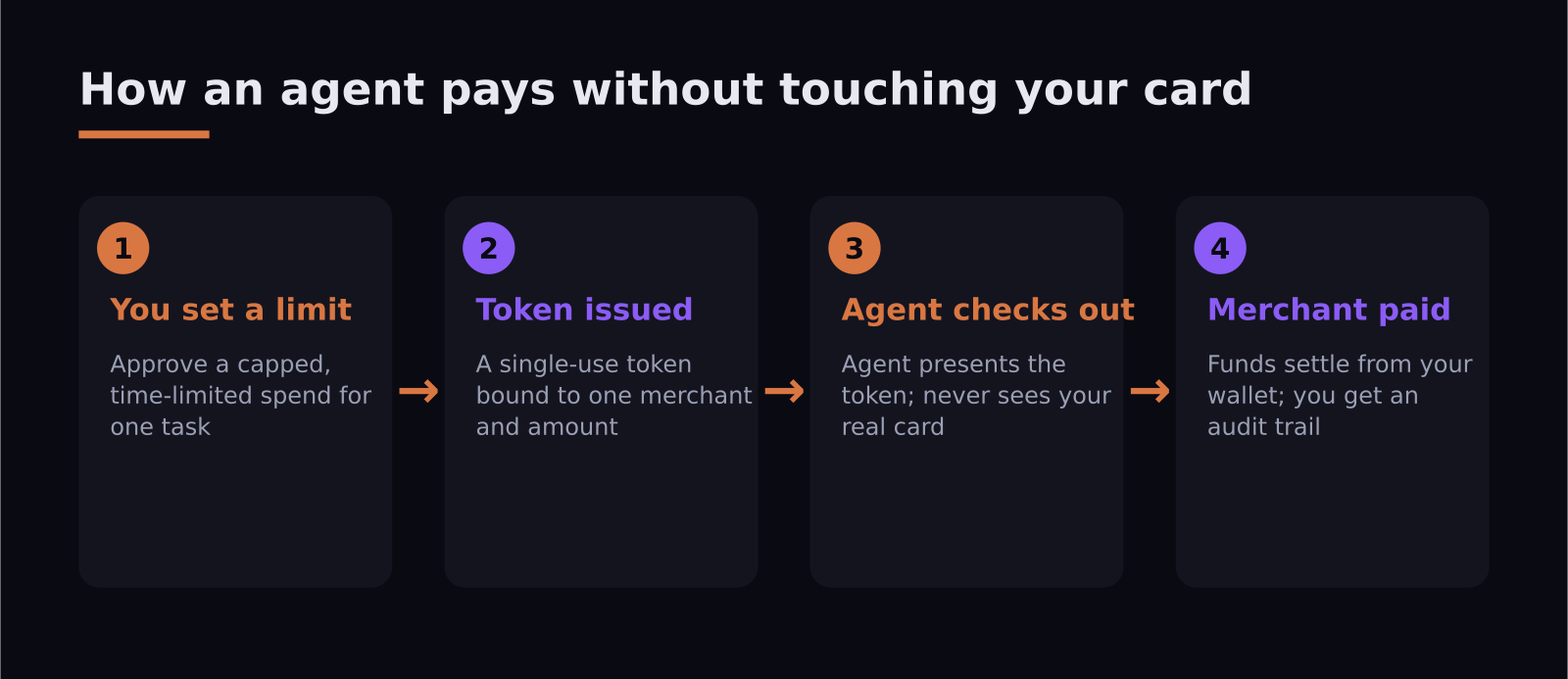
The answer that emerged in 2026 is the tokenized, scoped payment. Rather than giving the agent your card, the system issues a one-time credential that is bound to a specific merchant and a specific dollar amount, is time-limited, and can only be used once. The agent presents that token at checkout; the merchant gets paid; your real card details never leave your wallet provider. If the agent is compromised, the blast radius is a single capped transaction, not your whole account.
Who built the rails, and what does each piece do?
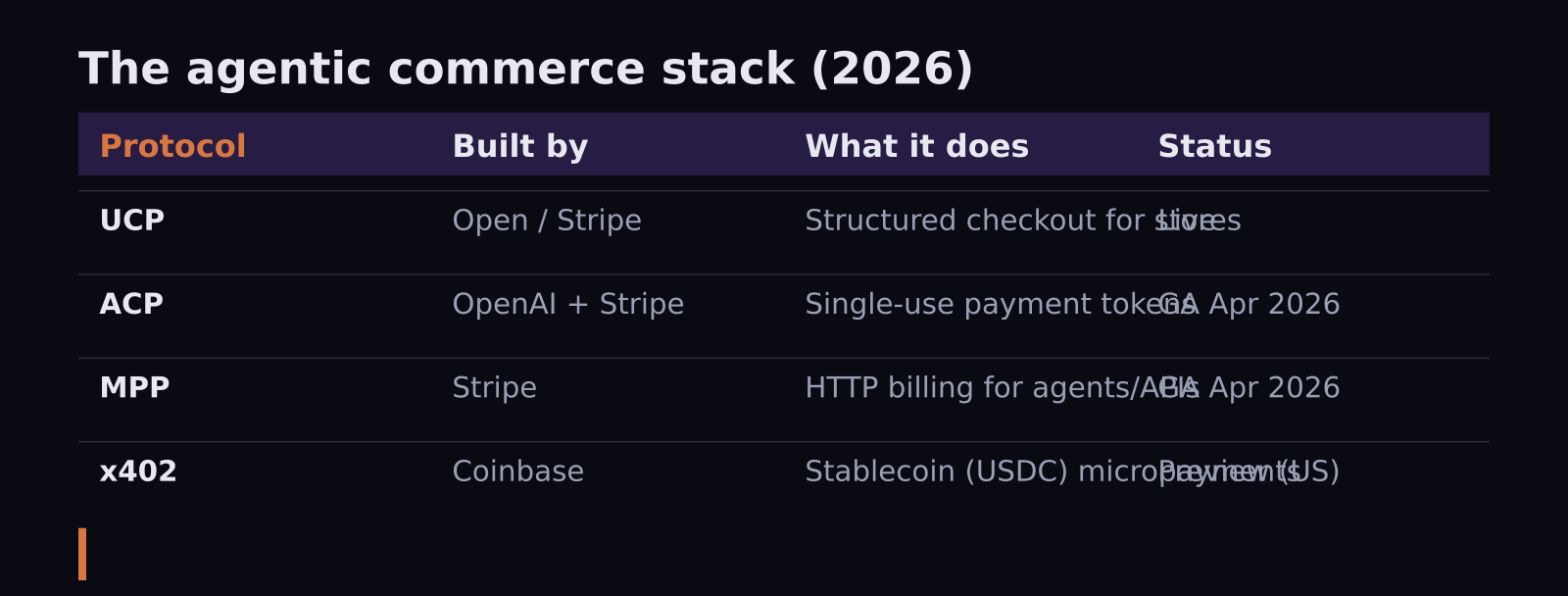
Stripe assembled the most complete stack. Its Link Agent Wallet lets an agent request a one-time-use card or a Shared Payment Token backed by the cards already in your Link wallet, and you approve each spend request from the web or Link's mobile apps. Alongside it, Stripe shipped the Machine Payments Protocol (MPP) for billing agents over HTTP — ideal when you sell an API and your customers are themselves bots.
OpenAI co-developed the Agentic Commerce Protocol (ACP) with Stripe. ACP is what issues that merchant-bound, amount-bound, single-use Shared Payment Token, ensuring the agent never sees your real credentials. It is the security spine of the whole arrangement.
Amazon went a different route with Bedrock AgentCore Payments, built on Coinbase's open x402 protocol and Stripe's Privy wallet. Here agents pay in stablecoins — USDC — and the first use cases are micropayments for APIs, data feeds, and paywalled content, with plans to expand to bigger purchases like travel and hotel bookings. Early testing includes companies like Warner Bros. Discovery.
Tying it together is the Universal Commerce Protocol (UCP), an open standard for structured checkout — cart management, tax, identity linking, order tracking — that lets an existing online store expose itself to agents. Stripe sits on its tech council.
How safe is letting an agent spend your money?
Safer than it sounds, by design, but not risk-free. The core protection is that the agent never holds reusable credentials. Tokens are single-use, capped to an amount, bound to one merchant, and time-limited. On the stablecoin side, the security focus shifts to wallet governance: who is allowed to authorize spend, how signing keys are protected, and how a compromise is contained. The recommended controls — isolating signing authority from the agent's logic, enforcing hard spend limits, and rate limiting — exist precisely because an agent acting on its own needs guardrails a human shopper does not.
The honest caveat: this is new, and the stablecoin path in particular is still in preview, restricted to US businesses on a handful of USDC contracts. Treat agent spending the way you would a junior employee with a company card — clear limits, visible approvals, and an audit trail. The infrastructure gives you those levers; using them is on you.
What this means if you sell anything online
The practical takeaway for business owners is that a new kind of customer is arriving: the agent doing the buying for a human. If your checkout assumes a person clicking through screens, an agent may not be able to complete it, and you will quietly lose sales you never see. Supporting a standard like UCP, or at minimum making sure your store is machine-readable and your checkout is clean, is becoming part of being discoverable — the commerce equivalent of the GEO shift where AI assistants, not search results, send you customers.
It is early, and most small businesses do not need to rebuild their checkout this week. But the direction is set, the rails are live, and the companies that make themselves easy for agents to buy from will have a head start when this becomes normal.
Why stablecoins keep showing up in this story
One detail trips people up: why do AWS and Coinbase route agent payments through stablecoins like USDC instead of just using cards? The answer is that agents are built to make lots of tiny payments — a fraction of a cent to read a data feed, a few cents for an API call — and the traditional card network was never designed for that. Card fees and minimums make a one-cent charge absurd. Stablecoin micropayments over a protocol like x402 settle almost instantly, cost very little, and happen right inside the web request, so an agent can pay per-call without a clunky checkout. For human-scale purchases the card rails still make sense, which is why the ecosystem has both paths: stablecoins for machine-to-machine micropayments, cards and tokens for buying actual products.
A realistic timeline for business owners
If you want to know when this affects you, think in three waves. Right now, the early adopters are developers selling APIs and data, who can monetize agent traffic immediately with machine payment protocols. Over the next year, expect mainstream stores to start advertising "agent-ready" checkout the same way they once advertised "mobile-friendly." Further out, agent-driven buying becomes a normal slice of e-commerce traffic, and being invisible to agents will cost real revenue. You do not have to act in wave one, but you should be paying attention so you are not scrambling in wave two.
Frequently asked questions
Can an AI agent really spend my money without my card details?
Yes. Systems like OpenAI's Agentic Commerce Protocol issue a single-use token bound to a specific merchant and dollar amount. The agent uses that token to pay, but your actual card or bank credentials stay with your wallet provider and are never exposed to the agent.
Is agentic commerce available now or still a demo?
Stripe's Link Agent Wallet, the Machine Payments Protocol, and OpenAI's ACP became generally available in late April 2026. AWS's stablecoin-based AgentCore Payments is live but the x402 path is still in preview and limited to US businesses.
Do I need to change my online store for AI agents?
Not urgently, but it is worth planning for. Adopting an open checkout standard like the Universal Commerce Protocol, or simply keeping your checkout clean and machine-readable, helps ensure agents can buy from you as agent-driven shopping grows.
SaaS Master
Creator behind SaaS Master — tutorials, walkthroughs, reviews, and explainers that help SaaS, AI, and WordPress products get understood and chosen. Writing here about the tools, trends, and tactics that actually move the needle. Work with me →
Want your product explained this clearly — in video?
Tutorials, walkthroughs, reviews, and shorts for SaaS, AI, and WordPress products.
Work With SaaS Master