AI & SaaS
Apple Foundation Models at WWDC 2026: What Every SaaS Builder Needs to Know
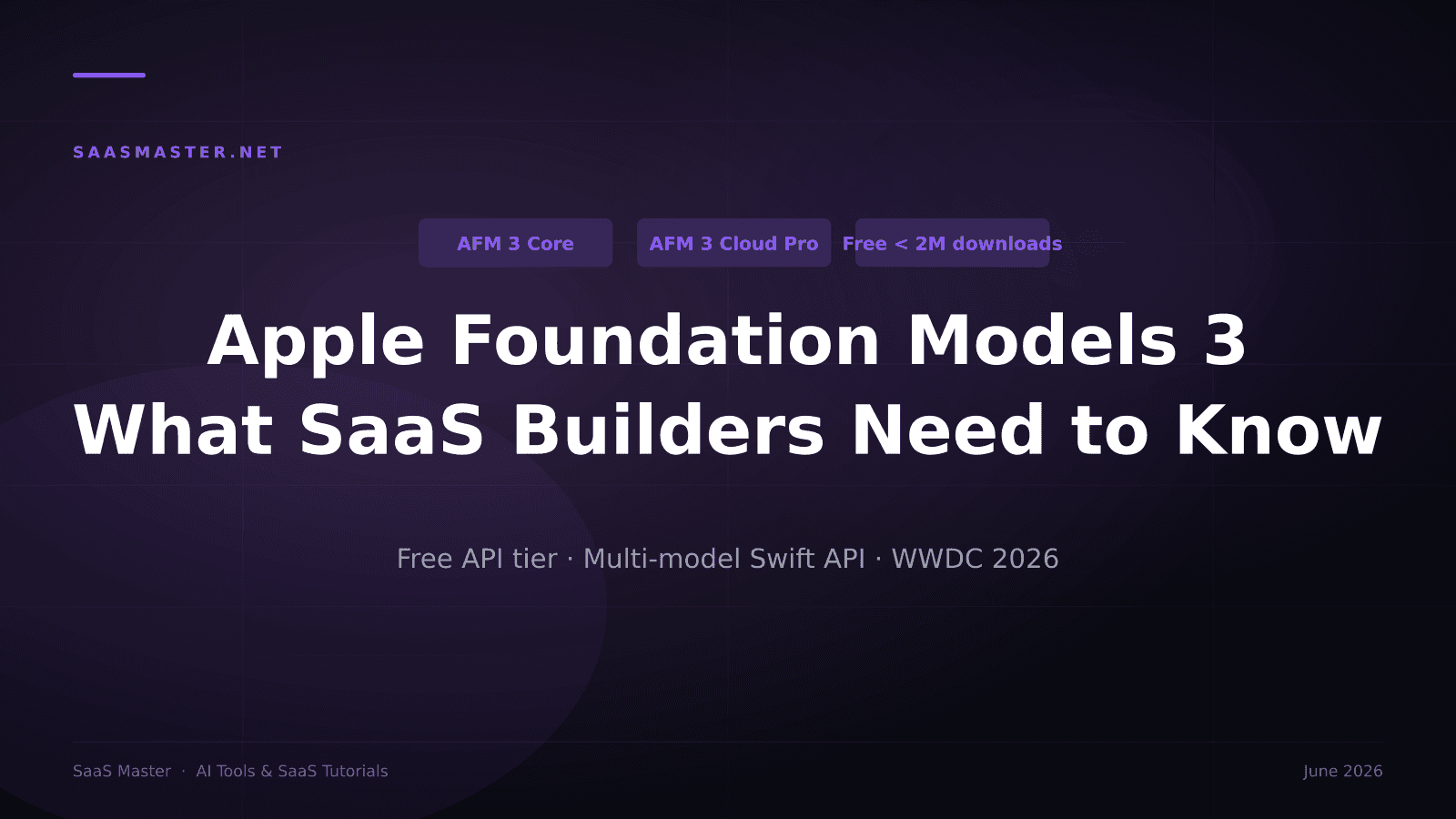
On June 8, 2026, Apple announced its third generation of Apple Foundation Models at WWDC — and buried in the developer keynote was something that should matter to every SaaS and app builder: free API access for any app with fewer than 2 million first-time App Store downloads. If you are building AI-native features on iOS or macOS, this changes your cost model.
Key takeaways: - Apple Foundation Models 3 launched June 8, 2026 at WWDC with a free cloud tier for apps under 2 million downloads - The framework now supports Claude, Gemini, and Apple models through a single Swift API with minimal code changes to switch - Dynamic Profiles enables native multi-agent workflows in iOS and macOS apps without custom orchestration infrastructure - AFM 3 Cloud Pro runs on NVIDIA GPUs hosted in Google Cloud, refined using Gemini frontier model outputs - For iOS SaaS builders, this is the clearest path to production AI features without per-token API costs at early scale
What Apple announced at WWDC 2026
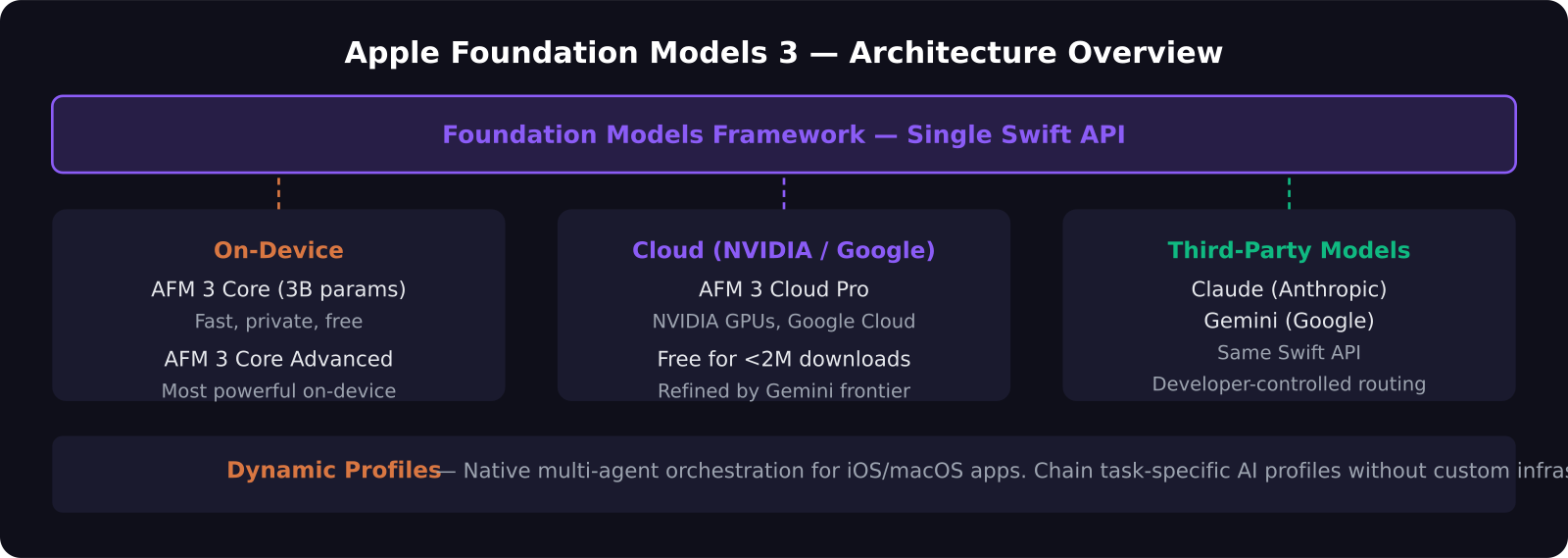
Apple introduced three model tiers under the AFM 3 umbrella. AFM 3 Core is an updated 3-billion-parameter dense model running entirely on-device — it processes requests locally on the iPhone or Mac without any server call. AFM 3 Core Advanced is Apple's most powerful on-device model, handling more complex tasks while keeping data on the device.
The new addition is AFM 3 Cloud Pro, a cloud-hosted model running on NVIDIA GPUs in Google Cloud, refined using outputs from Google's Gemini frontier models. This is the first time Apple has explicitly partnered with Google for model refinement — a significant shift in how Apple approaches AI capability gaps. Apple is saying publicly that its own models are not sufficient for all tasks, and it has built the infrastructure to route accordingly.
A single Swift API, the Foundation Models framework, now gives developers access to all three Apple model tiers — plus external models including Claude and Gemini — with minimal code changes to switch between them.
The free tier is the real story
The pricing announcement is what changes the conversation for independent developers and small SaaS teams. Developers whose apps have fewer than 2 million total first-time App Store downloads can access Apple Foundation Models running on Private Cloud Compute at no cloud API cost.
The vast majority of App Store apps fall well below 2 million downloads. This effectively gives most iOS developers free AI API access for their apps. A feature that previously required budgeting $500 to $5,000 per month in OpenAI or Anthropic API costs can now be built on Apple's infrastructure for free until you reach meaningful scale.
For early-stage SaaS products with an iOS component, this changes the calculus on what to build at launch. You can ship AI-native features on day one without a per-token budget line in your runway projections.
Dynamic Profiles and multi-agent workflows
The more technically interesting announcement for SaaS builders is Dynamic Profiles — Apple's approach to multi-agent orchestration built into the Foundation Models framework.
Dynamic Profiles lets developers define task-specific AI profiles that can be composed into workflows. A document summarization profile, a customer response drafting profile, and a data extraction profile can chain together with defined handoff logic — all within a native iOS or macOS app, without building custom orchestration code.
This is Apple doing something it has historically not done: providing an opinionated but native framework for multi-agent AI workflows. For teams building complex AI-powered features on Apple platforms, this reduces the amount of custom orchestration infrastructure they need to maintain.
The multi-model API in practice
The Foundation Models framework now routes between Apple, Claude, and Gemini through the same Swift interface. The practical implication is that developers can use Apple's on-device models for privacy-sensitive or latency-critical tasks, and route complex reasoning or creative tasks to Claude or Gemini without rewriting their integration layer.
This matters for healthcare apps, legal tools, or any category where some data should never leave the device, but where users also need access to frontier-model capabilities for specific task types. One API surface, multiple model backends, developer-controlled routing logic.
What this means for SaaS teams building on Apple platforms
If you are building a SaaS product with an iOS or macOS component, the WWDC 2026 announcements lower the barrier to shipping AI features in three concrete ways.
The free tier removes the biggest adoption hurdle for early-stage products — recurring AI infrastructure costs. The multi-model API means you are not locked into Apple's models. If Claude or Gemini performs better on your specific use case, you route there, and the framework handles the abstraction. Dynamic Profiles gives you a native, maintained orchestration primitive rather than a custom-built one, reducing infrastructure code and maintenance surface.
The tradeoff is honest: AFM 3 on-device models are competitive but not frontier-level. They run fast and for free, but for tasks requiring deep reasoning — complex analysis, nuanced writing, sophisticated code generation — you will still need to route to a cloud model and pay accordingly for those requests.
My take on what Apple got right this time
Apple has historically been late to practical AI developer tools. The original Foundation Models framework was useful but limited. AFM 3 feels like the first version where Apple has matched the developer experience expectations that OpenAI and Anthropic have set.
The free tier is genuinely generous, not a marketing gimmick. The multi-model API is the kind of pragmatic design decision Apple rarely makes — admitting that their models are not always the best choice and building flexibility in rather than locking developers into an all-Apple stack.
For anyone building on Apple platforms, this is a serious WWDC. The right response is to prototype at least one AI feature on AFM 3 Core and measure whether you actually need to route to an external model for it. Chances are, more workloads will run locally than you expect.
Frequently asked questions
What is the 2 million download limit based on? The free tier applies to apps with fewer than 2 million total first-time App Store downloads across all versions of the app. Apple disclosed this threshold in the WWDC 2026 developer sessions. Above that threshold, standard cloud API pricing applies.
Can I use Claude or GPT-5.5 through the Apple Foundation Models API? The framework supports Claude and Gemini through the same Swift API as of WWDC 2026. GPT-5.5 integration has not been announced as of June 2026 — only Claude and Gemini are listed as supported external models in the current framework documentation.
Is AFM 3 Cloud Pro data used for model training? Apple's Private Cloud Compute architecture is designed so that user data processed in the cloud is not retained or used for training. Apple made this a formal commitment in privacy documentation accompanying the WWDC announcement, consistent with their broader on-device AI privacy posture.
Was this article helpful?
SaaS Master
Creator behind SaaS Master — tutorials, walkthroughs, reviews, and explainers that help SaaS, AI, and WordPress products get understood and chosen. Writing here about the tools, trends, and tactics that actually move the needle. Work with me →
Want your product explained this clearly — in video?
Tutorials, walkthroughs, reviews, and shorts for SaaS, AI, and WordPress products.
Work With SaaS Master