Video Marketing
YouTube's 2026 AI Creator Tools: How SaaS Brands Should Use Veo 3 Fast, Lyria 2, and Branded Shorts
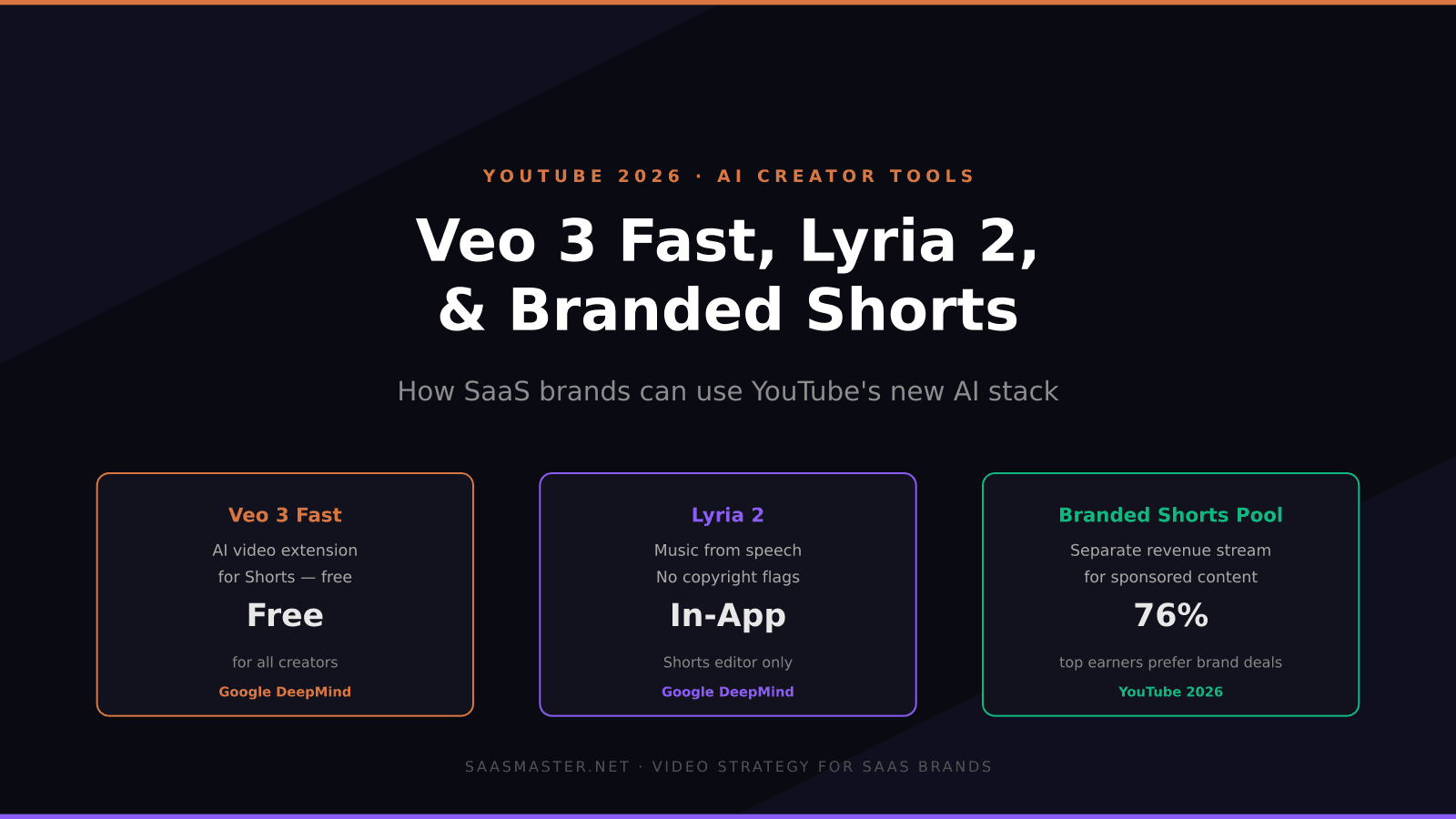
In 2026 YouTube handed SaaS marketers a production studio inside the platform they were already using. Veo 3 Fast generates video from text prompts. Lyria 2 writes and scores custom audio without copyright risk. A new Branded Shorts revenue pool created a third way for creators to earn — one funded by brands, not ad impressions. And a brand brief system that used to take two weeks to set up now takes 48 hours. These are not incremental updates. They change how SaaS companies should think about short-form video as an acquisition channel.
Key takeaways
- Veo 3 Fast is free for all YouTube Shorts creators and enables AI-generated video extensions from text prompts
- Lyria 2 generates custom music from creator speech or text, removing the background audio licensing problem in one step
- YouTube's Branded Shorts pool creates a brand-funded revenue tier separate from standard ad RPM
- 76 percent of top-earning Shorts creators already earn more from brand deals than from organic ad revenue
- A new brand brief system reduced partnership setup time from roughly 14 days to under 48 hours for pre-vetted creators
What is Veo 3 Fast and what does it actually do inside YouTube?
Google DeepMind's Veo 3 is the same foundation model behind Google's standalone video generator, but YouTube's implementation — called Veo 3 Fast — is a faster, lighter variant optimized for sub-second generation during live editing sessions. It appears to Shorts creators as two features: Extend with AI and Edit with AI.
Extend with AI takes a finished or partially finished Short and generates a seamless continuation based on a text prompt. You have a 20-second product demo that cuts off too quickly. You type "slow pan across the dashboard, fade to brand colors," and the model generates the extension, match-cutting to your existing footage. The visual style of the source clip is preserved automatically.
Edit with AI is the feature that matters most for SaaS content specifically. It takes raw camera roll footage — a screen recording, a talking-head explainer, a product walkthrough — and generates a structured first draft. Rough footage becomes a coherent short without a manual edit pass. For SaaS teams that produce product update videos regularly, that step-change in production speed is the real value.
Motion capture from still images is also part of the rollout. A product screenshot, a logo treatment, a UI mockup — any static image can be animated into a moving scene. For SaaS companies in early stages where a polished video budget does not exist, this changes what a solo founder can produce.
Veo 3 Fast is rolling out free to all Shorts creators and does not require a paid subscription tier. Availability started in 2026 as part of YouTube's broader AI creation suite.
What is Lyria 2 and why does it matter for SaaS video?
Background music is a recurring operational problem for SaaS video creators. Royalty-free libraries produce music that sounds generic and signals amateur production. Licensing real tracks for commercial use on YouTube requires time, cost, and ongoing rights management. Lyria 2, Google DeepMind's music generation model, eliminates all three problems.
The feature sits inside the Shorts editor and works by analyzing your speech or a text description to generate a melody and backing track timed to your content. "Generate music from your speech" is how YouTube describes it — the model reads the tone and pacing of how you talk, not just what you type. A measured product walkthrough where you are explaining a feature step by step gets ambient, focused backing. A launch announcement where the energy is high gets something that matches it.
For SaaS creators and the people who make content about SaaS products, this removes a bottleneck that has no good workaround. The output is original content, which means no Content ID flags, no copyright strikes, and no retroactive monetization claims from music rights holders. A creator can now score a Short entirely within YouTube's editor without sourcing audio separately.
The practical note for SaaS brands: if you are working with creators on product review content, sharing knowledge of Lyria 2 with your creator network reduces their production friction. Creators who finish Shorts faster produce more Shorts per campaign.
How does the Branded Shorts revenue pool work?
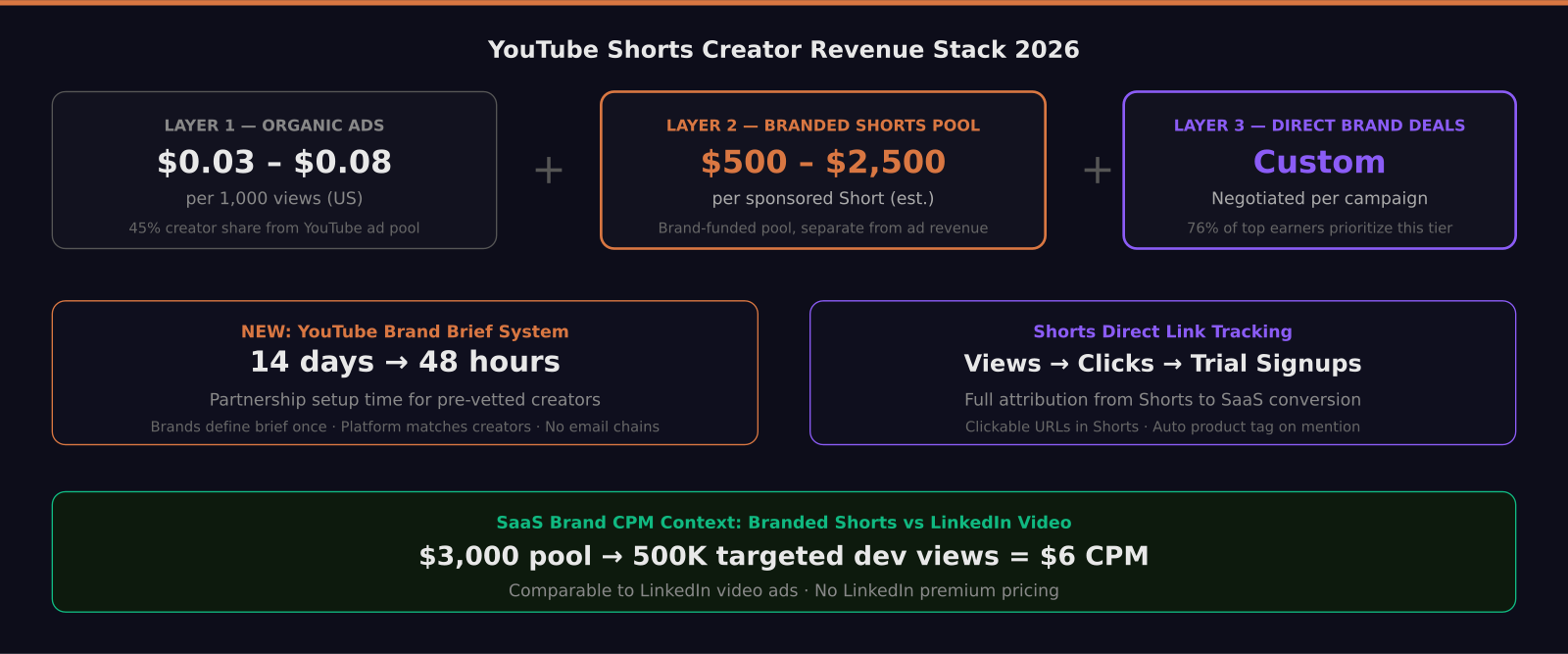
Before 2026, a creator posting sponsored Shorts earned from two sources: organic ad RPM on the Short's views (low, typically $0.03 to $0.08 per thousand views in the US) and whatever flat fee or affiliate commission they arranged with the brand. Those two streams were independent and the brand had no control over the organic side.
YouTube created a third layer in 2026: the Branded Shorts pool. Brands fund the pool per campaign. Creators who participate earn from their sponsored Short's views out of the brand-funded pool, separate from the standard ad revenue split. YouTube takes a platform fee, the brand controls the pool size, and creator earnings scale with view performance on their specific Shorts.
The alignment this creates is different from a flat sponsor fee. When a creator's sponsored Short performs well, they earn more from the pool. When it underperforms, they earn less. The incentive is for the creator to actually make good content about your product — not just produce something that meets minimum deliverable specs and move on.
YouTube reports that 76 percent of top Shorts earners already make more from brand deals than from ad RPM. The Branded Shorts pool formalizes and scales that dynamic, making it a structured product rather than an informal negotiation.
What changed about how SaaS brands find and brief creators?
YouTube launched a brand brief system that lets marketers define campaign parameters once — product, key message, target audience, content style, any restrictions — and distribute the brief to a matched creator list automatically. Creators can accept, counter, or decline without email threads.
The platform matching uses view history, subscriber audience demographics, and content category signals. A SaaS company targeting developers with a new API product can specify technical audience orientation, a minimum average view length to filter for engaged viewership, and a software tools or developer content category. The resulting creator list is pre-qualified.
The operational change for marketing teams is significant. Average partnership setup time dropped from roughly 14 days to under 48 hours for pre-vetted creator relationships. For quarterly campaigns with fixed launch windows, that time savings directly increases the number of creator partnerships a team can execute per cycle.
Direct Shorts links went live alongside this. Creators can now add a clickable URL to a Short that tracks views through to clicks, trial signups, and paid conversions with full attribution back to the creator and campaign. SaaS marketers finally have conversion data from Shorts — not just view counts and estimated reach.
What does the math look like for SaaS brands?
Consider a Branded Shorts campaign targeting developer-oriented YouTube creators. A $3,000 pool allocation reaching 500,000 targeted views in a software-adjacent audience works out to a $6 CPM. That is competitive with LinkedIn video advertising rates without the LinkedIn premium on developer audience targeting.
Organic Shorts ad revenue for creators runs $0.03 to $0.08 per thousand views in the US in 2026, after YouTube's 55 percent share of the ad pool. A Short reaching one million views earns its creator $30 to $80 in organic ad revenue. Brand pool earnings for a well-performing sponsored Short in a funded campaign are estimated at $500 to $2,500 — a 15 to 30 times multiplier over organic ad income.
That earnings gap is why top creators already prioritize brand relationships over ad optimization. The Branded Shorts pool extends that incentive further down the creator size range, making it viable for brands to work with mid-size accounts that have specific technical audiences rather than only the largest general creators.
What about the live stream features?
YouTube made two live stream additions in 2026 that are worth noting for SaaS brands that do webinars or live product demos.
Real-time sponsor-only switching lets a live streamer move between public broadcast and sponsor-only mode during a stream without ending it. For SaaS brands running demo events with a tiered audience — public interest and paying customers — this creates a live access control that was not previously possible.
Automatic product tag insertion is the other significant feature. When a creator mentions a product or brand name during a live stream, YouTube's AI places a tagged link to the product page at that moment in the stream. For SaaS companies, a creator naturally referencing your product during a live workflow or comparison generates a purchase-intent moment with a direct path to your product page. No manual link dropping required from the creator.
Frequently asked questions
Is Veo 3 Fast available to all YouTube creators? Veo 3 Fast is rolling out to all Shorts creators as part of YouTube's AI creation suite and does not require a paid subscription tier. Access is through the Shorts editor Extend with AI and Edit with AI features.
How much does a Branded Shorts campaign cost for a SaaS brand? YouTube has not published minimum spend requirements publicly. Based on creator community reports, effective campaigns appear to start around $2,000 to $5,000 to fund a pool with enough upside to attract established creators in technical niches. Enterprise campaigns run higher depending on creator tier and campaign duration.
Can SaaS companies use Lyria 2 directly for their own content? Lyria 2 is embedded in the YouTube Shorts editor as a creator tool and is not available as a standalone API for brands. SaaS companies access it indirectly by working with creators who use it in their Shorts production workflow, or by creating their own YouTube channel and using the Shorts editor for in-house content.
Was this article helpful?
SaaS Master
Creator behind SaaS Master — tutorials, walkthroughs, reviews, and explainers that help SaaS, AI, and WordPress products get understood and chosen. Writing here about the tools, trends, and tactics that actually move the needle. Work with me →
Want your product explained this clearly — in video?
Tutorials, walkthroughs, reviews, and shorts for SaaS, AI, and WordPress products.
Work With SaaS Master