AI & SaaS
Apple Launched Siri AI at WWDC 2026: What SaaS Builders and Developers Need to Know
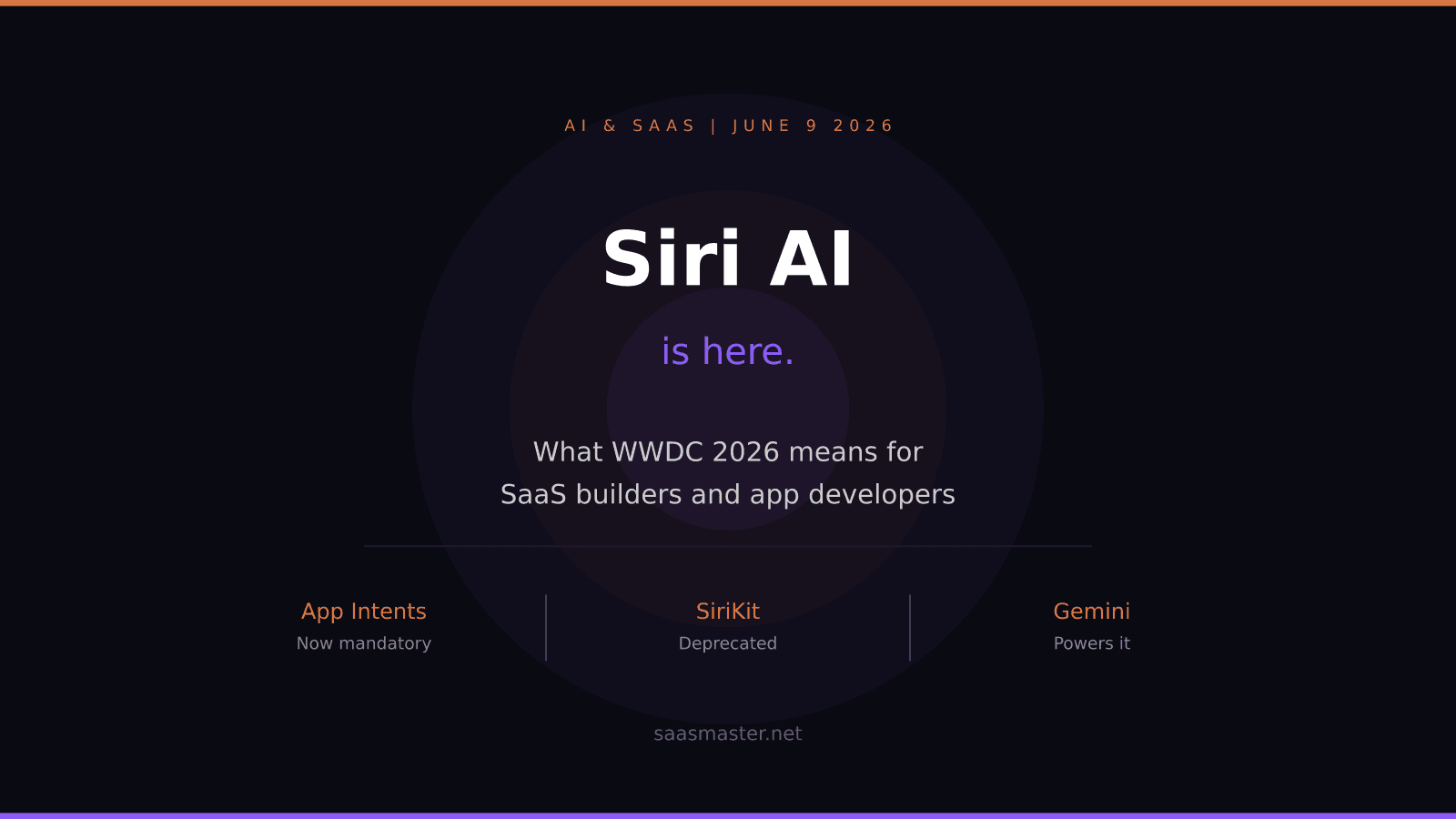
Apple shipped Siri AI on June 9, 2026 at WWDC, and it changes three things developers need to deal with immediately.
The update is bigger than it looks in the keynote highlights. Apple rebuilt Siri from the foundation up, powered by Google Gemini for cloud reasoning and Apple's own on-device foundation models for privacy-sensitive tasks. For end users, the result is a conversational assistant that actually has context — it can pull your hotel confirmation from an old email, find the restaurant a friend mentioned last month, or answer questions about what is on your screen right now. For developers building apps on iOS, iPadOS, and macOS, the implications are more structural: one integration layer has been deprecated, another has been made mandatory, and a new context-sharing API is available for the first time.
Key takeaways
- Siri AI launched at WWDC 2026 on June 9, running on Google Gemini for cloud reasoning and Apple's on-device foundation models for privacy-sensitive tasks.
- App Intents is now the mandatory integration surface for Siri. SiriKit received a formal deprecation notice in Xcode 27.
- A new cross-app context API lets approved developers read messages, emails, photos, and notes with an on-device privacy guarantee — data is used to execute the request and then discarded.
- Xcode 27 ships with on-device AI code completion, which is a meaningful developer experience change separate from Siri itself.
- Daily limits on heavy cloud AI features are tied to iCloud subscription tier. Design your app to degrade gracefully when users hit a cap.
What Siri AI Actually Does
The most important thing to understand about Siri AI is that it has genuine personal context for the first time. Previous versions of Siri worked with what was on screen or what you directly told it. Siri AI can access and synthesize across your messages, emails, photos, notes, and calendar without you switching apps. Ask it to find the hotel confirmation from last March and it finds it. Ask it for context on a meeting invite and it reads the email thread underneath.
The onscreen awareness feature extends this further. Siri AI can interpret what is displayed in any app — not just Apple's own apps — and answer questions or take actions based on what it sees. For productivity workflows, this is a material change in how users can interact with software on Apple devices.
Apple is using Google Gemini for the cloud reasoning layer that powers complex, multi-step queries. On-device requests — the ones that involve personal data like messages and photos — run on Apple's own foundation models inside Private Cloud Compute, with a binding privacy architecture: data is processed to fulfill the request, not stored or logged by Apple or Google. Apple is positioning this as the differentiated safe choice compared to cloud-only competitors.
The Three Developer Changes That Actually Matter
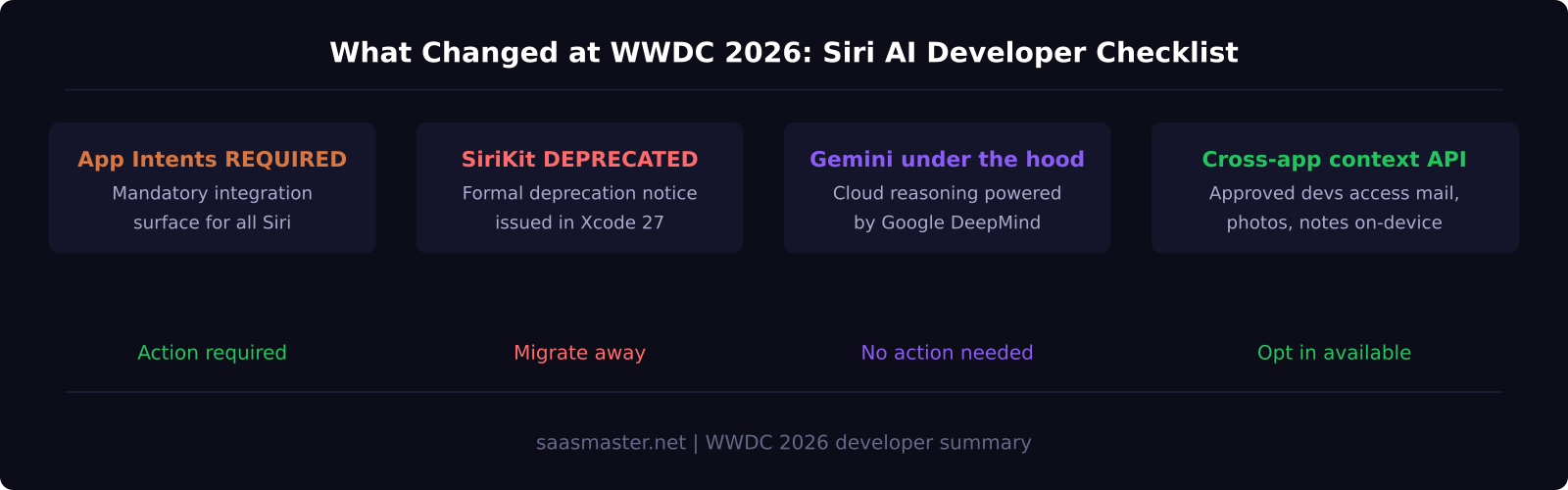
The first and most immediate is the App Intents requirement. Apple announced that App Intents is now the mandatory integration surface for any app that wants Siri compatibility going forward. If your app currently uses SiriKit for Siri integration, SiriKit has received a formal deprecation notice in Xcode 27. It will continue to function for now, but the migration path is clear: App Intents is the API you need to be building against.
App Intents is a different model from SiriKit. Rather than registering intent types and handling NSUserActivity objects, App Intents lets you expose discrete actions from your app as structured intents that Siri and Spotlight can discover and compose. The upside is that it is more flexible and composable. The downside is that it requires a meaningful rewrite for any app with existing SiriKit integration.
The second change is the cross-app context API. Apple is opening approved access to cross-device context — messages, emails, photos, notes — to third-party developers. The privacy architecture uses on-device processing: your app can request that Siri surface relevant context from the user's data to execute a specific action, but that data does not leave the device and is discarded after the action completes. This is a significant capability unlock for apps in productivity, CRM, health, and customer service categories.
Approval to use the cross-app context API is not automatic. It requires a justified privacy disclosure and presumably a review process, though Apple has not published the full criteria as of this writing.
The third change is Xcode 27's AI code completion. Apple added on-device code completion to Xcode 27, running on the same on-device foundation models as Siri AI. This is a smaller story than the Siri integration changes, but for anyone building Apple platform apps it is a meaningful workflow improvement — AI assistance without routing code to an external server.
What This Means for SaaS Apps on Apple Platforms
If you run a SaaS product with an iOS or macOS app, the most urgent implication is the App Intents requirement. Any Siri integration your app currently has via SiriKit will eventually need to be rebuilt. The migration is not optional if you want continued Siri support — it is just a question of when.
The more interesting opportunity is the cross-app context API. If your SaaS app handles tasks where user context from email, calendar, or messages would be valuable — scheduling, CRM, productivity, support — this is the first time Apple has opened a pathway for that kind of integration with a strong privacy story. For enterprise SaaS apps, the combination of cross-app context and on-device processing may make iOS 27 a compelling case study for large accounts that have historically avoided AI features on mobile due to data concerns.
One operational detail to plan for: Apple's cloud AI features — the ones that hit Gemini for heavy reasoning — carry daily limits tied to the user's iCloud subscription tier. Higher iCloud plans raise those limits. For apps that invoke Siri AI features on behalf of users, this means you need a graceful degradation path for users who have hit their daily cap. Design for that state.
The Bigger Picture: Apple Takes Its AI Seat
WWDC 2026 is Apple's substantive AI moment — not incremental features but a rebuilt architecture. The decision to run Gemini as the reasoning layer is significant. It is an acknowledgment that Apple's best path to a capable AI assistant is to lean on a frontier model for the hard reasoning work while differentiating on privacy architecture and hardware integration. Whether that is a sustainable moat or a temporary arrangement is an open question, but the partnership puts Siri AI in a different category from its 2024 and 2025 predecessors.
For SaaS builders, the practical directive is straightforward: if you have an Apple platform app, prioritize the App Intents migration and evaluate the cross-app context API for your use case. The capabilities are real and the integration window for early movers is open now.
Frequently asked questions
Does Siri AI use ChatGPT? No. Apple uses Google Gemini for the cloud reasoning layer that powers Siri AI. On-device tasks run on Apple's own foundation models via Private Cloud Compute. OpenAI had a partnership with Apple for ChatGPT integration in Siri in 2024 and 2025, but the June 2026 Siri AI architecture is powered by Gemini.
What is App Intents and why does it replace SiriKit? App Intents is Apple's current framework for exposing app actions to Siri, Shortcuts, and Spotlight. It replaces SiriKit, which received a formal deprecation notice in Xcode 27 at WWDC 2026. App Intents uses a structured, declarative model that allows Siri to compose actions across apps more flexibly than the older intent-handler pattern.
When is Siri AI available to users? Apple announced that developer betas are available starting June 9, 2026. A public beta is expected later in 2026, with full availability tied to the iOS 27 and macOS 27 general release later this year. Specific availability dates have not been confirmed as of this writing.
Was this article helpful?
SaaS Master
Creator behind SaaS Master — tutorials, walkthroughs, reviews, and explainers that help SaaS, AI, and WordPress products get understood and chosen. Writing here about the tools, trends, and tactics that actually move the needle. Work with me →
Want your product explained this clearly — in video?
Tutorials, walkthroughs, reviews, and shorts for SaaS, AI, and WordPress products.
Work With SaaS Master