AI Tools
Apple WWDC 2026: What Siri AI and the New Apple Intelligence Mean for SaaS Builders

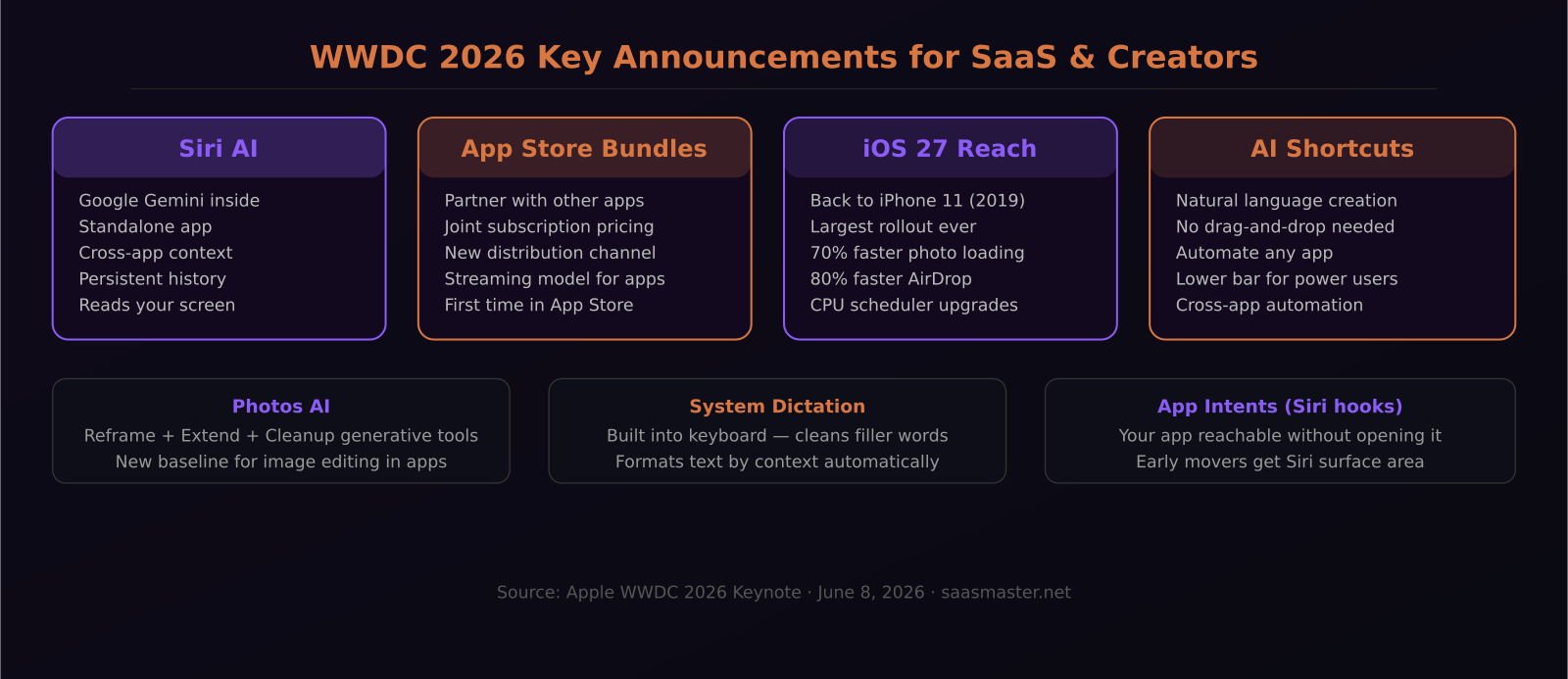
Apple has tried and failed at AI for five years. At WWDC 2026 on June 8, Tim Cook's farewell keynote did something no prior Apple Intelligence announcement managed: it showed real, working AI that changes how 1.5 billion devices behave. Siri AI, built with Google Gemini inside Apple Foundation Models, is now a standalone app that remembers your conversations, reads your screen in real time, and bridges every other app on your phone. App Store subscription bundles arrived for the first time. Natural language Shortcuts creation shipped. iOS 27 reaches back to the iPhone 11. For SaaS builders and creators, the question is not whether this matters — it is which part to move on first.
Key takeaways
- Siri AI is rebuilt with Google Gemini under the hood, now a standalone app with persistent conversation history and cross-app context awareness
- App Store subscription bundles let developers partner with complementary apps to offer cheaper joint access — a genuine new distribution channel
- iOS 27 covers devices back to iPhone 11 (2019), giving the broadest Apple launch ever
- Natural language Shortcuts creation lowers the bar for users to self-serve automation inside your app
- Tim Cook steps down September 1; hardware-first John Ternus takes over, signaling a deeper spatial computing push
Siri finally works — and now it has Google Gemini inside
The new Siri AI is not an incremental update to the assistant Apple has shipped since 2011. It is a replacement. Apple confirmed it collaborated with Google, using Gemini models as the reasoning backbone behind the Apple Foundation Models infrastructure. On-device privacy processing handles sensitive requests; heavier tasks run through Apple's Private Cloud Compute. Users who explicitly want ChatGPT can still access it — that integration from 2025 remains — but Siri AI handles the default experience.
What the new Siri does differently: it reads what is on your screen. It maintains conversation history so you can return to a thread. It bridges apps without you switching. The demo that landed hardest during the keynote was the Phone app pulling context from a related email mid-call — no prompt needed, no switching. That kind of ambient AI awareness is something competitors have promised for years and Apple is now shipping on the most popular smartphone platform on Earth.
Siri also gets voice customization (speed and expressiveness), a dedicated standalone app that works like ChatGPT in terms of persistence, and deeper iPad and Mac support that was missing in earlier Apple Intelligence iterations.
What cross-app context means if you build for iOS
Apple's expanded App Intents framework is where SaaS developers need to spend engineering time before iOS 27 launches this fall. Any capability you expose through App Intents becomes addressable by Siri without the user opening your app. Reading the latest status update from your project management tool, creating a new record in your CRM, updating a note — all of these are things Siri can handle if you have built the intents.
The apps that do this work will show up in Siri responses. The apps that don't will disappear as users increasingly talk to their phones rather than tap through them. It is an early-mover advantage and one of those Apple Developer moments that separates teams who read the WWDC session notes from those who wait for the marketing blog posts.
App Store subscription bundles: the most underreported SaaS development
This announcement was buried in the WWDC coverage but has direct revenue implications. Apple is now letting developers partner with each other to offer bundled subscriptions — two or more apps at a joint price lower than buying separately. The same model has driven subscriber growth for streaming services for years.
For SaaS teams, the implication is clear: find a complementary tool and negotiate a bundle. A writing app and a grammar assistant. A time tracker and a project manager. A design tool and an asset organizer. The discovery curve in the App Store is brutal; a bundle partnership with an established app gives you a distribution shortcut while reducing churn for both parties. This is new infrastructure Apple did not have before June 2026.
Also new: personalized App Store recommendations powered by behavior and interests, appearing across multiple App Store surfaces with "App Notes" explaining why they're being surfaced. Combined with bundles, the App Store is becoming meaningfully easier to grow through for the first time in years.
How Photos, Dictation, and Search raise user expectations for every app
Beyond Siri, three other WWDC announcements raise the baseline for what users expect from every app they use:
Photos got an AI Reframe tool (repositioning perspective as if you moved the camera), an Extend tool that expands images to any aspect ratio using generative AI, and an improved Cleanup for inpainting. If your app touches images in any way, your users now have an 8 PM comparison for what AI image editing looks like on a phone. Their bar for your tool's capabilities went up on June 8.
Dictation is now systemwide, built into the iOS keyboard, cleaning up filler words and formatting text by context — much like Wispr Flow and Willow. If your app takes voice or dictated input, this is the new baseline. Users are going to assume this quality is everywhere.
Search was rebuilt from scratch after Apple VP Stacey Ford acknowledged in the keynote that "you search for something you know is there, but it just won't show up." Email, Photos, and Spotlight all get a new foundation. If your app has in-app search, users are going to benchmark it against the new iOS standard.
Natural language Shortcuts: automation without code
Apple rebuilt Shortcuts so anyone can describe a workflow in natural language and the AI constructs it. No drag-and-drop action blocks required. "When I get a PDF in Mail, save it to my contract folder and add a task in my app to review it" — done.
The compounding benefit for SaaS developers: Apple is now doing the education work on automation that you no longer need to do. Users who previously had no idea what Shortcuts was are about to build automated workflows with it. Apps with deep Shortcuts support will get power-user engagement that was previously gated behind technical literacy. Review your App Intents documentation before fall.
iOS 27 compatibility and what it means for your install base
Apple confirmed iOS 27 supports devices from the iPhone 11 (2019) onward. Combined with performance improvements — 70% faster photo loading, 80% faster AirDrop, CPU scheduler upgrades for multitasking — it is a faster, smarter, and substantially broader platform.
For SaaS products with iOS apps, this eliminates the usual two-year bifurcation where a chunk of your user base cannot access new OS features. Apple Intelligence integrations, App Intents expansions, and Siri AI support are addressable to the vast majority of your users from launch day. That changes the economic calculus for investing in Apple-specific AI features.
What John Ternus taking over actually signals
Tim Cook's farewell at the end of the keynote was gracious and clearly planned. Ternus built his career running Apple Silicon, the Vision Pro, and the hardware supply chain. Industry observers expect a more aggressive push into spatial computing and wearables under his leadership — areas with direct SaaS implications around App Store categories, distribution models, and the kind of UX designed for a worn computer.
The post-Cook Apple may also behave differently with developers. Ternus is technical in ways Cook was not, and the hardware-first framing could accelerate investments in developer tooling and first-party frameworks.
The honest verdict on WWDC 2026
TechCrunch's read was blunt: "Apple plays catch-up." Google has had cross-app AI context in Android for over a year. ChatGPT has had conversation persistence since its inception. Natural language automation tools have existed outside iOS since 2023. None of that changes the fact that when Apple ships a feature, it ships it to a billion users with a privacy story no other company can match, on hardware the feature was designed for.
WWDC 2026 is the event that makes iOS 27 the most AI-native Apple platform ever. For SaaS builders, the next move is straightforward: audit your App Intents support, explore App Store bundle partnerships, and check your Shortcuts compatibility before the fall launch window opens.
Frequently asked questions
When is iOS 27 coming out? iOS 27 was previewed at WWDC on June 8, 2026. The public release is expected in fall 2026 alongside Apple's annual iPhone event. Developer betas are available now through the Apple Developer Program.
Which iPhones will support iOS 27? All iPhones from the iPhone 11 onward support iOS 27. The iPhone 11 launched in September 2019, making this the most broadly compatible iOS version Apple has released.
Is the new Siri AI replacing ChatGPT on iPhone? No. Siri AI, built with Google Gemini under the hood, handles the default assistant experience. ChatGPT remains available as an explicit option for tasks users choose to send to OpenAI. The two coexist — Siri AI is the default, ChatGPT is an opt-in extension for tasks requiring it.
Was this article helpful?
SaaS Master
Creator behind SaaS Master — tutorials, walkthroughs, reviews, and explainers that help SaaS, AI, and WordPress products get understood and chosen. Writing here about the tools, trends, and tactics that actually move the needle. Work with me →
Want your product explained this clearly — in video?
Tutorials, walkthroughs, reviews, and shorts for SaaS, AI, and WordPress products.
Work With SaaS Master