AI Tools
Claude Sonnet 4.6 vs GPT-5.5 Instant: Which AI API Should SaaS Builders Use in 2026?
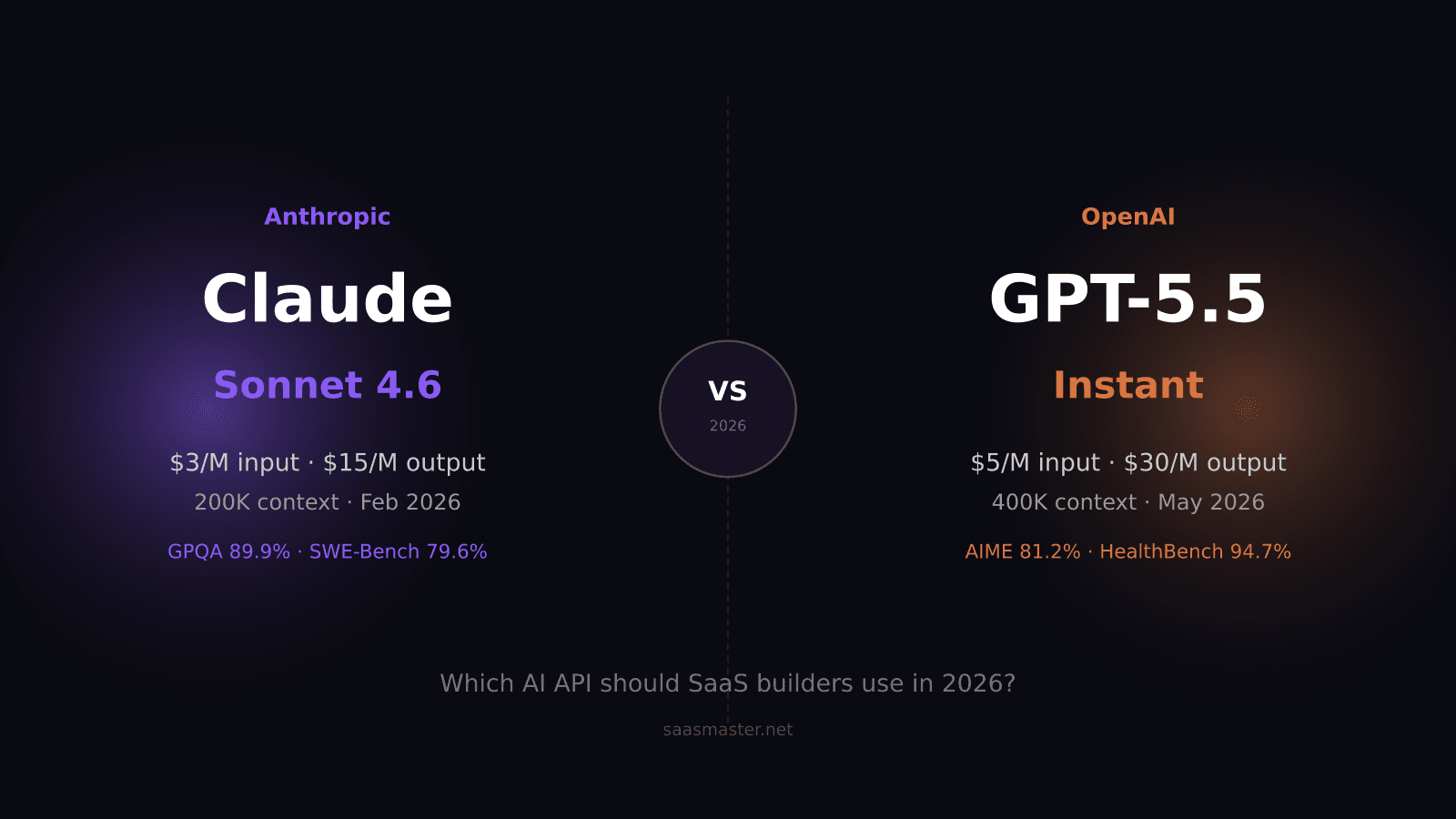
OpenAI shipped GPT-5.5 Instant on May 5, 2026, and made it the new default model in ChatGPT. It has a 400K token context window, multimodal input, and benchmark scores competitive with Anthropic's Claude Sonnet 4.6. The catch: it costs $5/M input and $30/M output — roughly double what Anthropic charges for Claude Sonnet 4.6 at $3/M input and $15/M output. Claude Sonnet 4.6, released February 17, 2026, leads on coding benchmarks. GPT-5.5 Instant leads on math and medical accuracy. If you are building a SaaS product and deciding which API to put in the core of your product, here is how to make the call.
Key takeaways
- Claude Sonnet 4.6 is 1.7x cheaper on input ($3 vs $5/M tokens) and 2x cheaper on output ($15 vs $30/M tokens)
- GPT-5.5 Instant doubles the context window: 400K input vs Claude's 200K input tokens
- Claude leads on coding: 79.6% on SWE-Bench Verified
- GPT-5.5 Instant leads on HealthBench medical accuracy (94.7%) and AIME 2025 math competition (81.2%)
- Claude Sonnet 4.6 leads on GPQA graduate-level reasoning (89.9% vs 85.6%)
What are these models?
Claude Sonnet 4.6 launched February 17, 2026, from Anthropic. It is the mid-tier model in Anthropic's current lineup — above Haiku in quality, below Opus in price — and has become the workhorse choice for SaaS builders who need frontier-level quality without Opus pricing. It supports 200K input tokens and 64K output tokens, handles text and images, and is available via API at anthropic.com.
GPT-5.5 Instant launched May 5, 2026, from OpenAI. It replaced GPT-5.3 Instant as the default ChatGPT model — the one that runs when you open chat.openai.com. According to OpenAI, it improved factuality, everyday reasoning, image understanding, STEM answers, concision, and conversational tone over its predecessor. It supports 400K input tokens and 128K output tokens. The API exposes it through the chat-latest alias. Knowledge cutoff: August 2025.
Is the price difference actually significant?
At the volume where price matters — production-scale SaaS — yes, the gap is material. Run the math:
At 500 million tokens per month of input (mid-scale for a SaaS product with AI features): - Claude Sonnet 4.6: $1,500/month - GPT-5.5 Instant: $2,500/month
That is $1,000/month saved on input alone. On output, using a 3:1 input/output ratio, your effective monthly cost is roughly 1.9x higher on GPT-5.5 Instant. Annualized across a production app, the savings on Claude compound into meaningful runway or margin.
For early-stage SaaS products, this is not abstract — it is the difference between extending runway by a month or not. For later-stage companies optimizing gross margin, the context window advantage of GPT-5.5 Instant may justify the premium depending on what you are building.
How do the benchmarks compare?
These two models are evenly matched on most general tasks, with each winning on different specialized evaluations. Here is the breakdown:
Claude Sonnet 4.6 wins on: - GPQA (graduate-level expert reasoning): 89.9% vs 85.6% for GPT-5.5 Instant - SWE-Bench Verified (real-world software engineering tasks): 79.6% - Tau2 Telecom domain benchmark: 97.9% - Tau2 Retail domain benchmark: 91.7%
GPT-5.5 Instant wins on: - HealthBench Consensus (medical accuracy): 94.7% - AIME 2025 (advanced math competition): 81.2% - MMMU-Pro (multi-modal university-level): 76.0% vs Claude's 75.6% - OmniDocBench (document parsing): 87.5%
The pattern is consistent: Claude is the stronger coding and general reasoning model. GPT-5.5 Instant is the stronger math, medical, and long-document model.
Which is better for a general SaaS product?
If you are building an AI assistant into a project management tool, a CRM, an email client, or a content creation product, Claude Sonnet 4.6 is the default choice. It costs 40% less on input tokens, it handles code generation better (79.6% SWE-Bench Verified is one of the highest scores at this price point), and its GPQA lead means it reasons through complex multi-step instructions more reliably. The 200K context window covers the vast majority of SaaS use cases.
I have been building with both APIs across several projects this year. My default for any new build is Claude Sonnet 4.6. The coding quality at $3/M input is the best I have seen at that price point — I am generating and iterating on product code faster than with any prior model, and the response structure on complex multi-step tasks is more predictable. Less "creative reinterpretation" of my instructions.
When should you use GPT-5.5 Instant?
For long-document workloads
If your product processes full legal contracts, lengthy codebases, medical records, or entire books in a single request, GPT-5.5 Instant's 400K context window is the deciding factor. You either fit the document in one API call or you don't, and model quality does not matter if you cannot hold the full context. Claude's upgrade path for context length moves to Opus, which is significantly more expensive.
For healthcare and medical SaaS
GPT-5.5 Instant's 94.7% HealthBench Consensus score is a meaningful lead in medical accuracy. If you're building clinical decision support, patient-facing health tools, or anything where medical precision is a hard requirement, this benchmark matters more than price savings.
For math-intensive products
The AIME 2025 score of 81.2% on GPT-5.5 Instant versus no published equivalent from Claude signals a gap in advanced mathematical reasoning. Financial modeling tools, quantitative research products, and STEM education platforms benefit from this edge.
A note on routing
If you want the best of both, AI routing frameworks like LiteLLM, PortKey, and Vellum let you route requests to different models based on task type or content length. You can default to Claude Sonnet 4.6 for most requests and switch to GPT-5.5 Instant when input length exceeds 150K tokens or when the task category matches math/medical. At scale, smart routing can cut API costs by 30-50% while maintaining quality on tasks that genuinely need the premium model.
The honest call
For most SaaS builders in 2026, Claude Sonnet 4.6 is the better default. The 40% price advantage on input tokens, the coding benchmark lead, and the GPQA reasoning edge make it the cleaner choice for the majority of use cases. GPT-5.5 Instant is the right call when you specifically need a 400K context window, high medical accuracy, or advanced math reasoning — categories where its benchmark advantages are large enough to outweigh the cost delta. Outside those use cases, you are paying a $2/M premium for OpenAI branding, which is a fine reason if your customers care about it, but not a technical one.
Frequently asked questions
Is Claude Sonnet 4.6 or GPT-5.5 Instant better for writing? Both perform well on writing tasks. Claude Sonnet 4.6 tends to produce more structured, instruction-following prose. GPT-5.5 Instant handles conversational and varied tone slightly better. For marketing copy and content generation, the quality gap is small — default to Claude based on price ($3 vs $5/M input) unless your content workflows specifically favor GPT's voice.
Can I use GPT-5.5 Instant as the default model in the ChatGPT interface? Yes. GPT-5.5 Instant became the default ChatGPT model on May 5, 2026, accessible via the chat-latest API alias and as the standard experience at chat.openai.com for both free and paid users.
What is the context window for Claude Sonnet 4.6? Claude Sonnet 4.6 supports 200,000 input tokens and 64,000 output tokens. GPT-5.5 Instant supports 400,000 input tokens and 128,000 output tokens — double the input capacity and double the output capacity. For workflows regularly exceeding 150K tokens, GPT-5.5 Instant or Claude Opus are the alternatives.
Was this article helpful?
SaaS Master
Creator behind SaaS Master — tutorials, walkthroughs, reviews, and explainers that help SaaS, AI, and WordPress products get understood and chosen. Writing here about the tools, trends, and tactics that actually move the needle. Work with me →
Want your product explained this clearly — in video?
Tutorials, walkthroughs, reviews, and shorts for SaaS, AI, and WordPress products.
Work With SaaS Master