AI Tools
Veo 3.1 vs Kling 3.0 vs Runway Gen-4.5: Which AI Video Generator Is Worth It in 2026?
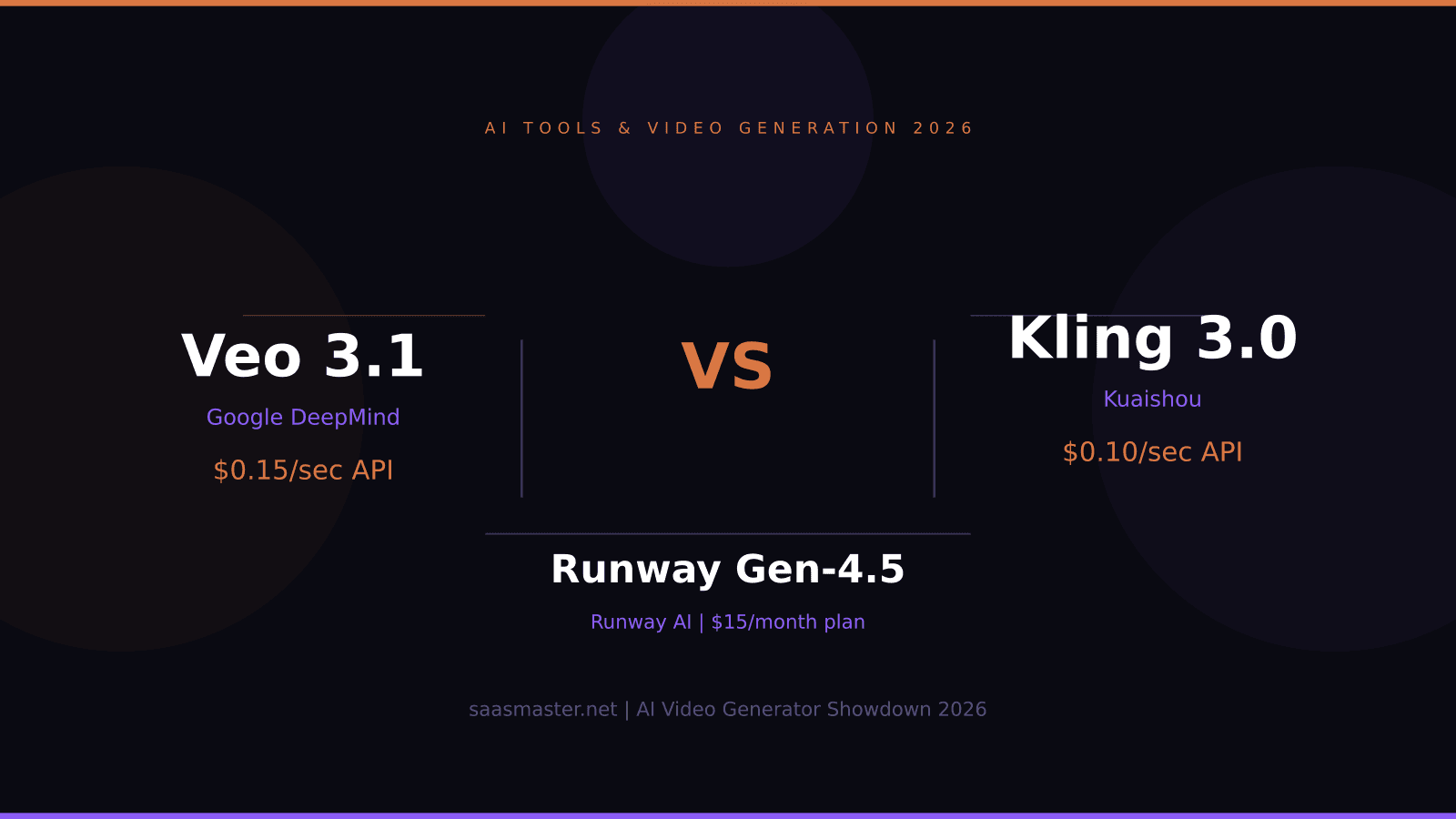
OpenAI pulled the plug on Sora in 2026 and left a real gap. Three tools are now filling it — and together they form a clearer picture of what AI video actually is today.
After burning roughly $1 million per day in compute costs and running into unresolved copyright disputes over training data, OpenAI shut down the Sora web app on April 26, 2026. The API follows on September 24. If you built workflows on Sora, the clock is ticking. But if you are new to AI video in 2026, you are entering a market that has, honestly, gotten better without Sora. Google Veo 3.1, Kling 3.0 from Kuaishou, and Runway Gen-4.5 are the three tools that now define this space — and they serve meaningfully different purposes.
Key takeaways
- Sora is shutting down. The consumer app went dark April 26, 2026; the API ends September 24, 2026.
- Veo 3.1 produces the best output quality with native 4K and native audio. API pricing starts at $0.15 per second via Google's fast tier.
- Kling 3.0 is the most affordable premium option at $0.10/sec and from $6.99/month, with excellent multi-shot consistency and native audio sync.
- Runway Gen-4.5 offers the deepest creative controls — motion brush, camera moves, character reference — and bundles Veo 3.1 and Kling 3.0 access in one $15/month plan.
- No single tool wins every use case. Your workflow determines your choice.
Why Sora Shut Down, and What That Tells Us
The Sora shutdown was an economic decision more than a quality one. The model was technically impressive at launch, but maintaining that output at scale cost roughly $1 million per day in compute, and the business model never justified it. Competitors — specifically Veo 3.1 and Kling 3.0 — caught up on quality while charging a fraction of Sora's $200/month price point.
The copyright problem compounded things. Sora used an opt-out model for training data, meaning rights holders had to actively remove their content rather than consent to its use. Major media companies pushed back, creating legal uncertainty that would have been expensive to resolve. Rather than rebuild the training pipeline, OpenAI chose to exit the consumer video space. The API staying live until September is a migration window, not a revival.
The practical takeaway: the AI video tools that survived are better for it. The market shakeout forced the remaining players to compete hard on quality, pricing, and feature depth.
Veo 3.1: The Best Output Quality Available Today
Google Veo 3.1 is the current quality benchmark. It generates native 4K in landscape and portrait orientations, produces synchronized audio from text prompts, and shows the fewest physics hallucinations — the glitchy liquid, fabric, or hand behavior that signals a weaker model.
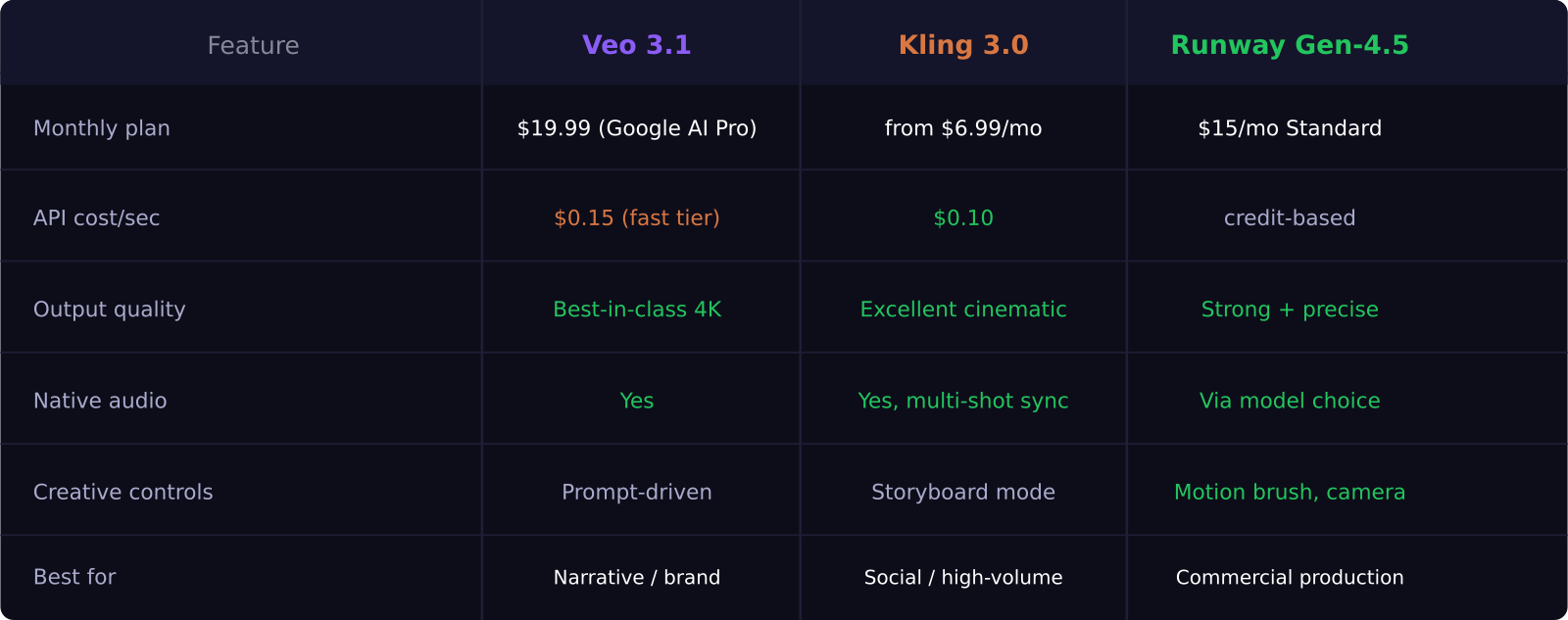
Access to Veo 3.1 follows Google's subscription tiers. Google AI Pro subscribers at $19.99/month get Veo 3.1 with usage limits tied to their plan's data bandwidth. Google AI Ultra at $249.99/month — currently discounted to $124.99 for the first three months — removes those limits and adds 30TB of storage and Project Mariner access. For API work, Veo 3.1 Standard costs $0.75 per second and the Fast tier runs $0.15 per second.
The primary interface is Google Flow, which wraps Veo 3.1 in a storyboarding and multi-shot orchestration layer for longer sequences. For teams producing narrative brand content, product walkthroughs, or cinematic establishing shots where quality is non-negotiable, Veo 3.1 is the strongest foundation.
The limitation is cost. At the Ultra tier, $249.99/month is a serious line item for an individual creator or small team. The AI Pro tier is reasonable but the usage limits on video generation can be tight for high-volume workflows.
Which Is Cheaper — Veo 3.1 or Kling 3.0?
Kling 3.0, built by Kuaishou — the Chinese short-video platform — is the most cost-effective premium option in 2026. Plans start at $6.99/month for basic access, with professional tiers ranging from $29 to $99/month depending on monthly credit volume. API access is priced at $0.10 per second, which is one-seventh of Veo 3.1's Standard API rate and one and a half times cheaper than Veo's Fast tier.
The quality gap between Kling 3.0 and Veo 3.1 is real but narrower than the price difference suggests. Kling's strongest capabilities are multi-shot cinematic sequences with native audio sync across cuts and what the platform calls subject consistency — keeping a character's face, outfit, and physical proportions stable across multiple shots. Its physics rendering for complex motion — hair, liquids, fabric — is arguably the best of the three tools.
For teams producing social content, product demos, marketing loops, or any workflow where per-clip economics matter, Kling 3.0 is the rational choice. The price-to-output ratio is difficult to argue with. If your use case does not demand Veo's absolute ceiling on quality, Kling gets you 85% of the way there at 20% of the cost.
Runway Gen-4.5: Best When You Need to Direct, Not Just Prompt
Runway Gen-4.5 operates at a different level of abstraction from Veo and Kling. Where those tools are primarily generation engines — describe it, render it — Runway adds a production control layer on top. Motion brush lets you paint specific regions of a frame and define directional movement. Named cinematic camera moves (pan, truck, push, pull, orbit) give you vocabulary that video professionals recognize. Reference-driven character consistency lets you upload a source image and maintain that subject across multiple generations.
Runway Standard costs $15/month (or $12 billed annually) with 625 credits, and the Pro tier runs $35/month (or $28 annually) with 2,250 credits. One significant feature of the Standard tier: Runway now bundles Gen-4.5, Veo 3.1, and Kling 3.0 Pro access under a single subscription. For someone who wants flexibility across models — sometimes Veo's quality ceiling, sometimes Kling's economics, sometimes Runway's controls — this makes the $15/month plan a multi-model access point at a competitive price.
The honest tradeoff is time. Runway's tools are powerful but they require decisions. If you need to ship content fast and trust the model to handle compositional choices, Runway's overhead adds friction. If you are doing commercial work where the client expects specific camera behavior, consistent talent, and frame-level creative control, Runway is the only tool that actually delivers those things reliably.
Is Runway's Plan Worth It Over Buying Directly?
The $15/month Runway Standard plan bundles three top-tier model families. Standalone Kling basic starts at $6.99/month; Google AI Pro (which includes Veo 3.1 with limits) costs $19.99/month. For someone testing across models without committing to a workflow, the Runway subscription at $15/month covers all three model families for less than the cost of Google AI Pro alone.
For high-volume users, the math changes. At scale, direct API access to Kling at $0.10/sec will be cheaper than burning through Runway credits, which price at varying rates depending on model and resolution. The Runway subscription is best for exploration, production toolchain, and moderate volume. Dedicated API access wins when you are rendering hundreds of clips per month.
Which AI Video Generator Should You Pick?
If output quality is the primary variable and cost is secondary, use Veo 3.1. Google AI Pro at $19.99/month gives you access to the best model available without the Ultra subscription premium.
If budget is the primary constraint, use Kling 3.0. At $6.99/month entry and $0.10/sec API pricing, you get professional-grade output — especially on multi-shot and motion-heavy scenes — at a price point that actually works for small teams and solo creators.
If you are doing commercial production where the client expects creative precision — specific camera moves, consistent characters, directed motion — use Runway Gen-4.5. The $15/month Standard plan also gives you API access to Veo and Kling through one dashboard, which is worth something if you are still finding your workflow.
The practical starting move for most teams: Runway Standard at $15/month, run the same prompt through all three model families on the first shoot, and let the output differences make the decision for you.
Frequently asked questions
Is Sora still available in 2026? No. OpenAI shut down the Sora web app on April 26, 2026 after compute costs of approximately $1 million per day made the product uneconomical. The Sora API remains live until September 24, 2026. The primary replacements are Google Veo 3.1, Kling 3.0, and Runway Gen-4.5.
What is the cheapest AI video generator in 2026? Kling 3.0 is the most affordable premium option. Plans start at $6.99 per month and API access costs $0.10 per second. This compares to Veo 3.1 at $0.75/sec Standard or $0.15/sec Fast, and Runway on credit-based pricing that varies by model and resolution.
Can you access Veo 3.1 without paying $249.99 per month? Yes. Veo 3.1 is included in Google AI Pro at $19.99/month with usage limits based on your plan tier. It is also accessible via API at $0.15/sec on the Fast tier and via the Runway Standard plan at $15/month, which bundles Veo 3.1, Kling 3.0, and Runway Gen-4.5 access in one subscription.
Was this article helpful?
SaaS Master
Creator behind SaaS Master — tutorials, walkthroughs, reviews, and explainers that help SaaS, AI, and WordPress products get understood and chosen. Writing here about the tools, trends, and tactics that actually move the needle. Work with me →
Want your product explained this clearly — in video?
Tutorials, walkthroughs, reviews, and shorts for SaaS, AI, and WordPress products.
Work With SaaS Master