AI & SaaS
Apple WWDC 2026: Free AI for Small Developers — What SaaS Builders Actually Get
In short
Apple announced free Foundation Models for qualifying developers at WWDC 2026. Here is who qualifies, what the free tier covers, and what the open source Linux announcement means for SaaS.
Apple made Foundation Models free for a specific group of developers at WWDC 2026 and opened the framework to third-party models including Claude and Gemini in the same announcement. If you build iOS or macOS apps and your total first-time App Store downloads are under two million, you now have access to Apple's on-device AI at no API cost. Here is exactly what was announced and what it actually means for product builders in 2026.
Key takeaways
- Developers in Apple's App Store Small Business Programme with under two million first-time downloads can call Foundation Models on Private Cloud Compute for free.
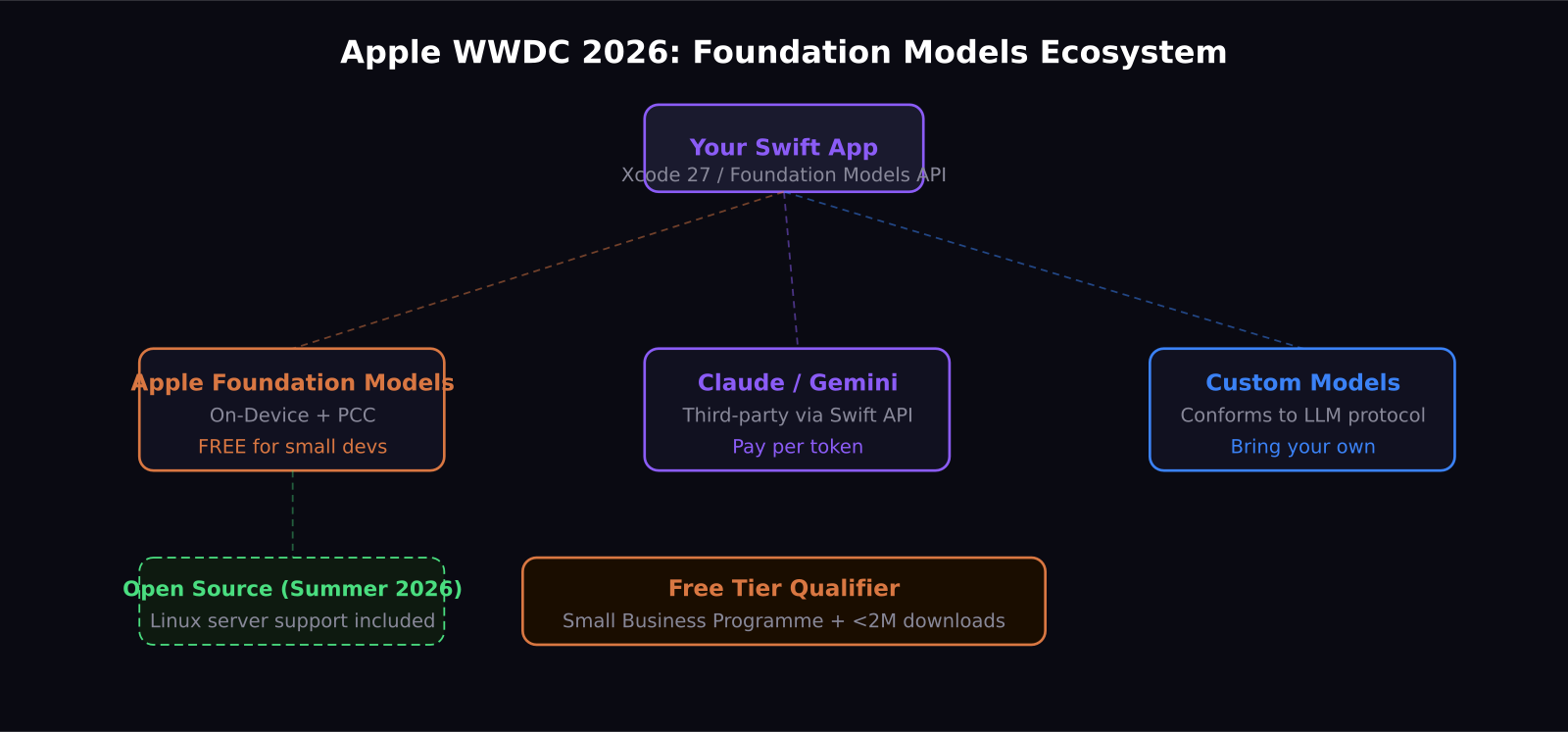
- Xcode 27 now routes natively to Claude, Gemini, and Apple Foundation Models through a single Swift API, with one-line model switching.
- Apple confirmed the Foundation Models framework will go open source in summer 2026, with Linux server support included.
- The framework is gaining image input support and a Dynamic Profiles system for multi-agent workflows.
- Apple Foundation Models is the same on-device model that powers Writing Tools, call summaries, and smart replies across iOS 26 and macOS Tahoe.
What Apple announced at WWDC 2026
The most significant AI announcement for developers at WWDC 2026 was not a new benchmark or a model upgrade. It was a pricing decision: Apple is subsidizing AI API costs for small developers who would otherwise be paying OpenAI, Anthropic, or Google.
The free tier covers calls to Apple Foundation Models running on Private Cloud Compute. The qualifying threshold is clear: enrollment in the App Store Small Business Programme and fewer than two million total first-time App Store downloads across all your apps. That threshold captures a wide range of early-stage and independent developers who are already on the reduced 15% App Store commission.
For an iOS developer building AI-powered features, this removes one of the biggest friction points in shipping an intelligent product. API costs for services like Claude or GPT-5.5 can reach thousands of dollars per month at moderate scale. Getting equivalent capability at zero API cost changes the unit economics of AI features for apps that qualify.
What Foundation Models actually does
Apple Foundation Models is the on-device and server-side language model behind Apple Intelligence features: Writing Tools, call transcription and summaries, photo descriptions, smart replies, and notification prioritization across iOS 26 and macOS Tahoe. The on-device variant runs entirely on the device, with no data leaving the hardware. Private Cloud Compute is Apple's server option for tasks that require more compute than the device can handle locally.
The model is not competing with Claude Opus 4.8 or GPT-5.5 on coding benchmarks. It is optimized for the tasks that matter most inside Apple apps: short-form summarization, tone adjustment, text classification, and on-device inference with strong privacy guarantees. For SaaS features that need to work offline or that process sensitive user data, those constraints make Foundation Models worth considering regardless of the free tier pricing.
Xcode 27 and unified model routing
The Xcode 27 announcement may be the more consequential change for developers who already pay for Claude or Gemini. Xcode 27's Foundation Models framework now allows developers to call any supported model, including Claude Opus 4.8, Gemini 3.1 Pro, and Apple Foundation Models, through the same Swift API. Switching between models is a one-line code change.
This makes A/B testing AI models practical in a way it was not before. You can build a feature using Apple Foundation Models to keep API costs at zero, then benchmark it against Claude and Gemini to see whether the quality gap justifies the additional spend. The unified interface makes that comparison operationally cheap.
It also removes the boilerplate of building separate network layers for different AI providers. For teams who want to stay in Swift end to end, Xcode 27 consolidates what used to require three different SDKs into one.
The open source plan
Apple confirmed at WWDC that the Foundation Models framework will go open source later in summer 2026. At that point, it will also support Linux servers, which is the part of the announcement I find most significant.
For SaaS companies running backends on Linux, open source Foundation Models on Linux servers would mean access to Apple's model without Apple hardware, without API fees, and without a dependency on Apple's infrastructure. The privacy-first design of Foundation Models makes it particularly interesting for enterprise SaaS products that handle regulated data.
The details on what exactly will be open sourced have not been fully specified. Whether the model weights, the inference engine, or just the framework code is released will determine how useful this actually is in practice. If the weights ship with the release, this becomes the most capable privacy-first open-weight model announced in 2026.
What this means for SaaS teams right now
If you run a pure web SaaS with no iOS or macOS surface, today's announcements are less immediately relevant. Foundation Models currently runs on Apple hardware and the free tier only applies to App Store developers.
If you have an iOS or macOS app and you have been paying for AI API calls for features like document summarization, smart reply, or content classification, the free tier is worth a serious evaluation. The model is not frontier quality for complex reasoning tasks, but for the majority of consumer-facing AI features that do not require deep multi-step reasoning, the quality gap from Claude or GPT-5.5 is smaller than the price gap.
The Linux and open source announcement is the part with the most long-term implication for SaaS builders who never ship to the App Store. If Apple follows through with model weights in the open source release, it could become viable infrastructure for privacy-conscious backend AI that eliminates third-party API dependence entirely.
My take on Apple's strategy
Apple is playing a different game from OpenAI, Google, and Anthropic. The goal is not to win the benchmark competition. It is to make AI features so cheap and easy for Apple developers that Foundation Models becomes the default choice before a developer reaches for a paid API.
That strategy appears to be working. At WWDC 2026, the room responded more strongly to the free tier announcement than to any benchmark number. Free access beats two percentage points better on SWE-bench every time when you are an independent developer watching your cloud costs.
For SaaS and video content creators watching this space, the practical implication is that iOS and macOS apps are about to ship smarter AI features faster and at lower cost. More capable competitor apps, higher user expectations, and a development ecosystem moving faster than it was six months ago.
Frequently asked questions
Who qualifies for the free Apple Foundation Models tier?
Developers enrolled in Apple's App Store Small Business Programme whose apps have collectively accumulated fewer than two million first-time App Store downloads qualify. The programme already provides a 15% App Store commission rate instead of 30%, and the Foundation Models free tier adds AI API access to those benefits at no additional cost.
Can I use Apple Foundation Models in a web or desktop SaaS app?
Not yet at the current API level. Foundation Models runs on Apple hardware with Private Cloud Compute as the server option. The open source release planned for summer 2026 will add Linux server support, which would make it viable for non-Apple infrastructure, but the details on what ships in that release have not been fully confirmed.
Is Apple Foundation Models better than Claude Opus 4.8 or GPT-5.5?
No, not on general reasoning or coding benchmarks. Foundation Models is optimized for on-device, privacy-preserving tasks and the specific AI features that Apple Intelligence powers in iOS 26 and macOS Tahoe. For complex agent work, coding, or large-context analysis, Claude Opus 4.8 and GPT-5.5 are significantly stronger. The value proposition is zero cost for qualifying developers, strong privacy guarantees, and native Apple integration, not raw capability.
Was this article helpful?
SaaS Master
Creator behind SaaS Master — tutorials, walkthroughs, reviews, and explainers that help SaaS, AI, and WordPress products get understood and chosen. Writing here about the tools, trends, and tactics that actually move the needle. Work with me →
Want your product explained this clearly — in video?
Tutorials, walkthroughs, reviews, and shorts for SaaS, AI, and WordPress products.
Work With SaaS Master