AI & SaaS
Bland AI Review: Voice AI Raised $50M After 180 Rejections — What SaaS Teams Need to Know
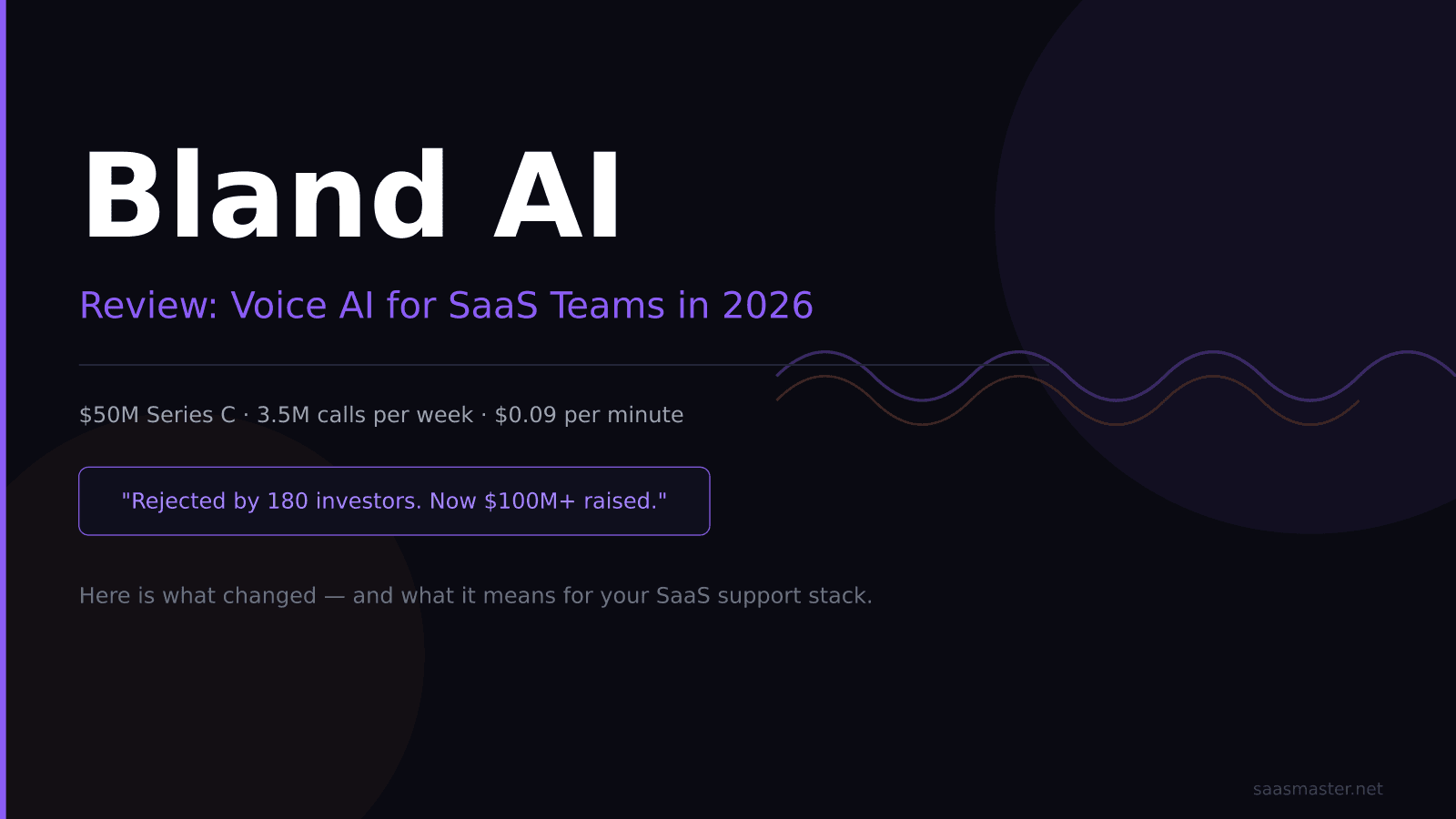
Bland AI was rejected by 180 investors before closing a $50 million Series C on June 16, 2026, led by Dell Technologies Capital. The company now handles more than 3.5 million calls per week for clients including Samsara, Kin Insurance, and CNO Financial Group. That is not a scrappy startup story anymore. That is a market signal about where enterprise voice AI is heading.
If you run a SaaS team that handles customer communication by phone — onboarding calls, support escalations, renewal conversations — this review covers everything you need to decide whether voice AI belongs in your stack this year.
Key takeaways
- Bland AI raised $50M Series C in June 2026 (led by Dell Technologies Capital), bringing total funding past $100M
- The platform handles 3.5M+ calls per week across healthcare, financial services, and enterprise SaaS
- Voice agents hold 30–45 minute conversations with real context retention, mid-call API lookups, and intelligent human handoff
- Pricing starts at $0.09 per minute on pay-as-you-go; subscription tiers scale costs down at volume
- Implementation takes two to six weeks for a production-ready agent; the platform is developer-first infrastructure, not a plug-and-play tool
Why 180 investors said no — and why they were wrong
The rejection story is useful context for understanding what Bland actually is. Most of those VCs said voice AI was too narrow, too operationally risky for high-stakes conversations, and too hard to differentiate from cheaper IVR tools. They were evaluating voice AI as a smarter phone menu.
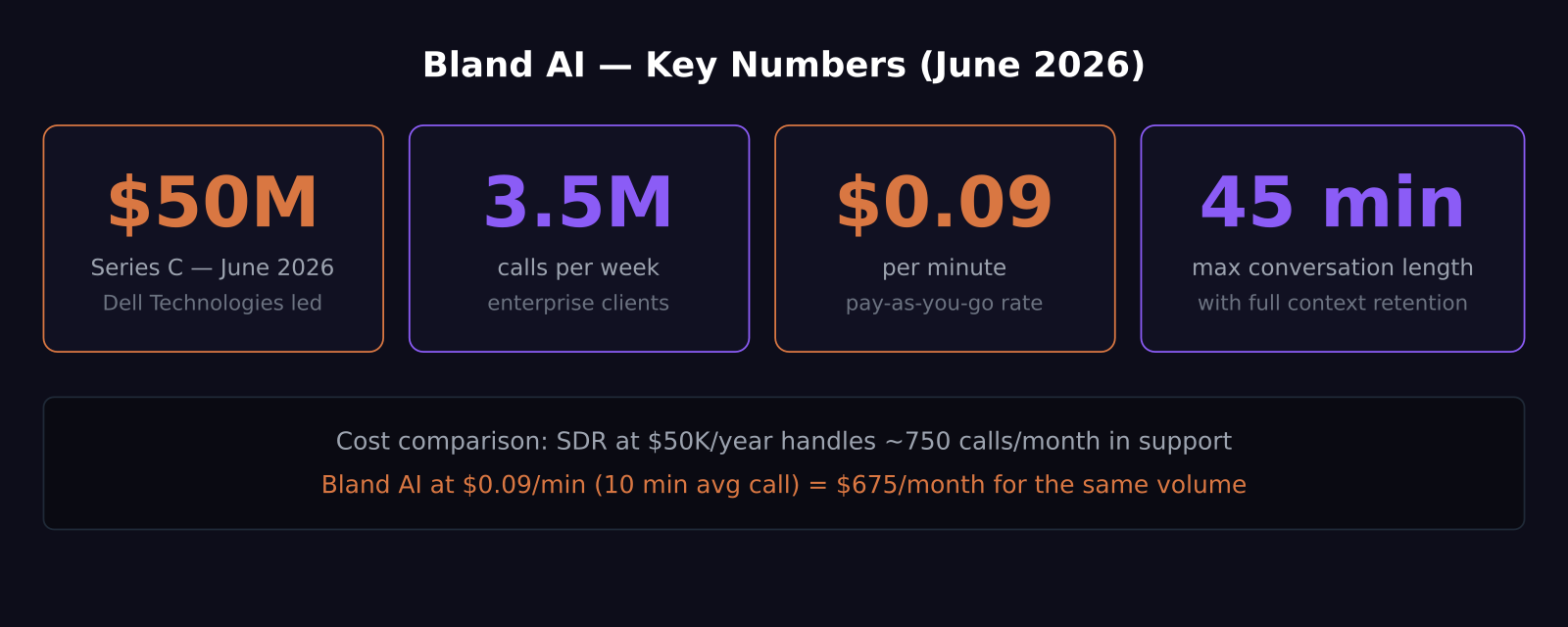
Bland bet on the opposite position: go after the hardest use cases first. Healthcare calls lasting 30 to 45 minutes. Insurance claims where every word carries liability. Enterprise support where a wrong answer costs a contract. If you can handle those, simple transactional calls are trivial. That strategy is now processing 3.5 million calls per week and backed by Dell Technologies Capital — not a firm that invests in novelty.
The signal for SaaS teams is not the funding number. It is the use case profile. If Bland handles blood pressure monitoring calls for elderly patients — including real-time reading interpretation and emergency escalation — your SaaS onboarding call is well within its operating envelope.
What Bland actually does
Bland is enterprise voice infrastructure: the platform you build AI phone agents on, not a pre-packaged bot you deploy out of the box.
What separates it from older voice automation is real-time function calling. While a Bland agent is talking to a customer, it silently triggers API requests mid-sentence — checks account status, pulls a support ticket, updates a CRM record, confirms a subscription tier — and responds naturally in the same breath without putting the caller on hold. The conversation does not pause while the system looks something up. The agent already knows.
Context retention is the other key differentiator. A Bland agent tracks the full arc of a conversation. If a customer explains their problem in the first minute and then provides two minutes of background detail, the agent uses all of it accurately for the rest of the call. It does not forget what it heard six exchanges ago. For multi-step onboarding flows or complex technical troubleshooting — the kind of call that used to require a trained support specialist — this is the capability that makes the tool worth considering.
What SaaS teams use it for
Inbound support at volume
The clearest SaaS use case is first-line support. Bland agents handle the calls that eat your support team's time — password resets, plan upgrades, billing questions, feature troubleshooting — and escalate to humans only when the conversation genuinely requires judgment beyond the agent's range. Because Bland carries the full conversation context into the handoff, the human who picks up does not have to ask the customer to start over.
Outbound onboarding and trial activation
SaaS companies with higher-touch onboarding — products where new users need a walkthrough, a check-in call, or a guided setup during a trial period — can run Bland agents for first-contact at scale. The agent runs the product tour, identifies where the user got stuck, logs the friction point, and either resolves it or schedules a human call if needed. For products where trial-to-paid conversion depends on early activation, automating that first onboarding call while maintaining genuine conversational quality is a significant lever.
Renewal and churn prevention
Renewal campaigns that used to require an SDR manually dialing a list are a natural fit. Bland agents run outbound renewal sequences, assess customer intent from the actual conversation, and hand off to a closer only when the account shows genuine purchase signals. For SaaS teams with subscription tiers and high renewal volume, this is a direct replacement for a category of sales development headcount.
How much does it cost?
Pay-as-you-go pricing is $0.09 per minute. A 15-minute onboarding call costs roughly $1.35. A 30-minute complex support call runs about $2.70.
Subscription tiers — Start, Build, Scale, and Enterprise — reduce per-minute costs at volume and add dedicated phone numbers, higher concurrency limits, and priority infrastructure. Enterprise pricing is custom and typically includes SLA guarantees and compliance documentation for regulated industries.
The comparison point that matters: a support SDR at $50,000 annual salary handles roughly 30 to 50 calls per day, or approximately 750 calls per month. At $0.09 per minute and a 10-minute average call length, 750 Bland calls cost about $675 per month. The economics are not subtle, and they become even clearer as call volume scales.
The developer reality
Bland is infrastructure. If your team does not have developers who can build and maintain a conversational workflow — call logic design, API integration for function calling, QA across hundreds of test calls — you are looking at a two-to-six-week implementation project, not a same-day installation.
The integrations that matter most are documented and actively maintained: Twilio for telephony, Zapier and Make for no-code connectors, Salesforce and HubSpot for CRM, and REST APIs for custom product integrations. The building blocks are mature. The configuration work is real.
What you do not get out of the box is a pre-built SaaS support agent. You get the infrastructure to build one correctly. That distinction matters when you are scoping timelines and headcount for implementation.
For teams considering whether to build versus buy: Bland occupies the build side. If you want a voice agent live in 48 hours with no engineering, Bland is not the right product. If you want a reliable, context-aware, deeply integrated voice agent that feels like a natural extension of your product — and you have the engineering resources to build it — Bland is one of the most mature options available at this price point.
Frequently asked questions
How is Bland AI different from a traditional IVR system?
Traditional IVR systems follow fixed decision trees: press 1 for billing, press 2 for support. Bland uses conversational models that respond naturally to what the caller actually says, retain context across the full call, trigger API calls mid-conversation, and hand off intelligently to humans based on call content. For the caller, the experience is closer to talking to a knowledgeable support rep than navigating a phone menu.
Does Bland AI support multiple languages?
Yes. Bland supports multilingual conversations and can detect and switch languages mid-call. For SaaS companies with international customer bases, this removes the need for separate agent configurations per language and simplifies global support operations.
How long does it take to deploy a Bland AI agent in production?
Most production Bland agents go live in two to six weeks. Timeline depends on conversation flow complexity, the number of API integrations required, and how thoroughly you QA the call logic before releasing to real customers. Teams with existing API infrastructure and experience in conversational design deploy faster.
Was this article helpful?
SaaS Master
Creator behind SaaS Master — tutorials, walkthroughs, reviews, and explainers that help SaaS, AI, and WordPress products get understood and chosen. Writing here about the tools, trends, and tactics that actually move the needle. Work with me →
Want your product explained this clearly — in video?
Tutorials, walkthroughs, reviews, and shorts for SaaS, AI, and WordPress products.
Work With SaaS Master