AI Tools
MiniMax M2.7 Review: The Self-Evolving AI That Rivals Claude at a Fraction of the Cost
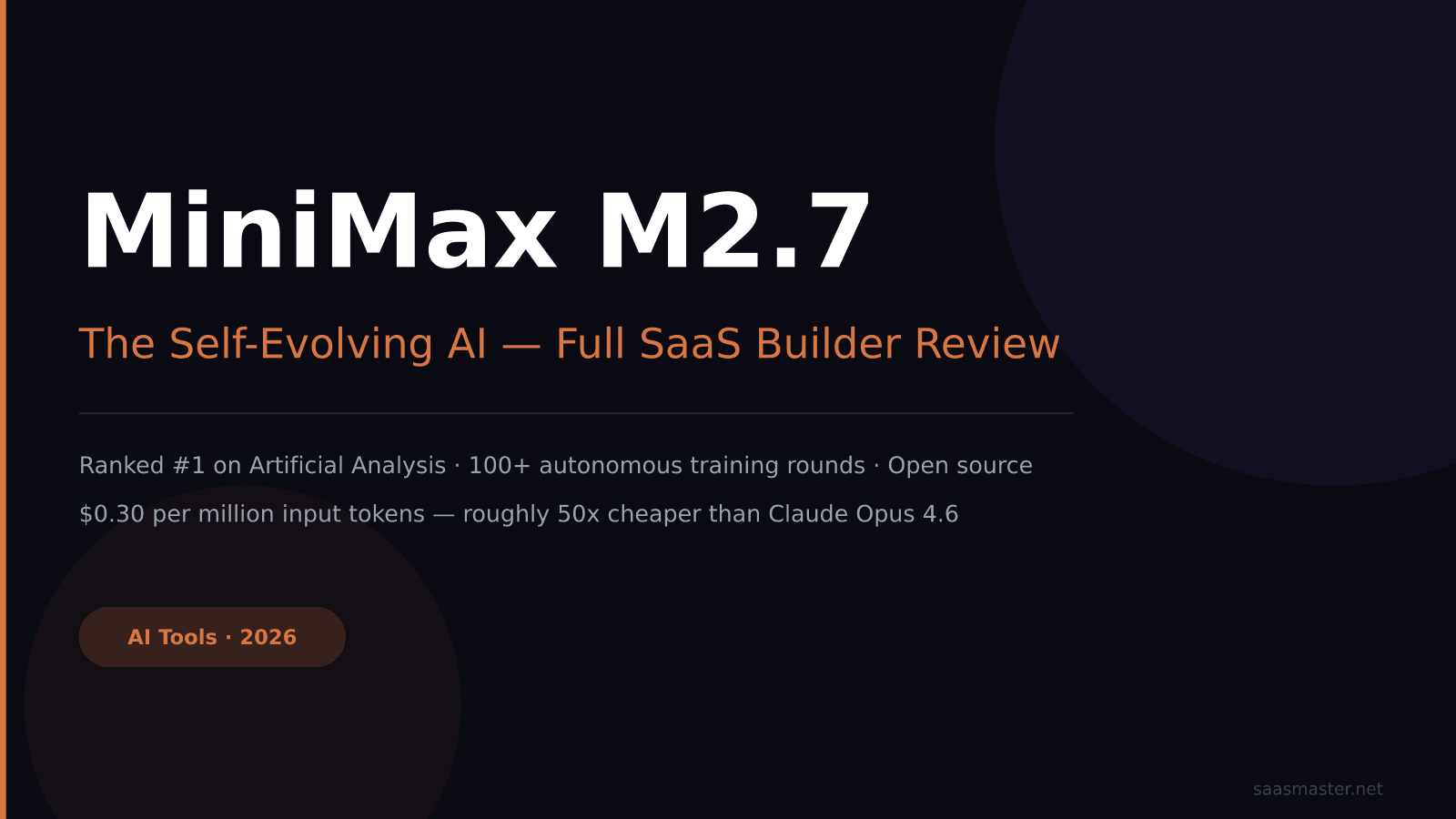
MiniMax M2.7 came out in March 2026, got open-sourced on Hugging Face, and quietly ranked number one on the Artificial Analysis Intelligence Index across 136 models. You probably did not hear about it. That is exactly the point of this review.
This is a model that partially trained itself — over 100 autonomous optimization rounds, no human sign-off on individual changes — and the result is a coding agent that scores 56.22% on SWE-Pro and handles 30 to 50 percent of its own reinforcement learning workflow. For SaaS builders paying $15 or more per million tokens for Claude Opus, the $0.30 input pricing deserves a serious look.
Here is what I found after putting it through the same workflows I use for real builder and client projects.
Key takeaways
- MiniMax M2.7 ranks #1 on the Artificial Analysis Intelligence Index with a score of 50, against a field average of 19 across 136 models tested
- It is the first AI model that autonomously optimized itself during training: 100+ cycles, 30% internal benchmark improvement, no human direction per round
- Pricing is $0.30 per million input tokens — roughly 50 times cheaper than Claude Opus 4.6 at comparable agentic performance
- The model is fully open-source and deployable on your own GPU infrastructure via Hugging Face
- 230 billion total parameters, 10 billion active per token, 200K context window
What is MiniMax M2.7?
MiniMax is a Shanghai-based AI lab founded in December 2021. Their M2.7 model, released March 18, 2026, is one of the most technically unusual models to come out of any lab this year — for one specific reason: it helped build itself.
During training, an internal version of M2.7 ran more than 100 rounds of scaffold optimization. It analyzed its own failure trajectories, modified its own training code, ran evaluations, and decided whether to keep or revert changes — all without human sign-off on individual decisions. MiniMax reports this produced a 30% improvement on internal evaluation sets. They call it self-evolution, and while the name is bold, the benchmark scores back the claim.
The underlying architecture is Mixture-of-Experts: 230 billion total parameters, but only 10 billion are active during any single token inference. That is why the pricing is sustainable at this level. Cost per token scales with active compute, not total parameter count — so you get near-frontier quality at a fraction of the inference cost of dense-architecture competitors.
How does it perform on real SaaS tasks?
Coding and software engineering
MiniMax M2.7 scores 56.22% on SWE-Pro and 57.0% on Terminal Bench 2. These benchmarks test models against actual GitHub issues in production codebases — not synthetic coding puzzles. SWE-Pro is the harder variant of SWE-Bench Verified, where models must produce code that gets merged into real open-source projects.
For SaaS builders, what this means in practice: M2.7 handles multi-file refactors, debugging across long codebases, and feature scaffolding without losing context. The 200K token window is large enough for most mid-size SaaS applications to fit in a single context load — which is the real difference between a model that understands your codebase and one that keeps forgetting what it just read.
What surprised me most was the spec-writing behavior. Before generating any code, M2.7 actively decomposes the problem: it writes out a project structure, lists the modules it plans to create, identifies dependencies, and only then begins implementation. This behavior emerged from training, not from a system prompt instruction. It mirrors what a senior engineer does naturally, and it catches the architectural mistakes that most language models make when asked to build something non-trivial from scratch.
Office work and document processing
MiniMax designed M2.7 around three core capability areas: software engineering, office work, and multi-agent collaboration. On the office side, the 200K context window is the differentiator. You can load full product specs, contract documents, customer transcript databases, or support ticket histories and get structured analysis without truncation.
For SaaS content workflows — summarizing user feedback at volume, writing release notes from changelogs, reviewing feature requests across a quarter of tickets, or extracting themes from customer interviews — M2.7 performs at a level comparable to models costing five to ten times as much per token.
Multi-agent workflows
The most forward-looking feature in M2.7 is what MiniMax calls Agent Teams: native multi-agent collaboration where multiple M2.7 instances can assign subtasks to each other, review each other's outputs, and iterate without a human coordinator. For SaaS teams experimenting with agentic pipelines — automated code review loops, customer onboarding sequences, background data processing — this is worth prototyping.
Is it actually cheaper to run?
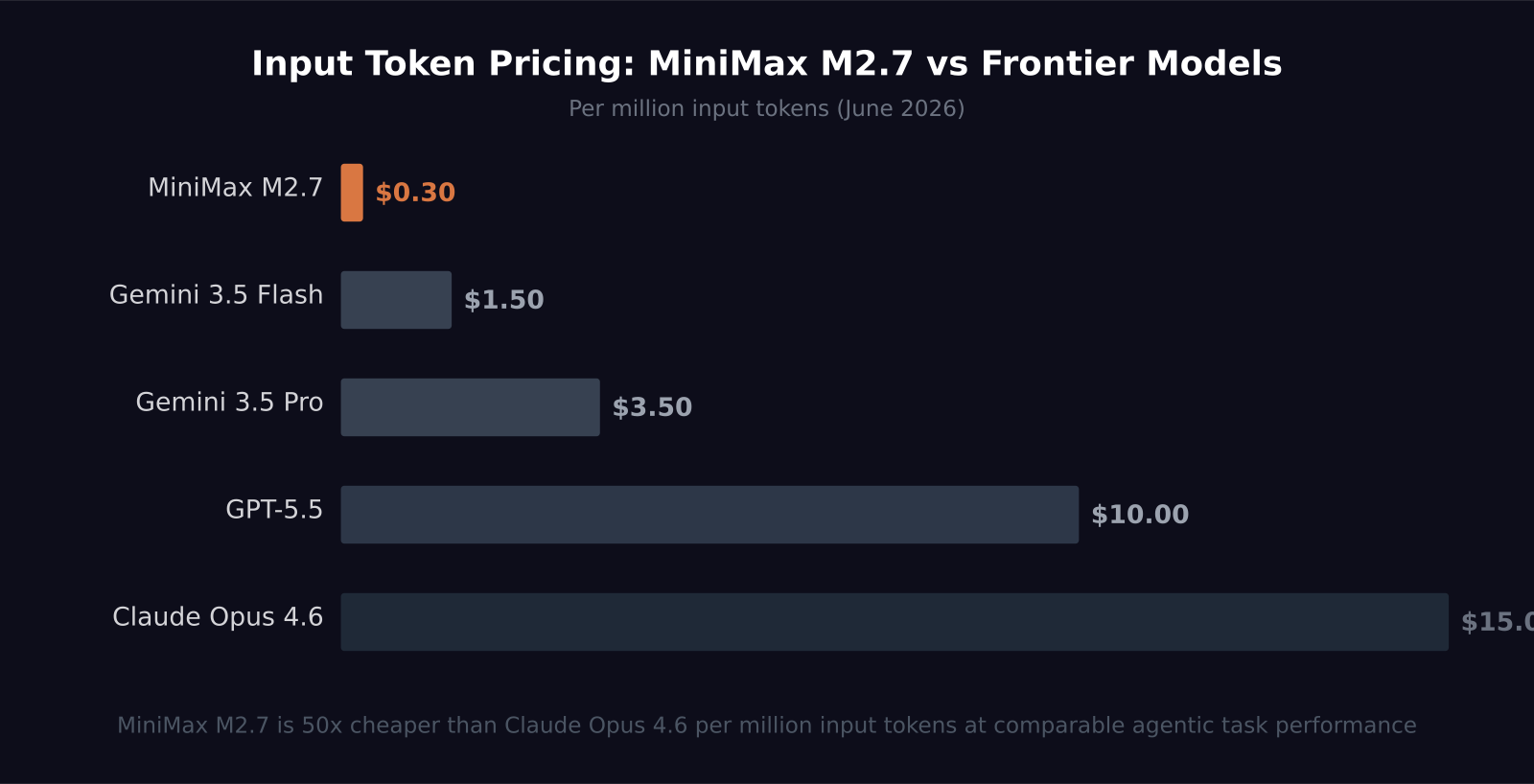
Yes, and the margin is significant. Here is the direct pricing comparison for API input tokens:
- MiniMax M2.7: $0.30 per million tokens
- Gemini 3.5 Flash: $1.50 per million tokens
- Gemini 3.5 Pro: $3.50 per million tokens
- GPT-5.5 standard: approximately $10.00 per million tokens
- Claude Opus 4.6: approximately $15.00 per million tokens
Running M2.7 at full capacity for one hour costs approximately $1. For a SaaS team running agentic workflows daily — code generation, document processing, automated support drafts — the monthly API spend difference can be significant enough to matter in a startup's budget.
It is also fully open-source. If your team has GPU infrastructure, you can self-host M2.7 entirely, eliminating per-token costs and keeping all data within your own environment. That is a real consideration for teams handling sensitive customer data or operating in regulated industries.
Who should use MiniMax M2.7?
MiniMax M2.7 fits SaaS development teams with real engineering workloads — not for quick one-off prompts, and not primarily as a consumer chat interface. The self-evolving architecture and Agent Teams features are built for workloads that run in loops: automated testing, CI/CD integration, agentic code review, background document processing.
If your team currently spends $500 or more per month on Claude Opus or GPT-5.5 API costs for agentic tasks, the case for routing at least a portion of that volume to M2.7 is straightforward. The performance gap is real but narrow. The cost gap is large.
For no-code SaaS builders or teams using AI primarily through consumer interfaces — Cursor, Claude.ai, ChatGPT — M2.7 is less immediately accessible. It is an API-first model, and its most compelling features do not surface through standard chat wrappers.
What to watch
The self-evolving label sets a high expectation that the current release does not fully meet. What MiniMax actually built is a model that autonomously ran training optimizations during its own development — impressive engineering, but not a model that updates itself while you use it. The evolution happened at training time, not inference time.
MiniMax is also a Chinese lab. After the US export controls applied to Claude Fable 5 this month, SaaS teams have had real reasons to evaluate alternatives. M2.7 runs outside the US export framework — but for teams inside regulated US industries, vendor due diligence on Chinese AI providers remains a genuine requirement, not an optional step.
The practical recommendation: test M2.7 on a bounded internal workload where you can measure performance and cost directly. If it matches Claude or GPT on your specific tasks, the economics justify the switch.
Frequently asked questions
Is MiniMax M2.7 open source?
Yes. MiniMax M2.7 is fully open-source and available on Hugging Face under a permissive license. You can self-host it on your own GPU infrastructure or access it via the MiniMax API at $0.30 per million input tokens for the standard model.
How does MiniMax M2.7 compare to Claude Opus 4.6 on coding tasks?
M2.7 scores 56.22% on SWE-Pro. Claude Opus 4.6 scores approximately 62% on comparable benchmarks. The performance gap is real but not dramatic for most production engineering workflows. The cost gap — roughly 50 times in input token pricing — makes M2.7 the practical choice for high-volume agentic pipelines where per-call economics matter.
What does self-evolving actually mean for MiniMax M2.7?
During M2.7's training, an internal version of the model ran over 100 autonomous optimization cycles: analyzing failure trajectories, modifying training scaffolds, evaluating the results, and deciding whether to keep or revert changes without human direction on individual rounds. This produced a 30% improvement on internal benchmarks. The self-evolution happened at training time — not during your conversations with the deployed model.
Was this article helpful?
SaaS Master
Creator behind SaaS Master — tutorials, walkthroughs, reviews, and explainers that help SaaS, AI, and WordPress products get understood and chosen. Writing here about the tools, trends, and tactics that actually move the needle. Work with me →
Want your product explained this clearly — in video?
Tutorials, walkthroughs, reviews, and shorts for SaaS, AI, and WordPress products.
Work With SaaS Master