AI Tools
ByteDance Doubao Seed 2.1 Pro: The Coding AI That Claims to Beat Claude — at 80% Lower Cost
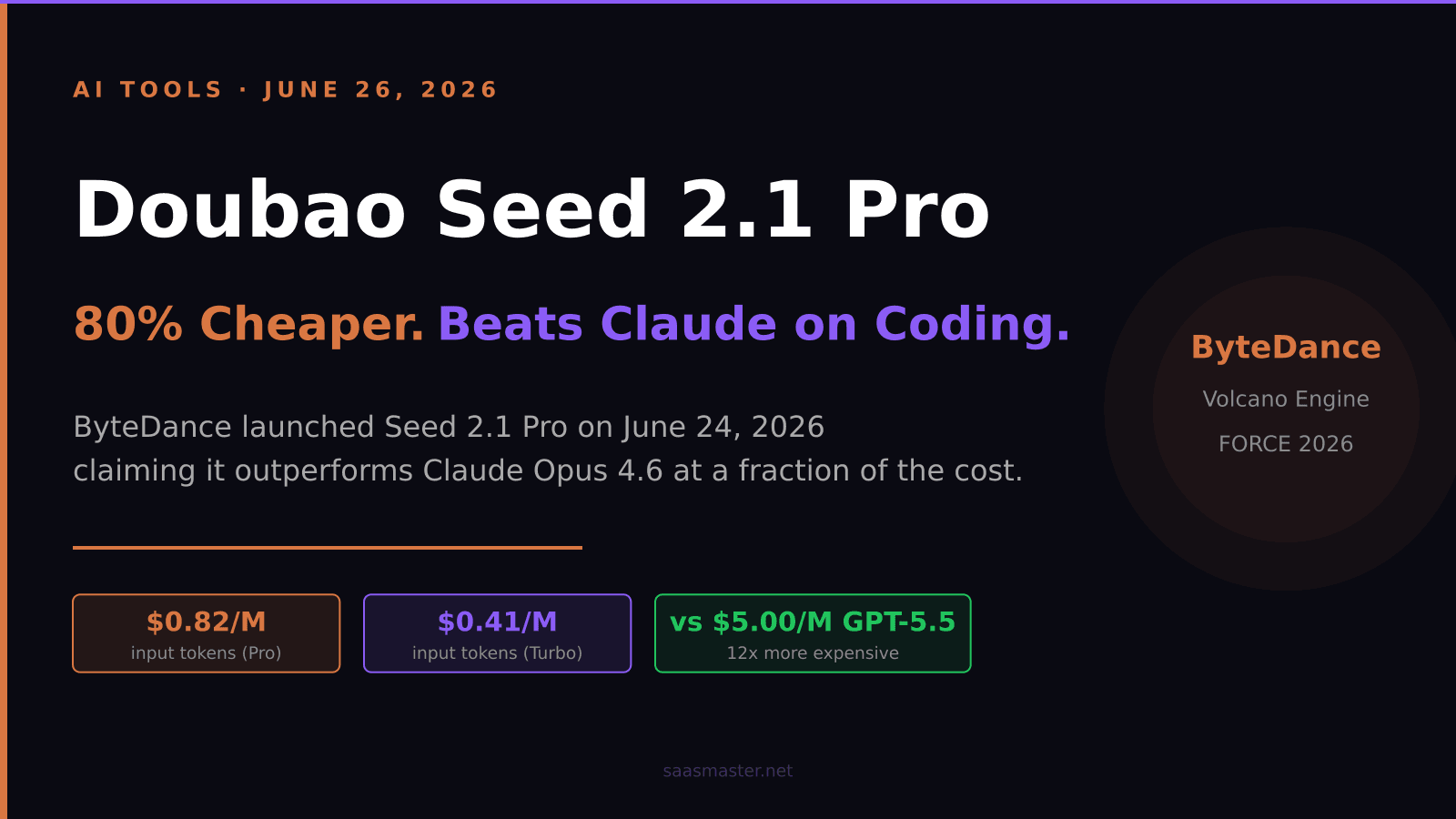
There is a pattern with Chinese AI labs: they ship something, the benchmarks look suspicious, and then a few weeks later the numbers hold up. Doubao Seed 2.1 Pro, released by ByteDance at its Volcano Engine FORCE conference on June 24, 2026, fits the pattern. The claim is straightforward — it outperforms Claude Opus 4.6 on SWE-Pro, OSWorld, and MMMU-Pro benchmarks, at roughly 80 percent lower total cost of ownership. For SaaS teams running large-scale AI workloads, those two facts together deserve more than a quick glance.
The model family ships in two versions: Seed 2.1 Pro, targeting complex engineering and long-chain agent tasks, and Seed 2.1 Turbo, which is half the price and optimized for high-frequency production deployment. Both launched on the Volcano Engine API on June 24.
Key takeaways
- Seed 2.1 Pro is priced at approximately $0.82 per million input tokens and $4.11 per million output tokens — about 80% cheaper total cost of ownership than Claude Opus 4.6 according to ByteDance
- ByteDance claims Seed 2.1 Pro leads on Terminal Bench 2.1, SWE-Pro, SciCode, OSWorld, MobileWorld, and MMMU-Pro
- The Turbo variant cuts pricing in half again: around $0.41 per million input tokens and $2.05 per million output tokens
- ByteDance's Volcano Engine now serves over 180 trillion daily token calls and holds 49.5% of China's public cloud Model-as-a-Service market per IDC
- Seedance 2.5, a companion video model capable of 30-second clips from up to 50 multimodal inputs, enters general availability in early July 2026
What Seed 2.1 Pro is built for
ByteDance positioned this model explicitly for two scenarios: complex engineering delivery and large-scale production deployment.
For complex engineering delivery, the Pro variant focuses on what ByteDance calls "strong demand understanding, long-term planning, and continuous repair." In plain terms: take a vague spec, build a plan, write code, and iterate when tests fail. The benchmarks ByteDance chose to highlight — SWE-Pro and Terminal Bench 2.1 — are designed to stress exactly these capabilities. SWE-Pro is a harder version of the standard SWE-bench that uses more complex real-world GitHub issues; Terminal Bench 2.1 tests autonomous multi-step terminal command execution.
For production deployment, the Turbo version matches most of Pro's capability at half the price, with lower latency designed for high-frequency API calls at enterprise volume. ByteDance serves 200 companies that each make over one trillion annual token calls. These are not toy workloads, and the Turbo architecture reflects that operational reality.
How does the pricing actually compare?
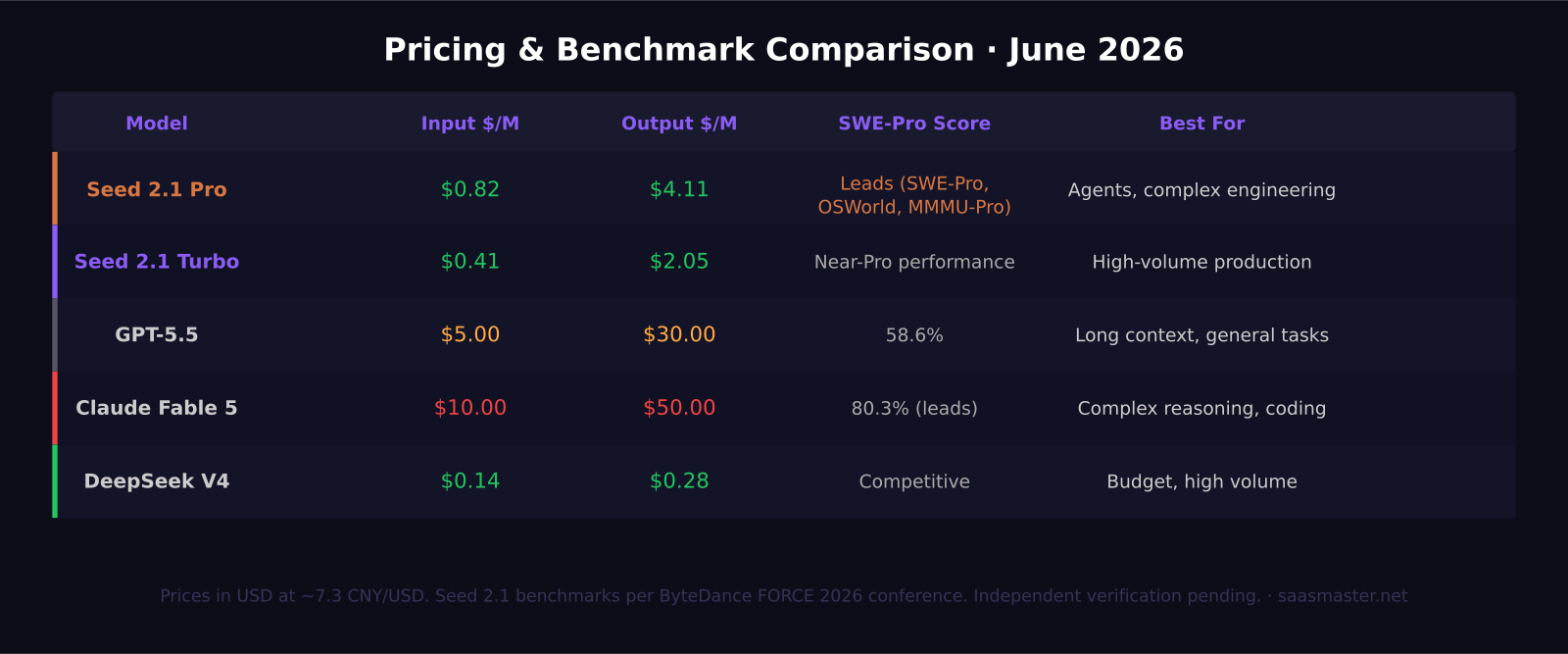
Converting at current exchange rates, 6 yuan per million input tokens works out to roughly $0.82. The full breakdown:
Seed 2.1 Pro: $0.82 per million input tokens, $4.11 per million output tokens. Cache-hit pricing drops to around $0.16 per million tokens.
Seed 2.1 Turbo: $0.41 per million input tokens, $2.05 per million output tokens.
For context, GPT-5.5 runs at $5 per million input and $30 per million output. Claude Fable 5, the current Anthropic flagship, is $10 per million input and $50 per million output. DeepSeek V4 remains the cheapest widely accessible option at $0.14 per million input — but ByteDance claims performance advantages over DeepSeek on the agent-specific benchmarks that matter most for enterprise workflows.
ByteDance's statement that total cost of ownership for Seed 2.1 Pro is 80% lower than Claude Opus 4.6 is plausible given these numbers. For a team running one million output tokens daily, that gap becomes roughly $41 per day on Turbo versus around $750 per day on Claude Opus 4.6. Over a year, that is a $255,000 difference on output alone.
Which benchmarks actually matter here?
OSWorld and MobileWorld measure how well a model can operate real computer interfaces — clicking through applications, navigating menus, completing multi-step GUI tasks. These are directly relevant if you are building AI agents that interact with existing software rather than operating purely in a coding sandbox. Seed 2.1 Pro's reported lead on OSWorld suggests ByteDance has invested heavily in computer-use style capabilities, which makes sense: their Doubao assistant serves hundreds of millions of users who need AI to operate software on their behalf.
SWE-Pro and Terminal Bench 2.1 are closer to what most SaaS engineering teams actually care about. If you are building an AI coding assistant, automating pull request review, or running an agent that edits files based on test output, these benchmarks map more directly to your real use case than general knowledge scores. The numbers ByteDance claims here are competitive — though independent verification has not yet been published as of this writing.
MMMU-Pro tests multimodal reasoning: understanding diagrams, charts, and mixed image-text documents. If your product processes product screenshots, UI mockups, or mixed-content reports, that benchmark is more relevant than it might first appear.
Who is this actually for?
I would split it into three groups.
If you are a SaaS team with high-volume AI workloads — summarization pipelines, automated code review, large-scale document processing — Seed 2.1 Turbo at $0.41 per million input tokens is worth evaluating right now. The cost savings at scale are real regardless of where the benchmark claims ultimately land.
If you are building long-chain AI agents that need to plan, execute, and recover from errors across multi-step tasks, Seed 2.1 Pro's claimed strengths on SWE-Pro and OSWorld make it a genuine candidate to test against Claude Fable 5 or GPT-5.5. The practical catch is availability: you need to set up a separate Volcano Engine account and API integration distinct from your existing OpenAI or Anthropic setup.
If you are a solo developer or small team building primarily in the US or Europe, the friction of adding a China-based API provider probably is not worth it unless you have a specific cost problem that existing options cannot solve cheaply enough. Models like DeepSeek V4 at $0.14 per million and GPT-5.5 at $5 per million cover most use cases without additional integration overhead.
What else launched at FORCE 2026
ByteDance did not stop at the language model. Three related products from the FORCE conference are directly relevant to creator-focused and video-forward SaaS tools.
Seedance 2.5 is a video generation model that takes up to 50 multimodal reference inputs — images, text, video clips — and produces 30-second clips. It enters global enterprise beta now with general availability expected in early July 2026. If you are building video generation into a SaaS product, Seedance 2.5 is a direct competitor to Sora and Runway Gen-4, and given ByteDance's track record with Stable Video and Seedance 1.0, the quality bar is likely to be high.
Seedream 5.0 Pro handles image generation. Details beyond the name are limited at this stage, but ByteDance's image generation work has been competitive with Midjourney and Flux in prior generations.
Seed-Audio 1.0 handles multi-character audio synthesis — generating distinct voices for multiple speakers within a single audio output. If you are building interactive audio features, automated podcast tools, or voiced AI agents, this is worth watching.
The real question: should you switch?
Probably not overnight. The model launched 48 hours ago and independent benchmarks take time to appear. ByteDance's track record with Seed 2.0 was solid, which gives me more confidence in these numbers than I would have had from a lesser-known lab. But trust-and-verify still applies.
What I would do: run your own evaluation on a representative sample of your actual workload. If you are doing anything agent-related or high-volume code generation, the pricing gap is large enough that even a 15% performance difference still makes Turbo worth it at roughly 12 times lower cost than GPT-5.5. Set up a Volcano Engine account, pull 100 representative examples from your real pipeline, and run them against GPT-5.5 and Seed 2.1 Turbo side by side. You will have a concrete answer within a day.
The broader point is that ByteDance now has serious model infrastructure. 180 trillion daily token calls is not a benchmark number — it is real usage from a platform serving hundreds of millions of people. That scale forces a level of reliability that most published evaluations never capture.
Frequently asked questions
Is ByteDance Doubao Seed 2.1 Pro available outside of China?
Yes. Seed 2.1 Pro and Turbo are available through the Volcano Engine API, which accepts international sign-ups through the Volcano Ark developer portal. Users should verify current data residency terms before integrating into production workloads.
How does Seed 2.1 Turbo compare to GPT-5.5 on price?
Seed 2.1 Turbo costs approximately $0.41 per million input tokens and $2.05 per million output tokens. GPT-5.5 is $5 per million input and $30 per million output. That makes Turbo roughly 12 times cheaper on input and 15 times cheaper on output, at the cost of some capability gaps on tasks like extreme long-context reasoning where GPT-5.5 has a documented advantage.
What context window does Seed 2.1 Pro support?
ByteDance has not published specific context window figures for Seed 2.1 Pro in the FORCE 2026 materials. The Seed 2.0 series supported 64K tokens; Seed 2.1 is expected to match or exceed that. Confirmed specifications are available on the Volcano Engine developer portal.
Was this article helpful?
SaaS Master
Creator behind SaaS Master — tutorials, walkthroughs, reviews, and explainers that help SaaS, AI, and WordPress products get understood and chosen. Writing here about the tools, trends, and tactics that actually move the needle. Work with me →
Want your product explained this clearly — in video?
Tutorials, walkthroughs, reviews, and shorts for SaaS, AI, and WordPress products.
Work With SaaS Master