AI Tools
GitHub Copilot AI Credits Explained: What the New Usage-Based Billing Means for Your Team
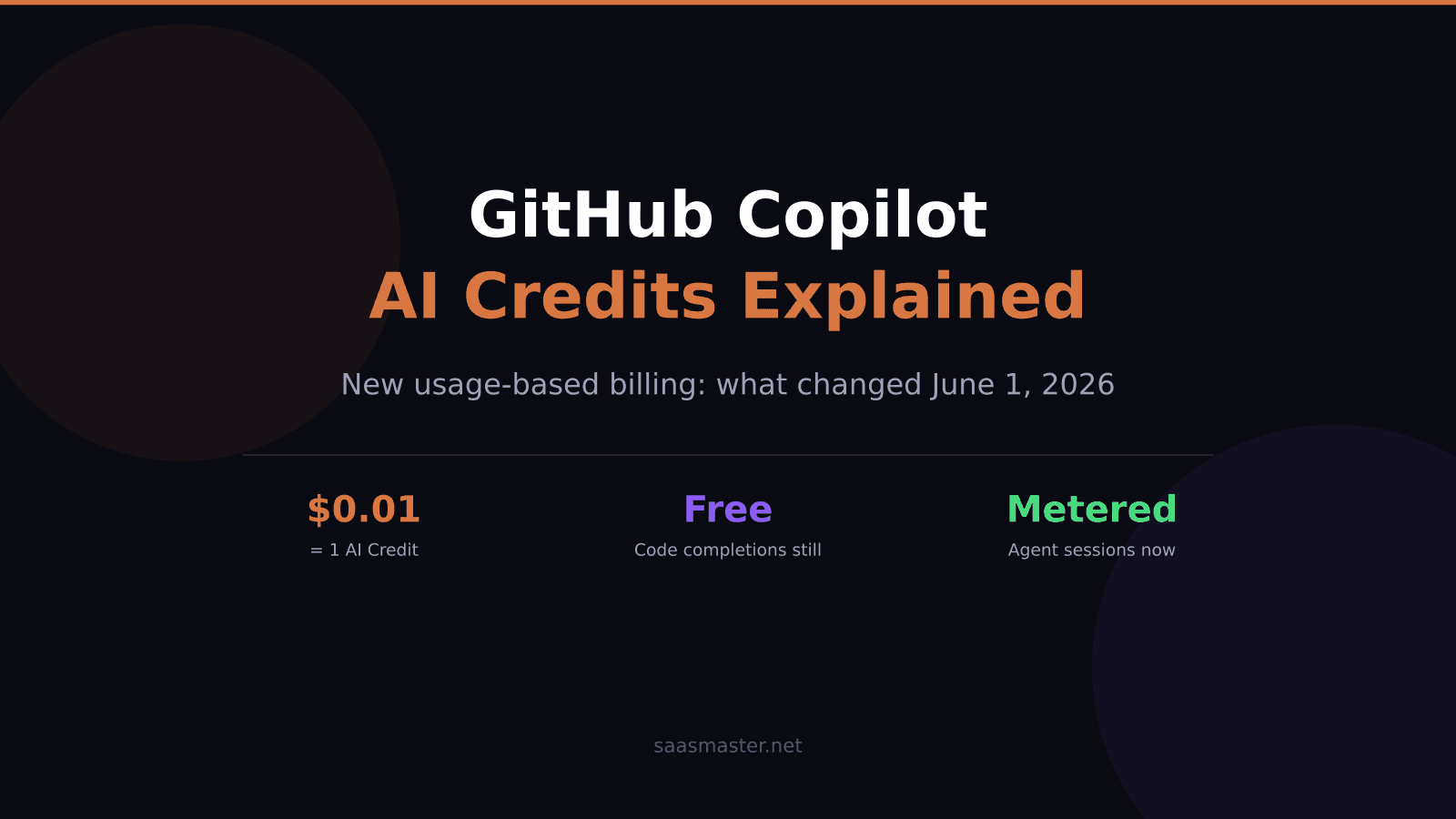
GitHub Copilot moved to usage-based billing on June 1, 2026. Instead of counting premium request quotas, every paid plan now includes a monthly allocation of GitHub AI Credits. One AI Credit equals $0.01. The key thing to understand immediately: inline code completions and next edit suggestions remain free on all paid plans and do not consume any credits. What changed is that agentic sessions — the more powerful, multi-step interactions — are now metered.
Key takeaways
- GitHub switched Copilot to AI Credits billing on June 1, 2026. One credit equals $0.01.
- Code completions and next edit suggestions stay free and do not consume AI Credits on any paid plan.
- Pro gets $10/month in credits, Pro+ gets $39, Business gets $19/user, Enterprise gets pooled credits per user.
- Promotional 3x credit allowances are active for Business and Enterprise through September 1, 2026.
- Credit consumption is based on token usage — input, output, and cached — at each model's listed API rates.
What actually changed on June 1
Before this switch, Copilot plans included a set number of premium requests per month. Heavy users — especially those running Copilot agents for longer tasks — would hit that ceiling and get downgraded to slower models for the rest of the billing cycle.
AI Credits replaces that system. Now usage is calculated in real-time based on token consumption. If you send a long prompt to a premium model and receive a detailed response, that draws down your credit balance by a corresponding amount. If you run a short inline completion, it costs nothing.
The advantage of this model is transparency. You can see exactly which interactions are consuming credits and adjust your usage patterns accordingly. The risk is unpredictability — particularly for teams running frequent agentic sessions where token counts can spike.
Plan-by-plan breakdown
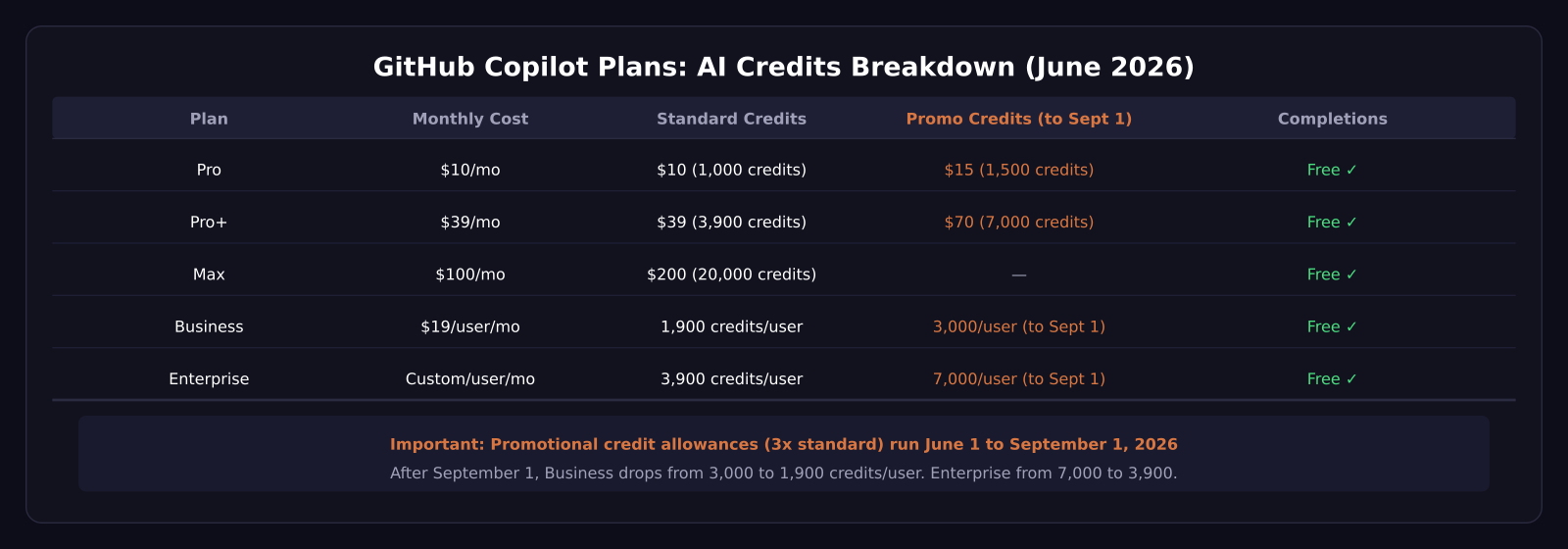
Pro at $10 per month includes $10 in monthly AI Credits — 1,000 credits — with a promotional bonus of $15 (1,500 credits) until September 1, 2026. Pro+ at $39 per month includes $39 in standard credits with a promotional $70 until September.
Business at $19 per user per month receives 1,900 credits per user under the standard model, but the promotional allowance through September 1 is 3,000 credits per user. Enterprise gets 3,900 standard credits per user, rising to 7,000 under the promotion. These business and enterprise credits are pooled at the organization level — a high-usage team member can draw from the collective balance.
The September 1 cliff is the most important date for business and enterprise admins to mark. After that date, allowances drop from the promotional 3x level back to standard. A Business team of 10 people currently running on 30,000 pooled credits per month will drop to 19,000. That is a significant change if your team has normalized usage patterns against the promotional level.
What consumes credits and what does not
The clearest rule: anything that looks like code completion — character-by-character suggestions, next edit predictions, inline chat for single file edits — does not consume credits. These remain free on all paid plans.
What does consume credits: Copilot Chat for longer conversations, Copilot Agent sessions where the AI runs multi-step tasks across files or codebases, and any interactions using premium models like o3, o4-mini, or GPT-5.5 via Copilot. The exact credit cost depends on the model and the token count of the specific interaction.
GitHub publishes a pricing page showing credit costs per model, updated as models are added or repriced. Checking that page before running a long agentic session on a premium model is worth the 30 seconds.
How to manage your credit spend
For individuals, the math is simple enough to estimate. Most interactive chat sessions with a mid-tier model cost 5 to 20 credits. An agentic task that reads a large codebase and makes several changes could cost 100 to 300 credits. The $10 Pro plan's 1,000 credits (or 1,500 under the promotion) gives most casual-to-moderate users plenty of room.
For teams, the pooled model means the admin console is now essential. GitHub's usage dashboard shows credit consumption by team member, by model, and over time. Setting spending limits or model restrictions for users who do not need access to premium models is a reasonable cost-control move before September 1.
One practical tip: if you are exploring a new agentic workflow, run a test session first and note the credit cost before deploying it for the whole team. Credit consumption scales with context length, so passing in a full repository versus a single file can mean a 10x difference in cost for the same task.
My take on whether this is a win or a loss for developers
For most individual developers, this is probably a net positive. The old request-limit system was opaque — you would not know you had burned your monthly quota until Copilot quietly started using a worse model. The credit system makes the cost legible and predictable.
For enterprise teams, it introduces budget complexity that did not exist before. The promotional allowances through September 1 have softened the landing, but teams should use that window to actually measure their usage patterns rather than assume September 1 will not be a shock.
The underlying direction is clear: as Copilot sessions get longer and more capable, GitHub wants a billing model that scales with actual value delivered rather than a flat subscription. AI Credits is that model.
Frequently asked questions
Do unused AI Credits roll over to the next month?
No. Unused monthly credits expire at the end of each billing cycle and do not carry forward. Plan usage accordingly — if you consistently end the month with large credit balances, you may be on a higher plan than you need.
What happens when a team runs out of AI Credits mid-month?
For paid plans, once the monthly credit allocation is exhausted, Copilot falls back to lower-cost models for agent sessions. Admins can purchase additional credits to restore access to premium models. Code completions remain unaffected regardless of credit balance.
Will the September 1 promotional credit reduction affect Business plan pricing?
The subscription price stays the same at $19 per user per month. Only the included credit allowance changes — from 3,000 to 1,900 credits per user. Teams that want to maintain the same usage level after September 1 will need to purchase supplemental credits or reduce agent session frequency.
Was this article helpful?
SaaS Master
Creator behind SaaS Master — tutorials, walkthroughs, reviews, and explainers that help SaaS, AI, and WordPress products get understood and chosen. Writing here about the tools, trends, and tactics that actually move the needle. Work with me →
Want your product explained this clearly — in video?
Tutorials, walkthroughs, reviews, and shorts for SaaS, AI, and WordPress products.
Work With SaaS Master