AI & SaaS
GPT-5.6 Is Here — But the US Government Decides Who Gets Access First
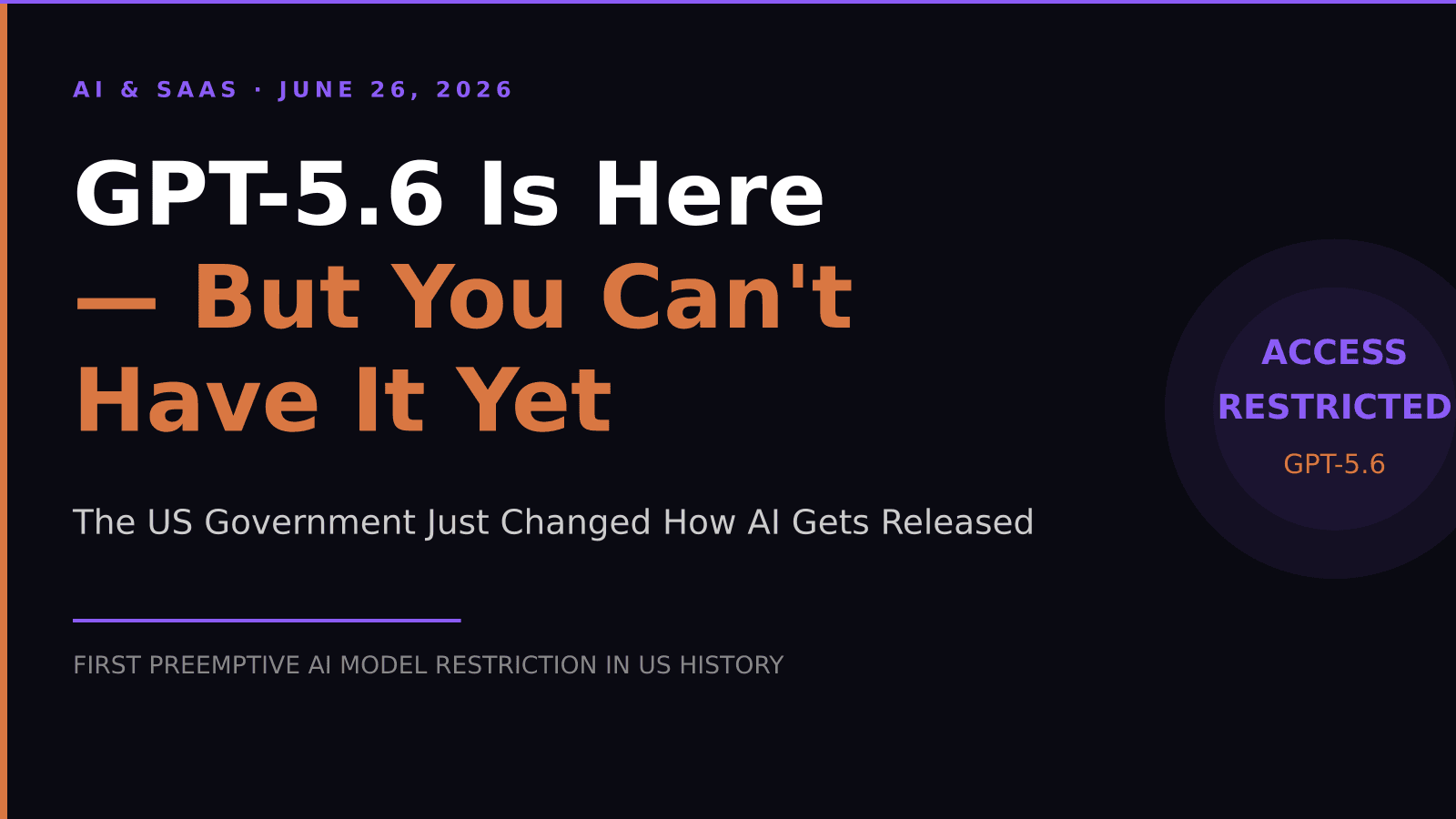
For the first time in the history of commercial AI, the US government stepped in before launch day and told an AI company exactly how to distribute its most powerful model. OpenAI's GPT-5.6 is ready, but as of June 25, 2026, the Trump administration instructed the company to release it exclusively to a handful of approved enterprise partners — approving each one "customer by customer" — before any wider rollout.
This is not a routine beta period. It is a structural change in how frontier AI reaches the market.
Key takeaways
- GPT-5.6 is considered by the administration to be on par with Claude Mythos 5, which the US deemed too powerful for general release
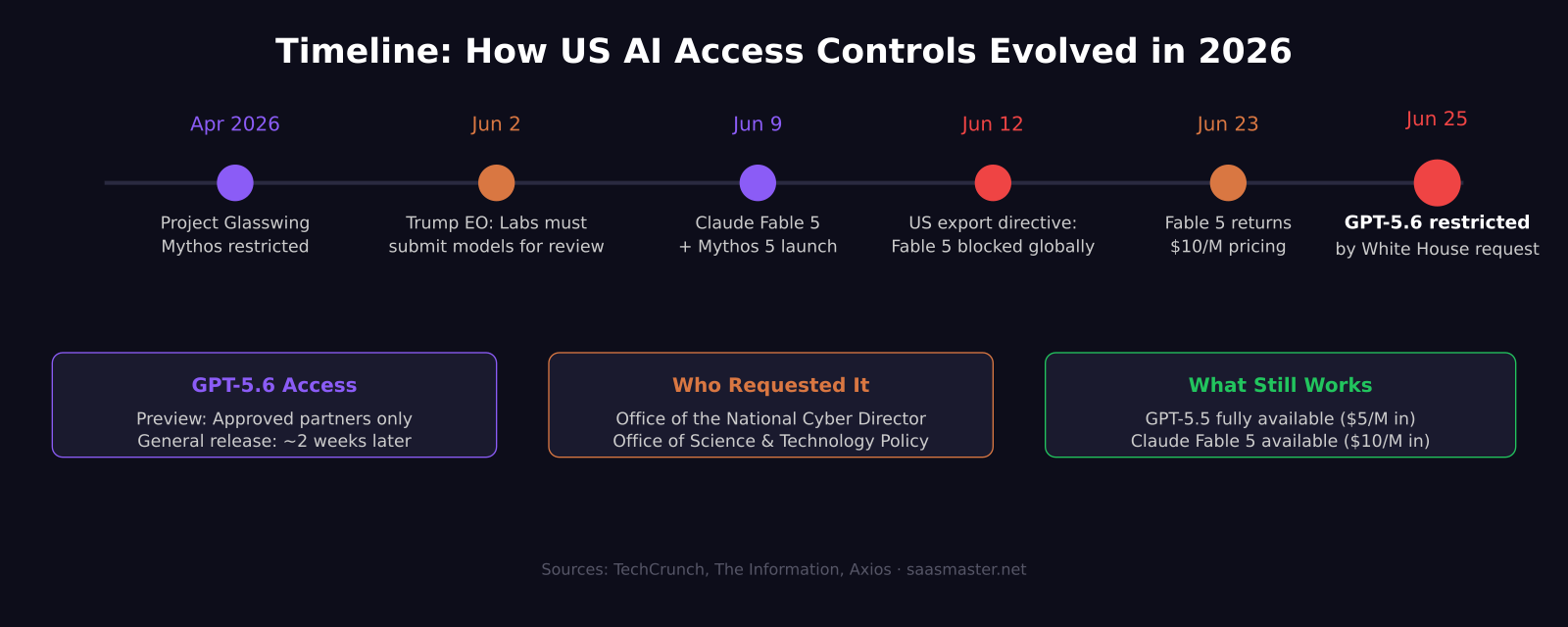
- Two federal offices — the National Cyber Director and the Office of Science and Technology Policy — requested the restricted launch
- Sam Altman told staff that a broader release could follow "a couple of weeks later" if the limited preview goes smoothly
- This marks the first time the US government preemptively controlled access to a US commercial AI model before public release
- A Trump executive order signed June 2, 2026, directed AI companies to voluntarily submit new models for government testing before launch
What actually happened
Sam Altman addressed OpenAI employees at an internal meeting on June 25. He confirmed that instead of a standard public launch, GPT-5.6 would go to a small number of close enterprise partners first, and that the government would vet additional customers one by one. Altman was candid: this arrangement, while he complied with it, is "not sustainable long term," and he said OpenAI would work with the administration on a better framework for future releases.
The agencies that made the request were the Office of the National Cyber Director (ONCD) and the Office of Science and Technology Policy (OSTP). Their concern mirrors what sparked the broader policy conversation earlier this month: that frontier AI models capable of identifying and exploiting software vulnerabilities at machine speed could cause serious harm if accessed by the wrong actors.
Why GPT-5.6 triggered this response
The short answer: Anthropic set the precedent, and the administration decided it applied to OpenAI too.
On June 9, Anthropic launched Claude Fable 5 — a public-facing version of its frontier model — alongside Claude Mythos 5, which was restricted from day one to a small group of cybersecurity partners through a program called Project Glasswing. Anthropic's argument was that Mythos had capabilities in vulnerability discovery so advanced that general access created unacceptable risk.
The US government agreed, and went further. On June 12, an export-control directive barred any foreign national from accessing both Fable 5 and Mythos 5, forcing Anthropic to disable global access across all its plans. Fable 5 returned on June 23, repriced at $10 per million input tokens and $50 per million output tokens — but only through Anthropic's controlled API, and still inaccessible to users in export-restricted countries.
GPT-5.6 reportedly sits at a comparable capability level to Mythos. The administration drew the same conclusion: if Mythos warranted restrictions, so does GPT-5.6.
Is this a slippery slope?
That depends on where you sit. If you run a SaaS company that relies on OpenAI's API for production workloads, the practical effect right now is minimal. GPT-5.5 remains fully available, and GPT-5.6's preview period is expected to last only a few weeks before a broader release follows. Nothing in your current integration breaks.
The longer-term question is more interesting. This is the first time in US history that a government agency proactively restricted a commercial AI launch before it reached the public. The administration's posture has shifted considerably: the same White House that described itself as taking a "hands off" approach to AI signed a June 2 executive order directing AI labs to voluntarily submit new models for testing before release. Altman's phrasing — "not sustainable" — suggests this friction will intensify as model capabilities continue advancing.
For builders and SaaS operators, the realistic read is this: government involvement in AI model access is now a permanent part of the landscape. It may not affect your daily work yet, but decisions about which AI provider to build on top of just got a new variable worth tracking.
What this means if you're building on OpenAI
If you were waiting for GPT-5.6 to ship a new product feature or upgrade your AI backend, expect a two-to-four week delay before general availability. The preview period will go to larger enterprise accounts first. Smaller SaaS teams and individual developers will almost certainly be in the "broader release" wave that Altman referenced.
If you need frontier capabilities now, Claude Fable 5 is available via Anthropic's API at $10 per million input tokens and $50 per million output tokens for accounts that qualify under current access terms. GPT-5.5 remains the most accessible option at $5 per million input and $30 per million output — and for most SaaS product workflows, it covers the ground you need.
The bigger picture
What is happening here is the normalization of government co-review for the most powerful AI systems. Anthropic built Glasswing and positioned Mythos as too powerful for general release. OpenAI followed a very similar path, under more pressure and with less public framing.
The underlying logic is not entirely wrong. Research published from NYU Tandon showed that frontier models can autonomously execute complete ransomware attack chains. When a model becomes capable enough to do that at scale, some form of access control has a reasonable case behind it.
What is less clear is whether the current mechanism — informal requests through ONCD and OSTP, customer-by-customer approvals — scales to a world where every major lab ships a new frontier model every six to eight weeks. That tension is exactly what Altman is pointing at. The question is not whether governments will stay involved in AI model releases. The question is whether they can build the institutional capacity to do it at the speed the technology moves.
Frequently asked questions
When will GPT-5.6 be available to the public?
OpenAI CEO Sam Altman said a broader general release would follow the limited preview "a couple of weeks later" if the preview period goes smoothly. The earliest realistic general availability date is mid-July 2026.
Does this affect existing OpenAI API access or ChatGPT?
No. GPT-5.5, GPT-5.5 Pro, and GPT-5.5 Instant remain fully available via API and ChatGPT. The restrictions apply only to the new GPT-5.6 model, which has not yet received a public release.
Which government offices requested the GPT-5.6 launch restriction?
The Office of the National Cyber Director (ONCD) and the Office of Science and Technology Policy (OSTP) both made the request, following a June 2, 2026 executive order directing AI companies to submit frontier models for government review before public release.
Was this article helpful?
SaaS Master
Creator behind SaaS Master — tutorials, walkthroughs, reviews, and explainers that help SaaS, AI, and WordPress products get understood and chosen. Writing here about the tools, trends, and tactics that actually move the needle. Work with me →
Want your product explained this clearly — in video?
Tutorials, walkthroughs, reviews, and shorts for SaaS, AI, and WordPress products.
Work With SaaS Master