AI & SaaS
The Cheapest AI APIs in 2026: Cut Your LLM Bill Without Killing Quality
If your AI bill is creeping up, you don't have to accept it. In 2026 you can cut LLM costs by 10x or more by routing the right work to budget models like DeepSeek V3.2, Gemini Flash-Lite, and Qwen-Turbo — without users noticing a drop in quality. The trick isn't finding one cheap model; it's matching each task to the cheapest model that can do it well.
I run a small content operation, and AI touches almost everything — drafting, summarizing, tagging, transcribing. When I started, I sent every request to a frontier model out of habit, and the bill showed it. Switching to a tiered approach cut my costs by more than 80% with no meaningful quality loss on the work that didn't need a genius. Here's how to do the same.
Key takeaways
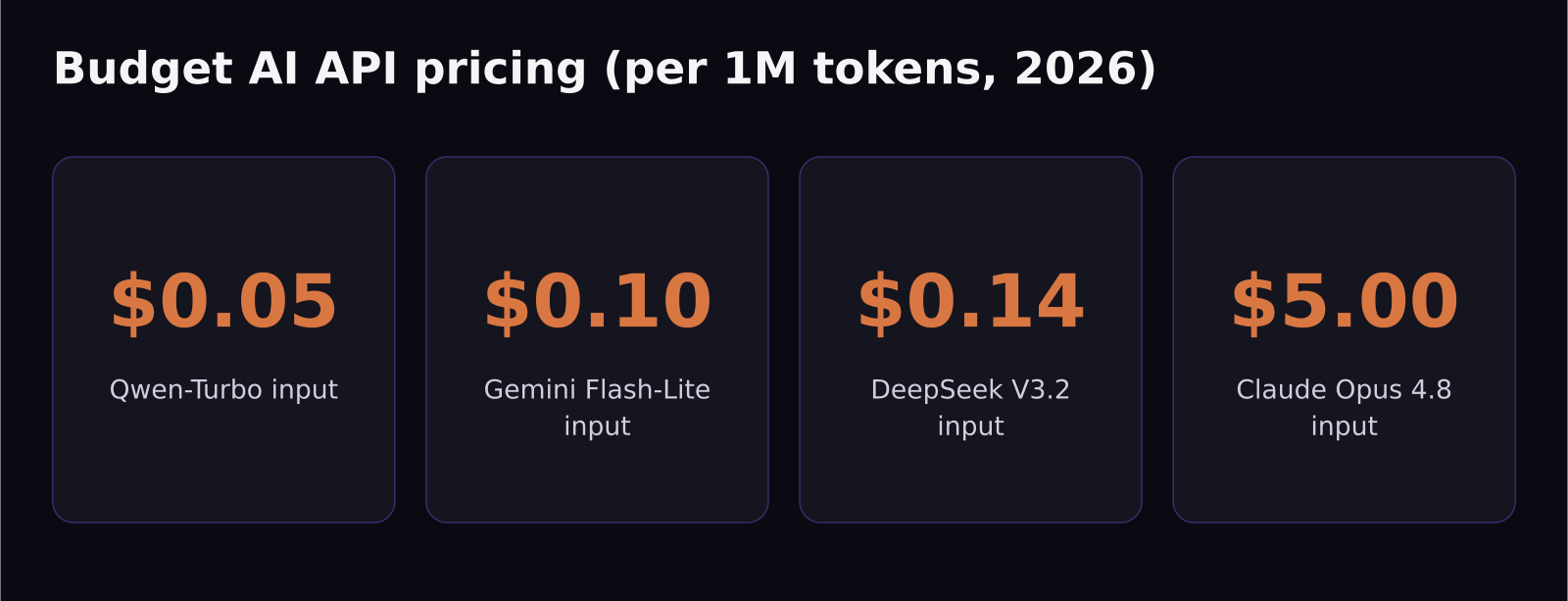
- The cheapest credible APIs in 2026 are Qwen-Turbo ($0.05/$0.20 per million tokens), Gemini 3.1 Flash-Lite ($0.10/$0.40), and DeepSeek V3.2 (~$0.14 input).
- Frontier models like Claude Opus 4.8 ($5/$25) cost 25–100x more per token, so reserving them for hard tasks is where the savings live.
- DeepSeek's cached-token pricing (~$0.028 vs $0.28 per million) makes repeated prompts dramatically cheaper.
- The winning strategy is routing: cheap models for bulk work, frontier models only for tasks that truly need them.
Which AI API is actually the cheapest in 2026?
On raw price, Qwen-Turbo leads the pack at $0.05 input / $0.20 output per million tokens — built for speed and high volume. Right behind it, Gemini 3.1 Flash-Lite runs $0.10 / $0.40, and DeepSeek V3.2 sits around $0.14 per million input tokens. DeepSeek V3 more broadly comes in near $0.27 / $1.10.
To put that in perspective: Claude Opus 4.8, the current intelligence leader, starts at $5 input / $25 output per million tokens. That's roughly 100x the input cost of Qwen-Turbo. You are not getting 100x better answers on a task like "summarize this support ticket" — which is exactly why blindly sending everything to a frontier model wastes money.
When is a cheap model good enough?
This is the question that decides your bill. Budget models are genuinely excellent at a huge share of real-world work: summarization, classification and tagging, data extraction, simple rewrites, routing, first-draft generation, and answering FAQs from provided context. For these, DeepSeek V3, Gemini 3 Flash, and Flash-Lite deliver strong price-to-performance and competitive benchmark scores at a fraction of frontier cost.
Where you still want a frontier model: complex multi-step reasoning, nuanced code generation, high-stakes writing where tone and accuracy can't slip, and anything where a wrong answer is expensive. The point isn't that cheap models are "worse" — it's that most tasks don't need the smartest model in the world.
How much can routing actually save?
A simple two-tier setup is where most of the savings come from. Send the bulk of your traffic — the summaries, tags, extractions, and drafts — to a budget model, and escalate only the genuinely hard requests to a frontier model. In most applications, the cheap-eligible work is the large majority of volume, so even a conservative split can cut spend by 70–90%.
Then layer in caching. DeepSeek charges roughly $0.028 versus $0.28 per million for cached tokens — a 10x discount on repeated prompt prefixes. If your app reuses a long system prompt or context block on every call (most do), caching alone can meaningfully shrink the bill before you change anything else.
What's the catch with the cheapest models?
A few honest trade-offs. The very cheapest models can be more literal and less creative, so they're better at structured tasks than open-ended ones. Latency and reliability vary by provider and region, so test under your real load before committing. And data-handling matters: check each provider's terms and data residency, especially for regulated work — DeepSeek and Qwen are based in China, which may affect your compliance requirements regardless of price.
None of these are dealbreakers; they're reasons to test rather than switch blindly. Run a few hundred of your real requests through a budget model and compare the outputs side by side with your current setup. You'll quickly see which tasks are safe to move.
A practical starting stack
If you want a concrete plan: use Gemini 3.1 Flash-Lite or DeepSeek V3.2 as your default workhorse for bulk tasks, turn on prompt caching for anything with a repeated prefix, and keep one frontier model (Claude Opus 4.8 or GPT-5.5) wired up for the small slice of requests that need real reasoning. Route based on task type, not habit. That single architectural choice is worth more than any individual model's price tag.
The broader trend is on your side: GPT-4-level performance that cost $30 per million tokens in 2023 now goes for under $1, and prices keep falling 10–100x a year as competition intensifies and open-weight models close the gap. The cost of being smart about this is small, and it compounds every month.
How do I set up routing without building a mess?
You don't need a complex system to start. The simplest version is a single if-statement in your code: if a task is on your "cheap-eligible" list — summaries, tags, extractions, drafts — call the budget model; otherwise call the frontier model. That one rule captures most of the savings. From there you can get fancier with a small classifier that reads each request and picks a tier, but I'd resist over-engineering it until the simple split proves itself.
A few guardrails make routing safe in production. Log which model handled each request so you can audit quality later. Set a fallback so that if the budget model returns something obviously broken, you retry on the frontier model — this catches the rare hard case that slipped through your routing rules. And review a sample of budget-model outputs weekly for the first month; you'll either gain confidence to route more aggressively or spot a task category that needs to move back up a tier.
What this means for small teams
For a small SaaS or content team, the math is compelling. Cutting your AI bill by 80% doesn't just save money — it lets you use AI in more places, because the per-use cost stops being a reason to hold back. The teams that win in 2026 aren't the ones paying the most for the smartest model; they're the ones spending intelligently and putting the savings into doing more. Cost discipline here is a growth lever, not just a cost-cutting exercise.
Frequently asked questions
What is the cheapest LLM API in 2026? Qwen-Turbo is among the cheapest at $0.05 input / $0.20 output per million tokens. Gemini 3.1 Flash-Lite ($0.10/$0.40) and DeepSeek V3.2 (~$0.14 input) are also extremely cheap and offer strong price-to-performance.
Will cheaper models hurt my product's quality? Not for most tasks. Budget models handle summarization, classification, extraction, and drafting very well. Reserve frontier models for complex reasoning, nuanced code, and high-stakes writing, and route the rest to cheaper models — users rarely notice.
How does prompt caching reduce costs? Caching reuses a previously processed prompt prefix at a steep discount — DeepSeek charges about $0.028 versus $0.28 per million for cached tokens, a 10x saving. If your app sends the same system prompt or context on every call, caching cuts those repeated costs dramatically.
SaaS Master
Creator behind SaaS Master — tutorials, walkthroughs, reviews, and explainers that help SaaS, AI, and WordPress products get understood and chosen. Writing here about the tools, trends, and tactics that actually move the needle. Work with me →
Want your product explained this clearly — in video?
Tutorials, walkthroughs, reviews, and shorts for SaaS, AI, and WordPress products.
Work With SaaS Master