AI & SaaS
Anthropic Adds Separate Agent SDK Credit to Claude Plans: Full Breakdown
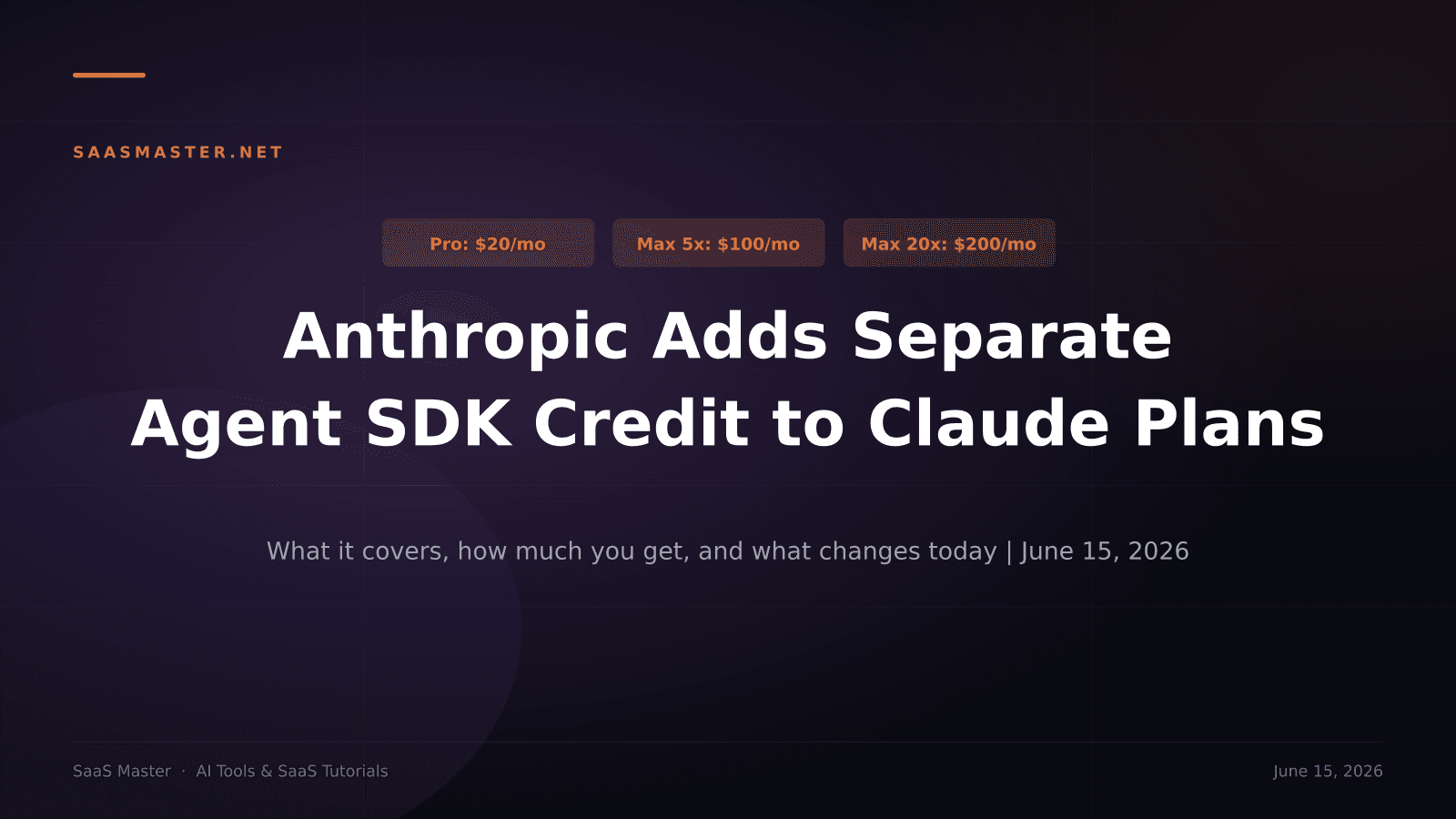
Starting today, June 15, 2026, Anthropic has separated Claude Agent SDK usage from your main Claude plan limits. If you are on Pro, Max, Team, or Enterprise, your interactive Claude usage and your Agent SDK usage now run off separate budgets. This is a meaningful change if you use Claude Code's non-interactive mode, build automations with the SDK, or use apps built on top of the Agent SDK.
Key takeaways: - As of June 15, 2026, Agent SDK and claude -p usage no longer counts against your Claude plan's usage limits - Pro users get $20 per month in Agent SDK credit, Max 5x gets $100, Max 20x gets $200 - Credits are per-user, refresh monthly, and require a one-time opt-in claim through your Claude account - When your credit runs out, SDK usage moves to usage credits at standard API rates — or stops if usage credits are off - API key users on Claude Platform see no change — pay-as-you-go billing continues as normal
What actually changed today
Before this update, running the claude -p command, triggering Claude Code in non-interactive mode, or using third-party apps built on the Agent SDK all drew from the same usage pool as your regular Claude conversations. Heavy SDK use could eat into the limits you relied on for interactive work.
Anthropic has now split these into two separate buckets. Your subscription usage limits are now reserved for what they call "interactive use" — Claude Code in the terminal or IDE, Claude conversations on web, desktop, and mobile, and Claude Cowork. Agent SDK usage gets its own separate monthly credit.
The change takes effect with your next billing cycle if you are already a subscriber, and as of June 15, 2026, for new subscribers.
How much credit you get
The credit scales with your plan tier. Pro subscribers get $20 per month. Max 5x subscribers get $100 per month. Max 20x — the top-tier personal plan — gets $200 per month.
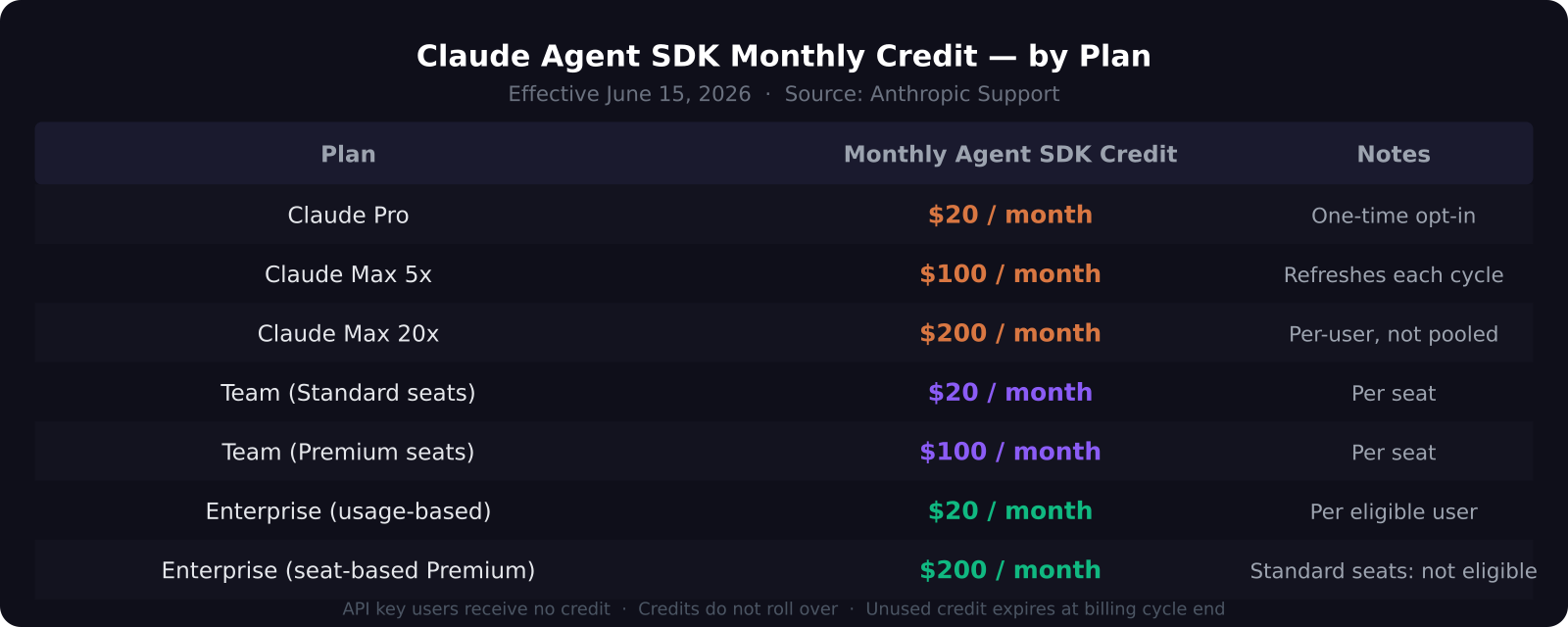
For Team plans, the credit tracks the seat type. Standard seats get $20 per month per user. Premium seats get $100 per month per user. Enterprise pricing splits similarly: $20 for usage-based plans, $200 for seat-based Enterprise plans on Premium seats. One notable exception: members of seat-based Enterprise plans on Standard seats are not eligible to claim the credit.
These credits are per-user. They cannot be pooled across a team or shared with a colleague. If you are an admin, each eligible user on your team claims and manages their own credit independently.
What the credit actually covers
The monthly credit applies to a specific set of use cases. It covers Claude Agent SDK usage in your own projects, whether you are building in Python or TypeScript. It covers the claude -p command — that is Claude Code running in non-interactive, programmatic mode rather than the interactive terminal experience. It also covers the Claude Code GitHub Actions integration and third-party apps that authenticate with your Claude subscription through the Agent SDK.
What it does not cover is equally important. Interactive Claude Code sessions in your terminal or IDE continue to use your subscription usage limits as before. Claude conversations on the web app, desktop app, or mobile continue the same way. Claude Cowork draws from subscription limits. The credit is specifically for the automated, programmatic side of the Claude ecosystem.
How the credit mechanics work
A few mechanics are worth understanding before you rely on this in production.
The credit drains first. When you use the Agent SDK, it draws from your monthly credit before touching any other source. This means that for most builders running moderate SDK workloads, the credit will cover everything.
When the credit runs out, behavior depends on whether you have usage credits enabled on your account. If you do, Agent SDK requests continue at standard API rates, billed against your usage credits balance. If usage credits are not enabled, Agent SDK requests stop until your credit refreshes at the next billing cycle. For anyone building anything time-sensitive, enabling usage credits is the safer configuration.
Credits do not roll over. Unused credit at the end of your billing cycle disappears. There is no accumulation across months.
The opt-in is a one-time action. You claim your credit once through your Claude account settings. After that, it renews automatically each cycle without any action required from you.
What this means for SaaS builders and teams
If you have been building personal automations or lightweight SDK tools on top of a Pro or Max subscription, this is a meaningful improvement. Separating the budgets means your scripted workflows cannot accidentally crowd out your interactive AI usage.
For teams running shared production automation through the Agent SDK, Anthropic is fairly direct in the documentation: the monthly credit is sized for individual experimentation and automation, not shared production pipelines at scale. For those use cases, the recommendation is to use a Claude Platform API key with pay-as-you-go billing. The credit system is not designed to carry a shared production workload where multiple users or services are drawing from it.
For individuals building on top of Claude — running nightly research scripts, building personal productivity tools with the SDK, connecting third-party apps that use Agent SDK authentication — this is the system you want. Your personal credit refreshes monthly and runs independently of your interactive usage.
API key users: nothing changes
If you are using the Agent SDK with an API key from Claude Platform, this announcement does not affect you. Pay-as-you-go billing continues. You do not receive a monthly credit and your billing model stays exactly the same. The credit system is specifically for subscription plan users authenticating through their Claude account rather than an API key.
My take
This is a practical quality-of-life improvement for anyone who blends interactive and automated Claude usage under one subscription. The previous setup had a real frustration point: heavy SDK or claude -p usage could quietly eat into the limits you needed for interactive work, and diagnosing why your interactive Claude seemed slow or limited was not always obvious.
The clean separation makes the budget model more predictable. You know what your interactive limits cover and you know what your SDK credit covers. The one thing worth paying attention to immediately is the usage credits setting — if you are building anything that needs to run continuously, enabling usage credits as a fallback is the right setup before you hit the credit ceiling.
Frequently asked questions
Do I need to do anything to get the Agent SDK credit? Yes — it requires a one-time opt-in through your Claude account. Anthropic says eligible subscribers will receive an email with instructions before June 15, 2026. After you claim it once, it renews automatically every billing cycle.
What happens if I use more than my monthly credit? If you have usage credits enabled on your Claude account, additional Agent SDK usage flows to usage credits at standard API rates. If usage credits are not enabled, Agent SDK requests stop until your credit refreshes at the start of your next billing cycle.
Does the credit apply to the Claude Code GitHub Actions integration? Yes. The Claude Code GitHub Actions integration is explicitly listed as covered by the Agent SDK monthly credit. It falls under the same category as other claude -p and non-interactive SDK usage.
Was this article helpful?
SaaS Master
Creator behind SaaS Master — tutorials, walkthroughs, reviews, and explainers that help SaaS, AI, and WordPress products get understood and chosen. Writing here about the tools, trends, and tactics that actually move the needle. Work with me →
Want your product explained this clearly — in video?
Tutorials, walkthroughs, reviews, and shorts for SaaS, AI, and WordPress products.
Work With SaaS Master