AI & SaaS
Claude Agent SDK Credit vs API Key: Which Should You Use in 2026?
Anthropic's new Claude Agent SDK credit system launched today, June 15, 2026 — and the most common question I'm seeing is a simple one: should I use my subscription credit, or should I just use an API key? Here is a direct answer: use the subscription credit for personal automation and individual projects; use an API key for anything running in production, shared across a team, or processing real customer traffic.
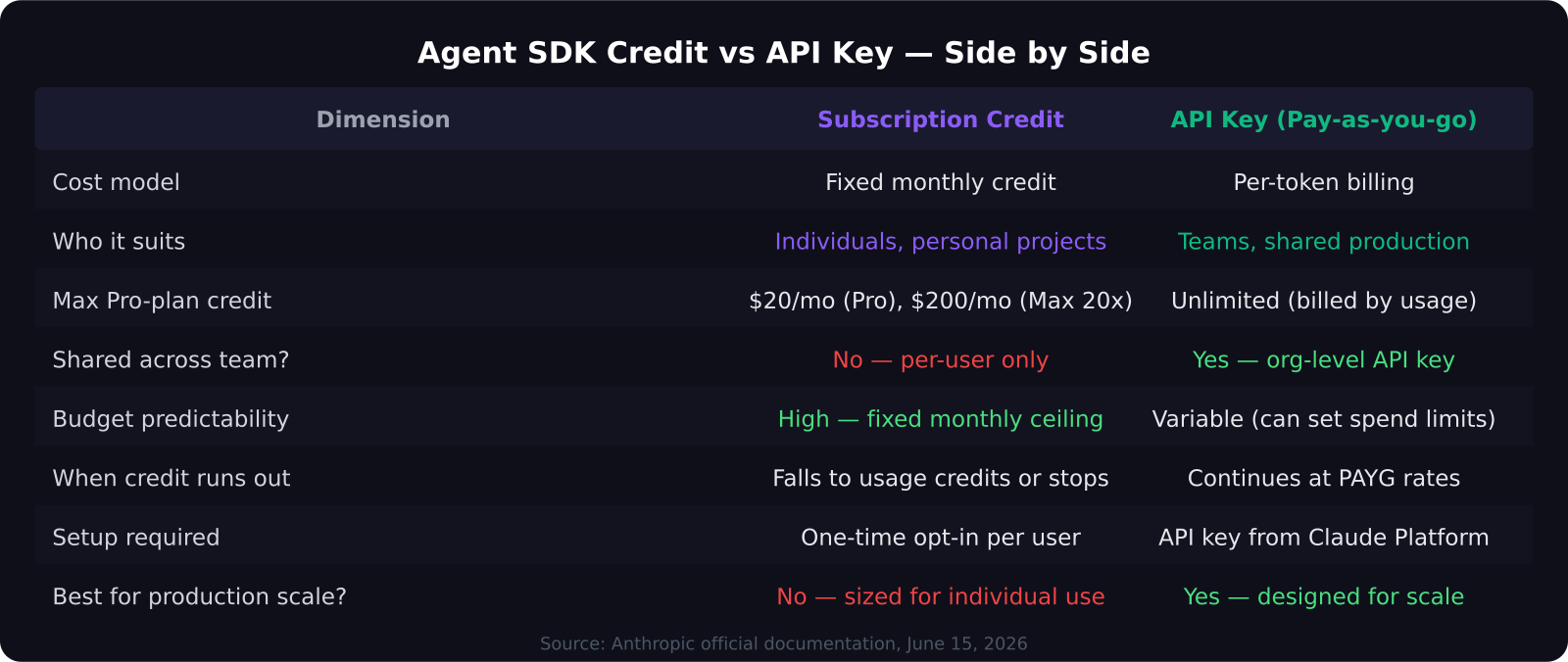
Key takeaways: - Subscription credits are per-user and capped — Pro gets $20/mo, Max 20x gets $200/mo — which makes them best for individual automation, not shared workloads - API keys from Claude Platform use pay-as-you-go billing with no monthly ceiling, making them the right choice for production systems and multi-user teams - The credit is sized and designed for personal experimentation and automation — Anthropic says this explicitly in the documentation - When your subscription credit runs out, behavior depends on whether you have usage credits enabled — requests either fall back to API-rate billing or stop entirely - For most solo builders and creators, the credit covers typical SDK usage comfortably — Pro's $20 and Max 20x's $200 map well to personal workflow automation
Understanding what you are choosing between
As of June 15, 2026, Claude subscription plans (Pro, Max, Team, Enterprise) include a separate monthly Agent SDK credit that covers programmatic Claude usage — the claude -p command, SDK calls in Python or TypeScript, GitHub Actions integration, and third-party apps authenticating through the Agent SDK.
The alternative has always existed: use Claude Platform with an API key, where you pay per-token with no subscription component.
The two paths are genuinely different in how they handle cost, scale, and team access. The right one depends on what you are building and who is using it.
When the subscription credit is the right call
The subscription credit makes sense when you are building for yourself. Personal automation scripts, nightly research pipelines, custom Claude integrations that only you run, lightweight apps you have built for your own workflow — all of these are solid fits.
The economics work well here. A Pro subscriber getting $20 per month in Agent SDK credit means you can run a meaningful amount of SDK usage — summaries, extractions, classifications, small agentic tasks — without paying anything beyond your subscription. Max subscribers getting $100 or $200 per month have even more headroom for personal projects.
There is also a convenience angle. The subscription credit is tied to your Claude account. You do not need to manage a separate API key or billing account on the Claude Platform. You claim the credit once and it refreshes automatically.
Third-party apps that authenticate through the Agent SDK with your Claude account also draw from this credit. If you use apps built on the Agent SDK and they support Claude account authentication, your monthly credit covers that usage too.
When the API key is the right call
The API key path becomes the clear winner the moment you move beyond personal use. The subscription credit has two hard constraints that matter at any meaningful scale: it is per-user and it is capped.
Per-user means a shared API key does not exist under the subscription credit model. Every teammate who wants SDK access needs their own Claude account and their own credit. Credits cannot be pooled, transferred, or shared. For a team of ten developers all making SDK calls against a shared automation pipeline, the subscription credit model does not work — there is no team-level pool.
Capped means that once your monthly credit runs out, you either stop or fall to usage credits at API rates. A production system that serves real customers cannot have a hard ceiling where requests simply stop. The API key with pay-as-you-go billing is continuous — you pay for what you use, and you can set spend limits at the account level for budget control.
Anthropic's own documentation is unambiguous about this: "Teams running shared production automation should use Claude Platform with an API key for predictable pay-as-you-go billing." That guidance is right.
The hybrid setup most builders end up using
In practice, many builders end up running both. Subscription credit for their personal explorations, prototyping, and personal automation tools. API key for anything that ships to users or runs as a shared service.
This is a reasonable and efficient configuration. It keeps personal experimentation costs low (covered by the subscription you already pay for) while giving production systems the scale they need. The two auth paths run independently — there is no conflict in using both.
What happens when the credit runs out
This is the detail most people miss, and it matters for planning. When your monthly Agent SDK credit is exhausted, what happens next depends on a single setting in your Claude account: whether usage credits are enabled.
If you have enabled usage credits, additional Agent SDK requests continue at standard API rates and bill against your usage credits balance. This is the right configuration for anyone who wants uninterrupted Agent SDK access throughout the billing cycle.
If usage credits are not enabled, Agent SDK requests stop when the credit runs out. They do not queue, they do not retry — they simply fail until the credit resets at the start of your next billing cycle.
For personal tools this is usually acceptable — you can design your scripts to handle this gracefully. For anything time-sensitive or user-facing, you need usage credits enabled, which effectively converts to the pay-as-you-go model once you exceed the credit ceiling anyway.
The practical setup checklist
For individual builders using the subscription credit: claim the credit through your Claude account settings (one-time), enable usage credits as a fallback if your workflows run continuously, and set a spending limit on usage credits if you want a hard cap.
For teams building production systems: create a Claude Platform account separate from personal accounts, generate an API key, set spend limits and usage alerts at the organization level, and keep API keys out of personal developer accounts.
For small teams blending both: use subscription credits for individual R&D and prototyping, use a shared API key for any pipeline that serves more than one person.
My take on the new credit system
The split between subscription usage limits and Agent SDK credits is a logical move. Before this, the boundaries around what consumed your plan limits were blurry enough that heavy SDK usage could surprise you.
The per-user, non-pooled nature of the credit is a real constraint that some teams will discover the hard way — especially teams who have been building shared workflows on top of personal accounts. If that is your setup, today is a good time to evaluate whether a dedicated Claude Platform API key should replace or supplement what you have been doing.
For solo builders and creators, the credit is a genuine improvement and fairly generous at the Max tier. A $200 monthly credit for personal Agent SDK automation is real money that covers a lot of workflow automation.
Frequently asked questions
Can I use my subscription credit and an API key at the same time? Yes. They are independent authentication paths. Your subscription credit applies when you authenticate Agent SDK calls with your Claude account. An API key uses separate Claude Platform billing. You can use both simultaneously without conflict.
If I am on Team plan, does each member need to claim their own credit? Yes. Credits are per-user and cannot be pooled. Each eligible Team member claims their own credit through their individual Claude account. Standard seat members get $20 per month; Premium seat members get $100 per month.
Is the subscription credit the same as buying API credits on Claude Platform? No — these are completely different. The Agent SDK monthly credit is included with your Claude subscription and covers subscription-authenticated SDK usage. Claude Platform usage credits are purchased separately and apply to API key usage. When your SDK credit runs out and usage credits kick in, the usage credits referenced are Claude.ai account usage credits, not Claude Platform credits.
Was this article helpful?
SaaS Master
Creator behind SaaS Master — tutorials, walkthroughs, reviews, and explainers that help SaaS, AI, and WordPress products get understood and chosen. Writing here about the tools, trends, and tactics that actually move the needle. Work with me →
Want your product explained this clearly — in video?
Tutorials, walkthroughs, reviews, and shorts for SaaS, AI, and WordPress products.
Work With SaaS Master