AI Tools
Claude Fable 5 Is Back: What the Export Control Reversal Means for SaaS Teams
In short
Claude Fable 5 is back after an 18-day export ban. See its 80.3% SWE-Bench Pro score, new API pricing, and what it means for SaaS teams building with it today.
Claude Fable 5 went dark on June 12, 2026, after the U.S. Department of Commerce slapped an emergency export control order on it. Eighteen days later, on June 30, Commerce reversed course, and Anthropic started restoring global access on July 1. If you had a project half-built on Fable 5 and had to scramble to Opus 4.8 or GPT-5.5 when the ban hit, the model you left behind is back, and it now leads every major coding benchmark that matters.
Key takeaways
- Claude Fable 5 and its sibling Claude Mythos 5 are back online as of July 1, 2026, after an 18-day export control ban that started June 12.
- The ban was triggered by an Amazon security team finding jailbreak prompts that could push Fable 5 into giving cyberattack-relevant output; Anthropic fixed it with a new safety classifier it says blocks the technique over 99% of the time.
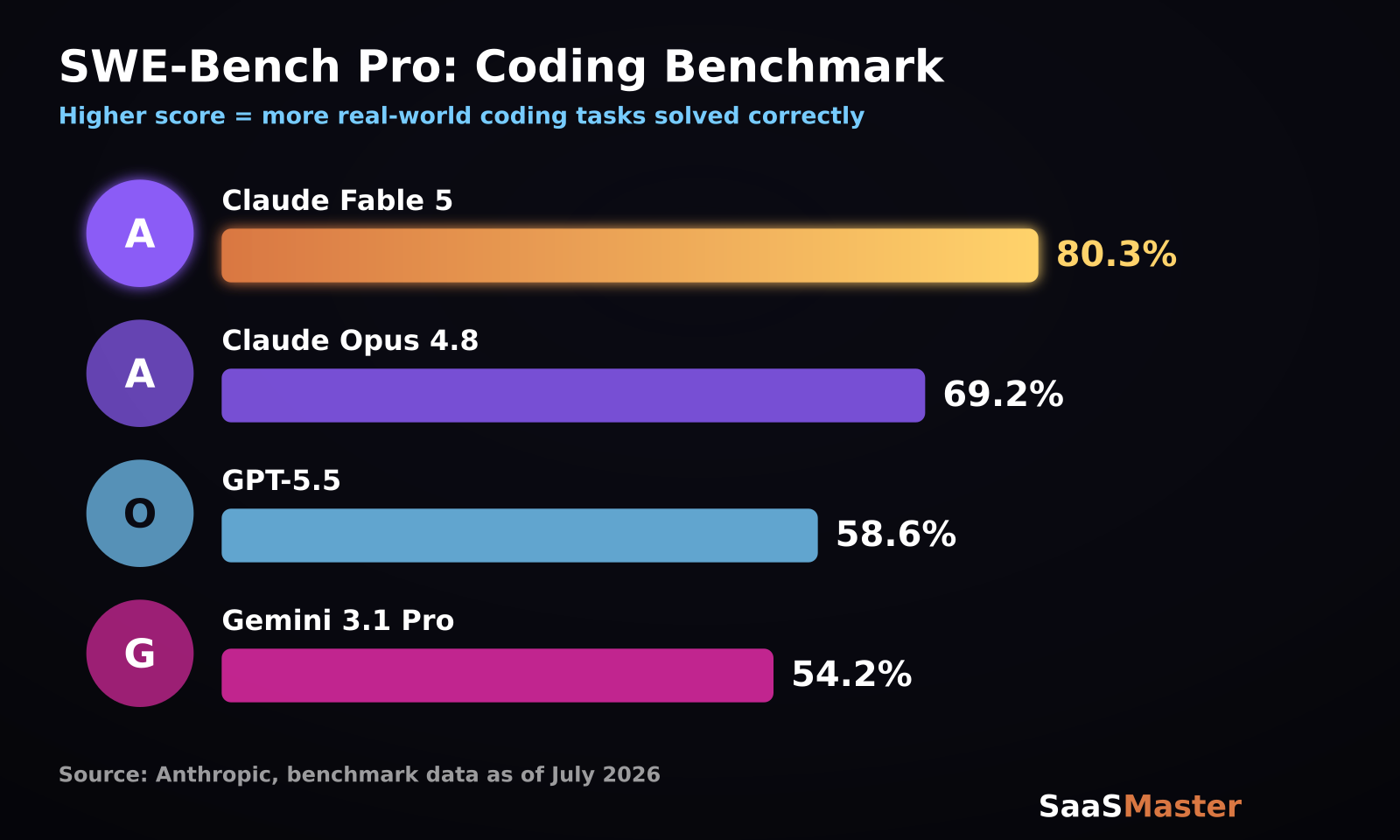
- Fable 5 scores 80.3% on SWE-Bench Pro, ahead of Claude Opus 4.8 (69.2%), GPT-5.5 (58.6%), and Gemini 3.1 Pro (54.2%).
- Pricing sits at 10 dollars per million input tokens and 50 dollars per million output tokens, roughly double Opus 4.8 and GPT-5.5 on input cost, with batch processing cutting that in half.
- For SaaS teams, the practical move is reserving Fable 5 for the coding and migration work where its accuracy pays for the higher price, not routing every request through it.
What actually happened with the export controls
On June 12, 2026, the Department of Commerce issued an emergency order blocking access to Claude Fable 5 and Claude Mythos 5, Anthropic's top two models at the time. The trigger wasn't a vague policy concern. Amazon's internal security researchers found specific prompt sequences that could get Fable 5 to describe techniques useful for identifying and exploiting software vulnerabilities, essentially treating the model as an unintentional research assistant for cyberattacks. Commerce treated that as a national security issue serious enough to pull the models from general availability while Anthropic addressed it.
For 18 days, anyone building on Fable 5 or Mythos 5 was stuck. Teams that had wired agentic coding workflows around Fable 5's higher accuracy had to either fall back to Opus 4.8 or eat the drop in reliability. I watched more than one developer forum thread turn into a slow-motion migration guide during that window.
Anthropic's fix was a new classifier trained specifically to recognize the flagged prompt pattern and block it before the model responds. The company says internal testing shows it stops the exploit technique in more than 99% of attempts, which was apparently enough for Commerce to lift the order on June 30. Access started rolling back out on July 1, and as of this writing it's available again through the Claude API, Claude Code, Amazon Bedrock, and Google Cloud Vertex AI, though enterprise customers on some government-adjacent contracts may see staged access depending on their agreement.
How good is Claude Fable 5 actually at coding
This is the part that makes the story matter beyond a regulatory footnote. Fable 5 didn't just come back, it came back on top of the leaderboard.
On SWE-Bench Pro, the benchmark Anthropic itself points to as the most representative of real production coding work, Fable 5 scores 80.3%. Claude Opus 4.8 sits at 69.2%. GPT-5.5 comes in at 58.6%. Gemini 3.1 Pro trails at 54.2%. That's not a marginal edge, it's an 11-point gap over Anthropic's own next-best model and a 20-plus point gap over the closest competitor.
Anthropic also reports 95.0% on SWE-bench Verified, and independent trackers list Fable 5 as the top scorer on CursorBench and on Cognition's FrontierBench eval. Anthropic has been circulating a case study where Fable 5 handled a codebase-wide migration across a roughly 50-million-line Ruby codebase at Stripe in a single day, work the team had estimated at more than two months for a full engineering group. Take vendor case studies with the usual grain of salt, but the magnitude of the claim lines up with what independent benchmarks are showing.
What does Claude Fable 5 cost
Fable 5 isn't cheap. Anthropic prices it at 10 dollars per million input tokens and 50 dollars per million output tokens through the standard API, which is roughly double what Opus 4.8 and GPT-5.5 charge on the input side. If your workload can tolerate asynchronous processing, batch requests cut that to 5 dollars and 25 dollars per million tokens, which makes Fable 5 realistic for background jobs like large-scale refactors, test generation sweeps, or documentation passes that don't need a human waiting on the response.
The math only works if you're actually using the accuracy. Running routine chat completions or simple CRUD scaffolding through Fable 5 at full price is burning money for capability you don't need. Where it earns its cost is exactly the kind of work Anthropic showcased: multi-file agentic changes, large migrations, and debugging sessions where a cheaper model's mistakes cost more in review time than Fable 5's token price.
Is Claude Fable 5 worth switching to for your SaaS team
Here's my honest take after watching this play out. If your team already had Fable 5 wired into a coding agent or CI pipeline before the ban, switching back is a no-brainer, you already knew the tradeoffs and the benchmarks confirm the model is even more capable now than when it left. If you spent the ban migrating fully to Opus 4.8 or GPT-5.5 and things are working fine, I wouldn't rip everything out just to chase a benchmark number. The 11 to 20 point SWE-Bench gap is real, but Opus 4.8 at roughly half the input cost is still a strong model, and switching infrastructure has its own cost in engineering time.
Where I'd move fast: any team doing heavy legacy-code migration, large monorepo refactors, or agentic multi-step coding tasks where Fable 5's accuracy edge compounds across hundreds of tool calls. That's the workload where an 11-point benchmark gap turns into hours of saved review time, and the higher per-token price stops mattering.
The bigger lesson from this whole episode, for any SaaS company building product on top of frontier models, is that regulatory risk is now a real dependency in your stack. An 18-day outage on your primary coding model because of an export control order is not something most engineering roadmaps plan for. If you're building critical workflows on any single frontier model right now, having a documented fallback path to a second model isn't paranoia anymore, it's basic infrastructure planning.
Frequently asked questions
Is Claude Fable 5 available again right now?
Yes. Access started restoring on July 1, 2026, through the Claude API, Claude Code, Amazon Bedrock, and Google Cloud Vertex AI. Some enterprise accounts on government-related contracts may see staged rollout depending on their agreement terms.
How does Claude Fable 5 compare to Claude Opus 4.8?
Fable 5 scores higher on coding benchmarks, 80.3% versus 69.2% on SWE-Bench Pro, but costs roughly double on a per-token basis. Opus 4.8 remains the more cost-efficient choice for everyday tasks; Fable 5 is better suited to complex agentic coding and large migrations where accuracy directly saves engineering time.
What is Claude Mythos 5?
Mythos 5 is Anthropic's other flagship model that was caught in the same export control order and restored alongside Fable 5 on July 1, 2026. Anthropic has described it as its "Mythos-class" model, positioned for long-context reasoning and complex business workflows rather than coding specifically.
Was this article helpful?
Jorge Aguilar
Founder & Creator, SaaS Master
Producing SaaS and AI product videos since 2019 — 800+ videos for 200+ brands, covering tutorials, demos, walkthroughs, and explainers. Writing here about the tools, trends, and tactics that actually move the needle. LinkedIn · About · Work with me
Want your product explained this clearly — in video?
Tutorials, walkthroughs, reviews, and shorts for SaaS, AI, and WordPress products.
Work With SaaS Master