AI Tools
Sora 2 vs Veo 3.1 vs Runway Gen-4.5: Which AI Video Generator Should You Use in 2026?
In short
Sora 2's consumer app shut down April 26, 2026, and its API ends September 24. Here is how Veo 3.1 and Runway Gen-4.5 compare on price and quality now.
Sora 2's consumer app shut down on April 26, 2026, and its API is scheduled to follow on September 24, 2026, which leaves Google's Veo 3.1 and Runway Gen-4.5 as the two AI video generators actually worth building a workflow around this week. Veo 3.1 wins on native synchronized audio and per-second API pricing, while Runway Gen-4.5 wins on creative control and currently ranks first on the Video Arena leaderboard. Here is how the numbers and the actual output compare.
Key takeaways
- Sora 2's consumer app closed April 26, 2026, and its API access ends September 24, 2026, so any workflow built on it needs a replacement plan now
- Veo 3.1 starts at 0.15 dollars per second in fast mode, with a standard tier at 0.75 dollars per second that includes native audio generation and 4K output
- Runway Gen-4.5 uses a credit-based subscription rather than per-second pricing, with a Standard plan at 12 dollars a month, billed annually, that bundles Gen-4.5, Veo 3.1, Kling 3.0, and the Aleph editing tool in one subscription
- Runway Gen-4.5 currently ranks number one on the Video Arena leaderboard for early 2026, ahead of both Veo 3.1 and the now-discontinued Sora 2 consumer product
- Veo 3.1 leads specifically on synchronized audio generation, while Runway is generally considered stronger on creative editing control
- Sora 2's remaining API-only tier runs 0.10 dollars per second at base quality and 0.30 to 0.50 dollars per second at the Pro tier, but its September 24 sunset date makes it a short-term option at best
What actually happened to Sora 2?
OpenAI shut down the Sora 2 consumer app on April 26, 2026. The API is still live and billed per second, but OpenAI has confirmed it will be retired on September 24, 2026, which means any team still building video workflows on Sora 2 today is working against a hard deadline. This is not a case of Sora 2 quietly losing relevance the way some AI tools fade; it is a scheduled shutdown with a public date, which makes it the least defensible option of the three for anyone starting a new project now.
For teams that already have Sora-based pipelines in production, the practical move is to start testing Veo 3.1 or Runway Gen-4.5 in parallel well before September, since prompt behavior, aspect ratio handling, and output length limits are not identical across the three tools and a same-day swap is unlikely to produce matching results.
How much do Sora 2, Veo 3.1, and Runway Gen-4.5 cost?
The three tools price themselves in genuinely different ways, which makes a direct comparison a little messy but still worth laying out plainly.
Sora 2's API-only tier, while it lasts, runs 0.10 dollars per second at base quality and climbs to 0.30 to 0.50 dollars per second at the Pro tier. Veo 3.1 starts at 0.15 dollars per second in fast mode for quick drafts, with a standard tier at 0.75 dollars per second that adds native audio generation and 4K output, billed transparently per second through the Gemini API. Runway takes a different approach entirely: rather than per-second billing, its Standard plan is a flat 12 dollars a month on annual billing, and that single subscription bundles access to Runway's own Gen-4.5 model alongside Google's Veo 3.1, Kling 3.0, and Runway's Aleph editing tool, all inside one credit pool.
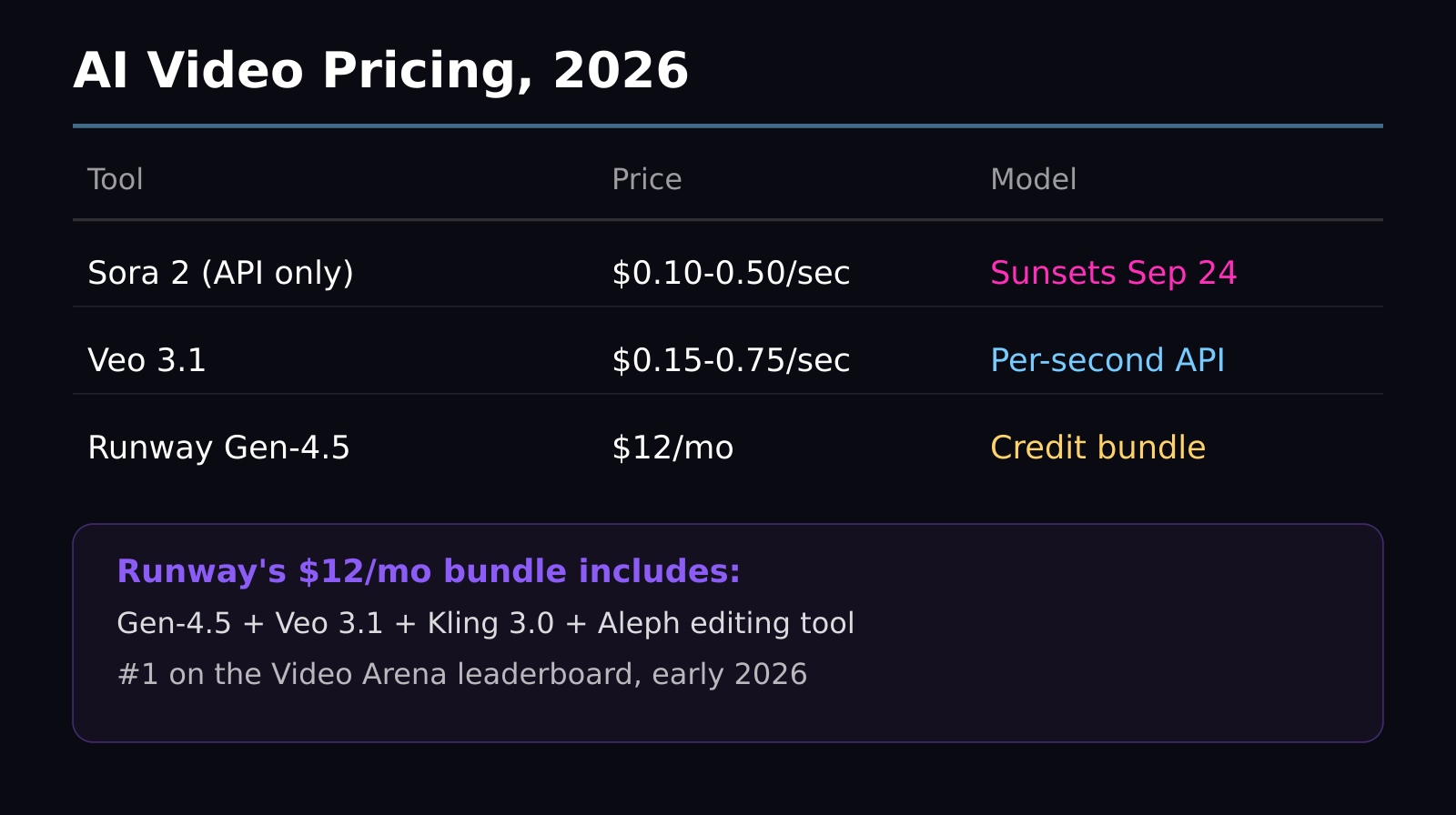
For a team that generates video occasionally, Runway's flat 12 dollar bundle is hard to beat, since it gives you three different generation models plus an editing tool for less than most single-tool subscriptions. For a team generating video programmatically at real volume through an API, Veo 3.1's transparent per-second pricing is easier to forecast and budget against, since you are not sharing a shared credit pool across multiple products.
Which one produces the best-looking video?
Quality comparisons here depend heavily on what you are optimizing for. Runway Gen-4.5 currently sits at number one on the Video Arena leaderboard, a head-to-head ranking based on blind output comparisons, and is generally seen as the strongest option for creative control, meaning fine-grained direction over camera movement, style, and edits after generation. Veo 3.1 is considered the strongest on synchronized audio, generating dialogue, sound effects, and ambient audio that lines up with the visual action in the same generation pass, which none of the other tools handle as cleanly. Sora 2, before its shutdown, was frequently cited for film-grade visual output and strong prompt adherence, and some of that reputation still holds for teams squeezing use out of the API before September, but it is a shrinking option rather than a growing one.
Which one should you pick for marketing and social content?
If your content needs dialogue, voiceover, or synced sound effects baked into the generation itself, rather than added afterward in an editor, Veo 3.1 is the more direct path, and its per-second pricing scales predictably as your output volume grows. If your workflow is closer to short-form social clips, product demos, or stylized brand content where you want to iterate on look and camera direction after the first generation, Runway's bundle gives you three generation models and an editing tool to bounce between without paying for three separate subscriptions. Teams doing both should seriously consider Runway's bundle specifically because it already includes Veo 3.1 access inside the same 12 dollar plan, which removes the need to choose at all for lower-volume use.
Is Runway's bundle actually the better deal?
For most small teams and solo creators, yes. Paying 12 dollars a month for access to Runway Gen-4.5, Veo 3.1, Kling 3.0, and the Aleph editing tool in one credit pool is a meaningfully better deal than subscribing to Veo separately at its per-second API rate unless your generation volume is high enough that dedicated API billing becomes cheaper in aggregate. The break-even point comes down to volume: light to moderate use favors the flat-rate bundle, while sustained, high-volume programmatic generation favors direct API pricing where you are not sharing a credit pool with three other models.
How do prompt adherence and output length actually compare?
Beyond raw quality scores, the practical differences show up in how much control you get over a single generation. Veo 3.1 and Runway Gen-4.5 both support extending or continuing a shot from a previous generation, which matters if you are building longer sequences rather than isolated clips, while Sora 2's API access is increasingly limited in how much support it gets given the September shutdown. Runway's Aleph tool, included in that same 12 dollar bundle, is specifically built for post-generation editing, letting you restyle, recut, or adjust a clip after it comes out of the model rather than starting over with a new prompt, which is a workflow advantage none of the pure generation APIs replicate on their own.
Aspect ratio and resolution handling also differ enough to matter for a real production pipeline. Veo 3.1's standard tier natively outputs 4K, which is useful if your final destination is a large display or a client deliverable that needs to hold up at full resolution, while Runway's bundle is more oriented toward fast iteration across multiple models rather than maximizing a single output's technical specs. If your workflow depends on hitting a specific resolution or aspect ratio consistently across a batch, test that requirement directly against each tool before committing a production pipeline to it, since stated capabilities and real-world consistency are not always identical.
Frequently asked questions
Is Sora 2 still usable in 2026?
The consumer app is no longer available, having shut down April 26, 2026. The API remains accessible for now but is scheduled to be retired on September 24, 2026, so it is only a short-term option for teams already building on it, not a good starting point for a new project.
Which is cheaper, Veo 3.1 or Runway Gen-4.5?
It depends on volume. Runway's flat 12 dollar monthly bundle is cheaper for light to moderate use since it includes Veo 3.1 access inside the same subscription. Veo 3.1's direct API pricing, starting at 0.15 dollars per second, becomes more cost-effective at high, sustained generation volume where a shared credit pool would run out quickly.
Does any of these include native audio generation?
Yes, Veo 3.1's standard tier at 0.75 dollars per second includes native synchronized audio generation alongside 4K video output, and it is generally considered the strongest of the three specifically for audio that matches the generated visual action.
Was this article helpful?
Jorge Aguilar
Founder & Creator, SaaS Master
Producing SaaS and AI product videos since 2019 — 800+ videos for 200+ brands, covering tutorials, demos, walkthroughs, and explainers. Writing here about the tools, trends, and tactics that actually move the needle. LinkedIn · About · Work with me
Want your product explained this clearly — in video?
Tutorials, walkthroughs, reviews, and shorts for SaaS, AI, and WordPress products.
Work With SaaS Master