Claude Fable 5 vs GPT-5.5 vs Gemini 3.1 Pro: Which AI Model Should Your SaaS Team Use in 2026?
In short
Fable 5, GPT-5.5, and Gemini 3.1 Pro compared on benchmarks, pricing, and real SaaS use cases — with a clear pick for each team size and budget in July 2026.
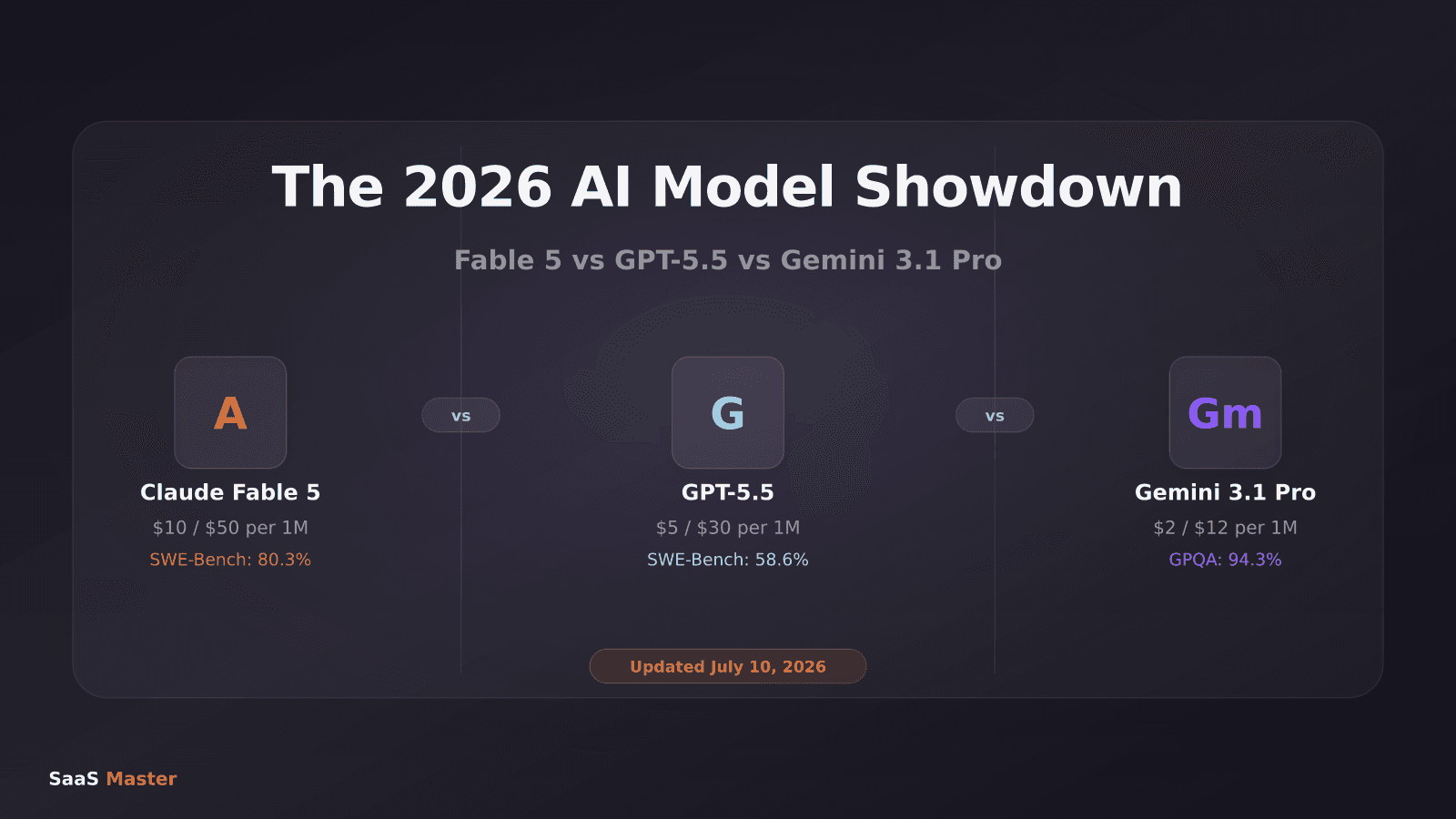
Claude Fable 5 launched June 9, 2026, and in the weeks since, it has reshaped how SaaS teams think about AI model selection. If you are choosing between Fable 5, GPT-5.5, and Gemini 3.1 Pro right now, the core answer is straightforward: Fable 5 leads on coding and hallucination rate, Gemini 3.1 Pro leads on price, and GPT-5.5 is the reliable middle ground most teams default to when they need coverage across many task types.
Key takeaways: - Fable 5 scores 80.3% on SWE-Bench Pro — 21.7 points ahead of GPT-5.5 and 26 ahead of Gemini 3.1 Pro - Fable 5 hallucinates at 36.18% vs GPT-5.5's 85.53% on the AA-Omniscience benchmark - Fable 5 costs $10/$50 per 1M input/output tokens; GPT-5.5 is $5/$30; Gemini 3.1 Pro is $2/$12 - Fable 5 switched from free access to metered pricing on July 13, 2026 - Gemini 3.1 Pro leads on GPQA Diamond (94.3%) and is the cheapest of the three - The best strategy for most teams is routing — not standardizing on one model
What changed in June and July 2026?
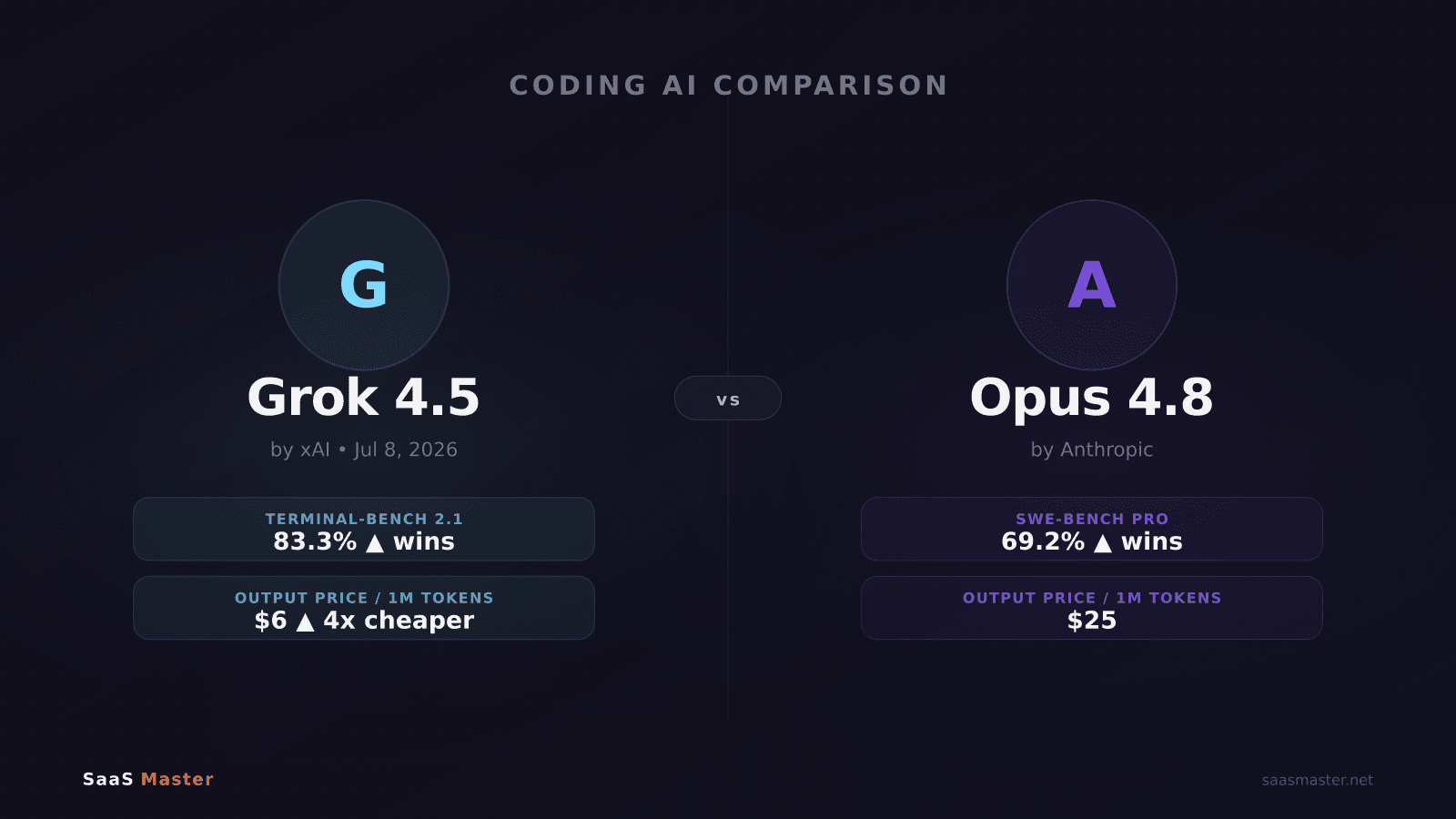
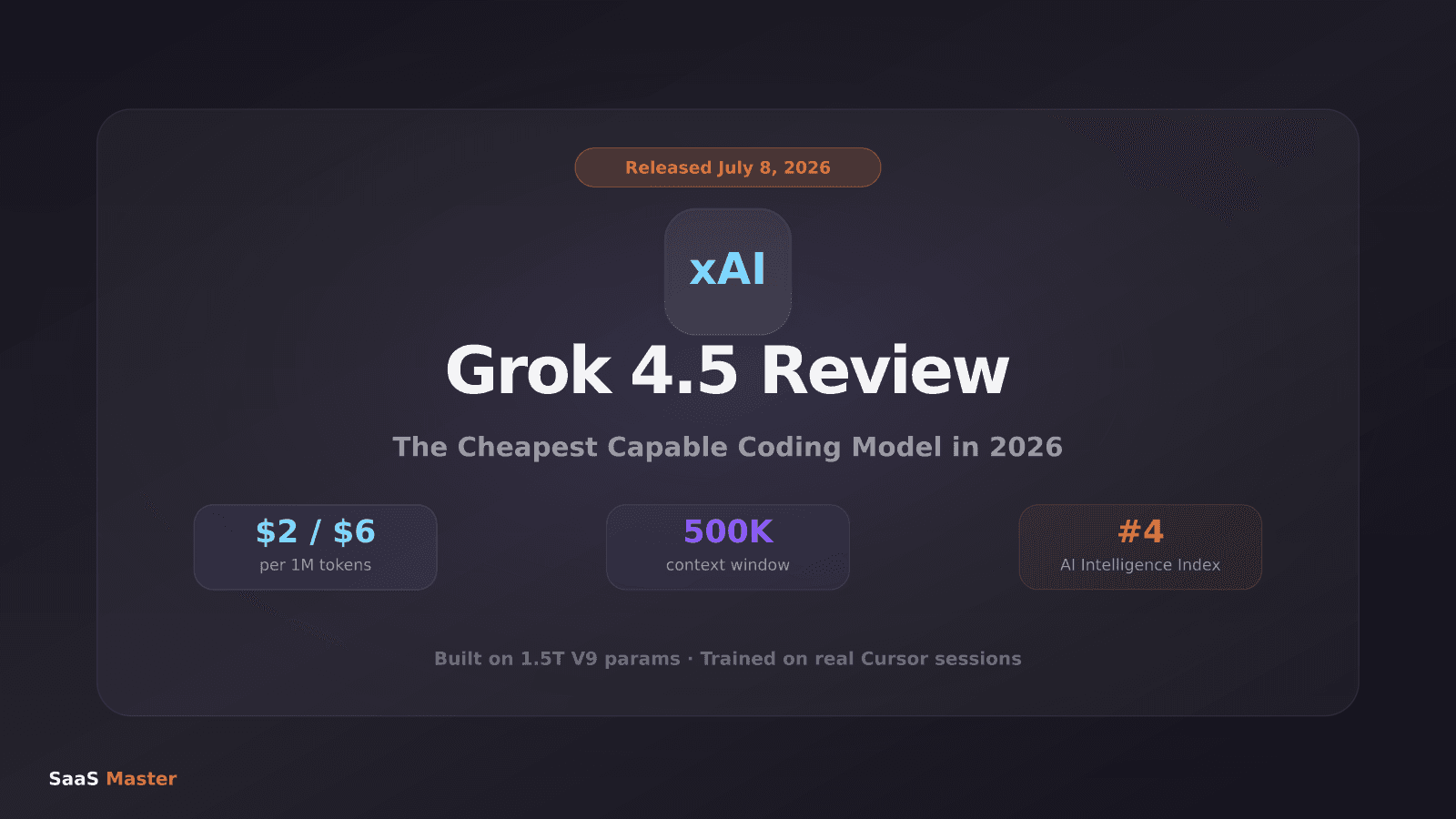
Anthropic released Claude Fable 5 on June 9, 2026, as the first publicly available Mythos-class model. At launch it posted a composite score of 64.9 on the Artificial Analysis Intelligence Index, about five points ahead of GPT-5.5 at 59.8. On July 8, xAI released Grok 4.5 as a cost-efficient coding-focused contender, but Fable 5 retained its lead at the top.
Google's Gemini 3.1 Pro, available since earlier in 2026, continues to hold the cost advantage among frontier models and performs strongly on scientific reasoning benchmarks. These three — plus Grok 4.5 — are what enterprise SaaS teams are actively evaluating this summer.
How do the benchmarks actually compare?
The gap is largest on coding. SWE-Bench Pro, which evaluates real software engineering tasks against verified test suites, gives Fable 5 an 80.3% pass rate. GPT-5.5 scores 58.6% and Gemini 3.1 Pro scores 54.2%. That 21.7-point lead over GPT-5.5 is larger than the gap between GPT-5.5 and Gemini combined.
On scientific reasoning, Gemini 3.1 Pro leads. GPQA Diamond, covering graduate-level questions in biology, chemistry, and physics, gives Gemini 94.3%, GPT-5.5 92.8%, and Fable 5 91.3%. The difference is small enough that it only matters for teams running science-heavy workflows.
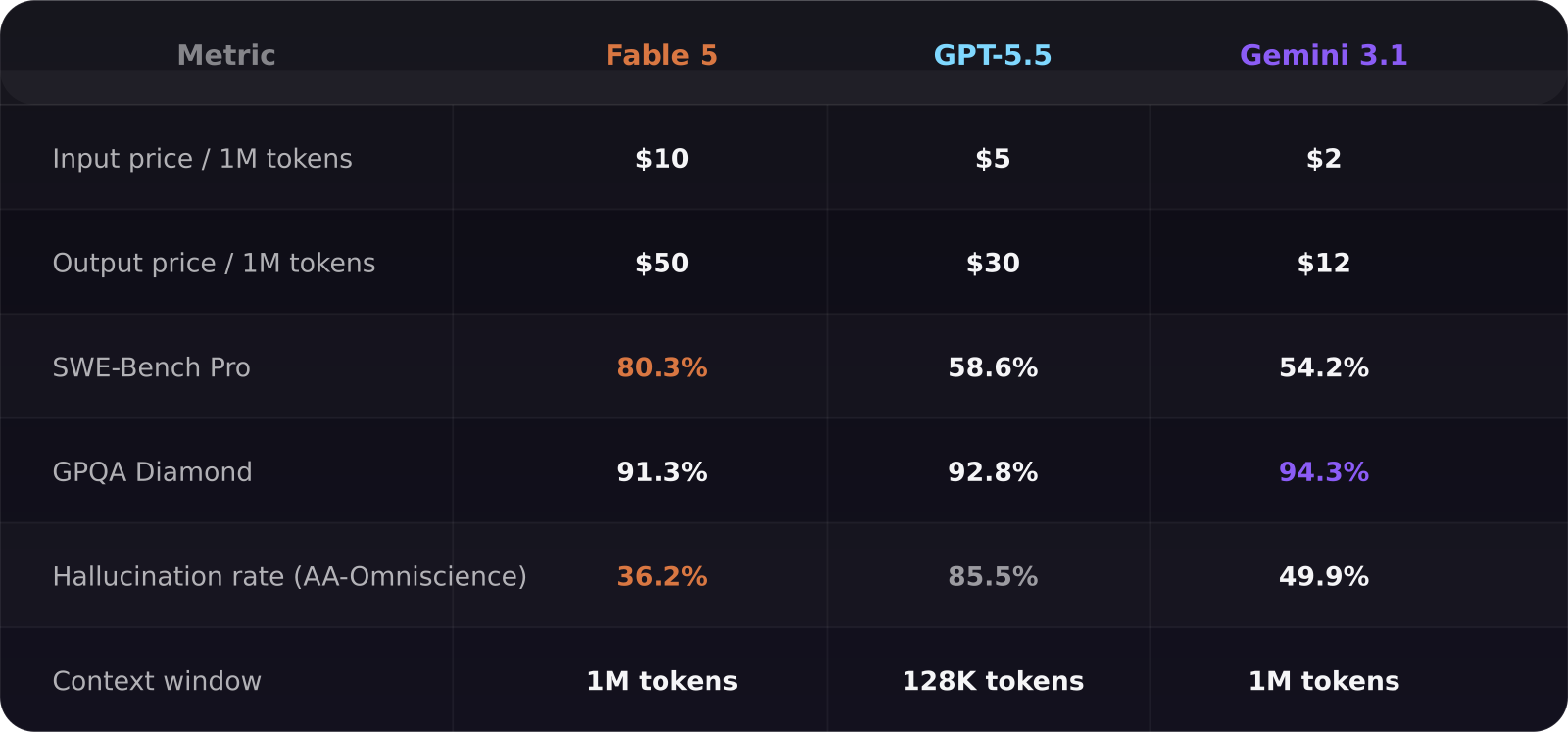
The metric that surprises most teams is the hallucination rate. On the AA-Omniscience benchmark, Fable 5 hallucinates at 36.18%, GPT-5.5 at 85.53%, and Gemini at 49.87%. For any content that reaches customers — website copy, help docs, email sequences — this difference is operationally significant.
What does pricing actually mean for your team?
Fable 5 costs $10 per 1M input tokens and $50 per 1M output tokens. GPT-5.5 is $5 input and $30 output. Gemini 3.1 Pro is $2 input and $12 output.
A workload costing $1,000 per month on Gemini 3.1 Pro would cost roughly $4,000–$5,000 on Fable 5 at similar token volumes. That arithmetic matters at scale, but it ignores quality differences. If Fable 5 resolves a task that GPT-5.5 requires two attempts on, the effective cost per resolved task shifts.
Starting July 13, 2026, Fable 5 moved from free-to-access to metered usage credits. Teams that evaluated it for free during June and early July need to factor that cost into their AI budget immediately.
Which model wins on coding?
Fable 5, by a clear margin. Its 80.3% SWE-Bench Pro score is the highest of any publicly accessible model as of this writing. Anthropic designed it for long-horizon agentic tasks: code migrations across thousands of files, multi-day autonomous sessions, and production-ready deliverables that previously required constant developer supervision.
For teams building SaaS products and using AI to accelerate engineering, Fable 5 is the model to benchmark against. The cost is real, but so is the quality difference on complex refactors.
Which model is best for content, research, and customer-facing work?
For content creation and customer-facing text, the ranking is less decisive. GPT-5.5 has strong instruction-following and the most mature integrations with tools like Slack, Notion, HubSpot, and Make.com. Gemini 3.1 Pro handles large document inputs efficiently given its 1M context window and is competitive on multimodal tasks.
Fable 5's 36.18% hallucination rate makes it the safest choice for factual content where errors are costly. However, at $50/M output tokens, most teams will not run high-volume blog posts, email campaigns, or customer support drafts through it.
The AI tools hub has more comparisons on model selection by use case. If you are a SaaS company explaining these model differences to prospects through video, the AI tool video production format is effective for making abstract benchmarks tangible.
What model should your SaaS team actually use?
For complex coding and agentic workflows where errors are expensive, choose Fable 5 — the benchmark lead and low hallucination rate justify the premium.
For general-purpose mixed use with broad tool integrations and reliable performance, choose GPT-5.5 — it sits in the middle on price and performance and remains the safest default.
For cost-sensitive, high-volume work — including routine content generation, classification, and summarization — choose Gemini 3.1 Pro at $2/$12 per 1M tokens.
The teams getting the most value right now are routing different workloads to different models rather than standardizing on one. Fable 5 for the hard stuff, Gemini 3.1 Pro for the volume, and GPT-5.5 for everything in between.
Frequently asked questions
Is Claude Fable 5 worth the price premium in 2026?
For coding-intensive and agentic workflows, yes. Fable 5's 80.3% SWE-Bench Pro score and 36.18% hallucination rate (versus 85.53% for GPT-5.5) make it the most reliable model for high-stakes tasks. For routine content work at volume, Gemini 3.1 Pro delivers substantially better cost efficiency.
When did Claude Fable 5 pricing change?
Fable 5 was accessible for free from its June 9, 2026 launch through July 12, 2026. Starting July 13, 2026, access switched to metered usage credits at $10 per 1M input tokens and $50 per 1M output tokens through the Anthropic API.
How does Gemini 3.1 Pro compare to Claude Fable 5?
Gemini 3.1 Pro leads on GPQA Diamond (94.3% vs Fable 5's 91.3%) and costs about five times less on output tokens. Fable 5 leads on SWE-Bench Pro (80.3% vs 54.2%) and hallucination rate. For scientific reasoning and cost-sensitive work, Gemini is competitive. For software engineering and low-error-rate tasks, Fable 5 has a substantial advantage.
Was this article helpful?
Jorge Aguilar
Founder & Creator, SaaS Master
Producing SaaS and AI product videos since 2019 — 800+ videos for 200+ brands, covering tutorials, demos, walkthroughs, and explainers. Writing here about the tools, trends, and tactics that actually move the needle. LinkedIn · About · Work with me
Building an AI product that needs a clearer onboarding flow?
Client-owned videos that make your product easy to understand — demos, walkthroughs, onboarding, and explainers.
Explore AI product video productionRelated guides
More AI Tools & AI Workflows →
Perplexity vs ChatGPT for SaaS Teams in 2026: Which AI Actually Wins?
Grok 4.5 Review: xAI's Cheapest Capable Coding Model Is Here (July 2026)
OpenCode vs Claude Code vs Cursor: Which AI Coding Agent Wins in 2026?