Grok 4.5 vs Claude Opus 4.8: Which Coding AI Is Worth Paying For in 2026?
In short
Grok 4.5 launched July 8, 2026 as xAI's Opus-class model at 60% lower cost. We compare benchmarks, token efficiency, and per-task pricing vs Claude Opus 4.8.
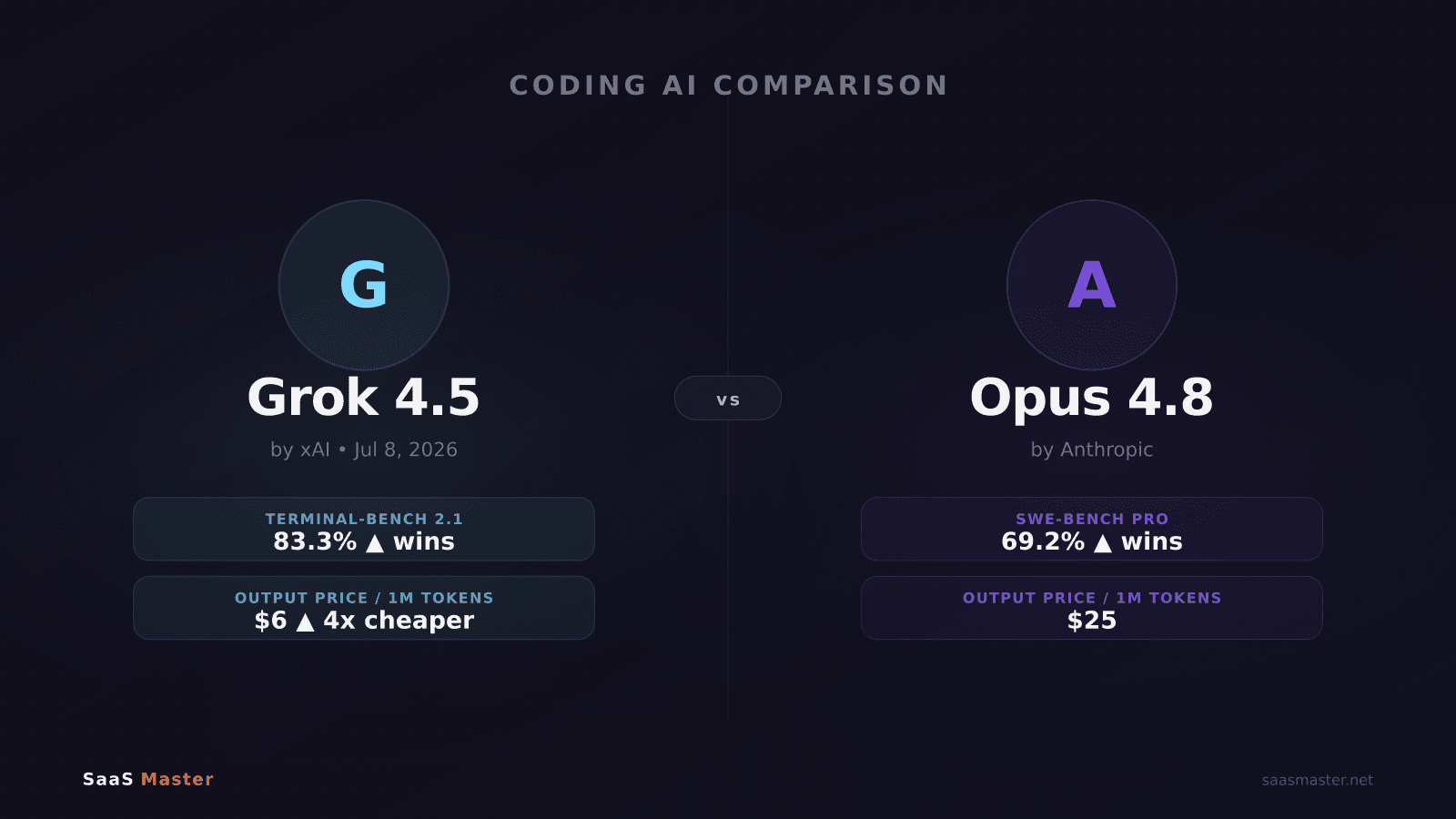
xAI launched Grok 4.5 on July 8, 2026, and the headline claim was unusually specific: Elon Musk described it as an "Opus-class model" before it shipped. That's a direct shot at Anthropic's Claude Opus 4.8, which costs $5 input / $25 output per million tokens. Grok 4.5 is priced at $2/$6. If it can actually match Opus on real coding tasks, that pricing gap becomes one of the most interesting value stories in AI this year.
Key takeaways:
- Grok 4.5 costs $2/$6 vs Claude Opus 4.8's $5/$25 per 1M input/output tokens — roughly 4x cheaper on output
- Grok 4.5 uses 4.2x fewer output tokens per coding task (15,954 vs 67,020 on SWE-bench Pro), making the real per-task cost gap closer to 17x
- Claude Opus 4.8 leads on SWE-bench Pro: 69.2% vs 64.7% — a real and reproducible 4.5-point advantage
- Grok 4.5 leads on Terminal-Bench 2.1: 83.3% vs 78.9%, a 4.4-point win for CLI and agentic workflows
- Grok 4.5 ranked 4th on the Artificial Analysis Intelligence Index in July 2026, above all Gemini models
Is xAI's "Opus-class" claim actually true?
Short answer: it's close, and on some benchmarks Grok 4.5 genuinely wins. On the most rigorous software engineering benchmark available today — SWE-bench Pro — Claude Opus 4.8 leads at 69.2% vs Grok 4.5's 64.7%. That 4.5-point gap is real and reproducible. For teams where SWE-bench score is the primary filter, Opus 4.8 is still ahead.
But "Opus-class" looks more defensible when you look at Terminal-Bench 2.1, which tests real command-line and coding workflows rather than the isolated code-generation tasks SWE-bench emphasizes. There, Grok 4.5 scores 83.3% to Opus 4.8's 78.9% — a 4.4-point lead for developers using AI in terminal-heavy work.
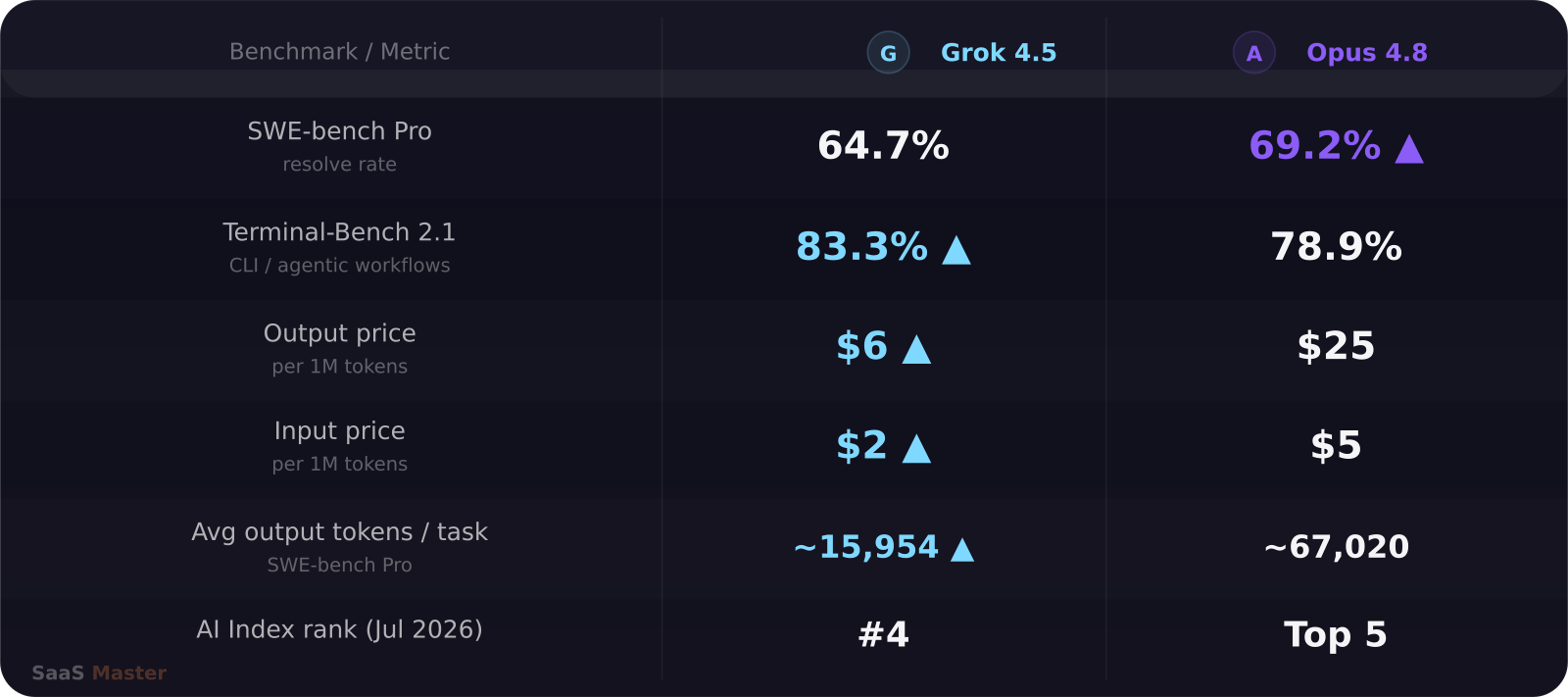
On the Artificial Analysis Intelligence Index — a composite that weights knowledge, reasoning, and coding across multiple evaluations — Grok 4.5 ranked 4th globally as of July 2026, above every Gemini model and directly competitive with the Anthropic frontier.
How the benchmarks compare
SWE-bench Pro resolve rate: Claude Opus 4.8 at 69.2%, Grok 4.5 at 64.7%. Opus wins by 4.5 points. For context, Claude Fable 5 leads the overall leaderboard at 80.4%, but that model costs significantly more than either of these two.
Terminal-Bench 2.1: Grok 4.5 at 83.3%, Claude Opus 4.8 at 78.9%. Grok wins by 4.4 points. Terminal-Bench measures tasks like writing shell scripts, debugging build errors, navigating codebases via CLI, and running agentic terminal workflows — scenarios that reflect how developers actually use AI.
xAI also published DeepSWE 1.0 at 62.0% and SWE Marathon resolution rate at 29.0%. These numbers have held up against third-party replications published in the week since launch.
Which is cheaper, Grok 4.5 or Claude Opus 4.8?
On API rates, Grok 4.5 at $2 input / $6 output per 1M tokens compares to Claude Opus 4.8 at $5 input / $25 output. That's 2.5x cheaper on input and roughly 4.2x cheaper on output.
But here's the number that changes the math entirely: Grok 4.5 uses 4.2x fewer output tokens per coding task than Claude Opus 4.8. On SWE-bench Pro, Grok 4.5 averaged about 15,954 output tokens per task versus Opus 4.8's 67,020.
If Grok uses 4.2x fewer tokens at a 4.2x lower output rate, the per-task cost gap compounds to roughly 17x — not 4x. For SaaS teams running automated code review, PR description generation, or CI pipelines with hundreds of calls per day, this changes your infrastructure cost calculation significantly.
Token efficiency: the number nobody's talking about
Most API cost comparisons stop at the rate card. But actual cost per completed task depends on how many tokens the model uses to finish the work.
Grok 4.5's architecture was optimized for token efficiency. xAI claimed "twice greater token efficiency than the latest leading models at the same tasks," and the SWE-bench data backs that claim when comparing against Opus 4.8: 15,954 vs 67,020 average output tokens per task.
This also affects latency. Fewer output tokens means faster completion per task, which matters for any pipeline where the AI response is in the critical path of a user-facing interaction.
Who should use Grok 4.5?
Grok 4.5 is the right call if you're running high-volume coding pipelines where per-task cost is a primary constraint. Automated code review at scale, commit message generation, documentation from code, test scaffolding — these are the use cases where Grok's token efficiency compounds into real savings.
It's also the better fit if your workflows are terminal-heavy or involve agentic command-line tasks. The Terminal-Bench 2.1 lead reflects an architecture that handles tool use and CLI navigation well.
For SaaS companies building AI coding features, demonstrating Grok 4.5's speed and cost advantages through software demo videos is more convincing to prospects than a pricing table alone.
Who should stick with Claude Opus 4.8?
If you need the highest resolve rate on complex, multi-file software engineering tasks — and you're working in production where a 4.5-point SWE-bench gap translates to real quality differences — Opus 4.8 is still the stronger pick. Anthropic's ecosystem, breadth of evaluations, and safety track record make it the lower-risk choice for enterprise teams with strict vendor requirements.
Opus 4.8 is also the better fit when output length matters. Deep code analysis, long-form architecture documentation, or anything where verbosity is a feature rather than a cost — Grok's token efficiency advantage becomes a disadvantage when you need comprehensive explanations.
For more model comparisons, see the AI tools hub and the MiniMax M3 review if you're exploring even lower-cost options for less complex tasks.
Frequently asked questions
Is Grok 4.5 actually better than Claude Opus 4.8 for coding?
It depends on the benchmark. Claude Opus 4.8 leads on SWE-bench Pro (69.2% vs 64.7%), which tests isolated code generation and repair. Grok 4.5 leads on Terminal-Bench 2.1 (83.3% vs 78.9%), which tests real-world CLI and agentic workflows. For most production coding pipelines, Grok 4.5 delivers competitive results at a dramatically lower per-task cost.
How much cheaper is Grok 4.5 vs Claude Opus 4.8 per task?
On API rates alone, Grok 4.5 is roughly 4x cheaper per output token. Because Grok also uses 4.2x fewer output tokens per task (about 15,954 vs 67,020 on SWE-bench Pro), the real per-task cost advantage is closer to 17x for coding-heavy workloads.
Is Grok 4.5 available via API now?
Yes. Grok 4.5 launched on July 8, 2026 and is available via the xAI API at $2 input / $6 output per 1M tokens. It is also accessible in Codex at roughly half the per-task cost of GPT-5.5 according to xAI's published benchmarks.
Was this article helpful?
Jorge Aguilar
Founder & Creator, SaaS Master
Producing SaaS and AI product videos since 2019 — 800+ videos for 200+ brands, covering tutorials, demos, walkthroughs, and explainers. Writing here about the tools, trends, and tactics that actually move the needle. LinkedIn · About · Work with me
Building an AI product that needs a clearer onboarding flow?
Client-owned videos that make your product easy to understand — demos, walkthroughs, onboarding, and explainers.
Explore AI product video productionRelated guides
More AI Tools & AI Workflows →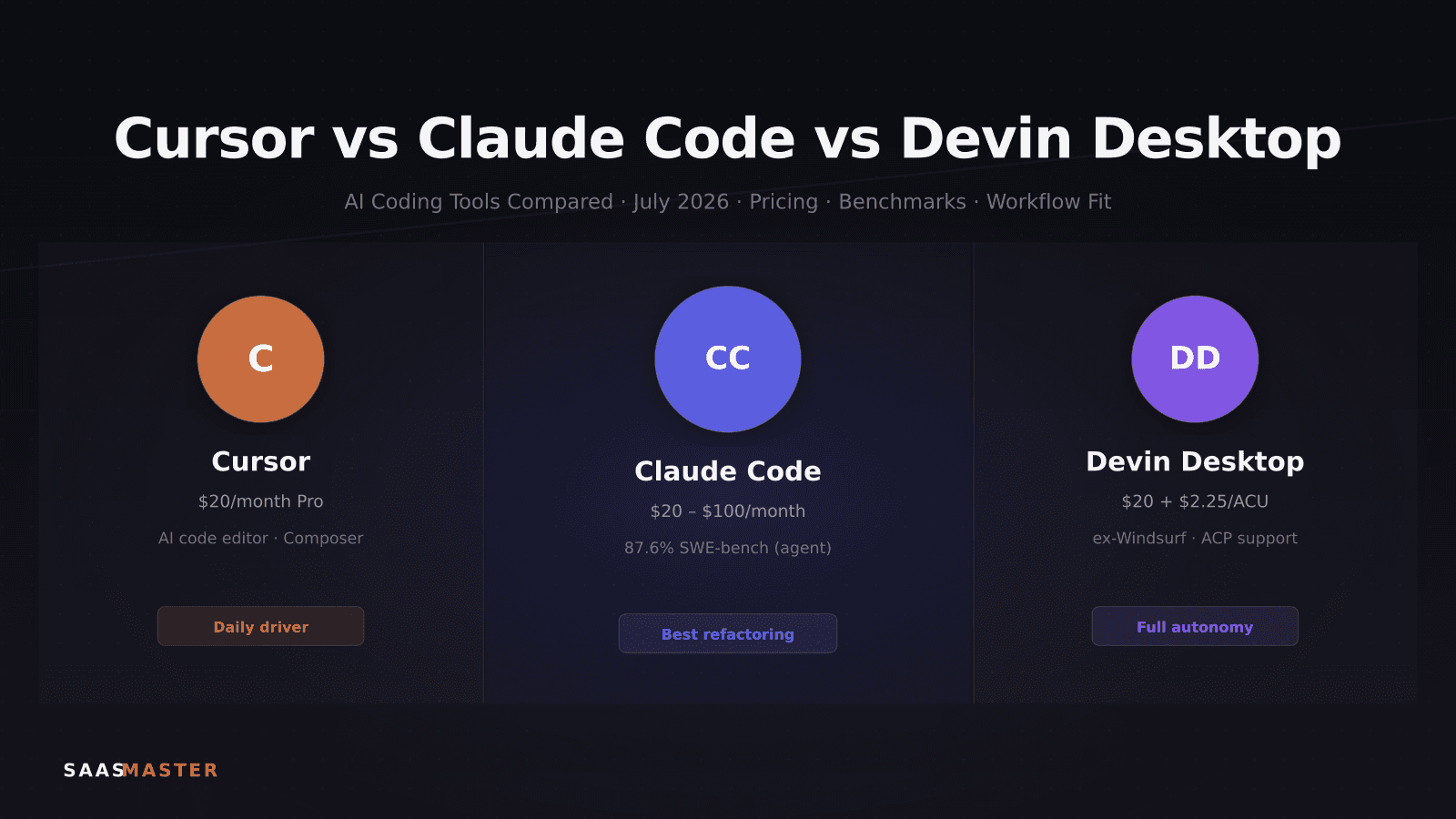
Cursor vs Claude Code vs Devin Desktop 2026: Which AI Coding Tool Wins?
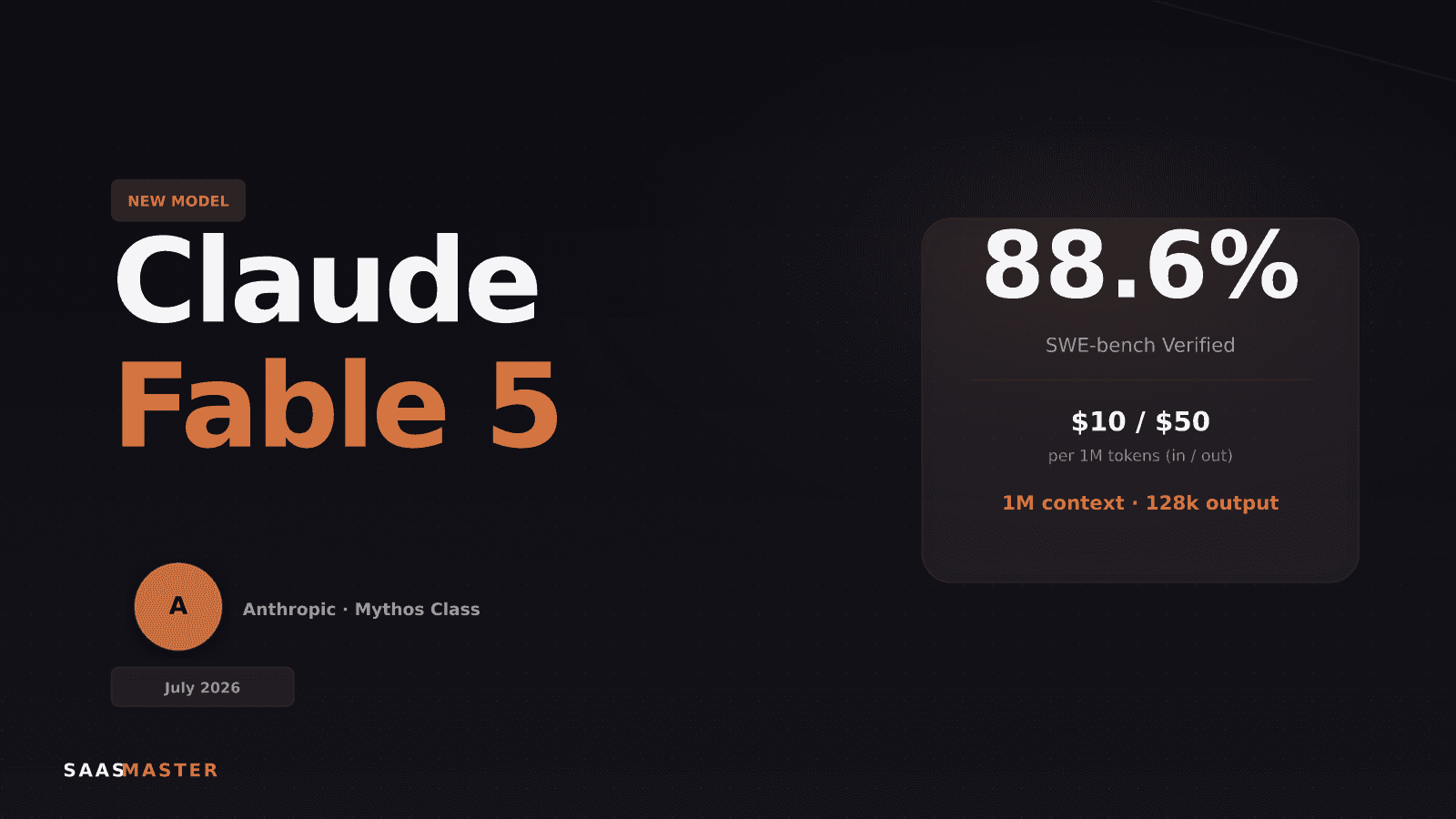
Claude Fable 5 Review: Anthropic's First Mythos-Class Model Arrives
GPT-5.6 Sol, Terra & Luna: OpenAI's Three-Tier Model Family Lands Today