Grok 4.5 Review: xAI's Cheapest Capable Coding Model Is Here (July 2026)
In short
Grok 4.5 launched July 8, 2026 — xAI's first model built for coding and agents. Full review of $2/$6 per 1M token pricing, 500K context, benchmarks, and who should use it.
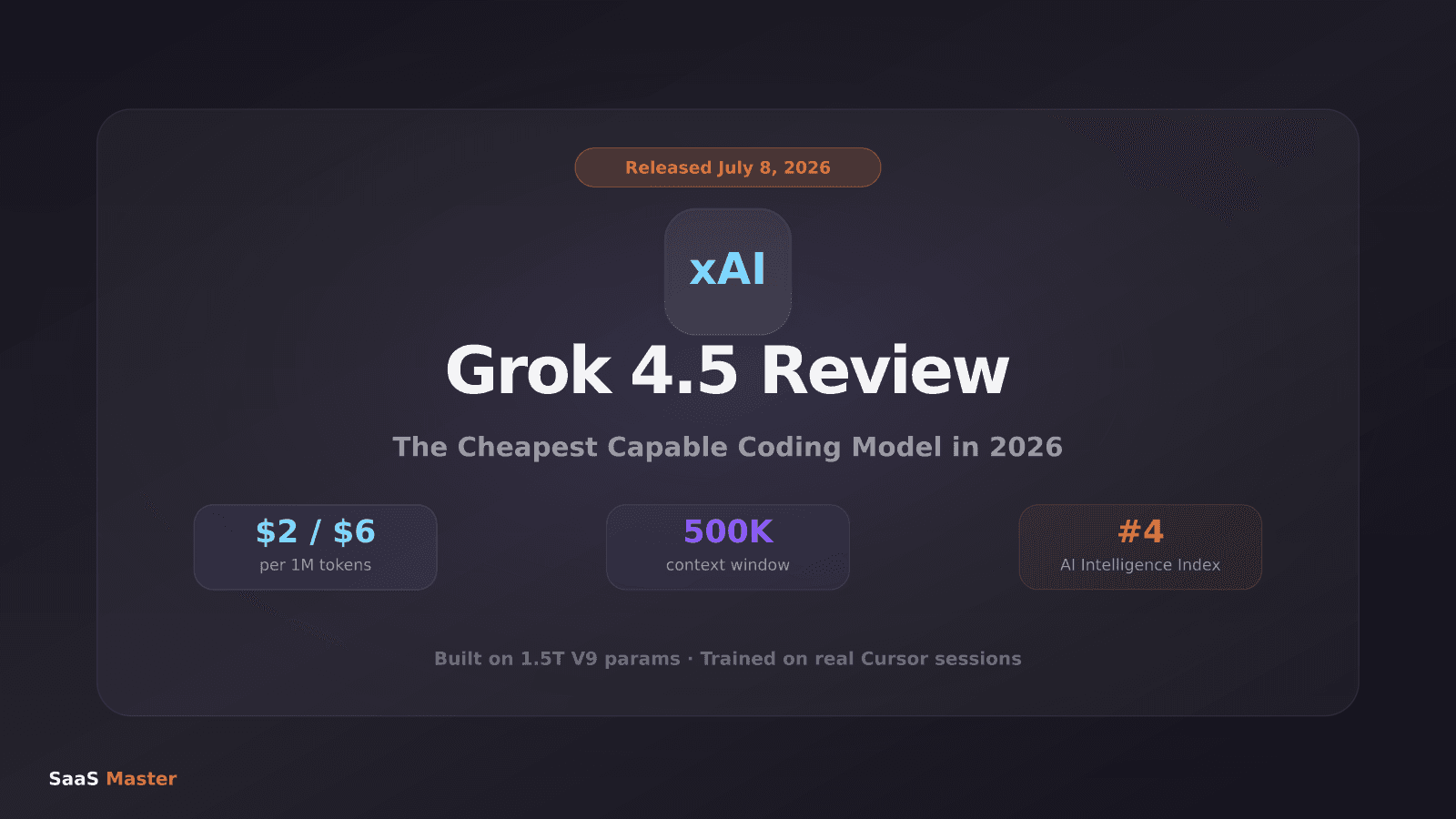
Grok 4.5 launched on July 8, 2026, and it is the most significant model release for developers since Claude Fable 5 in June. At $2 per 1M input tokens and $6 per 1M output tokens, it is the cheapest capable coding model available right now — and it was specifically built for agentic work inside real codebases using actual Cursor developer session data as training material.
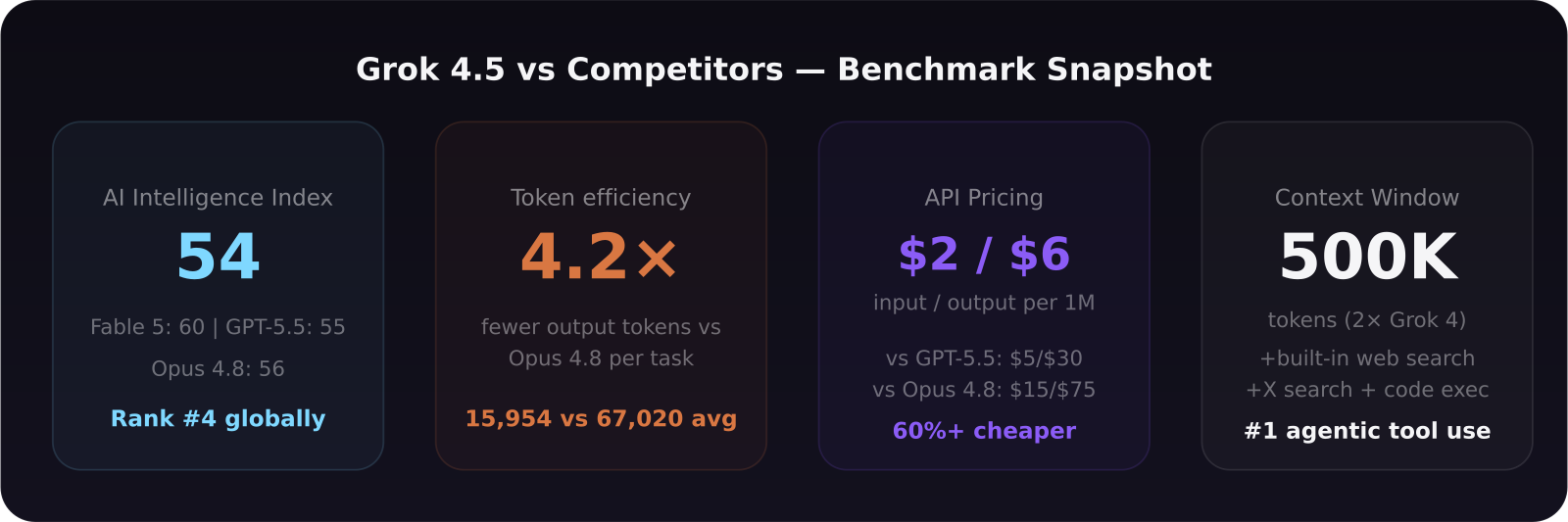
Key takeaways: - Grok 4.5 was released July 8, 2026 by xAI — the first Grok model purpose-built for coding and agentic work - Priced at $2/$6 per 1M input/output tokens — over 60% cheaper than Claude Opus 4.8 or GPT-5.5 - Built on xAI's 1.5-trillion-parameter V9 foundation, trained on real developer sessions from Cursor - 500,000-token context window — double the original Grok 4's 256K - Ranks #4 globally on the Artificial Analysis Intelligence Index with a score of 54 - Uses 4.2× fewer output tokens per resolved coding task than Claude Opus 4.8 on average - Takes the single top spot on agentic tool use benchmarks
What is Grok 4.5 and why does it matter?
Grok 4.5 is xAI's first model built specifically for coding and agentic tasks rather than general-purpose reasoning. The original Grok 4, released in July 2025, was a strong reasoning model — MATH 500 at 99%, GPQA Diamond at 87.7% — but was designed as a frontier general model. Grok 4.5 narrows the focus to what developers actually do in long coding sessions.
The key architectural decision is the training data. xAI used real developer sessions from Cursor — not just code corpora or synthetic benchmarks — which means the model has seen how developers actually reason through multi-step problems, debug failing tests, and implement changes across dozens of files. That training signal shows up in the benchmarks where it matters most: agentic tool use and token efficiency.
The model also introduces a reasoning_effort parameter with low, medium, and high settings (high is the default), letting teams trade some quality for lower output token costs on simpler tasks.
How does Grok 4.5 benchmark against the field?
On the Artificial Analysis Intelligence Index, Grok 4.5 scores 54, placing it #4 globally behind Claude Fable 5 (60), Claude Opus 4.8 (56), and GPT-5.5 (55). It is not the top performer on composite intelligence, but it is competitive at a fraction of the cost.
Where Grok 4.5 separates itself is token efficiency and agentic tool use. On SWE Bench Pro, Grok 4.5 averages about 15,954 output tokens per resolved task versus roughly 67,020 for Claude Opus 4.8 Max — about 4.2 times fewer tokens for comparable task completion. At $6/M output tokens versus $75/M for Opus 4.8, that efficiency multiplier turns into roughly a 20× cost difference per resolved task in a favorable comparison.
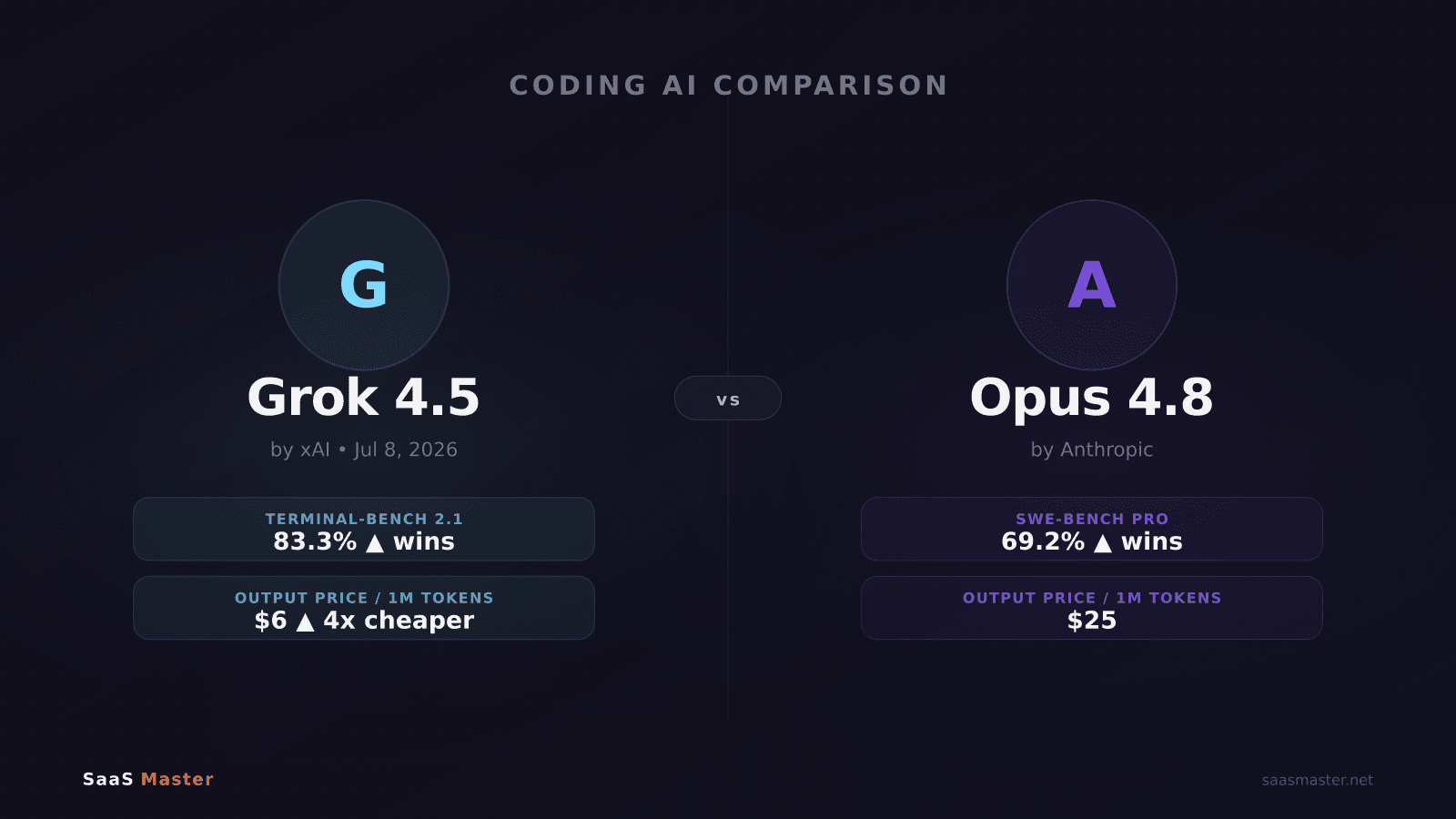
On xAI's own published benchmarks: Grok 4.5 beats Opus 4.8 on DeepSWE 1.0 and Terminal-Bench 2.1, and loses to Opus 4.8 on DeepSWE 1.1 (by 6 points) and SWE-Bench Pro (by approximately 4.5 points). xAI published both wins and losses, which is a reasonable sign of confidence in the overall value proposition.
What does the pricing mean in practice?
At $2/$6 per 1M tokens, Grok 4.5 is dramatically cheaper than every model it competes with. Claude Fable 5 costs $10/$50. Claude Opus 4.8 costs $15/$75. GPT-5.5 costs $5/$30.
For teams running agentic coding pipelines at scale, the math is significant. A pipeline that costs $1,000 per month on Opus 4.8 might cost $50–$80 per month on Grok 4.5, assuming similar task completion rates. The 4.2× token efficiency advantage compounds that savings further — you pay less per token and need fewer tokens per task.
The reasoning_effort parameter adds another layer of cost control. Setting it to low or medium on simpler tasks reduces output tokens meaningfully without losing much quality on straightforward implementations.
What is Grok 4.5 actually best at?
Grok 4.5 is strongest at terminal-based agentic coding — long sessions where the model reads files, proposes implementations, runs tests, and iterates across multiple steps. The training on real Cursor sessions gives it a specific edge on multi-step debugging and implementations that span many files in a realistic developer workflow.
It also works well in OpenCode, which supports Grok models natively through OpenRouter. Teams can route simpler tasks to free models and complex coding sessions to Grok 4.5 while keeping total costs well below Claude or GPT-5.5 equivalents. This flexibility is the practical advantage of the open-provider ecosystem.
Where Grok 4.5 is less strong: the absolute quality ceiling that Claude Fable 5 holds on the most complex reasoning tasks, and hallucination rates. Fable 5's 36.18% hallucination rate on AA-Omniscience is substantially lower than the broader field. For compliance-sensitive or customer-facing content, that gap matters.
Who should actually use Grok 4.5?
If your team runs agentic coding pipelines at volume and cost efficiency is a real constraint, Grok 4.5 is the strongest option available as of July 10, 2026. The combination of competitive benchmark performance, #1 agentic tool use scores, 500K context window, and 60%+ lower pricing than GPT-5.5 makes it a compelling choice for production engineering workloads.
For teams that need the absolute quality ceiling and are running tasks where Fable 5's SWE-Bench lead and lower hallucination rate justify the 4–8× price premium, Fable 5 is still the better pick.
For general-purpose use cases that go beyond coding — vision inputs, scientific reasoning, broad tool use — the original Grok 4 may still be more appropriate for some workflows.
Access to Grok 4.5 is through the xAI API (model ID: x-ai/grok-4-5) and via OpenRouter for teams that prefer consolidated provider management. You can explore the broader AI tools and workflows category for more model comparisons. If you are building a product on top of Grok 4.5 and want to communicate your AI stack to prospects, a software demo video tends to convey capability more clearly than benchmark tables.
Frequently asked questions
How much does Grok 4.5 cost compared to competitors?
Grok 4.5 costs $2 per 1M input tokens and $6 per 1M output tokens — over 60% cheaper than Claude Opus 4.8 ($15/$75) and GPT-5.5 ($5/$30). At typical developer usage, monthly API costs run $2–$15. The reasoning_effort parameter allows teams to reduce output costs further on simpler tasks.
How does Grok 4.5 compare to Claude Fable 5 on coding?
Fable 5 leads on overall intelligence (60 vs 54 on the Artificial Analysis Index) and SWE-Bench Pro (80.3% vs roughly 75.8% for Grok 4.5). Grok 4.5 leads on agentic tool use benchmarks and is 4.2× more token-efficient per resolved coding task. Grok 4.5 costs about 70–80% less per token. For cost-sensitive agentic pipelines, Grok 4.5 is strong. For maximum quality on the most complex tasks, Fable 5 wins.
Is Grok 4.5 available in OpenCode or Cursor?
Grok 4.5 is available through the xAI API directly and via OpenRouter, which means it works in OpenCode out of the box — OpenCode supports OpenRouter as one of its 75+ providers. Cursor availability depends on its current model partnerships; check Cursor's model settings directly, as the model was released on July 8, 2026.
Was this article helpful?
Jorge Aguilar
Founder & Creator, SaaS Master
Producing SaaS and AI product videos since 2019 — 800+ videos for 200+ brands, covering tutorials, demos, walkthroughs, and explainers. Writing here about the tools, trends, and tactics that actually move the needle. LinkedIn · About · Work with me
Building an AI product that needs a clearer onboarding flow?
Client-owned videos that make your product easy to understand — demos, walkthroughs, onboarding, and explainers.
Explore AI product video productionRelated guides
More AI Tools & AI Workflows →
Perplexity vs ChatGPT for SaaS Teams in 2026: Which AI Actually Wins?
OpenCode vs Claude Code vs Cursor: Which AI Coding Agent Wins in 2026?
Claude Fable 5 vs GPT-5.5 vs Gemini 3.1 Pro: Which AI Model Should Your SaaS Team Use in 2026?