OpenCode vs Claude Code vs Cursor: Which AI Coding Agent Wins in 2026?
In short
OpenCode (free/MIT), Claude Code ($20/mo), and Cursor ($20/mo) compared on features, performance, and pricing for developers in July 2026. Includes real benchmark data.
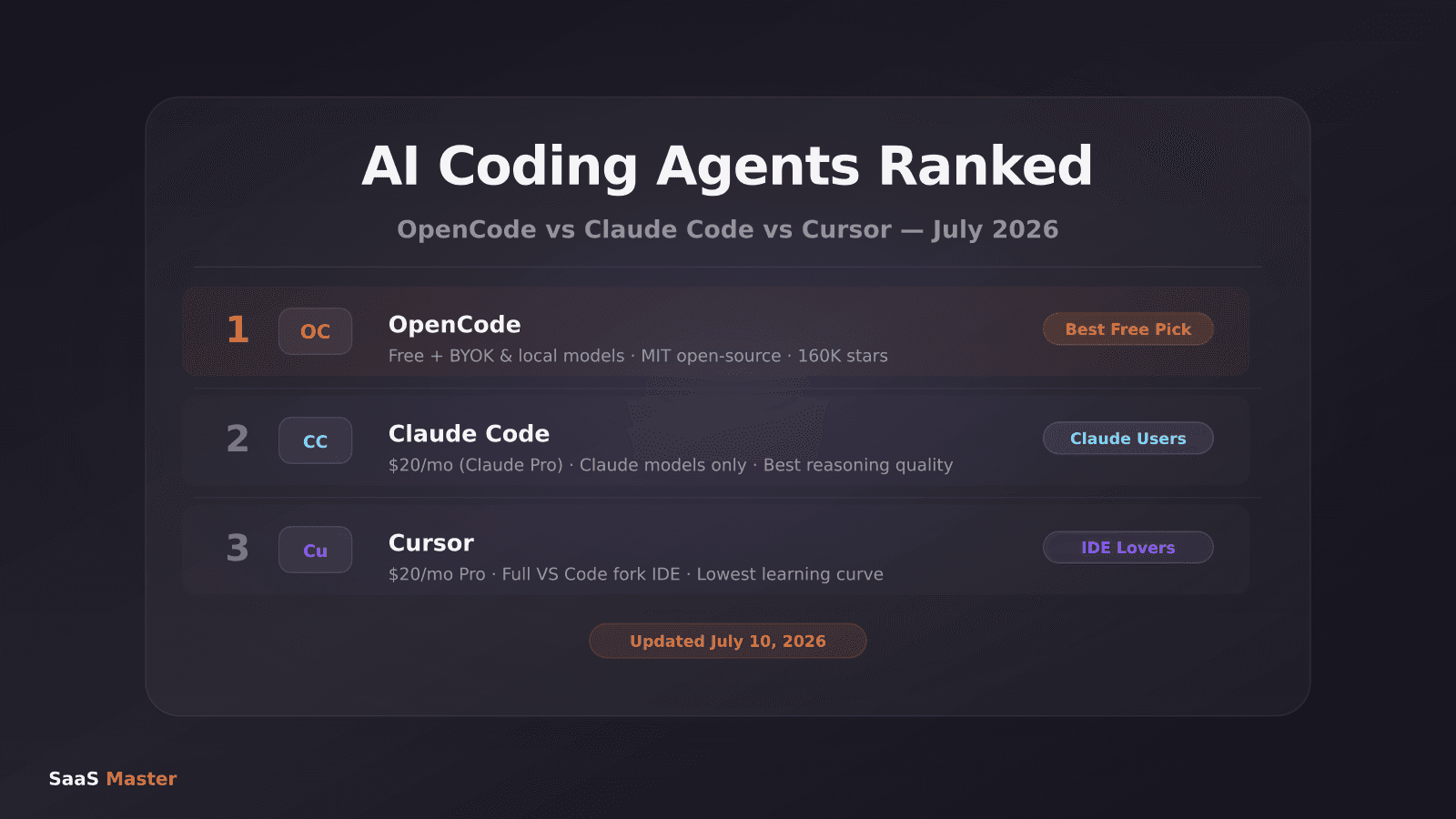
For developers and non-technical SaaS builders choosing an AI coding agent in July 2026, three tools dominate the conversation: OpenCode, Claude Code, and Cursor. OpenCode is the best free option and the most model-flexible. Claude Code delivers the tightest integration with Anthropic's models and strongest reasoning for complex codebases. Cursor is the most accessible for anyone who prefers a full IDE over a terminal.
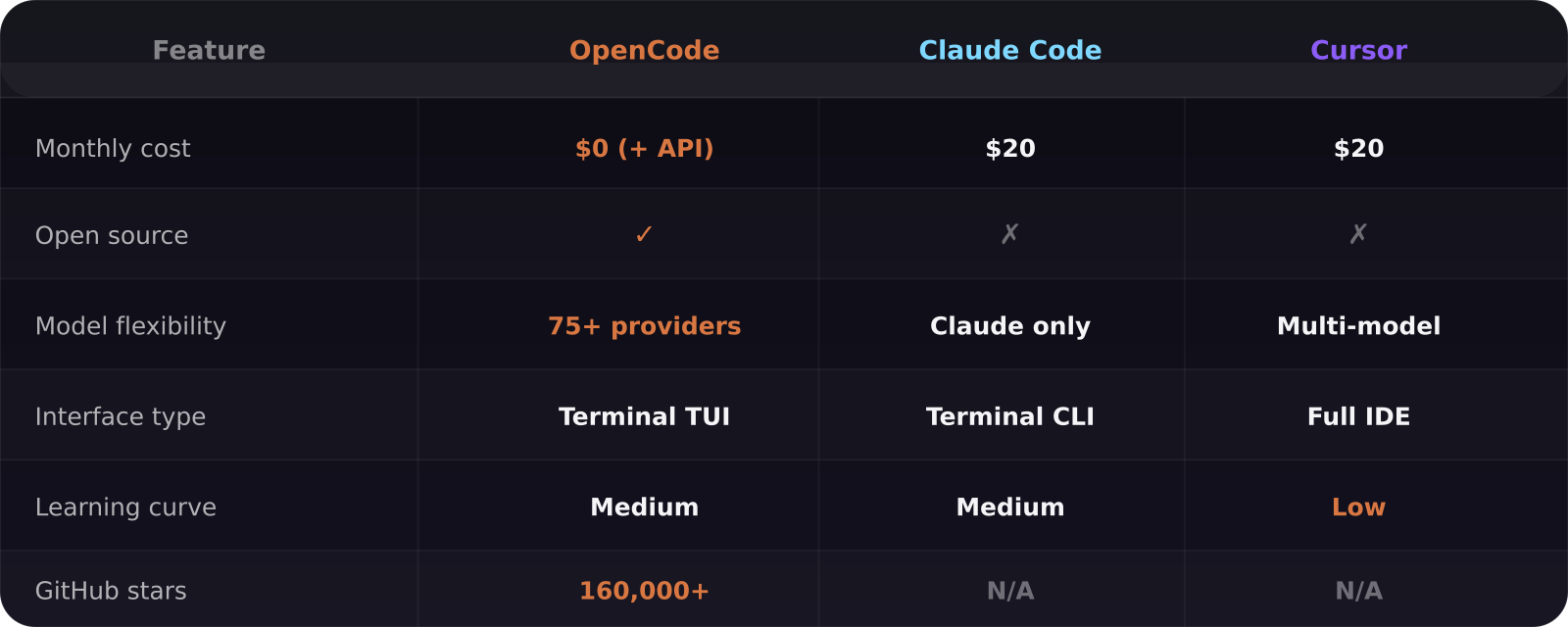
Key takeaways: - OpenCode is MIT-licensed, free to use, and supports 75+ AI providers including local models via Ollama - OpenCode has over 160,000 GitHub stars and approximately 7.5 million monthly active developers - Claude Code requires a $20/month Claude Pro subscription and works only with Claude models - Cursor Pro is $20/month, supports multiple model providers, and offers a full VS Code-fork IDE experience - All three tools handle multi-file editing, codebase awareness, and complex refactoring - The right choice depends primarily on whether you prefer terminal flexibility, Claude ecosystem integration, or IDE comfort
What is the AI coding agent landscape right now?
The category has matured fast. Two years ago, Copilot was adding inline suggestions to existing editors. Then Cursor demonstrated what a VS Code fork with native AI context looks like. Now OpenCode has become the open-source, terminal-first alternative that gives developers full model flexibility without vendor lock-in.
The big shift in mid-2026 is that model quality has converged enough that the interface — terminal vs IDE, open-source vs proprietary — matters as much as the underlying model. Claude Code defaults to Claude Fable 5 for complex tasks. Cursor Pro includes access to Claude, GPT-5.5, and Gemini. OpenCode supports all of those plus 70+ additional providers, local models through Ollama, and free models like Grok Code Fast at no API cost.
This is also the category SaaS engineering teams are actively building workflows around. The decision is no longer whether to use AI coding assistance — it is which tool fits your workflow, budget, and values.
How do the three tools work differently?
OpenCode runs in your terminal with a polished TUI (terminal user interface). It operates in two modes: Plan mode reads your files and proposes changes without touching anything; Build mode executes across multiple files and runs shell commands. You configure your preferred model provider once, then switch between models in seconds. It supports 75+ providers — Anthropic, OpenAI, Google, Mistral, xAI, and any OpenAI-compatible endpoint — so you can run Claude Fable 5 for complex tasks and a free model for simpler ones in the same session.
Claude Code works similarly in the terminal but is built exclusively around Anthropic's Claude family. Being the official integration means Anthropic optimizes it for Claude's specific capabilities — and the reasoning quality shows on large, complex codebases. The limitation is real: no GPT-5.5, no Gemini, no local models. For developers already on Claude Pro or Max, that may be fine. For everyone else, it is a significant constraint.
Cursor is a completely different experience. It is a full IDE, forked from VS Code, with AI embedded into every layer of the editing workflow. You get AI-powered inline completions (Tab), Cmd+K for quick in-line edits, Composer for describing multi-file changes in natural language, and a chat panel that understands your codebase. If you already use VS Code, the extensions, keybindings, and workspace settings transfer over unchanged.
Which tool performs best on real coding tasks?
For simple tasks — writing a function, explaining unfamiliar code, fixing a bug — all three perform comparably. The model matters more than the interface for straightforward requests.
On complex multi-file refactoring, differences emerge. In a standardized March 2026 test, Cursor completed a responsive data table component in 2 rounds of prompting; OpenCode with Claude needed 3; GitHub Copilot needed 5 with manual fixes. On a more complex task — migrating a 3,000-line Express.js codebase from CommonJS to ESM — Windsurf's agent completed it in one pass with 2 test failures out of 47, while Cursor took 3 attempts.
OpenCode's advantage appears on long sessions where you need model switching: route a planning task to Gemini, a complex implementation to Claude Fable 5, and quick edits to a free model. Claude Code's advantage is the tightest feedback loop with Anthropic's reasoning capabilities when that is exactly what you need.
What does the cost look like over time?
OpenCode costs nothing as a tool. You pay for API tokens directly: roughly $2–$8 per month for moderate coding use at standard model pricing. If you use free models — Grok Code Fast, GLM 4.7, or local models through Ollama — your monthly cost is $0 beyond electricity.
Claude Code requires $20/month for Claude Pro, which also includes Claude in the browser, API access, and other Anthropic benefits. Claude Max at $100/month adds 5× the usage limits for heavier workloads.
Cursor Pro is $20/month with a Business tier at $40 per user per month that adds team features, admin controls, and enterprise security. Cursor's business pricing matters for SaaS teams standardizing on a single tool.
Who should use which tool?
If you are a developer who values open-source transparency, needs the flexibility to switch models (including free options), or prefers terminal-first workflows without a graphical IDE, OpenCode is the strongest choice.
If you are already on Claude Pro or Max and want the tightest Claude integration with minimal configuration overhead — and you do not need other AI providers — Claude Code is the logical pick.
If you prefer a full IDE, already use VS Code, or are onboarding a team that needs unified tooling with the lowest possible learning curve, Cursor is the most accessible path. The IDE-native experience is genuinely different from a terminal agent.
You can explore more AI tool comparisons in the AI tools hub. For SaaS companies building on top of AI coding stacks and wanting to show prospective customers how their product integrates, a software walkthrough video often communicates more clearly than documentation alone.
Frequently asked questions
Is OpenCode actually free to use in 2026?
OpenCode itself is MIT-licensed and costs nothing as a tool. Your costs come from the AI model you choose: free models like GLM 4.7 or Grok Code Fast cost $0; standard API rates for Claude or GPT-5.5 typically run $2–$15 per month at moderate developer usage. There is no subscription to OpenCode itself.
Can Claude Code use models other than Claude?
No. Claude Code is built exclusively for Anthropic's Claude models. If you need to use GPT-5.5, Gemini 3.1 Pro, Grok 4.5, or local models in a terminal coding agent, OpenCode supports all of those and is the right tool for that workflow.
How does Cursor compare to a standard VS Code setup?
Cursor is a direct fork of VS Code, so every extension, keybinding, and workspace setting transfers over without changes. The difference is AI built into the core editing experience — inline completions, multi-file Composer mode, and a codebase-aware chat panel. Most VS Code users describe the transition as an upgrade with no relearning required.
Was this article helpful?
Jorge Aguilar
Founder & Creator, SaaS Master
Producing SaaS and AI product videos since 2019 — 800+ videos for 200+ brands, covering tutorials, demos, walkthroughs, and explainers. Writing here about the tools, trends, and tactics that actually move the needle. LinkedIn · About · Work with me
Building an AI product that needs a clearer onboarding flow?
Client-owned videos that make your product easy to understand — demos, walkthroughs, onboarding, and explainers.
Explore AI product video productionRelated guides
More AI Tools & AI Workflows →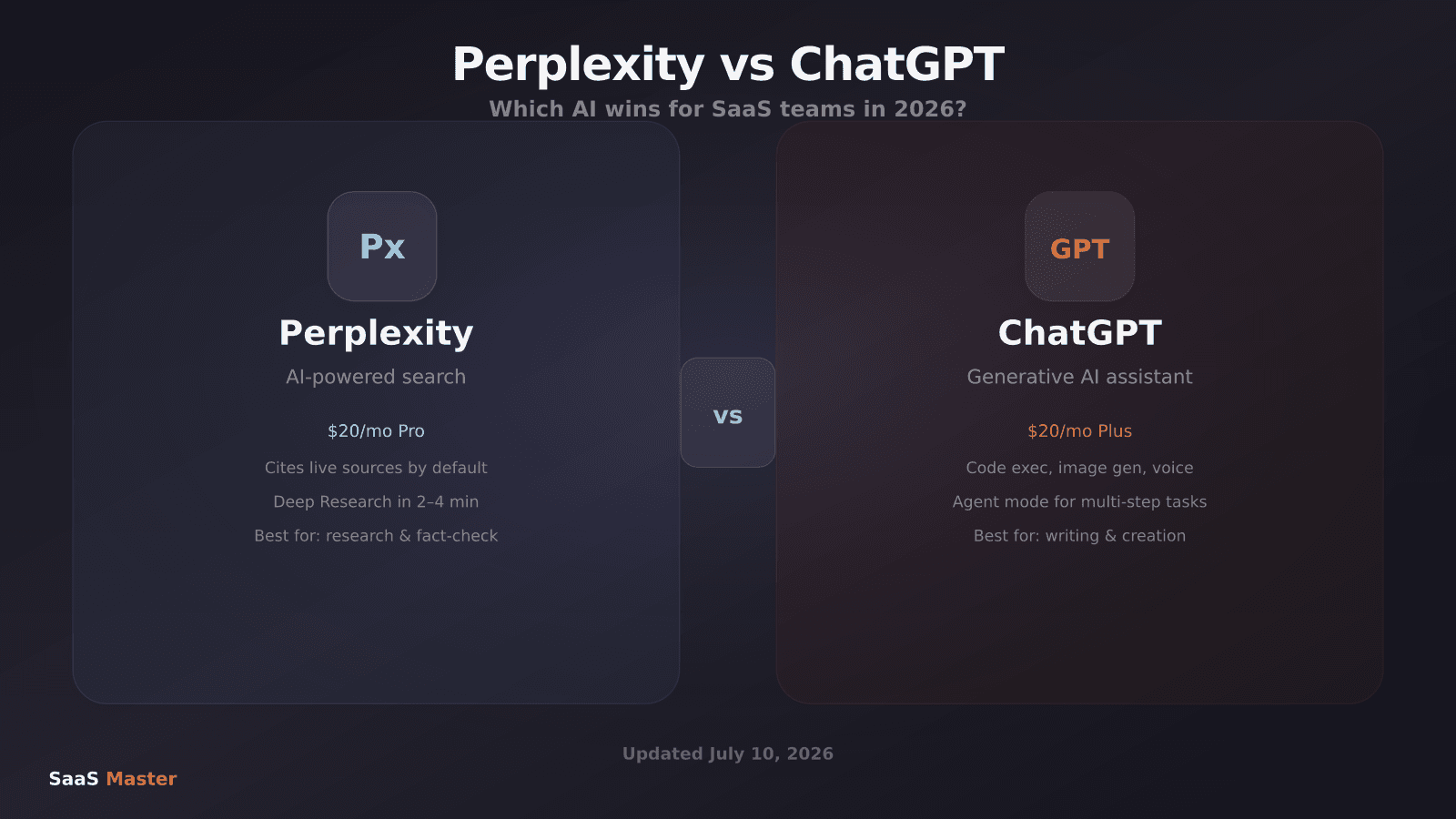
Perplexity vs ChatGPT for SaaS Teams in 2026: Which AI Actually Wins?
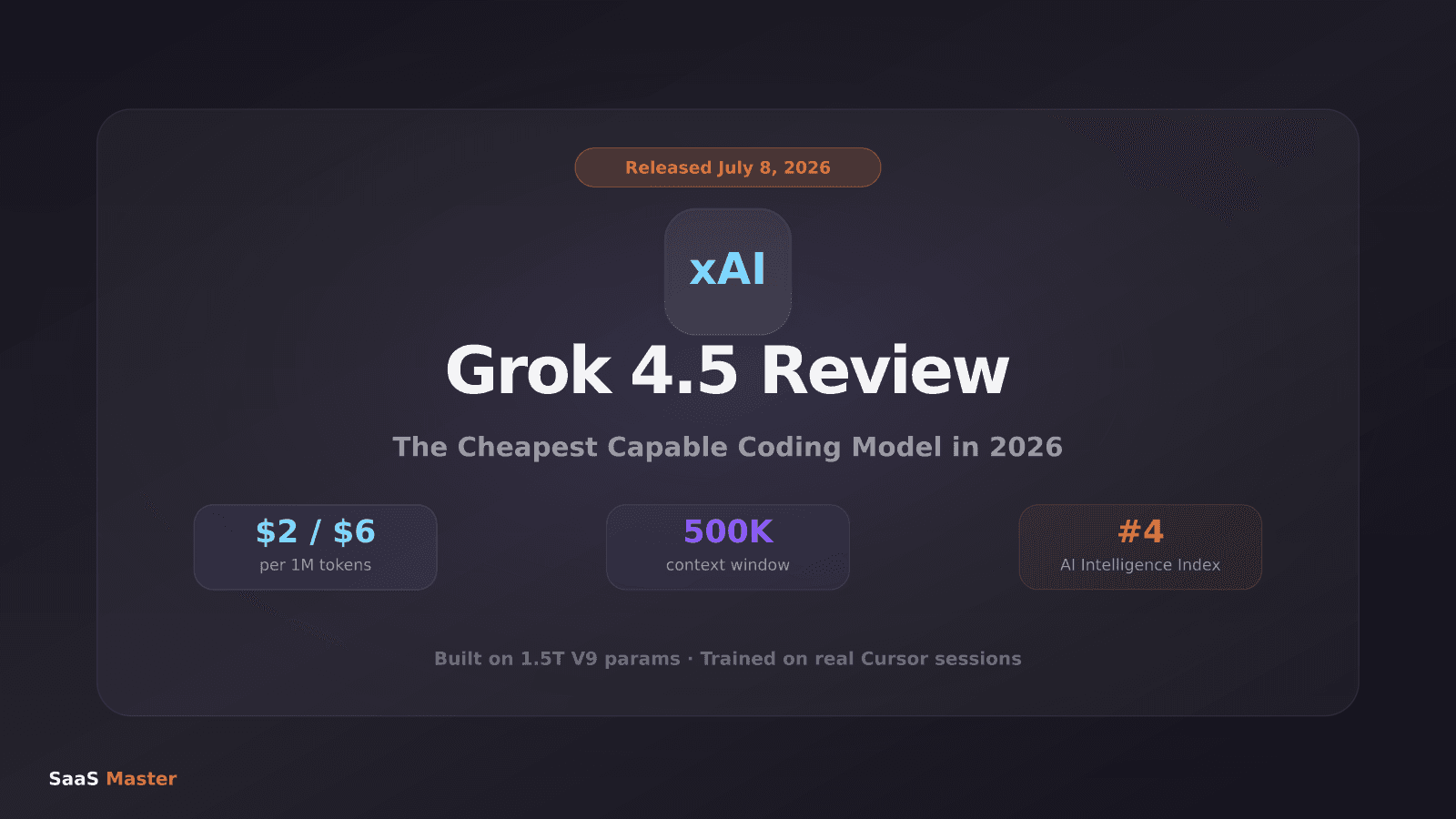
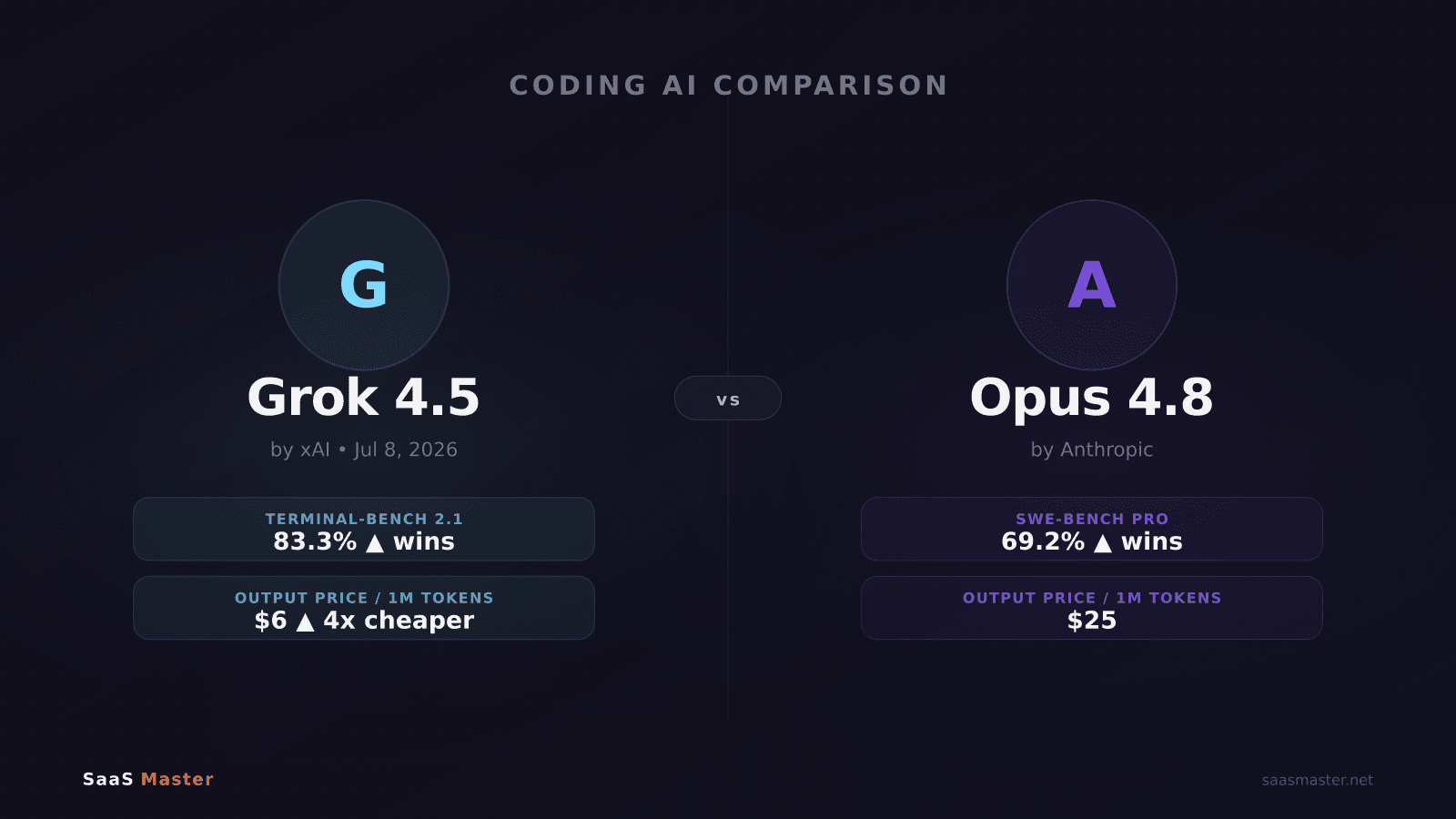
Grok 4.5 Review: xAI's Cheapest Capable Coding Model Is Here (July 2026)
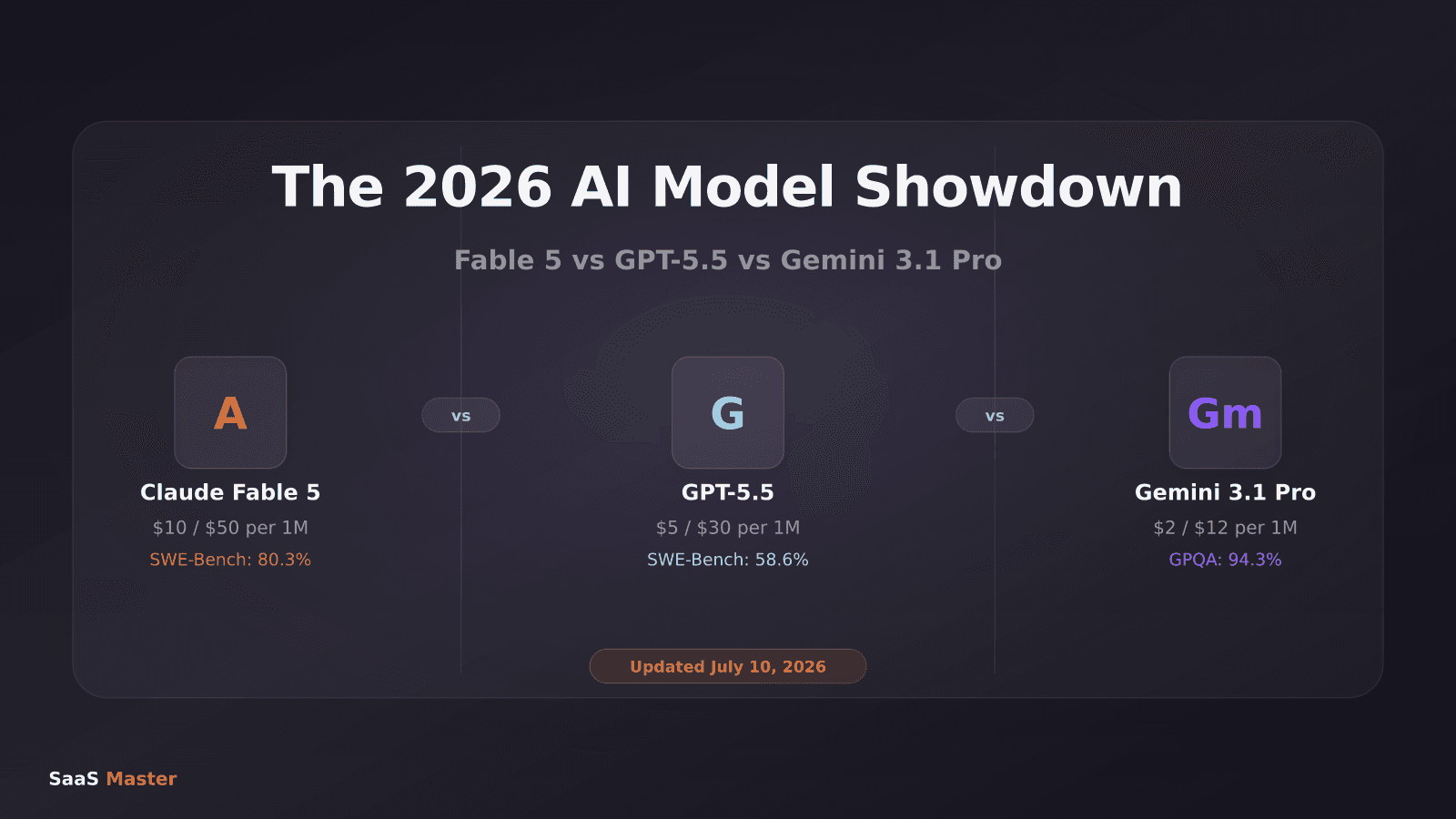
Claude Fable 5 vs GPT-5.5 vs Gemini 3.1 Pro: Which AI Model Should Your SaaS Team Use in 2026?