AI & SaaS
Claude Fable 5 vs Opus 4.8: A Plain-English Cost Comparison
Here's the cost comparison in one line: Claude Fable 5 costs exactly twice as much as Claude Opus 4.8 — $10 per million input tokens and $50 output, versus Opus 4.8's $5 and $25. They come from the same company and Fable even falls back to Opus on restricted topics, so the real question is when the more powerful, pricier model earns its premium and when Opus 4.8 does the job for half the money. Let me run the numbers.
I track Anthropic's pricing closely because these two models are the choice most Claude users now face. Here's the honest breakdown.
Key takeaways
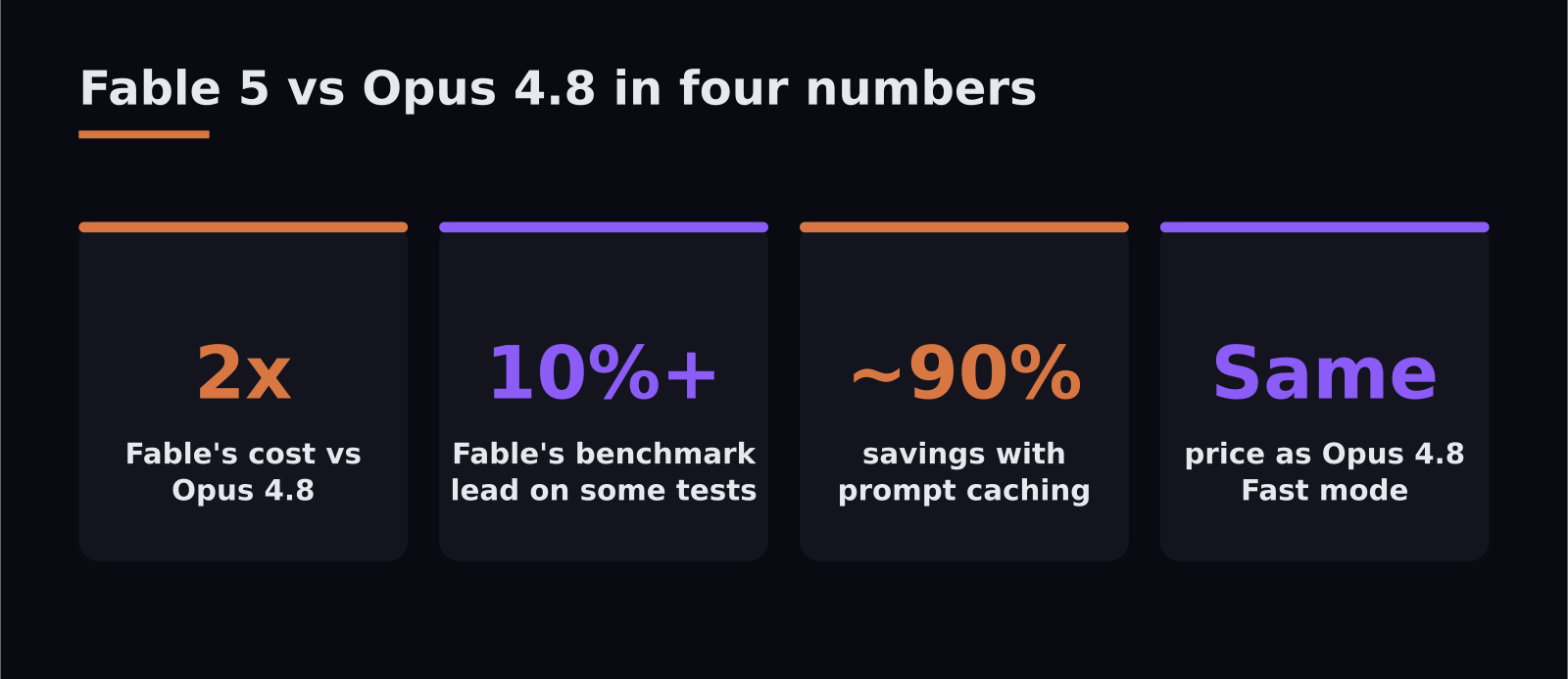
- Fable 5 is $10/$50 per million tokens; Opus 4.8 is $5/$25 — Fable costs exactly 2x on both input and output.
- Opus 4.8 Fast mode is also $10/$50, the same as Fable 5 — so at that tier you're comparing speed vs Fable's extra capability.
- Fable 5 beats Opus 4.8 by more than 10% on some benchmarks, with its biggest lead on long, complex tasks.
- For routine work, Opus 4.8 at half the price is the better value; for the hardest long-horizon jobs, Fable 5 earns its premium.
- Both support prompt caching (up to ~90% savings) and batch processing, which cut either bill substantially.
The headline: Fable 5 is exactly double Opus 4.8
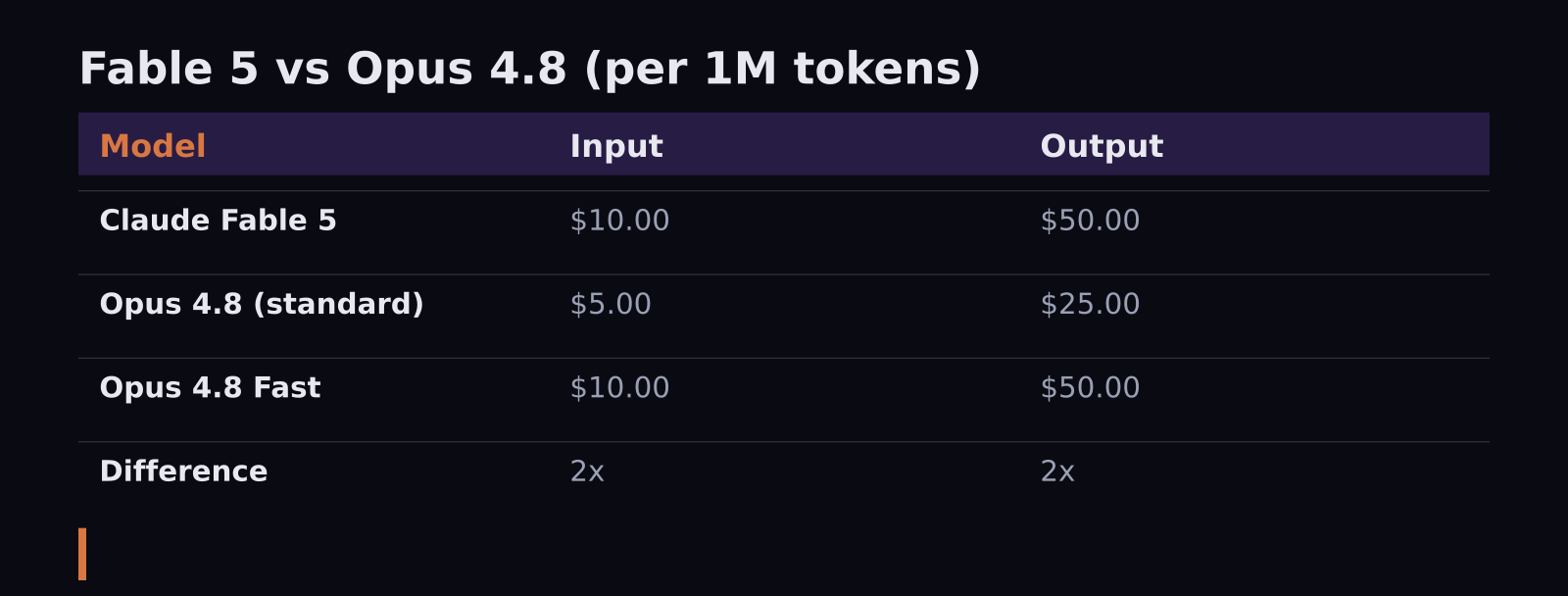
The numbers line up cleanly. Claude Opus 4.8 lists at $5.00 per million input tokens and $25.00 per million output. Claude Fable 5 lists at $10.00 input and $50.00 output. That's a precise 2x on both sides — for every dollar you'd spend on Opus 4.8, the same workload on Fable 5 costs two.
There's a wrinkle worth knowing: Opus 4.8 also has a "Fast" mode that runs about 2.5x faster and is priced at $10/$50 — identical to Fable 5. So if you were already paying for Opus 4.8 Fast, Fable 5 costs you nothing extra per token; you're simply choosing between raw speed (Opus Fast) and extra capability (Fable 5) at the same price point.
What the extra money buys you
Doubling your token cost only makes sense if you get more in return, and on capability Fable 5 does deliver. It's a Mythos-class model — a full tier above Opus — and beats Opus 4.8 by more than 10% on some benchmarks. Crucially, its advantage grows with task length and complexity. On a quick question, you may not notice a difference. On a sprawling code migration, a week-long research project, or analysis that has to stay coherent across millions of tokens, Fable pulls clearly ahead.
So the premium isn't for everyday chat — it's for the hard, long, high-value work where being 10%+ better changes the outcome. When Fable does in a day what would take a team months, the doubled token cost is trivial against the labor it replaces.
A worked example
Say a workload uses 100 million input and 20 million output tokens in a month. On Opus 4.8 that's about $500 input plus $500 output — roughly $1,000. On Fable 5 it's about $1,000 input plus $1,000 output — roughly $2,000. The same job, double the bill.
Now ask what you're buying with that extra $1,000. If the workload is routine — summaries, classification, straightforward Q&A — you're paying double for quality you can't perceive, and Opus 4.8 (or a cheaper model still) is the smarter choice. If the workload is a hard, long-horizon task where Fable's capability lead actually shows up, the extra $1,000 can be worth far more than that in saved time and better results. The dollar figure is identical; the value depends entirely on the difficulty of the work.
The smart play: use both
Because Fable 5 already falls back to Opus 4.8 on restricted topics, Anthropic has effectively built a two-tier system into one model. You can mirror that deliberately: route routine, high-volume requests to Opus 4.8 (or cheaper) and reserve Fable 5 for the genuinely demanding jobs. That keeps your average cost near the Opus tier while giving you frontier capability exactly when it matters.
And don't forget the levers that apply to both: prompt caching can cut costs by up to around 90% on repeated context, and batch processing offers roughly 50% savings on non-urgent work. Output tokens are the expensive half on both models, so concise prompting and tight output limits help no matter which you pick.
Frequently asked questions
How much more expensive is Claude Fable 5 than Opus 4.8?
Exactly double. Fable 5 is $10 input / $50 output per million tokens; Opus 4.8 is $5 / $25. The 2x premium applies to both input and output.
Is Fable 5 worth twice the price of Opus 4.8?
For hard, long, high-value tasks where its 10%+ capability lead changes the result, yes. For routine, high-volume work, Opus 4.8 at half the cost is the better value. Many teams route between the two.
Is there a way to get Fable-level pricing on Opus 4.8?
Opus 4.8 Fast mode is priced at $10/$50 — the same as Fable 5 — and runs about 2.5x faster. At that tier you're choosing speed (Opus Fast) versus extra capability (Fable 5) for the same token price.
SaaS Master
Creator behind SaaS Master — tutorials, walkthroughs, reviews, and explainers that help SaaS, AI, and WordPress products get understood and chosen. Writing here about the tools, trends, and tactics that actually move the needle. Work with me →
Want your product explained this clearly — in video?
Tutorials, walkthroughs, reviews, and shorts for SaaS, AI, and WordPress products.
Work With SaaS Master