AI Tools
Claude Sonnet 5 on Amazon Bedrock vs OpenAI API: Best Cloud AI for SaaS in 2026
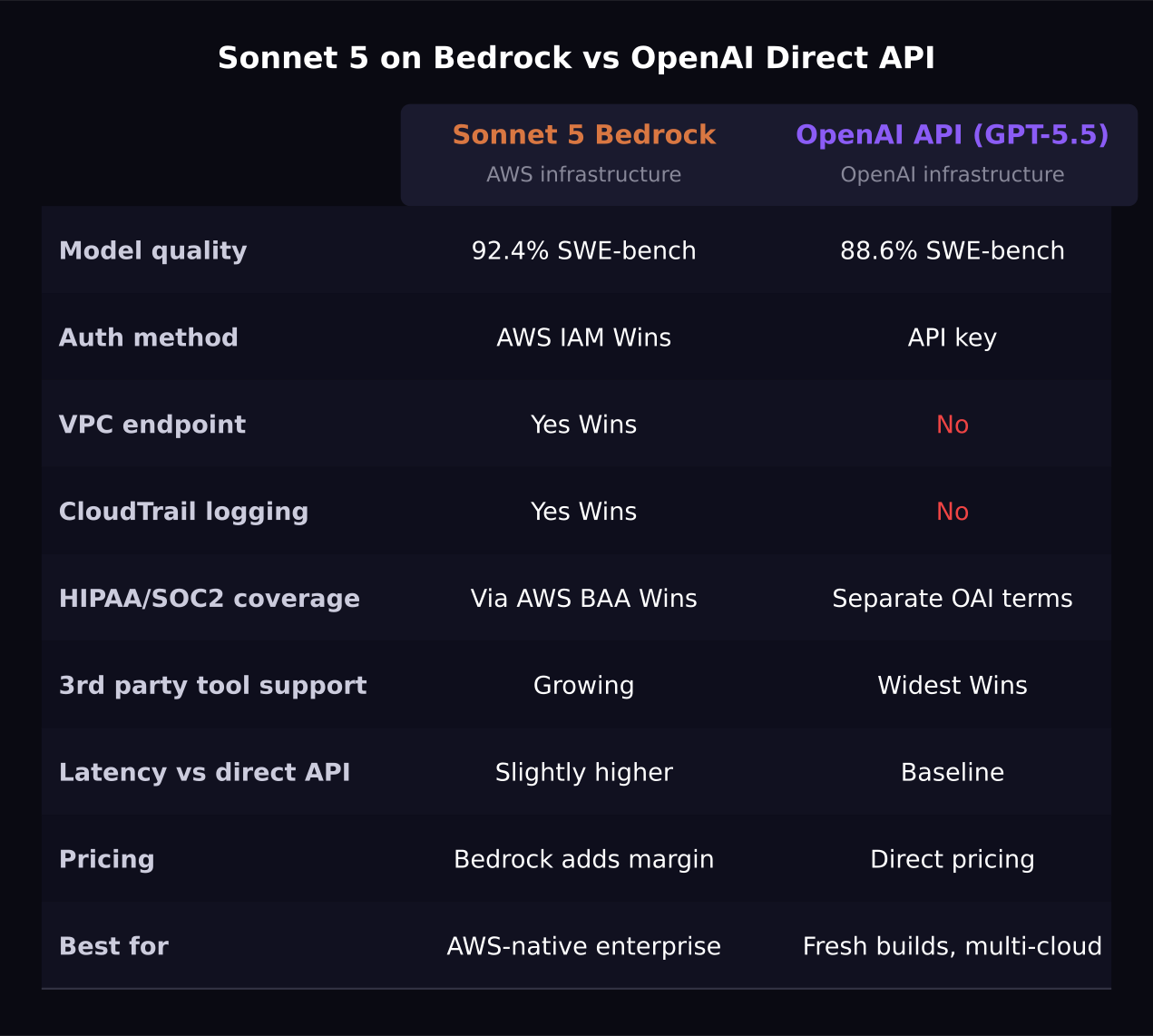
Claude Sonnet 5 is available through three channels: Anthropic's direct API, Amazon Bedrock, and Google Cloud Vertex AI. OpenAI's GPT-5.5 is available through OpenAI's direct API and Azure OpenAI Service. For SaaS teams choosing where to host their AI inference, the choice of cloud platform matters for pricing, latency, compliance, data handling, and operational complexity. Here is a direct comparison of Sonnet 5 on Bedrock versus running OpenAI GPT-5.5 through the OpenAI API.
Key takeaways
- Sonnet 5 on Amazon Bedrock integrates natively with AWS services: IAM, VPC, CloudWatch, S3, and Lambda, reducing the complexity of building production AI applications on AWS.
- Bedrock adds some latency overhead compared to Anthropic's direct API, but offers enterprise compliance features including VPC endpoints and AWS data processing agreements.
- The OpenAI API offers the simplest onboarding and the most extensive third-party integrations. Bedrock offers better AWS-native operational tooling.
- Pricing on Bedrock for Sonnet 5 may differ from Anthropic's direct pricing. Check Bedrock's pricing page, as AWS adds its own service margin.
- For teams already on AWS with compliance requirements, Bedrock is the stronger operational choice. For startups or multi-cloud teams, Anthropic's direct API offers the most control.
What Amazon Bedrock adds
Amazon Bedrock is AWS's managed AI model service. It hosts Sonnet 5 (and other models) behind AWS's standard infrastructure, which means: IAM authentication instead of API key management, VPC endpoint support for private network access, AWS CloudTrail logging of all API calls, integration with AWS Lambda for serverless agent deployments, and data processing terms covered under your existing AWS Business Associate Agreement if applicable.
For companies that have already negotiated data processing agreements with AWS for HIPAA, SOC 2, or GDPR compliance, running Sonnet 5 on Bedrock means that compliance framework extends to your AI workloads. This is a significant advantage for enterprise SaaS companies in regulated industries.
The latency difference
Running Sonnet 5 through Bedrock adds a small amount of latency compared to Anthropic's direct API due to the routing overhead. In practice, the difference is under 100 milliseconds for most prompts and is not noticeable in most production applications. For computer use and agent sessions where a single task takes many seconds or minutes, the latency difference is irrelevant.
For real-time streaming applications where first-token latency is critical, test Bedrock versus direct API latency from your specific AWS regions before making a deployment decision.
OpenAI API advantages
The OpenAI API remains the standard integration point for the broadest ecosystem of third-party AI tools. LangChain, LlamaIndex, and most AI development frameworks default to OpenAI's interface. If you are using a framework that wraps OpenAI's API, migrating to Sonnet 5 requires either using a framework that supports the Anthropic API natively or using a proxy layer.
The OpenAI API's documentation is the most comprehensive and its error messages and rate limit behaviors are the most familiar to AI developers in 2026. The developer experience is polished.
When to use Bedrock for Sonnet 5
Use Bedrock when: your team already operates in AWS and wants to use IAM for AI access control; your product has data residency requirements that are satisfied by AWS data processing agreements; you want CloudTrail audit logs of all AI API calls for compliance; you are building a serverless application and want Lambda and Bedrock to work together without NAT gateways or API key management.
When to use Anthropic's direct API
Use Anthropic's direct API when: you want the lowest latency access to Sonnet 5; you want to access new features the day they are released rather than waiting for Bedrock to add support; you are a startup or small team with no existing AWS commitment; or you are building a product that deploys across cloud providers and do not want single-cloud dependency.
Frequently asked questions
Is Sonnet 5 the same model on Bedrock as on Anthropic's API?
Yes. The model weights are identical. The difference is in the infrastructure layer: Bedrock routes requests through AWS infrastructure and adds AWS-native operational tooling.
Does Bedrock support Sonnet 5's computer use capability?
Computer use for Claude is available through Bedrock. AWS has published computer use support for Claude models as part of Bedrock's agent capabilities.
Can I switch between direct API and Bedrock without rewriting my code?
Switching between Anthropic's direct API and Bedrock requires updating authentication (from API key to AWS credentials) and changing the endpoint URL. The request and response structure for Sonnet 5 is the same. Most Anthropic SDK implementations support both authentication methods with minimal code changes.
Was this article helpful?
SaaS Master
Creator behind SaaS Master — tutorials, walkthroughs, reviews, and explainers that help SaaS, AI, and WordPress products get understood and chosen. Writing here about the tools, trends, and tactics that actually move the needle. Work with me →
Want your product explained this clearly — in video?
Tutorials, walkthroughs, reviews, and shorts for SaaS, AI, and WordPress products.
Work With SaaS Master