AI Tools
Claude Sonnet 5 vs Perplexity for SaaS Research in 2026: Which Should You Use?
Claude Sonnet 5 and Perplexity AI are both used for research tasks in 2026, but they work in fundamentally different ways. Perplexity is a search-augmented answer engine: it searches the web in real time and synthesizes current information from live sources. Claude Sonnet 5 is a reasoning model with training data through early 2026: it synthesizes from deep knowledge but not from live web results by default. For SaaS teams using AI for research, understanding when to use each one changes the quality of your outputs.
Key takeaways
- Perplexity is better for current-events research, live pricing lookups, recent product launches, and any question where the answer may have changed in the past few months.
- Sonnet 5 is better for deep reasoning about complex topics, synthesizing multi-document information you provide, writing research deliverables from gathered facts, and analysis tasks where source freshness matters less than depth.
- Perplexity's Pro plan with Claude Sonnet 5 is an option that combines Perplexity's search with Sonnet 5's reasoning.
- For SaaS competitive research workflows, the best combination uses Perplexity to gather recent data and Claude Sonnet 5 to analyze, structure, and write from that data.
- Claude Sonnet 5 on Amazon Bedrock can be extended with search tools via function calling, giving it real-time web access in custom applications.
When Perplexity wins
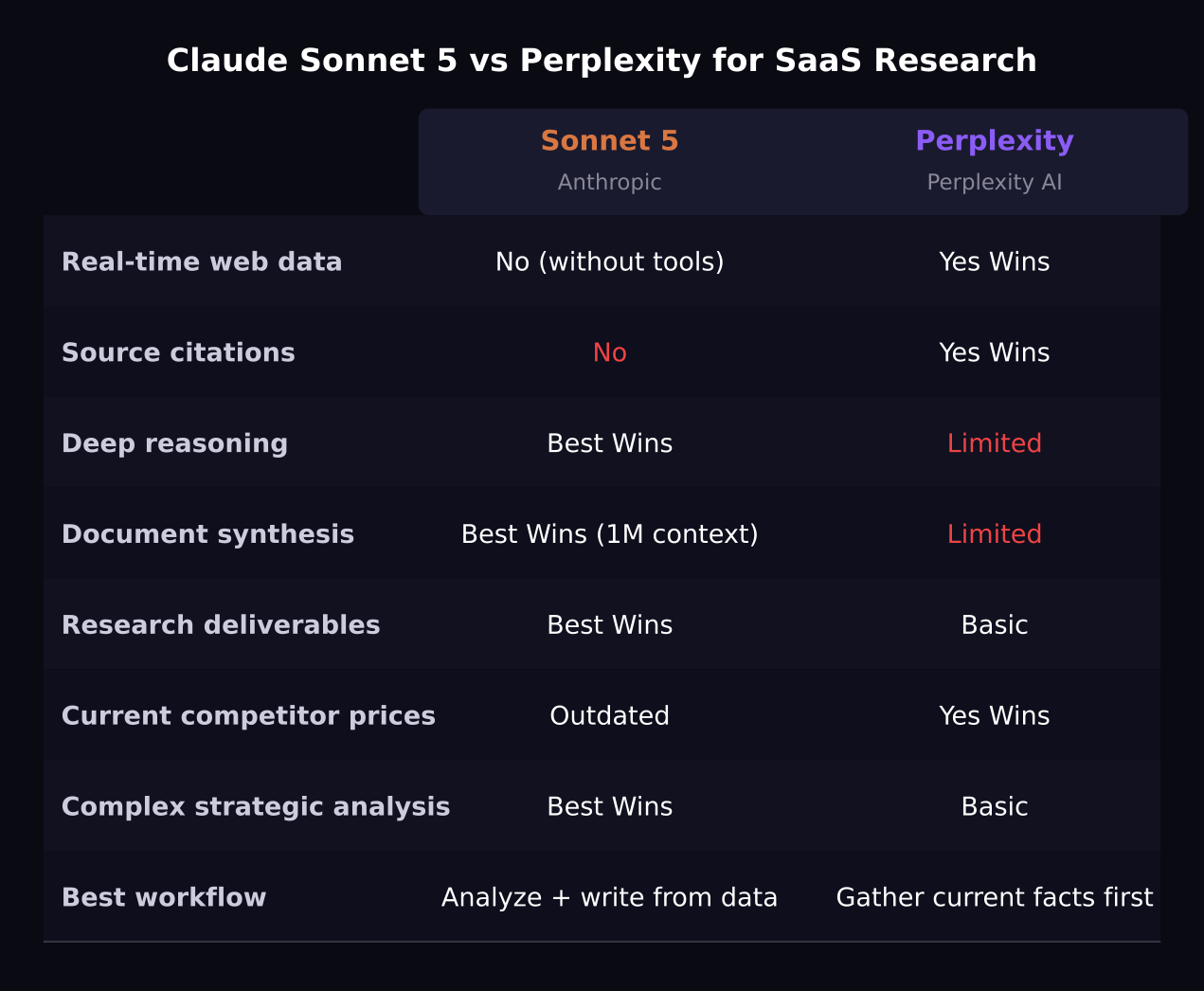
Perplexity's core advantage is real-time web access. For any research question where the answer depends on current information, Perplexity has a structural advantage over Claude Sonnet 5 without web search.
Use Perplexity for: current competitor pricing pages (prices change monthly), recent product announcements from the past 60 to 90 days, live market data, news-based research, recent industry reports and survey results published after Sonnet 5's training cutoff.
Perplexity's source citation also helps with research credibility — you can trace its claims back to specific URLs, which matters for research that needs to be verified or shared with stakeholders.
When Sonnet 5 wins
For everything that does not require live data, Sonnet 5's reasoning depth produces better research outputs than Perplexity. Its ability to work with large documents you provide, reason through complex multi-factor questions, structure comprehensive analyses, and write polished deliverables from research data is substantially better than Perplexity's generative output.
Use Sonnet 5 for: synthesizing research you have gathered (paste articles, reports, documents), writing competitor analysis from data you have assembled, reasoning through strategic questions with no single "current" answer, building frameworks for evaluating options, and producing polished research reports that need to be shared.
The best SaaS research workflow
The highest-quality SaaS research in 2026 uses both tools in sequence. Start with Perplexity to gather current information: search for recent competitor announcements, pricing changes, customer reviews, and news. Copy the relevant findings. Then move to Claude Sonnet 5 with the gathered information in context and ask it to analyze, structure, and synthesize the research into a deliverable.
This sequence combines Perplexity's live data gathering with Sonnet 5's analytical and writing strength. Neither tool alone produces the same quality as the two used together.
Adding web search to Sonnet 5
For SaaS teams building research automation, Sonnet 5 can be given web search capability through tool use. By defining a search tool in the API, Sonnet 5 can issue search queries, receive results, and incorporate current information into its analysis. This gives Sonnet 5 Perplexity-like functionality within a custom application where you control the search sources and result formatting.
This approach is more complex to build than using Perplexity directly but offers more control over what is searched, how results are filtered, and how the information is used.
Frequently asked questions
Is Perplexity using Claude Sonnet 5 under the hood?
Perplexity offers multiple AI models for synthesis, including Claude Sonnet 5 on its Pro plan. When you select Claude mode in Perplexity Pro, it combines Perplexity's search infrastructure with Sonnet 5's reasoning for the synthesis step.
Which is better for writing a competitive analysis?
For a competitive analysis on competitors you are familiar with (established companies that have not changed dramatically in the past few months), Claude Sonnet 5 with a detailed prompt and any supporting documents you provide will produce a better-structured, more actionable analysis than Perplexity. For current competitive data where competitors have changed recently, use Perplexity to gather the current facts first, then Sonnet 5 to structure the analysis.
Can I use Sonnet 5 instead of Perplexity for academic or technical research?
For research where authoritative sources from your training period are sufficient, yes. For research requiring very recent papers, current clinical trials, or the latest technical documentation, use Perplexity or Sonnet 5 with search tools. Sonnet 5's knowledge is deep but has a training cutoff that matters for fast-moving technical fields.
Was this article helpful?
SaaS Master
Creator behind SaaS Master — tutorials, walkthroughs, reviews, and explainers that help SaaS, AI, and WordPress products get understood and chosen. Writing here about the tools, trends, and tactics that actually move the needle. Work with me →
Want your product explained this clearly — in video?
Tutorials, walkthroughs, reviews, and shorts for SaaS, AI, and WordPress products.
Work With SaaS Master