AI Tools
Claude Sonnet 5 Makes Every Free User a Power User — Here Is What Changed
On June 30, 2026, Anthropic updated the Claude free plan to use Claude Sonnet 5 as the default model, replacing Claude Sonnet 4.6. This is not a small upgrade. Sonnet 5 is Anthropic's best-benchmarked mid-tier model, scoring 92.4% on SWE-bench Verified, above the human expert baseline for computer use, and significantly better than Sonnet 4.6 on reasoning and coding tasks. The free plan now gives every user access to the same model that SaaS developers pay $2 per million tokens to use through the API.
Key takeaways
- The Claude free plan now defaults to Sonnet 5 as of June 30, 2026.
- Sonnet 5 scores 92.4% on SWE-bench Verified, compared to Sonnet 4.6's lower score on the same benchmark.
- Free plan users have message limits. Pro, Team, Max, and Enterprise users have higher limits and access to Opus 4.8 and additional features.
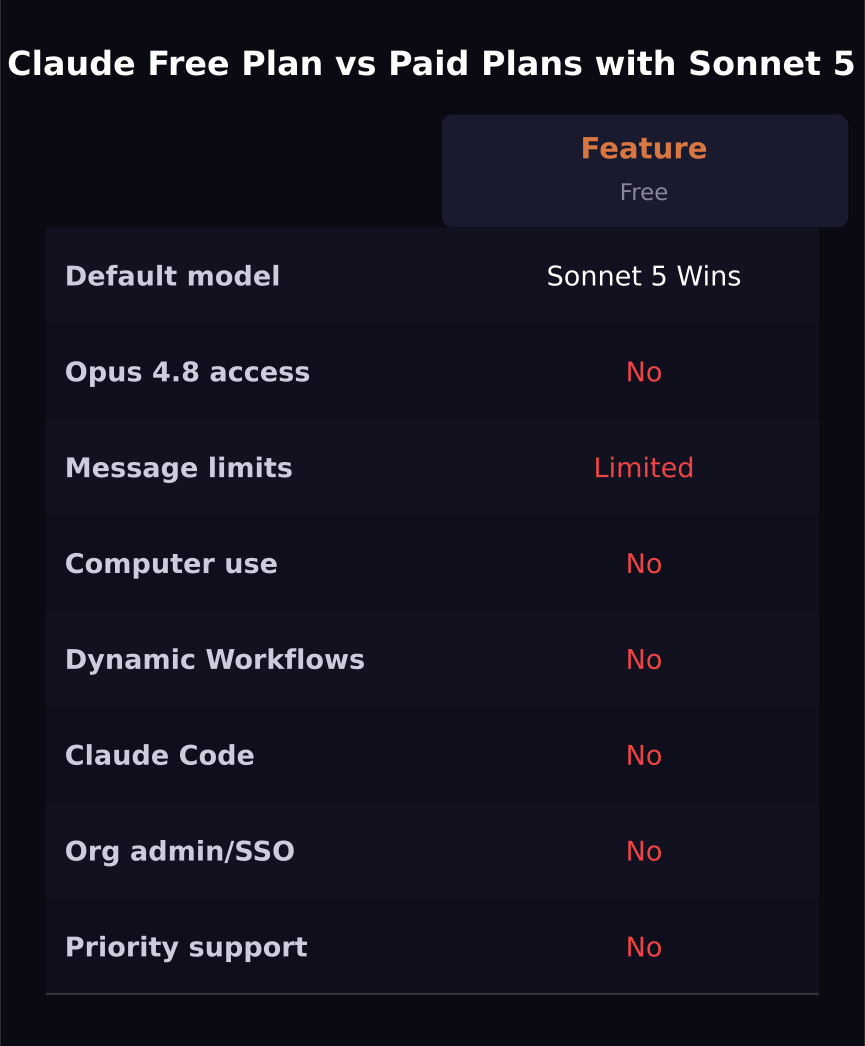
- Computer use and Dynamic Workflows are not available on the free plan.
- For SaaS builders testing Sonnet 5 before API integration, the free plan is an effective way to prototype prompts before paying for API access.
What the free plan upgrade means in practice
The free plan's previous default, Sonnet 4.6, was a capable model for everyday tasks. Sonnet 5 is measurably better on coding, reasoning, and complex analytical work. For a free plan user who uses Claude for coding help, document analysis, or strategic thinking, the upgrade to Sonnet 5 is immediately noticeable on harder tasks.
Sonnet 5 produces longer, more coherent outputs on complex topics. It follows multi-step instructions more reliably. It handles code review on real production-style problems better. It produces fewer generic, surface-level responses on nuanced questions.
For a solo developer, freelancer, consultant, or student using Claude for everyday professional work, Sonnet 5 on the free plan is the most capable AI tool available without payment as of today.
Message limits and what happens when you hit them
Free plan users have daily message limits that reset periodically. The exact limit is not published explicitly but is typically in the range of 20 to 40 Sonnet 5 messages per day. When you hit the limit, Claude offers the option to upgrade to Pro or continue when the limit resets.
For light-to-moderate daily use, the free plan limit is sufficient for most use cases. For developers actively building, where long coding sessions might exhaust the daily limit, Claude Pro at $20 per month unlocks higher message limits and access to Opus 4.8.
The difference between the free plan and paid plans
The free plan provides Sonnet 5 access with message limits and no computer use, no Dynamic Workflows, and no Claude Code integration. The Pro plan at $20 per month adds higher message limits, access to Opus 4.8, and the ability to use Claude.ai's extended features. The Max plan adds 5x or 20x higher usage limits than Pro. The Team and Enterprise plans add organizational features, SSO, and administrative controls.
For individuals, the free-to-Pro upgrade decision comes down to whether you regularly hit the free message limit. For teams, the Team plan adds collaboration features that matter for shared workflows.
Why this matters for the AI market
Making Sonnet 5 the free default changes the competitive landscape for every other AI provider offering free tiers. Google's Gemini free tier uses Gemini 2.0 Flash, which is fast but trails Sonnet 5 on reasoning benchmarks. OpenAI's free ChatGPT uses GPT-4o, which trails Sonnet 5 on SWE-bench Verified.
Anthropic's decision to give every free user Sonnet 5 access signals confidence in the model's quality and a strategic choice to build user familiarity with Sonnet 5 across the widest possible audience before the standard pricing period begins in September.
Sonnet 5 for SaaS prototyping on the free plan
For SaaS builders who want to test Sonnet 5's capabilities before committing to API integration, the free plan is a practical prototyping environment. Use Claude.ai's free tier to test prompt designs, evaluate output quality on your specific use cases, and build intuition for how Sonnet 5 behaves before writing API code.
This is particularly useful for evaluating whether Sonnet 5 is meaningfully better than your current model for your specific tasks. Run 20 to 30 real examples from your use case through the free plan interface before making the API integration decision.
Frequently asked questions
Will the free plan always use Sonnet 5?
Anthropic updates the free plan default when new models launch. Sonnet 5 is the current default as of June 30, 2026. When a future model (likely Sonnet 5.6 or Sonnet 6) launches, it may replace Sonnet 5 as the free default, similar to how Sonnet 5 replaced Sonnet 4.6 today.
Is Sonnet 5 on the free plan the same as Sonnet 5 on the API?
Yes. The model is identical. The difference is the interface (claude.ai versus API), the absence of computer use and agentic features on the free web interface, and the message rate limits.
How do I make the most of free plan message limits?
Combine questions into single comprehensive prompts rather than conversational back-and-forth. Provide sufficient context in the first message to get a complete response without follow-ups. For coding tasks, include the full code snippet, the error message if there is one, and what you want the model to do, all in one message.
Was this article helpful?
SaaS Master
Creator behind SaaS Master — tutorials, walkthroughs, reviews, and explainers that help SaaS, AI, and WordPress products get understood and chosen. Writing here about the tools, trends, and tactics that actually move the needle. Work with me →
Want your product explained this clearly — in video?
Tutorials, walkthroughs, reviews, and shorts for SaaS, AI, and WordPress products.
Work With SaaS Master