AI Tools
Cursor vs Devin Desktop vs GitHub Copilot vs Claude Code: The 2026 Comparison
On June 2, 2026, Windsurf — one of the most popular AI code editors on the market — quietly disappeared. Not because it failed, but because Cognition relaunched it as Devin Desktop, an agent command center designed to manage your entire AI coding stack from one place. That single rebrand reshuffled the competitive map for AI coding tools. Four platforms now dominate the space, and they have grown more different from each other than their overlapping price tags suggest.
Here is how Cursor, Devin Desktop (formerly Windsurf), GitHub Copilot, and Claude Code compare in June 2026 — and which one actually belongs in your workflow.
Key takeaways: - GitHub Copilot has the most generous free tier in this group, with GPT-4o, Gemini 2.0 Flash, and Claude 3.5 Sonnet at zero cost - Cursor is still the strongest daily IDE experience at $20/month for developers who want AI woven into their editor - Devin Desktop is no longer just a code editor — it is an agent management hub, a meaningful shift in what the product actually does - Claude Code has the highest autonomous capability ceiling for complex multi-file tasks but costs more at heavy API usage - Most developers should spend two weeks on free tiers before committing to a paid plan
What happened to Windsurf?
Windsurf became Devin Desktop on June 2, 2026. Cognition — the company behind the autonomous AI engineer Devin — acquired Windsurf and completely rebuilt it as an agent command center. The new product opens on an Agent Command Center dashboard rather than a code canvas. You see all your active agents, their current tasks, memory usage, and tool calls from a single interface, and you can run multiple agents in parallel without context-switching between terminal windows.
The underlying code editor is still there. But Cascade, the local agent that powered Windsurf, is end-of-life on July 1, 2026. It has been replaced by Devin Local, a completely Rust-rewritten agent that Cognition says is up to 30 percent more token efficient than Cascade and supports subagents. Devin Desktop also supports the open Agent Client Protocol, meaning you can run Codex, Claude agents, and other ACP-compatible tools alongside Devin Local inside the same interface.
Pricing did not change. Existing Windsurf accounts, settings, and plans migrated automatically.
What does each tool cost in 2026?
The AI coding market has converged at roughly $20/month for pro-level individual access. The real differences appear at the free tier and at high-usage scale.
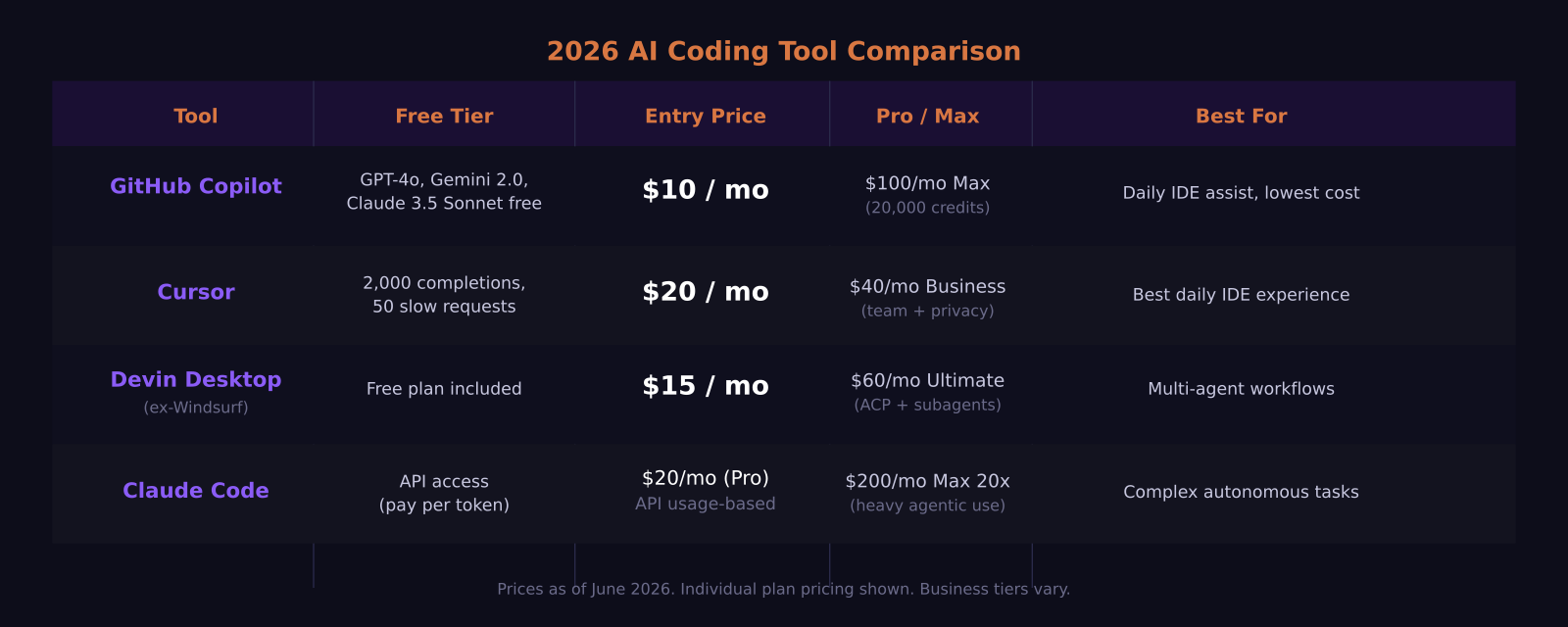
GitHub Copilot's free plan is the most generous of the four. At zero cost, you get access to GPT-4o, Gemini 2.0 Flash, and Claude 3.5 Sonnet. The individual paid plan is $10/month — the cheapest in this comparison. A new $100/month Max tier launched in June 2026 with 20,000 AI Credits and flex billing for teams with uneven usage patterns.
Cursor's free Hobby plan gives 2,000 completions and 50 slow premium requests. Pro is $20/month for unlimited completions. Business is $40/user/month with privacy controls and centralized billing.
Devin Desktop (formerly Windsurf) carries the same pricing from its Windsurf era: a free plan, Pro at $15/month, and Pro Ultimate at $60/month.
Claude Code runs on usage-based API pricing — approximately $3 per million tokens for Claude Sonnet and $15 per million tokens for Claude Opus. Claude Pro at $20/month covers most individual developer workflows. A Claude Max 20x plan at $200/month is built for developers doing intensive agentic work where output volume is high.
Is GitHub Copilot worth it at $10 per month?
For developers who want AI assistance without switching their editor or changing their workflow, yes. Copilot integrates cleanly into VS Code, JetBrains, Neovim, and other tools. At $10/month, you get inline completions, a chat sidebar, and multi-file editing suggestions.
The honest limitation is autonomy. Copilot is an assistant that responds to your cursor. It completes code, explains functions, and suggests edits — but it does not take ownership of a task and run it to completion independently the way Devin Local or Claude Code does. If a capable coding assistant is enough for your workflow, Copilot is the most efficient choice in this group, and its free tier is good enough that many developers never need to pay at all.
Why do most working developers still choose Cursor?
Cursor's strength is the total experience. It is a VS Code fork that feels native rather than bolted on. At $20/month, you get fast inline completions, a chat panel with full codebase context, and an agent mode that handles multi-file edits while tracking your project architecture.
The model-switching interface is one of Cursor's most practical features. You can use Claude Sonnet for complex reasoning, GPT-4o for quick completions, and Gemini for long-context tasks — all within the same session. Real-world coding mixes these cases constantly, so the flexibility matters.
Where Cursor trails is in deep autonomous workflows. Spawning a background agent that implements an entire feature branch without step-by-step guidance is better served by Devin Desktop or Claude Code.
What makes Devin Desktop different from the others?
The conceptual shift is what matters. Cursor is a code editor with AI inside it. Devin Desktop is an agent platform with a code editor inside it. If your workflow has become agent-heavy — running multiple AI tasks in parallel across different projects — that inversion is significant.
The Agent Command Center dashboard gives you visibility and control over every active agent: what it is doing, what tools it is calling, and how much context it is consuming. Devin Local's 30 percent token efficiency improvement over Cascade and its subagent support make it meaningfully better for sustained agentic work.
ACP compatibility is the forward-looking angle. As more AI tools adopt the Agent Client Protocol, Devin Desktop positions itself as the hub that orchestrates your entire agent stack — running Claude agents, Codex, and Devin Local inside the same interface. The learning curve is real, though. If you are coming from a clean code editor, the Command Center has more surface area than simple tasks require.
When does Claude Code actually make sense?
Claude Code is a terminal-first, autonomous coding agent. You give it a task — implement this endpoint, refactor this module to match the new architecture, fix this bug across five files — and it works through your codebase autonomously without guiding each step.
Its deep codebase understanding is the clearest differentiator in this comparison. Claude Code can hold a large repository in context, follow your existing style guide and patterns, and make coordinated changes across many files without losing the architectural thread. For high-complexity, discrete tasks, the output quality matches what a senior developer would produce.
The cost tradeoff is real. Developers doing continuous inline completions all day will spend more on API calls than on a flat $20 Cursor subscription. Claude Code earns its place for high-value isolated tasks — build this module, migrate this service, review this architecture — rather than as a constant coding companion.
Which AI coding tool should you use?
For free AI coding assistance that is genuinely useful: Copilot Free or Cursor Hobby — both are real tools, not stripped-down demos.
For the best daily IDE experience at $20/month: Cursor Pro.
For managing multiple AI agents running in parallel: Devin Desktop Pro at $15/month.
For high-complexity autonomous coding where output quality matters more than monthly cost: Claude Code on the Anthropic API.
The biggest takeaway from the 2026 landscape is that these tools have diverged in purpose more than they have in price. Copilot and Cursor are IDE-first. Devin Desktop is agent-first. Claude Code is output-first. The right choice depends less on features and more on which philosophy matches how you actually work.
Frequently asked questions
Is Windsurf still available in 2026?
Windsurf was renamed Devin Desktop on June 2, 2026, after Cognition acquired and rebuilt the product. Existing accounts, settings, and pricing migrated automatically. The Cascade local agent that powered Windsurf is end-of-life on July 1, 2026, replaced by the faster Rust-based Devin Local.
Can I use Claude Code and Cursor at the same time?
Yes, and many developers do. Cursor handles daily coding — inline completions, quick edits, codebase chat — while Claude Code handles large autonomous tasks like implementing a feature from a spec or refactoring a service. They serve different parts of the workflow and complement each other well.
Which AI coding tool works best for non-developers building with AI?
Cursor and Devin Desktop are the most accessible for non-developers. Cursor's chat interface lets you describe what you want in plain language and see the changes made. Devin Desktop's agent model means you can assign a task without managing each coding step. GitHub Copilot assumes you are writing code alongside it, which makes it better suited for developers than for people using AI to generate code for them.
Was this article helpful?
SaaS Master
Creator behind SaaS Master — tutorials, walkthroughs, reviews, and explainers that help SaaS, AI, and WordPress products get understood and chosen. Writing here about the tools, trends, and tactics that actually move the needle. Work with me →
Want your product explained this clearly — in video?
Tutorials, walkthroughs, reviews, and shorts for SaaS, AI, and WordPress products.
Work With SaaS Master